
Temporary Access Roads for Data Center Construction
A guide to the civil engineering design of temporary access roads for data center construction, covering structural sections, drainage, permitting, and maintenance. Learn best practices from RSP Engin
Strategic Alignment and Site Logistics Planning
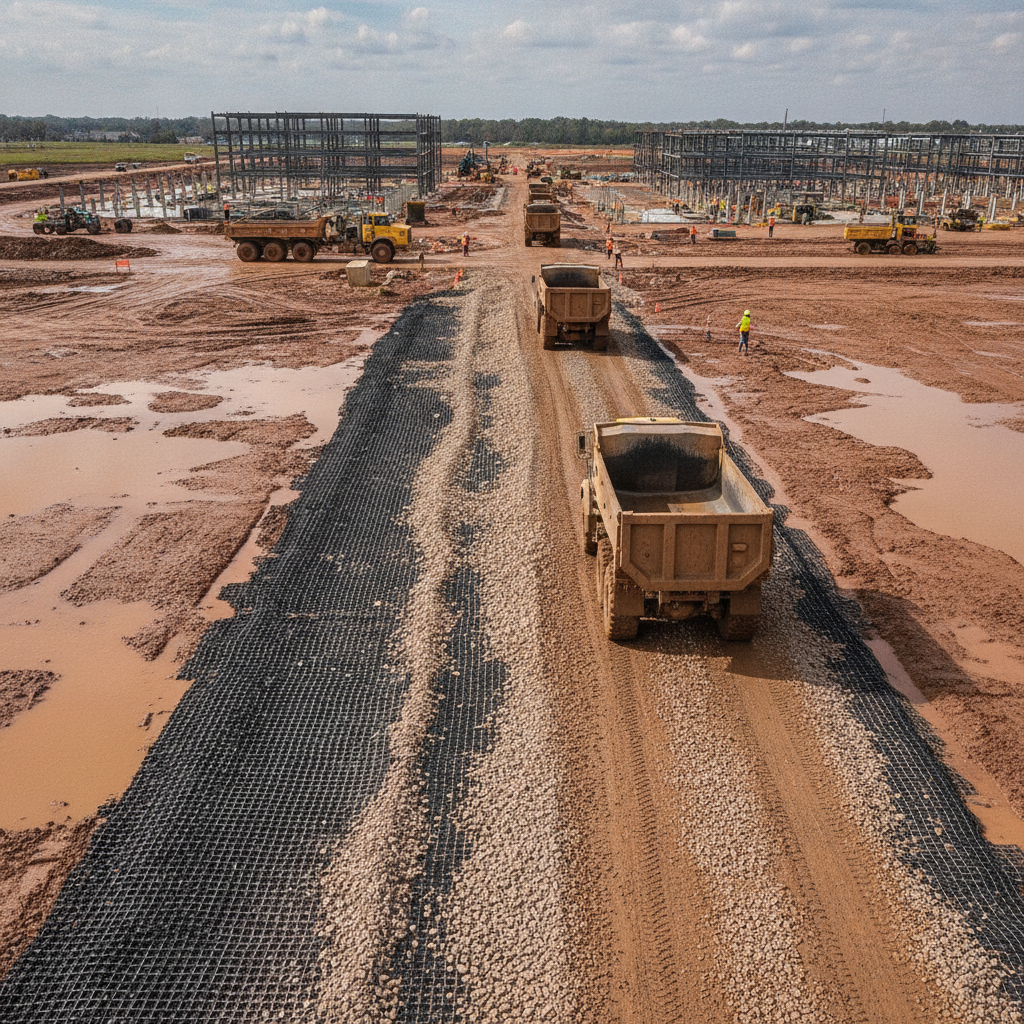
The first step in designing a temporary access road is determining its optimal alignment. This is not a simple task of connecting the site entrance to the building pad. The road’s path must be strategically planned in coordination with the overall master site plan design to avoid conflicts with future permanent infrastructure. A poorly placed road can interfere with future building foundations, underground utility corridors, permanent roadways, and critical stormwater management facilities. A forward-thinking alignment considers the entire construction sequence. Effective planning involves overlaying the temporary road design onto the final site plan to identify potential conflicts. The goal is to create a durable haul route that serves the project from initial earthwork through final building fit-out without requiring costly relocation. This process requires close utility coordination with all trades to ensure the road does not obstruct the installation of water, sewer, power, and fiber optic conduits. The alignment must also provide adequate turning radii for the largest anticipated delivery vehicles and emergency apparatus, a key component of site logistics and safety.
Structural Design for Heavy Construction Loads
Comparison of Temporary Roadway Materials and Applications
| Material Type | Key Characteristics | Best Use Case | Maintenance Considerations |
|---|---|---|---|
| Geotextile Fabric with Aggregate | Most common and cost-effective. Provides separation, stabilization, and drainage. Section thickness is engineered. | Large-scale projects with heavy truck traffic and poor to moderate soil conditions. | Requires regular grading and addition of new aggregate to fill ruts. Subgrade must be properly prepared. |
| Timber Mats (Crane Mats) | Heavy-duty, interlocking wood mats. Excellent load distribution. Reusable and rentable. | Extremely poor soil conditions (swamps, mud), stream crossings, or protecting sensitive underground utilities. | Can be slippery when wet. Individual mats can break under extreme loads and require replacement. |
| HDPE Composite Mats | Lightweight, durable, and interlocking high-density polyethylene panels. Reusable and easy to install. | Environmentally sensitive areas, short-term access, or sites requiring minimal ground disturbance. | Higher upfront cost than aggregate. Can become slippery. Must be securely connected to prevent separation. |
| Soil Cement / Stabilization | Mixing cement or lime with native soil to create a hardened, durable base. | Sites with suitable native soils where a semi-permanent or long-term temporary road is needed. | Requires specific soil types and weather conditions for proper curing. Can be costly to remove if not converted to permanent pavement. |
Temporary access roads for data center sites must withstand immense and repetitive loading from concrete trucks, cranes, steel haulers, and equipment transport vehicles. The structural section of the road is therefore a critical engineering consideration, typically involving a layered system designed to distribute these loads and prevent failure. A common design includes a non-woven geotextile fabric placed on the prepared subgrade, followed by a thick layer of coarse aggregate, such as #2 or #3 stone, and topped with a driving surface of denser aggregate like #57 stone or crusher run. The geotextile serves the dual purpose of separating the aggregate from the underlying soil to prevent mixing and providing tensile strength to the road section. The required thickness of the aggregate layers depends on the subgrade soil conditions, which are determined through a Geotechnical Engineering investigation, and the anticipated maximum axle loads. A qualified Geotechnical engineer can provide recommendations on subgrade preparation and aggregate thickness to ensure long-term performance. Permitting requirements for temporary roads and their associated drainage features vary by jurisdiction, and every project team should confirm the applicable standards with the local, state, regional, and federal authorities that hold review authority over the site. This ensures the design meets all local standards for durability and environmental protection during the permitting process.
Stabilized Construction Entrances and Haul Routes
The interface between the temporary site road and the public roadway is a point of major regulatory focus. A stabilized construction entrance (SCE) is required to prevent mud, dirt, and rock from being tracked onto public streets, which can create a safety hazard and lead to regulatory violations. An SCE is typically a stone pad of coarse aggregate constructed to dimensions specified by the local authority or in the project’s Stormwater Pollution Prevention Plan (SWPPP). It is designed to dislodge debris from truck tires before they exit the site. Maintaining the SCE and the entire haul route is an ongoing obligation. The entrance must be periodically top-dressed with fresh stone as it fills with sediment. The haul route itself requires regular grading to maintain a crown for proper drainage and to repair potholes or ruts that develop under heavy traffic. Effective management of the haul route is a key part of zoning compliance and maintaining good standing with local roadway authorities and adjacent property owners throughout the construction process.
Integrated Stormwater Management and Erosion Control
Constructing a temporary road fundamentally alters the site’s topography and drainage patterns. The compacted aggregate surface creates an impervious or semi-impervious area that concentrates stormwater runoff, which can cause significant erosion if not properly managed. An effective drainage design for the temporary road is therefore essential for environmental compliance and site stability. This typically includes roadside swales or ditches to collect and convey runoff, along with temporary culverts to carry water under the road at low points. These drainage features must be integrated with the site-wide erosion and sediment control plan. Silt fences, check dams, and temporary sediment traps are often required along the road’s length to slow runoff velocity and capture sediment before it leaves the site. This is a critical requirement for compliance with the National Pollutant Discharge Elimination System (NPDES) permit, which governs stormwater discharges from construction activities. Proactive stormwater management prevents washouts of the road itself and protects downstream water bodies from sedimentation.
Ongoing Maintenance, Dust Control, and Weather Contingencies
A temporary access road is not a “set it and forget it” installation. It is a dynamic element of the construction site that requires continuous maintenance to remain functional and safe. This includes routine grading to reshape the driving surface, manage drainage, and eliminate potholes. In dry, windy conditions, dust generated by truck traffic can become a major issue, creating air quality concerns and visibility hazards. A dust control plan, often involving regular application of water by a water truck, is a standard requirement for agency review and approval. Weather is the most significant variable affecting road performance. A comprehensive plan must include contingencies for heavy rain events. This may involve having extra aggregate stockpiled on-site for immediate repairs, identifying alternative staging areas, or even planning for temporary site shutdowns to prevent irreparable damage to the road and subgrade. Proactive maintenance is far more cost-effective than reactive repairs and is essential for keeping the project on schedule during the construction administration phase.
Decommissioning and Site Restoration
Once construction is substantially complete and permanent roadways are in place, the temporary access road must be decommissioned. The approach depends on the road’s location relative to the final site development plan. If the road is in an area designated for landscaping or green space, it must be completely removed. This involves scraping away all aggregate material and the underlying geotextile fabric, followed by re-grading the area to its final design contours and stabilizing it with topsoil, seed, and mulch. In some cases, a strategically placed temporary road can be converted into a permanent feature. With additional engineering and paving, it might become a permanent service drive, fire lane, or base for a parking area. This approach can offer significant cost savings by reducing material waste and earthwork. The decision to remove or convert the road should be made during the initial design phase to maximize efficiency and minimize site restoration costs.
How RSP Engineers Approaches Temporary Access Design
At RSP Engineers, we treat temporary access roads as the critical engineered systems they are. Our process begins with a thorough review of the project’s master plan and logistics needs. We collaborate with a Geotechnical engineer to analyze the Geotechnical soil report and understand the site’s subsurface conditions. This data informs our structural design, ensuring the road section is robust enough for the heaviest anticipated loads without being over-designed. Our team integrates the road alignment and drainage design directly into the overall site plan design and erosion control strategy. We develop clear construction details and specifications to guide the contractor, and we provide responsive construction administration services to address unforeseen field conditions. By taking a holistic approach, we ensure the temporary road supports the project’s goals from groundbreaking to final stabilization, facilitating a smooth and efficient construction process.
Common Issues and Design Challenges
Even with careful planning, several common issues can arise with temporary construction roads. Underestimating the frequency and weight of construction traffic is a primary cause of failure, leading to deep ruts and an impassable surface. Another frequent problem is inadequate drainage design, which results in water ponding on the road or causing severe erosion along its edges. Conflicts with underground utility coordination are also common when the road alignment was not checked against the final utility plans. Failure to maintain a proper stabilized construction entrance can result in stop-work orders or fines from local authorities. Similarly, neglecting dust control can lead to complaints from neighbors and regulatory scrutiny. Addressing these challenges requires a proactive approach to design, a commitment to ongoing maintenance, and clear communication between the civil engineering team, the general contractor, and all subcontractors.
Partner with RSP for Your Mission-Critical Site Development
Designing and managing temporary infrastructure for a complex data center project requires specialized expertise. The team at RSP Engineers provides comprehensive site engineering services to support every phase of your development. From initial due diligence and permitting to detailed drainage design and construction administration, we deliver practical solutions that keep your project moving forward. Don’t let a poorly planned access road become a critical path liability. Contact us to ensure your site logistics are built on a solid foundation.
Conclusion: Building a Foundation for Success
Temporary access roads are a foundational element of any successful data center construction project. When treated as an engineered system, they provide safe, reliable access for workers and materials, protect the site from erosion, and help maintain regulatory compliance. A proactive approach that integrates strategic alignment, robust structural design, and diligent maintenance is key. Investing in proper civil engineering for this temporary infrastructure pays dividends by preventing costly delays and setting the stage for a successful site development outcome.
FAQs
-
The required aggregate thickness is not a one-size-fits-all answer. It depends heavily on the strength of the underlying soil (the subgrade) and the maximum weight of the vehicles that will use it. A Geotechnical soil report is essential to determine the subgrade strength, and from there, a Professional Engineer can calculate the necessary depth, which can range from 12 inches to over 24 inches for heavy-duty applications.
-
While not strictly required in every single case, using a non-woven geotextile fabric is a widely accepted best practice, especially over soft or clayey soils. The fabric prevents the expensive aggregate from being pushed down into the mud, maintains the structural integrity of the road, and significantly extends its useful life. The cost of the fabric is minimal compared to the cost of continually adding more stone to a failing road.
-
Typically, a permit is required from the local or state transportation agency that has authority over the public road you are connecting to. This is often called a driveway permit, access permit, or right-of-way use permit. The permit submittals will need to show the design of the stabilized entrance, traffic control measures, and sight distance analysis to ensure safety.