
Planning Substation Areas for Data Center Developments
Learn the critical civil engineering and site development steps for planning a data center substation, from land allocation and utility coordination to drainage, access, and permitting.
Strategic Substation Siting and Land Allocation
The first critical decision is where to locate the substation. The ideal location balances proximity to high-voltage transmission lines with the operational needs of the data center campus. Siting the substation adjacent to existing transmission corridors minimizes the cost and complexity of building new transmission spurs. However, the substation also requires a significant land area—often several acres—that must be integrated into the overall campus master plan. This land must accommodate not only the initial build-out but also future expansion phases, maintenance access, and required security buffer zones. Effective land development strategies involve evaluating topography, environmental constraints, and zoning compliance from day one. The site must be relatively flat to minimize earthwork costs, and it must be free of significant environmental encumbrances like wetlands or protected habitats. The civil engineering team works to optimize the layout, ensuring the substation parcel is logically positioned relative to the data halls it will serve, while also preserving valuable land for future revenue-generating buildings.
Navigating Utility Coordination and Ownership Boundaries
Substation Site Development Comparison: Key Civil Engineering Considerations
| Design Element | Single-Transformer Substation (e.g., 50-100 MW) | Multi-Transformer Substation (e.g., 200-500+ MW) |
|---|---|---|
| Typical Land Area | 2-4 acres | 5-15+ acres |
| Access Road Requirements | Single primary access road, designed for transformer delivery loads. | Multiple access points, perimeter roads, and robust internal circulation for concurrent construction and maintenance. |
| Stormwater Management Complexity | Typically managed with perimeter swales and a single detention/retention basin integrated with the larger site plan. | Requires a more complex network of inlets, pipes, and potentially multiple basins or underground storage systems to manage large impervious areas. |
| Foundation Design | Standardized foundations for a limited set of equipment. Geotechnical Engineering is crucial but scope is contained. | Extensive foundation design for numerous transformers, breakers, and bus supports. Requires detailed Soil Test and analysis across a large area. |
| SPCC Containment Volume | Containment sized for one large transformer, often integrated directly beneath the equipment pad. | Requires large, often separate, containment systems or a collective impoundment basin to handle potential spills from multiple large transformers. |
| Utility Easement Scope | Defined easements for a single transmission line tap and distribution feeders. | Extensive and complex easements required for multiple high-voltage transmission lines, distribution networks, and communication conduits. |
Engaging the electric utility provider is one of the most critical and long-lead-time items in data center development. The process of planning, designing, and constructing a new substation can take years, and it begins with extensive utility coordination. The developer and their engineering team must work hand-in-hand with the utility to define the scope, technical requirements, and physical boundaries of the project. This includes establishing a clear demarcation point that defines where the utility’s equipment and responsibility end and the data center owner’s begin. This coordination extends to legal and real estate matters, such as negotiating easements for transmission lines and access roads, and often involves subdividing and deeding the substation parcel to the utility. The specific requirements for permitting, design review, and construction oversight are dictated by the utility provider and the relevant public service commission. Permitting requirements vary by jurisdiction, and every project team should confirm the applicable standards with the local, state, regional, and federal authorities that hold review authority over the site. A failure to align on these details early can lead to significant delays and budget overruns during the agency review process.
Civil Engineering Design for the Substation Yard
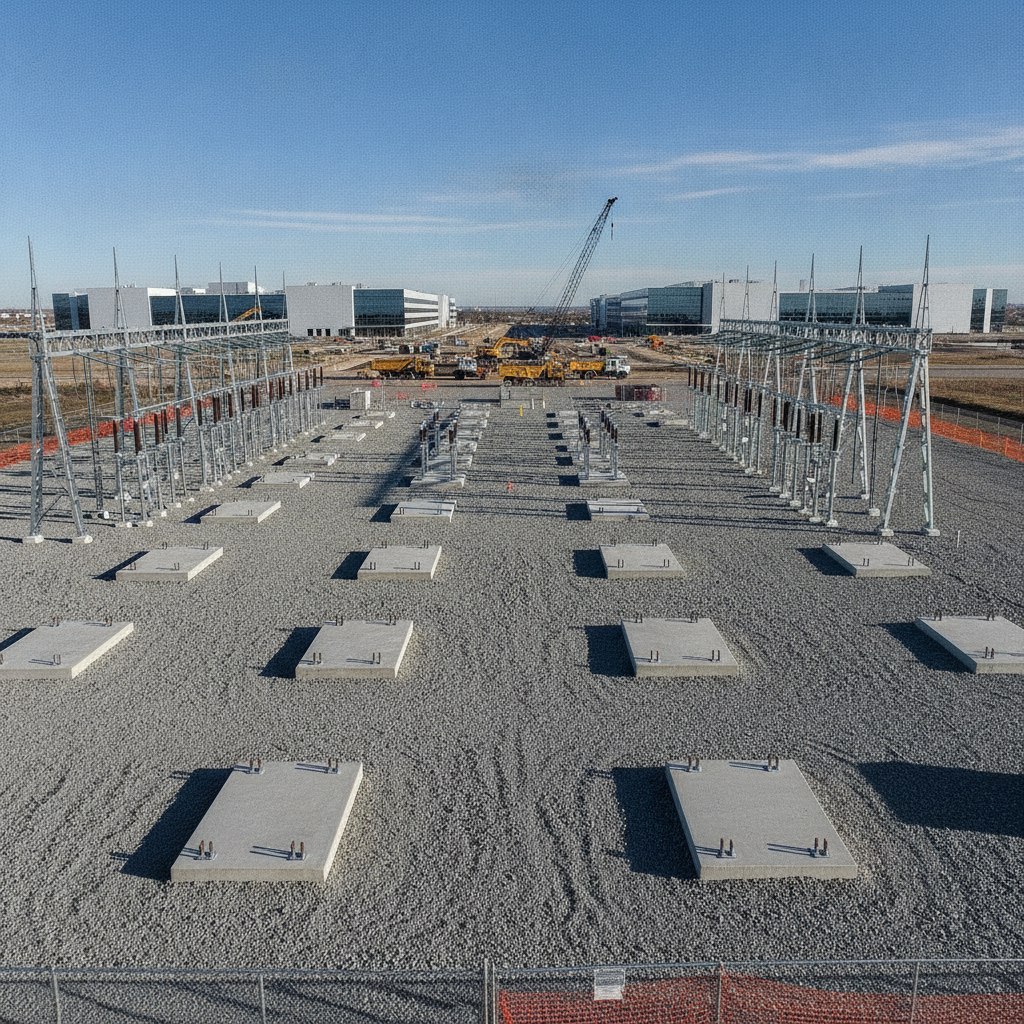
The substation yard itself is a specialized environment requiring precise civil engineering design. The primary goal is to create a stable, secure, and well-drained platform for high-voltage electrical equipment. The entire yard is typically graded to be nearly flat, with subtle slopes to direct stormwater to collection points. A comprehensive drainage design is essential to prevent ponding water, which can compromise equipment foundations and create safety hazards. This often involves perimeter swales, catch basins, and underground piping as part of a broader stormwater management plan. The yard surface is almost always covered with a thick layer of crushed stone. This surfacing serves multiple purposes: it provides a stable working surface for maintenance vehicles, suppresses weed growth, and, most importantly, increases the electrical resistivity of the ground surface to protect personnel from dangerous step-and-touch potentials during a fault event. Beneath this stone, the site development plan includes robust concrete foundations designed to support the immense weight of transformers, circuit breakers, and steel support structures.
Critical Infrastructure: Grounding, Containment, and Security
Beyond the visible surface, several critical infrastructure systems are integrated into the substation’s civil design. A key safety feature is the grounding grid, a network of buried copper conductors that extends throughout the entire substation yard. This grid ensures that all metallic structures are at the same electrical potential, providing a safe path for fault currents to dissipate into the earth. The design of this grid is a collaborative effort between civil and electrical engineers, informed by a site-specific Geotechnical soil report that measures soil resistivity. For substations with large, oil-filled transformers, federal regulations often require a Spill Prevention, Control, and Countermeasure (SPCC) plan. The civil engineering design must incorporate secondary containment systems capable of holding the entire volume of oil from the largest transformer, plus a margin for precipitation. This is typically achieved with concrete containment pits or remote impoundment basins. Finally, physical security is non-negotiable. The design includes high-security fencing, controlled access gates compliant with ADA compliance standards where applicable, and appropriate lighting to deter unauthorized access and protect this mission-critical asset.
Ensuring Heavy Haul Access for Transformer Delivery
One of the most significant logistical challenges in substation construction is the delivery of the main power transformers. These units can weigh hundreds of tons and are transported on specialized multi-axle vehicles. The civil engineering team is responsible for designing an access route—from the public roadway to the final transformer pad—that can withstand these extreme loads. This involves more than just paving a road; it requires a thorough analysis of the entire heavy haul path. The design must ensure that road widths and turning radii are sufficient to accommodate the oversized transport vehicle. The pavement section and any underlying subgrade must be designed to prevent failure under load. If the route crosses any culverts or bridges, a structural analysis is required to confirm their capacity. This process often requires close coordination with local and state transportation agencies to secure the necessary permits for oversized loads, making it a critical component of the overall site engineering services.
The RSP Engineers Approach to Substation Site Planning
At RSP Engineers, we approach substation site planning as an integrated discipline that bridges land development, utility requirements, and mission-critical reliability. Our process begins with a thorough due diligence and feasibility analysis, identifying optimal locations based on transmission access, topography, and environmental factors. We engage with utility providers at the earliest possible stage to establish clear design criteria and streamline the long and complex review and approval process. Our team of Civil engineers collaborates closely with electrical and Geotechnical engineer professionals to deliver a cohesive design package. We develop detailed grading and drainage design plans, robust foundation and containment solutions, and meticulously planned heavy haul access routes. By managing the entire permitting and site plan design process, we help data center developers navigate regulatory hurdles and mitigate risks, ensuring that the power infrastructure is delivered on schedule and on budget.
Common Challenges in Substation Development
Even with careful planning, substation projects can encounter significant hurdles. One of the most common issues is underestimating the timeline for utility coordination and approval, which can easily add a year or more to a project schedule. Another frequent challenge is insufficient land allocation, which can constrain future expansion or create conflicts with other campus infrastructure. Overlooking subsurface conditions is also a major risk; unexpected rock or poor soils discovered during construction can lead to costly redesigns and delays if a proper Geotechnical soil report was not obtained early. Other potential pitfalls include failing to adequately plan for heavy haul logistics, leading to last-minute route modifications, and encountering unforeseen environmental or cultural resources on the property. Proactive due diligence and engaging experienced Civil Engineering firms early in the conceptual phase are the best strategies to identify and mitigate these common challenges before they impact the project. Frequently Asked Questions How much land is needed for a data center substation? The land required depends entirely on the ultimate power capacity of the data center campus. A smaller, 100 MW substation might fit on 2-4 acres, while a large, 500+ MW substation serving a hyperscale campus could require 10-15 acres or more to accommodate equipment, security buffers, access roads, and future expansion. Who is responsible for designing the substation—the utility or the developer? This is a collaborative effort. Typically, the utility provider dictates the electrical protection and control schemes, equipment specifications, and overall layout within the fence. The developer’s civil engineering consultant is responsible for the site development aspects, including grading, drainage, foundations, access, and SPCC containment, all designed to meet the utility’s stringent standards. What are the biggest delays in getting a substation energized? The two most common sources of delay are long-lead-time equipment procurement (especially for large power transformers) and the lengthy process of utility coordination and regulatory approval. The utility’s internal review and construction scheduling can take years, making early engagement absolutely critical. Why is a Geotechnical soil report so important for substation design? A Geotechnical soil report, based on Soil boring test data, provides essential information for several key design elements. It determines the bearing capacity of the soil for designing massive transformer foundations, informs the design of the electrical grounding grid by measuring soil resistivity, and identifies any potential issues like rock or unstable soils that will impact the grading plan and earthwork costs. What is the purpose of the crushed stone surface in a substation yard? The crushed stone (or gravel) serves multiple functions. It provides a durable, all-weather surface for vehicle access, inhibits vegetation growth, and facilitates drainage. Most importantly, its high electrical resistivity helps protect personnel from hazardous electrical shocks (step and touch potentials) during an electrical fault. How does stormwater management for a substation differ from the rest of the data center site? While part of the overall site’s stormwater management system, a substation’s design has unique considerations. The yard is a large impervious area, and the design must prevent any standing water near high-voltage equipment. Additionally, the outfall from any oil containment structures must be controlled and potentially routed through an oil-water separator before being discharged into the main stormwater system, in compliance with environmental regulations.
Partner with RSP Engineers for Your Mission-Critical Project
Successfully navigating the complexities of substation site planning requires a partner with deep expertise in mission-critical land development. The team at RSP Engineers provides the comprehensive site engineering services needed to support your data center project, from initial due diligence and master planning to final construction administration. We specialize in utility coordination, regulatory permitting, and the detailed civil engineering design required to deliver a reliable and scalable power infrastructure. Contact us to discuss how we can help lay the groundwork for your next project.
Conclusion
The electrical substation is more than just a utility connection; it is a foundational component of a data center’s success. Its planning and design demand a specialized focus on long-term scalability, operational resilience, and safety. By prioritizing thorough civil engineering, proactive utility coordination, and meticulous site development, developers can mitigate significant project risks and ensure that their facility has the robust power infrastructure needed to support mission-critical operations for decades to come.
FAQs
-
Planning Substation Areas for Data Center Developments requires careful planning, qualified engineering, and compliance with the applicable codes and permits.
-
Getting Planning Substation Areas for Data Center Developments right protects safety, supports regulatory compliance, and avoids costly redesigns or delays.
-
RSP Engineers provides licensed expertise and end-to-end support for Planning Substation Areas for Data Center Developments, from early planning through permitting.