
Ground Improvement Alternatives for Data Center Sites
Explore key ground improvement methods for data center sites, including aggregate piers, dynamic compaction, and soil mixing. Learn how to select the right technique to ensure foundation stability and
The Critical Role of Geotechnical Investigation
Before any ground improvement method can be considered, a comprehensive geotechnical investigation is non-negotiable. This phase is the foundation of the entire design process, providing the essential data needed to characterize the subsurface conditions accurately. A thorough investigation, typically involving a Soil boring test program and laboratory analysis, identifies the soil stratigraphy, strength, compressibility, and groundwater levels. This data is compiled into a Geotechnical soil report, which is the primary reference for the design team. The investigation must be tailored to the unique demands of a data center. Key objectives include identifying problematic layers such as soft clays, loose sands, or undocumented fill that could lead to unacceptable settlement under heavy foundation loads. The Geotechnical engineer uses this information to assess risks like liquefaction potential in seismic areas and to develop preliminary recommendations. A robust upfront investigation minimizes the risk of costly surprises during construction and ensures that the selected ground improvement strategy is both effective and efficient for the specific site development challenges.
Aggregate Piers and Stone Columns
Comparison of Ground Improvement Methods
| Method | Primary Application (Soil Type) | Typical Improvement Depth | Key Considerations |
|---|---|---|---|
| Aggregate Piers / Stone Columns | Soft clays, silts, loose sands, variable fill | 10 - 40 feet | Excellent settlement control; low vibration; requires specialized contractor. |
| Deep Dynamic Compaction (DDC) | Loose granular soils (sands, gravels) | 15 - 60 feet | Cost-effective for large areas; high vibration requires significant buffer zones. |
| Vibro-Compaction | Clean, loose granular soils | 15 - 50 feet | Effective for liquefaction mitigation; requires sufficient water for jetting. |
| Deep Soil Mixing (DSM) | Soft clays, silts, organic soils | Up to 100+ feet | Creates high-strength elements; can serve as foundation and cutoff wall; higher cost. |
| Surcharge with Wick Drains | Saturated, soft cohesive soils (clays, silts) | Dependent on soil layer thickness | Low direct cost but significant schedule impact; requires large volume of fill. |
| Removal and Replacement | Shallow unsuitable soils (organics, debris, fill) | Typically < 15 feet | Simple concept; can be costly and slow if deep or below groundwater. |
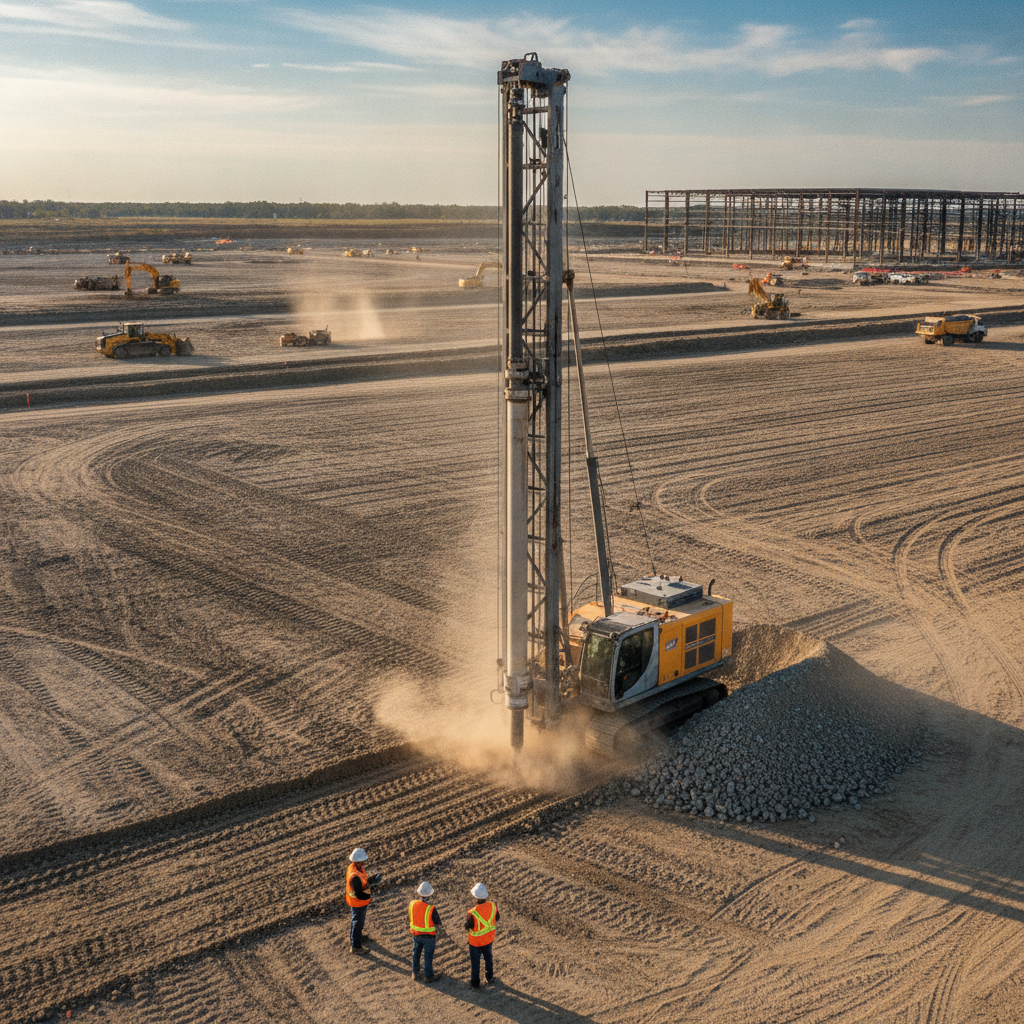
Aggregate piers, also known as stone columns, are a widely used ground improvement technique for increasing the bearing capacity and controlling the settlement of shallow foundations. The process involves advancing a hole into the ground, either by drilling or displacement, and then constructing a dense column of compacted crushed stone. These stiff columns reinforce the surrounding soil matrix, creating a composite ground mass with significantly improved engineering properties. This method is highly effective in a range of soil types, from soft clays and silts to loose sands. The columns provide a stiff load path to transfer structural loads to more competent underlying strata, while also promoting drainage and accelerating consolidation in cohesive soils. For data center projects, the precise control over settlement offered by aggregate piers is a major advantage. The installation process generates less noise and vibration than driven piles, which can be a critical factor for projects near sensitive areas. Proper quality control during installation is essential to ensure each column meets design specifications.
Deep Dynamic Compaction (DDC)
Deep Dynamic Compaction (DDC) is a ground improvement method that densifies loose, granular soils at depth by applying high-energy impacts. The process involves repeatedly dropping a heavy steel tamper, weighing anywhere from 10 to 40 tons, from a significant height onto the ground surface. The resulting shockwaves rearrange the soil particles into a denser configuration, increasing their strength and reducing their susceptibility to liquefaction and settlement. DDC is best suited for large, open sites with thick deposits of unsaturated granular soils, such as sands and gravels. It is a relatively fast and cost-effective method for treating large areas, making it attractive for sprawling data center campuses. However, the primary drawback of DDC is the significant ground vibration it generates, which can impact nearby structures and utilities. A thorough pre-construction survey and vibration monitoring plan are essential components of any DDC program, requiring careful construction administration and utility coordination to mitigate risks.
Vibro-Compaction and Vibro-Replacement
Vibroflotation techniques use a large, vibratory probe, or vibroflot, to improve soil conditions. The specific method used depends on the native soil type. Vibro-compaction is used to densify existing clean, granular soils. The vibroflot is lowered into the ground, and its powerful vibrations cause the loose sand particles to rearrange into a denser state. This method is particularly effective for mitigating liquefaction risk and increasing bearing capacity for the site plan design. In cohesive or mixed soils, vibro-replacement is used to construct stone columns. The vibroflot displaces the weak soil, and crushed stone is fed down to the tip of the probe to form a dense, interlocking column. These columns function similarly to aggregate piers, reinforcing the soil and providing excellent drainage. The applicability of these methods and associated permitting requirements for vibration and noise can vary by jurisdiction, and it is essential to confirm all applicable standards with the local, state, and regional authorities overseeing the site development. Both techniques require specialized equipment and experienced contractors to ensure successful implementation.
Soil Mixing and Grouting Techniques
When soil needs to be strengthened or its permeability reduced, soil mixing and grouting techniques offer targeted solutions. Deep Soil Mixing (DSM) involves using large-diameter augers to blend the in-situ soil with a cementitious binder, such as cement or lime, to create soil-cement columns or panels. This method transforms weak, compressible soils into a stronger, more stable mass, making it suitable for foundation support, excavation shoring, and groundwater cutoff walls. The engineered properties of the soil-cement can be precisely controlled by adjusting the binder content. Grouting involves injecting fluid materials into the soil or rock to fill voids and improve its characteristics. Compaction grouting uses a stiff, low-mobility grout to displace and densify surrounding soils, while permeation grouting uses a low-viscosity grout to penetrate the pore spaces of granular soils, binding them together. These methods are often used for targeted problem areas, such as stabilizing soils beneath existing structures or mitigating karst features, and require careful planning and execution by a qualified Geotechnical engineer.
Surcharge Preloading and Wick Drains
For sites with highly compressible, saturated clays and silts, surcharge preloading is a time-tested method for inducing settlement before construction begins. The process involves placing a temporary load, or surcharge—typically a large mound of soil—over the future building footprint. This added weight consolidates the underlying soft soils by squeezing out pore water, thereby increasing their strength and minimizing future settlement. This is a critical consideration in the overall land development timeline. To accelerate this consolidation process, which can otherwise take years, vertical drains (or wick drains) are often installed. These prefabricated drainage paths allow pore water to escape more quickly, significantly reducing the time required to achieve the desired degree of consolidation. While effective, this method has major schedule implications. The surcharge must remain in place for several months or longer, which must be factored into the overall project management and construction sequencing. Careful monitoring with settlement plates and piezometers is required to track progress and determine when the soil is ready for construction.
The Deep Foundation Alternative
In some cases, ground improvement may not be the most suitable solution. When unsuitable soils extend to great depths, or when structural loads are exceptionally high, a deep foundation system may be necessary. Deep foundations, such as driven piles, drilled shafts, or auger-cast piles, bypass the weak upper soils and transfer loads directly to a competent bearing stratum like dense sand, stiff clay, or bedrock. This approach provides a high degree of certainty regarding foundation performance and settlement. The decision between ground improvement and deep foundations is a complex engineering and economic trade-off. Deep foundations often have a higher upfront material and installation cost but can sometimes offer a faster construction schedule than methods like surcharging. A detailed cost-benefit analysis, considering factors like material costs, schedule impacts, and long-term performance, is essential. This analysis should be performed by experienced civil engineering and geotechnical professionals in the early stages of site plan design.
Our Approach to Ground Improvement Strategy at RSP Engineers
At RSP Engineers, we guide clients through the complexities of site selection and foundation design for mission-critical facilities. Our process begins with a rigorous geotechnical investigation to build a comprehensive understanding of the subsurface risks and opportunities. We collaborate closely with the client, structural engineer, and contractor to evaluate the feasibility of various ground improvement techniques versus deep foundation systems. Our team performs detailed engineering analyses to compare the performance, cost, and schedule implications of each viable option. We provide clear recommendations tailored to the project’s specific performance criteria and business goals. Throughout the permitting and construction phases, we provide expert oversight and construction administration services, ensuring that the selected ground improvement program is implemented according to the highest quality standards and delivers the required performance for your data center.
Common Challenges in Ground Improvement Projects
Even with careful planning, ground improvement projects can encounter challenges. One of the most common is discovering unexpected subsurface conditions, such as buried debris, old foundations, or boulders that can obstruct drilling or compaction equipment. A high groundwater table can also complicate many techniques, potentially requiring dewatering operations that add cost and complexity to the site development process. Site logistics, including access for large, heavy equipment and the management of soil spoils or imported materials, must be carefully planned. Perhaps most importantly, verification of the completed work is critical. Post-improvement testing, such as plate load tests, cone penetration tests (CPT), or standard penetration tests (SPT), is necessary to confirm that the soil has achieved the specified engineering properties. This verification step is essential for agency review and provides the owner with confidence in the long-term performance of their foundation system.
Partner with RSP for Your Mission-Critical Facility
Navigating the complexities of foundation design for data centers requires specialized expertise. The team at RSP Engineers provides comprehensive site engineering services, from initial due diligence and geotechnical investigation to detailed design and construction administration. We help clients evaluate ground improvement options, manage permitting challenges, and deliver stable, reliable foundations for their most critical assets. Contact us to discuss how we can support your next mission-critical project.
Conclusion
For data center developers, addressing poor soil conditions is a critical step in ensuring the long-term stability and performance of the facility. While deep foundations are a proven solution, a well-designed ground improvement program can often provide an equally robust foundation at a lower cost and with greater design flexibility. The key to success lies in a thorough geotechnical investigation, a careful evaluation of the available techniques, and expert civil engineering oversight. By partnering with an experienced engineering firm, developers can confidently select and implement the optimal foundation strategy for their specific site.
FAQs
-
The choice depends on a cost-benefit analysis that considers soil type and depth, foundation load requirements, project schedule, and overall budget. Ground improvement is often more economical if suitable soils can be improved at a reasonable depth. Deep foundations are typically chosen when weak soils are very deep or loads are extremely high, making it more practical to bypass the poor soil layers entirely. A detailed Geotechnical soil report is the first step in this evaluation.
-
Verification is crucial and typically involves a program of in-situ testing after the ground improvement is complete. Common methods include plate load tests to confirm bearing capacity, Cone Penetration Testing (CPT) to assess soil density and strength, and Standard Penetration Tests (SPT). The specific testing program is designed by the Geotechnical engineer to confirm that the design specifications have been met.
-
The schedule impact varies significantly by method. Techniques like aggregate pier installation or dynamic compaction can be relatively fast. In contrast, surcharge preloading with wick drains is a slow process that can add many months to the pre-construction timeline. This must be integrated into the overall site development and construction schedule from the outset.