
Geotechnical Monitoring During Data Center Construction
A guide to construction-phase geotechnical monitoring for data centers, covering excavation validation, settlement and vibration monitoring, and the engineer’s role.
The Role of the Geotechnical Engineer of Record During Construction
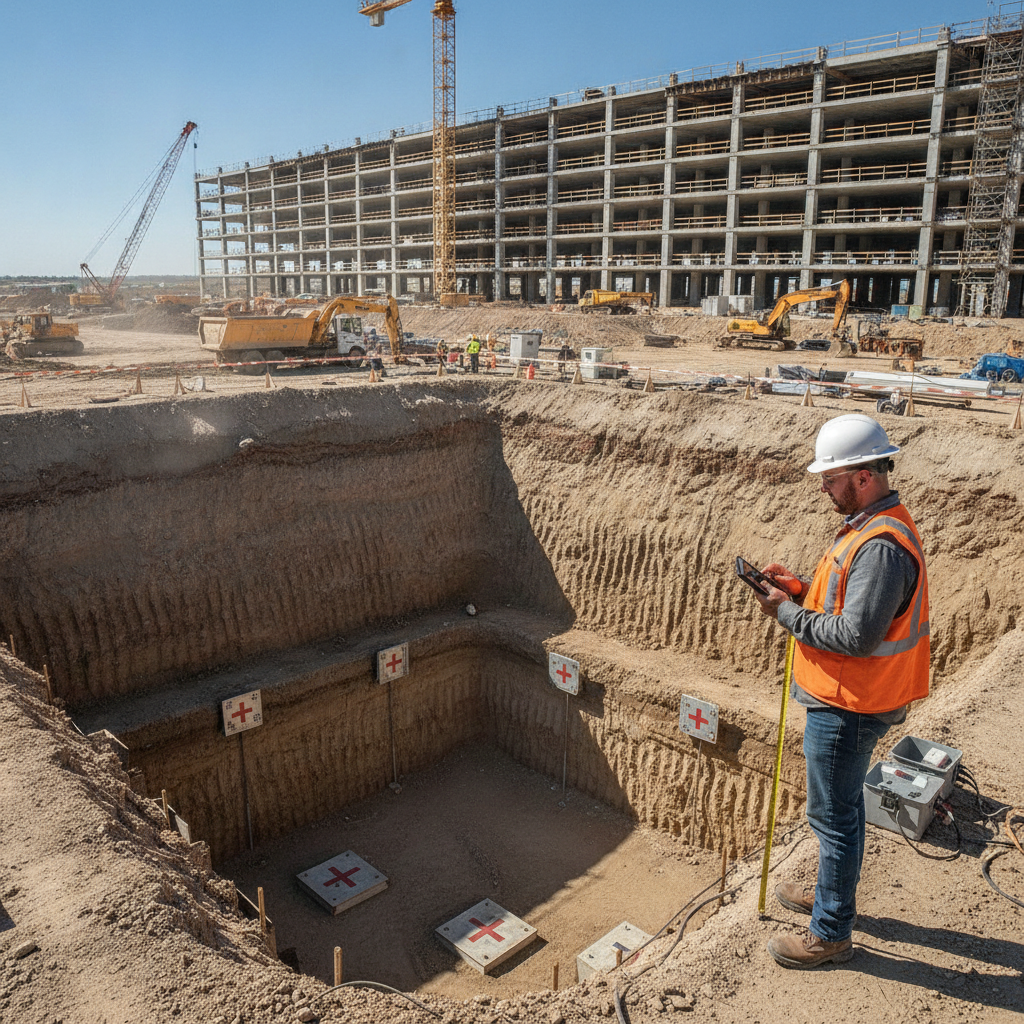
During the construction phase, the role of the Geotechnical engineer transitions from a designer to a field observer and consultant. Their primary responsibility is to confirm that the soil and groundwater conditions encountered during excavation are consistent with the data and interpretations presented in the initial investigation and Soil boring test. This verification is fundamental to confirming that the foundation design remains valid for the actual site conditions. The engineer serves as the owner’s expert representative, providing critical judgments on the suitability of bearing surfaces, the stability of excavations, and the effectiveness of earthwork operations. This role requires a deep understanding of soil mechanics, foundation engineering, and construction means and methods. The engineer documents their observations in field reports, which become part of the permanent project record. These reports are vital for resolving disputes, justifying field decisions like soil undercuts, and demonstrating building code compliance. Permitting requirements for geotechnical observation and reporting vary by jurisdiction, and every project team should confirm the applicable standards with the local, state, regional, and federal authorities that hold review authority over the site. This proactive engagement ensures that all inspection and documentation protocols are met from the outset.
Validating Subgrade and Foundation Excavations
Key Geotechnical Monitoring Activities and Objectives
| Monitoring Activity | Key Objective | Typical Instrumentation / Method |
|---|---|---|
| Foundation Excavation Observation | Verify soil bearing strata and capacity; identify anomalies. | Visual inspection, hand auger, dynamic cone penetrometer (DCP). |
| Proof Rolling | Identify soft or unstable subgrade areas under load. | Observation of a loaded dump truck or water truck for rutting/pumping. |
| Settlement Monitoring | Track vertical movement of foundations and fills over time. | Optical survey, settlement plates, extensometers, tiltmeters. |
| Vibration Monitoring | Protect adjacent structures from construction-induced vibrations. | Seismographs measuring peak particle velocity (PPV). |
| Groundwater Observation | Ensure excavation stability and effective dewatering. | Visual inspection, observation wells, piezometers. |
| Compaction Testing | Verify density of engineered fill and backfill materials. | Nuclear density gauge, sand cone test. |
One of the most critical tasks in geotechnical monitoring is the direct observation of foundation excavations. As earth is removed for footings, mat foundations, and utility trenches, the Geotechnical engineer inspects the exposed subgrade. They are looking for several key indicators: confirming the soil strata match the boring logs, verifying the required soil bearing capacity, and identifying any anomalies like undocumented fill, soft pockets of organic material, or unexpected rock formations. This is not a passive activity; it often involves probing the excavation bottom with a hand auger or dynamic cone penetrometer to assess its consistency and strength. If the engineer identifies soils that do not meet the design specifications, they must immediately notify the project team. This triggers a collaborative process to determine the appropriate remedial action. The solution could range from a simple localized over-excavation and replacement with engineered fill to more complex soil stabilization techniques. This real-time validation is indispensable for data centers, where uniform foundation support is non-negotiable for the long-term performance of server racks and cooling infrastructure.
Proof Rolling and Managing Undercuts
For areas supporting slabs-on-grade, roadways, and heavy equipment pads, proof rolling is a common method used to assess the uniformity and stability of the prepared subgrade. This process involves driving a fully loaded piece of heavy equipment, such as a tandem-axle dump truck or water truck, over the entire area in a systematic pattern. The Geotechnical engineer observes the ground surface for any rutting, pumping, or weaving that indicates soft, unstable soils beneath. Where unstable areas are identified, the next step is typically an undercut. This involves excavating the unsuitable material and replacing it with compacted, engineered fill or a geotextile fabric and aggregate base. The engineer provides the recommendation for the depth and extent of the undercut based on the severity of the instability and the nature of the underlying soils. Proper execution of proof rolling and undercutting is essential for preventing future slab settlement and pavement failure, which are costly and disruptive to repair in an operational facility.
Settlement Monitoring for Mission-Critical Structures
Because data centers are extremely sensitive to differential settlement, a comprehensive settlement monitoring program is often implemented. Even a fraction of an inch of uneven movement between columns can stress the building frame, crack floor slabs, and misalign sensitive equipment connections. The monitoring program is designed to provide early warning of any settlement trends that deviate from the predicted performance, allowing for corrective action before damage occurs. Methods for settlement monitoring can range from simple optical surveys of fixed points on columns and foundation walls to more sophisticated instrumentation. These may include settlement plates installed at the base of structural fills, extensometers to measure vertical compression within the soil mass, and piezometers to monitor pore water pressure, which influences settlement rates. Data is collected at regular intervals throughout construction and into the initial operational period, providing a clear record of the foundation’s performance under increasing load.
Vibration Monitoring for Adjacent Structures and Operations
Data center construction often involves activities that generate significant ground vibrations, such as pile driving, dynamic compaction, and heavy truck traffic. If the site is located near existing buildings, underground utilities, or sensitive operational facilities, vibration monitoring is a critical risk mitigation tool. The goal is to ensure that construction-induced vibrations do not exceed established thresholds that could cause cosmetic or structural damage to adjacent properties or disrupt sensitive processes. Monitoring is performed using seismographs placed at strategic locations between the construction activity and the sensitive receptors. These instruments continuously measure ground motion and record the peak particle velocity (PPV), which is the primary metric used to assess the potential for damage. The Geotechnical engineer helps establish project-specific vibration limits and reviews the monitoring data to ensure zoning compliance and adherence to project specifications, providing an objective record in case of any claims.
Groundwater Management and Dewatering Observations
Encountering groundwater during deep excavations for basements or utility vaults can pose a significant challenge to site development. A properly designed dewatering system is required to lower the water table and maintain a stable, dry working environment. The role of the geotechnical monitor includes observing the effectiveness of this system and watching for adverse effects, such as ground loss or instability in adjacent areas. The engineer will observe the discharge water for excessive sediment, which could indicate that fine soil particles are being piped out of the ground, potentially causing voids and settlement. They also inspect the excavation slopes and bottom for signs of instability, such as sloughing or “boiling” conditions where upward water flow reduces soil strength. Proper management of groundwater control is essential for worker safety, the stability of the excavation itself, and the protection of nearby structures.
How RSP Engineers Manages Geotechnical Construction-Phase Services
At RSP Engineers, our approach to geotechnical construction-phase services is proactive and collaborative. We position our field professionals as an integrated part of the project team, working closely with the owner, architect, and contractor. Our process begins with a pre-construction meeting to review the geotechnical report’s recommendations and establish clear communication protocols and expectations for field testing and observation. Our goal is to provide timely, decisive feedback to keep the project moving forward without compromising quality or safety. Our experienced field engineers and technicians provide detailed daily field reports, documenting all observations, tests, and decisions made on site. This creates a transparent and defensible record of construction quality control. By providing a dedicated Professional Engineer to oversee the construction administration process, we ensure that complex field issues are resolved quickly and effectively, leveraging our deep expertise in Geotechnical Engineering to protect our client’s interests from groundbreaking to final acceptance.
Common Issues Encountered During Geotechnical Monitoring
Even with a thorough site investigation, unexpected conditions can arise during construction. One of the most common issues is encountering undocumented or unsuitable fill material that must be removed and replaced, impacting the project’s budget and schedule. Another frequent challenge is a higher-than-anticipated groundwater table, requiring a more robust dewatering plan. Discrepancies between the soil conditions in the borings and those found in foundation excavations can also occur, necessitating a rapid re-evaluation of the foundation design. Contractor deviations from the specified procedures for earthwork and compaction are another area of concern. Without diligent observation and testing, improperly compacted fill can lead to long-term settlement problems. The geotechnical monitor’s role is to identify these issues early, document them clearly, and work with the project team to implement the correct and specified solution before it becomes a larger problem.
Partner with RSP for Your Mission-Critical Project
The demands of data center construction require a civil engineering partner with specialized expertise. At RSP Engineers, we provide comprehensive geotechnical services, from initial site investigation through final construction observation. Our team understands the unique challenges of mission-critical facilities and is dedicated to providing the rigorous oversight needed to ensure your project’s success. Contact us today to discuss how our expertise in site development, Geotechnical Engineering, and construction administration can bring certainty and value to your next data center project.
Conclusion
Geotechnical monitoring during construction is not merely a quality control checkbox; it is an active and essential component of risk management for data center development. It provides the critical link between design assumptions and the reality of the constructed environment. By validating subgrade conditions, managing earthwork quality, and monitoring foundation performance, this process ensures the structural integrity and long-term stability of the facility. Investing in thorough geotechnical monitoring protects the enormous capital investment of a data center and provides peace of mind that the facility is built on a solid foundation.
FAQs
-
If field conditions differ significantly from the Geotechnical soil report, the Geotechnical Engineer of Record will immediately notify the project team. They will assess the new conditions and provide revised recommendations. This could involve changes to foundation depth, bearing pressure, or the need for soil stabilization techniques. The goal is to adapt the design to the actual conditions while maintaining safety and performance standards.
-
The frequency of monitoring depends on the project phase and complexity. During critical activities like foundation excavation and subgrade preparation, a Geotechnical engineer may be on-site continuously. For other activities like utility backfill or fill placement, testing and observation may occur on an intermittent or milestone basis. The specific requirements are typically outlined in the project specifications or by the authority having jurisdiction.
-
Responsibility for the cost of unforeseen conditions, such as extensive undercutting, is typically defined in the construction contract. It may be handled through a contingency allowance, a change order, or other contractual mechanisms. A clear geotechnical report and proactive construction-phase monitoring can help quantify these risks early.