
Traffic Impact Studies for Data Center Developments
A comprehensive guide to the traffic impact study (TIS) process for data center developments. Learn about trip generation, LOS analysis, and agency permitting.
Defining the Unique Traffic Profile of Data Centers
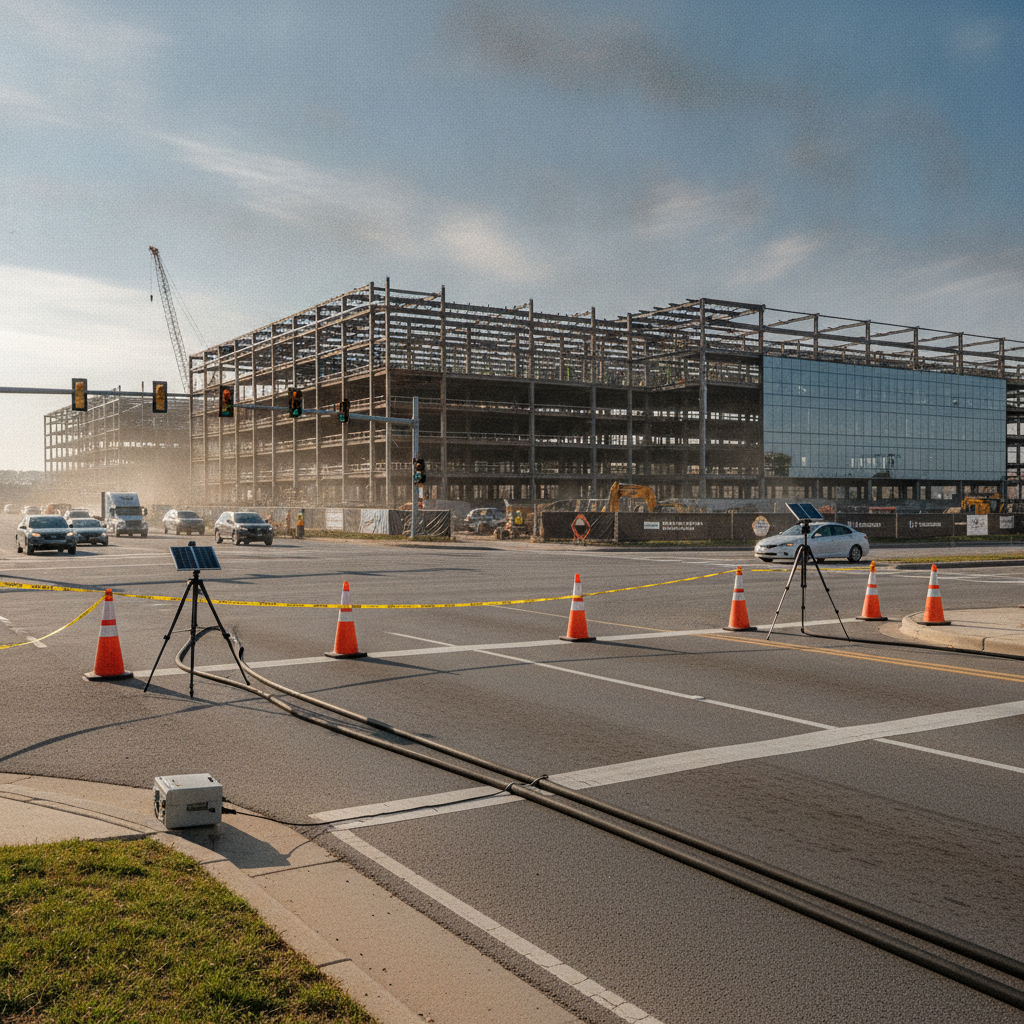
The core challenge in analyzing data center traffic is its dissimilarity to conventional land uses. The Institute of Transportation Engineers (ITE) Trip Generation Manual, the industry standard, categorizes land uses based on predictable patterns, such as morning and evening commuter peaks for an office building. Data centers defy these simple classifications. Their operational traffic is dominated by a small number of highly specialized employees per shift, resulting in minimal commuter impact. However, this is offset by other critical traffic components. The operational phase includes periodic but significant events like bulk fuel deliveries for backup generators, cooling system maintenance, and the arrival of heavy trucks carrying server racks and other critical hardware. Furthermore, the construction phase generates a massive, temporary surge in traffic from workers, concrete trucks, and oversized loads for structural and electrical components. A thorough TIS must separately analyze both the construction and operational phases to provide a complete picture of the site’s impact, a critical step in any site development plan prepared by leading Civil Engineering firms.
The Scoping Process: Aligning with Reviewing Agencies
Data Center Traffic Study Phase Comparison
| Phase | Primary Traffic Source | Key Analysis Objective |
|---|---|---|
| Pre-Development (Baseline) | Existing through-traffic | Establish existing Level of Service (LOS) and safety conditions. |
| Construction | Worker vehicles, concrete trucks, heavy equipment delivery | Assess temporary impacts on roadway capacity and pavement condition; develop a traffic control plan. |
| Initial Operation (Year 1) | Employee shifts, initial server/equipment delivery | Model the 'Day 1' operational impact and confirm access points function as designed. |
| Mature Operation (Year 5+) | Employee shifts, routine maintenance, fuel/water delivery, equipment replacement cycles | Forecast long-term impacts, including background traffic growth, to ensure sustained network performance. |
| Peak Delivery Events | Multiple simultaneous heavy truck deliveries (e.g., generator or server refresh) | Analyze queuing at site entrances and impacts on intersection turn movements during non-typical peak events. |
Before any analysis begins, the most critical step is the scoping meeting with the reviewing transportation agencies. This could be a local, regional, or state-level authority responsible for the roadways serving the project. During this collaborative process, the project’s civil engineering team and the agency agree on the fundamental parameters of the study. This includes defining the study area, selecting specific intersections for detailed analysis, and establishing the peak hours to be modeled (e.g., AM, PM, and sometimes weekend peak hours). This early alignment is crucial for avoiding costly revisions and delays later in the permitting process. The scope will dictate the level of effort required for data collection, including new traffic counts and roadway geometry surveys. Because requirements for study methodology, impact thresholds, and mitigation expectations vary by jurisdiction, every project team should confirm the applicable standards with the local, state, regional, and federal authorities that hold review authority over the site. A clearly defined scope, agreed upon in writing, serves as the roadmap for the entire traffic impact analysis.
Trip Generation: Beyond Standard ITE Manual Rates
Trip generation is the process of estimating the number of vehicle trips that a proposed development will add to the transportation network. For most projects, engineers can rely on the rates published in the ITE Trip Generation Manual. However, due to the unique operational characteristics of data centers, a direct application of standard ITE land use codes (like General Office or Industrial Park) can produce highly inaccurate results. Using an office code would vastly overestimate employee traffic, while an industrial code might not capture the specific nature of server and fuel deliveries. Therefore, a best practice for data center projects is to develop custom trip generation rates. This is often accomplished by gathering empirical data from existing, comparable data center facilities. When such data is unavailable, the analysis may be built from the ground up based on the project’s specific operational plan, including staffing levels per shift, anticipated delivery schedules, and maintenance contracts. This tailored approach provides a much more defensible and realistic forecast of traffic, which is essential for a credible agency review.
Analyzing Traffic Operations and Level of Service (LOS)
Once trip generation is established, the next step is to analyze the impact on the roadway network. This is measured using a metric called Level of Service (LOS), which grades traffic conditions from ‘A’ (free-flow) to ‘F’ (forced-flow or gridlock). The analysis is conducted for multiple scenarios: existing conditions, future conditions without the project (background growth), and future conditions with the project’s added traffic. This allows engineers to isolate the specific impact of the data center. Using specialized traffic modeling software, Civil Engineers evaluate key intersections and roadway segments for factors like vehicle delay, queuing, and overall capacity. The goal is to determine if the project will cause any location’s LOS to degrade below the acceptable threshold set by the reviewing agency. This quantitative analysis forms the core of the TIS report and is the basis for determining whether mitigation is required for the site plan design.
Identifying and Designing Mitigation Measures
If the TIS concludes that the data center will cause an unacceptable degradation in Level of Service or create a safety issue, the reviewing agency will require mitigation. These are physical or operational improvements designed to offset the project’s impact. The responsibility for designing and often funding these improvements typically falls to the developer. The goal is to ensure the post-development traffic conditions are no worse than the pre-development conditions, or meet the agency’s minimum standard. Common mitigation measures include: Turn Lanes: Adding dedicated left-turn or right-turn lanes at key intersections to increase capacity and reduce delays. Traffic Signals: Installing a new traffic signal or modifying the timing of an existing one to improve traffic flow. Deceleration Lanes: Providing a dedicated lane for vehicles to slow down before entering the site, improving safety on high-speed roads. Roadway Widening: Expanding a road segment to add through-lanes and increase overall capacity. These improvements must be fully engineered and integrated into the project’s overall site plan design, requiring close coordination between transportation and site civil engineering teams.
Construction Phase vs. Operational Phase Traffic Analysis
A comprehensive TIS must address two distinct timelines: the temporary construction period and the long-term operational life of the facility. Construction traffic is often the most intense period of activity, with a high volume of heavy vehicles and a large workforce arriving and departing in concentrated peaks. This requires a detailed analysis of haul routes, potential pavement damage, and the need for temporary traffic control. Effective Construction Management Services rely on this analysis to plan logistics. Operational traffic, while lower in overall volume, presents a different set of challenges. The focus shifts to ensuring safe and efficient access for large delivery trucks, accommodating employee shift changes without causing backups, and planning for emergency vehicle access. By analyzing both phases, the TIS provides agencies with the assurance that the project has accounted for its full lifecycle of traffic impacts, a key part of responsible land development.
How RSP Engineers Manages the Traffic Impact Study Process
At RSP Engineers, we approach the Traffic Impact Study as a foundational element of project success. Our process is built on proactive communication and rigorous technical analysis. We begin with early engagement, facilitating the scoping meeting between the client and reviewing agencies to establish clear expectations. Our team of experienced transportation professionals then develops custom trip generation models tailored specifically to data center operations, ensuring the analysis is both accurate and defensible. Using state-of-the-art modeling software, we conduct a detailed Level of Service (LOS) analysis to pinpoint potential impacts. When mitigation is necessary, we design practical, cost-effective solutions that integrate seamlessly with the overall project goals. Our comprehensive site engineering services ensure that the traffic mitigation plan works in concert with drainage, utilities, and site layout, providing a holistic solution that streamlines the permitting process and delivers a successful project.
Common Challenges in Data Center Traffic Studies
Navigating a TIS for a data center can present several common hurdles. A primary challenge is the lack of standardized ITE data, which places a greater burden on the applicant to justify their proposed trip generation rates. Another issue is agency unfamiliarity with the unique traffic patterns of mission-critical facilities, which can lead to requests for overly conservative assumptions or unnecessary analysis. Scope creep is also a risk, where the study area or number of required scenarios expands during the agency review process, impacting budget and schedule. Finally, developers often underestimate the intensity of construction-phase traffic, leading to inadequate planning for haul routes and potential conflicts with public roadways. A proactive and experienced Professional Engineer can anticipate these challenges and develop strategies to address them before they become critical path delays.
Partner with RSP for Your Data Center Development
A successful data center project requires an engineering partner who understands the nuances of mission-critical facilities. The Traffic Impact Study is a complex and vital step in the permitting process that demands specialized expertise. The team at RSP Engineers provides the in-depth transportation analysis and civil engineering design needed to navigate the intricate agency review process. Our experience with data center projects nationwide allows us to anticipate challenges, develop defensible analyses, and design practical mitigation solutions. Contact us today to discuss your project and learn how our site engineering services can help you achieve your development goals.
Conclusion: A Foundation for Successful Permitting
The Traffic Impact Study is more than a regulatory hurdle; it is a critical planning tool that de-risks a data center development. By accurately forecasting traffic impacts and proactively designing necessary improvements, a well-executed TIS builds trust with reviewing agencies, streamlines the permitting process, and ensures the project is a responsible and well-integrated part of the community’s infrastructure. For data center developers, investing in a thorough and specialized traffic impact analysis is a direct investment in the certainty and success of their land development project.
FAQs
-
Using a general office code would grossly overestimate the number of employee vehicles during peak commuter hours while completely failing to account for the primary traffic driver: heavy trucks for equipment and fuel delivery. This inaccuracy would lead to a flawed analysis and likely be rejected by the reviewing agency, requiring a costly restudy.
-
The timeline for a TIS can range from a few weeks to several months. Key factors include the time required to schedule a scoping meeting with the agency, the data collection period (which can be affected by weather or school schedules), the complexity of the traffic modeling, and the agency’s review and comment period. Early initiation of the TIS process is critical to meeting project deadlines.
-
If the analysis shows that the project will degrade the Level of Service below the agency’s acceptable threshold, mitigation will be required. Your civil engineering consultant will work with the agency to identify appropriate improvements, such as adding turn lanes or a traffic signal, to offset the impact. The design and construction of these improvements become part of the overall project requirements.