
Geotechnical Recommendations for Data Center Pavements
A technical guide to geotechnical recommendations for data center pavements, covering subgrade characterization, stabilization, and designing for heavy traffic loads. Learn how expert civil engineerin
The Critical Role of Subgrade Characterization
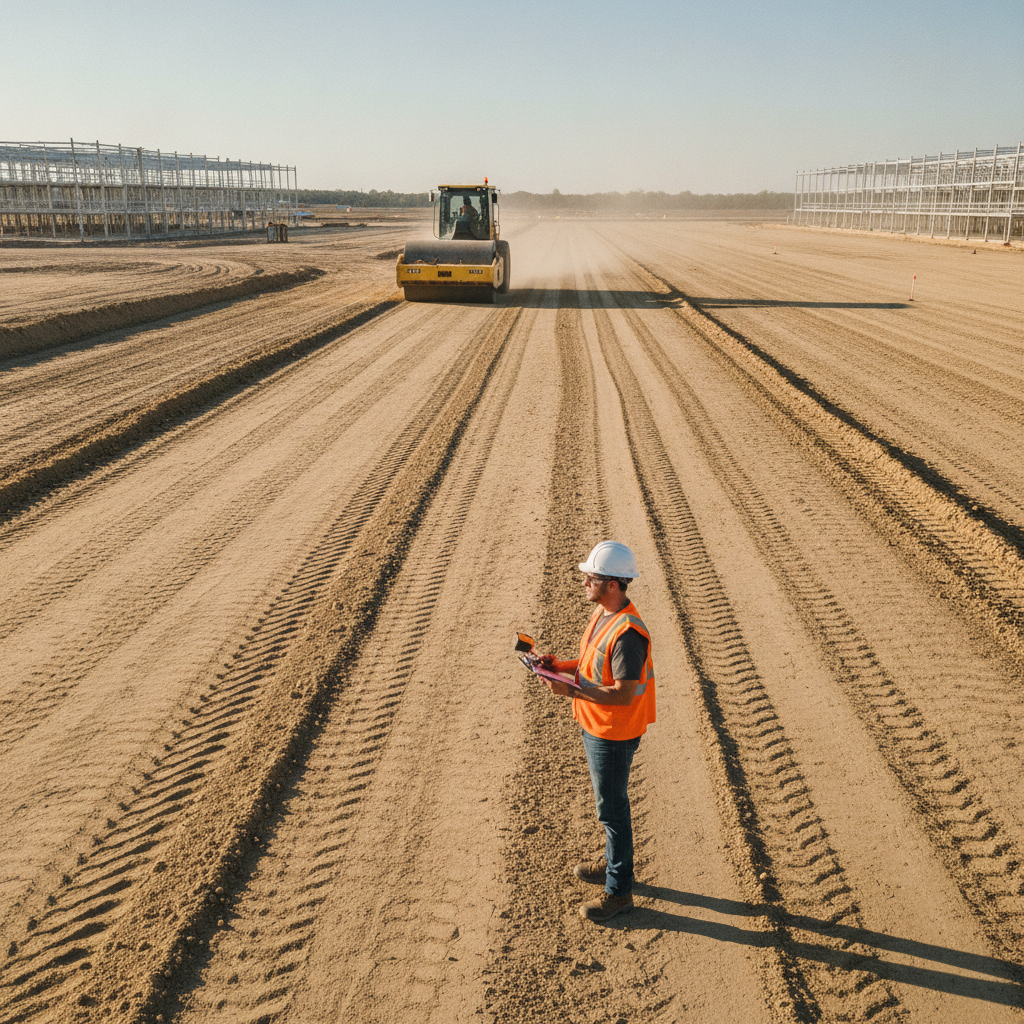
The performance of any pavement is fundamentally dependent on the strength and stability of the underlying soil, known as the subgrade. A comprehensive subgrade characterization is the first and most important step in the design process. This involves a combination of field exploration and laboratory testing to classify the soils and determine their engineering properties. Field methods often include drilling soil borings and conducting in-situ tests like the Standard Penetration Test (SPT) or Cone Penetration Test (CPT) to assess soil density and consistency. Samples collected from the field are then subjected to a suite of laboratory tests. These typically include moisture content analysis, Atterberg limits to determine soil plasticity, and particle size analysis (sieve and hydrometer) to classify the soil according to the Unified Soil Classification System (USCS). A Proctor test is also essential to establish the soil’s maximum dry density and optimum moisture content, which provides the target for achieving proper compaction during construction. This detailed data forms the basis for all subsequent pavement design calculations.
Assessing Subgrade Support and Strength
Pavement Subgrade Stabilization Method Comparison
| Stabilization Method | Primary Mechanism | Suitable Soil Types | Key Considerations |
|---|---|---|---|
| Lime Stabilization | Cation exchange and pozzolanic reaction to reduce plasticity and bind particles. | High-plasticity clays (Plasticity Index > 10). | Requires a curing period; effectiveness is temperature-dependent; can increase sulfate heave potential in some soils. |
| Cement Stabilization | Hydration creates a rigid, bound soil-cement matrix, significantly increasing strength. | Wide range of granular and low-plasticity fine-grained soils. | Creates a stiff layer that can be prone to shrinkage cracking; requires rapid mixing and compaction after application. |
| Geogrid Reinforcement | Interlocks with aggregate base course to provide confinement and tensile reinforcement. | Very soft, low-CBR subgrades (CBR < 3). | Reduces required base course thickness; does not change soil properties but improves system performance; proper aggregate selection is key. |
| Over-excavation & Replacement | Removes unsuitable soil and replaces it with competent, engineered fill. | Localized areas of very poor soil (e.g., organic material, debris). | Can be costly and time-consuming if large areas or deep excavation is required; dependent on availability of suitable borrow material. |
| Mechanical Blending | Mixing coarse aggregate (sand, gravel) into fine-grained soil to improve gradation and strength. | Marginal soils that need a moderate boost in strength and workability. | Less expensive than chemical stabilization but provides a more modest improvement; requires thorough mixing to be effective. |
Once the subgrade soils are classified, the next step is to quantify their ability to support the anticipated loads. The most common metric for this in flexible pavement design is the California Bearing Ratio (CBR). The CBR test measures the shear strength of a soil relative to a standard crushed rock material. A higher CBR value indicates a stronger subgrade, which may allow for a thinner and more economical pavement section (i.e., less base course and asphalt). For rigid (concrete) pavements, the key parameter is the Modulus of Subgrade Reaction (k-value). The geotechnical engineer uses laboratory CBR results, correlated with soil index properties, to assign a design CBR value for the pavement design. It is crucial that this value represents the subgrade’s condition when it is weakest, which is typically at a high moisture content. A proper geotechnical investigation will assess the variability of soils across the site to ensure the design accounts for the worst-case conditions, preventing localized pavement failures. This analysis directly informs the pavement structural design performed by the civil engineer.
Managing Moisture and Drainage Effects on Subgrade Performance
Water is the primary enemy of pavement subgrades. The presence of excess moisture can significantly reduce the strength and stiffness of most soil types, particularly fine-grained silts and clays. A low-strength, saturated subgrade is prone to deformation under traffic loads, leading to rutting and fatigue cracking in the pavement surface. Therefore, controlling moisture is a central objective of the geotechnical design and the overall site development plan. Effective stormwater management and subsurface drainage are critical. This includes establishing proper surface grading to direct water away from paved areas and, where necessary, installing subdrain systems to intercept groundwater or infiltrating surface water. The design of these systems must consider soil permeability and site topography. Effective drainage design is not just a best practice; it is a regulatory necessity. Pavement drainage design standards and permitting requirements vary by jurisdiction, and every project team should confirm the applicable standards with the local, state, regional, and federal authorities that hold review authority over the site.
Subgrade Improvement and Stabilization Strategies
When the native subgrade soils are weak, highly plastic, or moisture-sensitive, relying on them in their natural state can lead to an impractically thick and expensive pavement section. In these cases, subgrade improvement or stabilization is often the most effective solution. These techniques enhance the engineering properties of the soil, increasing its strength, reducing its plasticity, and minimizing its susceptibility to moisture. This allows for a more efficient and reliable pavement design. Common methods include: Mechanical Stabilization: This involves blending better-quality aggregate into the subgrade or over-excavating the poor soil and replacing it with engineered fill. Proper compaction is the simplest form of mechanical stabilization. Chemical Stabilization: This involves mixing additives like lime, cement, or fly ash into the subgrade. Lime is effective for high-plasticity clays, while cement is better suited for a wider range of soil types. These additives create chemical reactions that bind soil particles, increasing strength and durability. Geosynthetic Reinforcement: The use of geogrids or geotextiles can provide reinforcement, separation, and drainage functions. A geogrid placed at the bottom of the base course layer can confine the aggregate and distribute loads more effectively over a weak subgrade.
Base and Subbase Course Requirements for Heavy-Duty Pavements
Above the prepared subgrade lies the pavement’s foundation: the base and subbase courses. These layers of crushed aggregate serve several critical functions. They distribute the concentrated wheel loads from the surface over a wider area of the subgrade, provide a stable platform for construction equipment, and help drain water that enters the pavement structure. The quality and thickness of these layers are determined by the geotechnical engineer and civil engineer based on the subgrade strength (CBR) and the design traffic loads. Material specifications for base course are stringent, requiring hard, durable aggregates with a specific gradation to ensure high density and stability when compacted. The geotechnical recommendations will specify the required material properties, lift thicknesses, and compaction criteria (e.g., 98% of the maximum dry density). Quality control during construction, including density testing with a nuclear density gauge, is essential to verify that these requirements are met. A well-compacted, high-quality base course is fundamental to long-term pavement performance.
Accounting for Heavy Construction Traffic Loads
A frequent oversight in pavement design is failing to account for the immense loads imposed during the construction phase. Heavy equipment such as cranes, concrete trucks, and haul trucks carrying major electrical and mechanical components can exert wheel loads that far exceed those of the facility’s post-construction operational traffic. A pavement designed only for cars and occasional delivery trucks can be severely damaged before the data center even opens. The geotechnical investigation and pavement design must explicitly consider these temporary but critical construction loads. This may involve designing certain haul routes and staging areas with a thicker, more robust pavement section. Alternatively, the project can be phased so that the final surface course is placed only after all heavy construction is complete. Close coordination between the geotechnical engineer, civil engineer, and the construction team is vital to develop a practical strategy that protects the pavement investment throughout the entire project lifecycle.
Our Process: A Geotechnical-First Approach to Pavement Design
At RSP Engineers, we embed geotechnical considerations into the pavement design process from day one. Our approach begins with a comprehensive site assessment to plan a targeted geotechnical investigation that addresses the unique challenges of data center development. We collaborate closely with the site development team to understand the facility’s layout, traffic patterns, and critical construction sequencing. Our engineers translate field and lab data into clear, actionable recommendations for subgrade preparation, stabilization, and pavement section thickness. We provide detailed specifications for materials and construction quality control to ensure the design intent is realized in the field. By integrating our geotechnical engineering expertise with our civil design and permitting services, we deliver a holistic solution that optimizes performance, cost, and long-term reliability for our clients’ mission-critical infrastructure.
Common Issues in Data Center Pavement Geotechnical Design
Even with a plan, challenges can arise. The most common issues stem from an incomplete understanding of subsurface conditions or a disconnect between design and construction. These can include discovering undocumented fill or organic soils that require costly over-excavation, encountering a high water table that complicates subgrade preparation, or failing to achieve specified compaction due to overly wet or dry soil conditions. Another frequent problem is the underestimation of construction traffic, leading to premature failure of pavements intended for lighter operational loads. Proactive geotechnical investigation and diligent construction-phase testing are the best defenses against these costly surprises.
Partner with RSP Engineers for Mission-Critical Pavement Design
Your data center’s operational integrity depends on the reliability of every component, including its pavements. Don’t let overlooked subsurface conditions compromise your investment. The team at RSP Engineers provides comprehensive geotechnical engineering, civil engineering, and site development services tailored to the unique demands of mission-critical facilities. From initial site assessment and geotechnical investigation to detailed pavement design and construction administration, we are your trusted partner. Contact us today to discuss how we can ensure your project is built on a solid foundation.
Conclusion
Designing and constructing durable pavements for data centers is a complex task that hinges on expert geotechnical engineering. A proactive approach that includes thorough subgrade characterization, thoughtful management of soil moisture, and appropriate stabilization strategies is essential for success. By accounting for the extreme demands of both construction and operational traffic, developers can build pavements that perform reliably for decades. Integrating geotechnical insights into the earliest stages of site development is the most effective way to mitigate risk and deliver a resilient, cost-effective project.
FAQs
-
The most critical factor is the strength and uniformity of the prepared subgrade. All pavement layers rely on the subgrade for support. A weak or variable subgrade is the root cause of most pavement failures, making a thorough geotechnical investigation essential.
-
For pavement areas, soil borings typically extend 5 to 10 feet below the proposed subgrade elevation. The depth should be sufficient to identify any weak soil layers, determine the depth to groundwater, and characterize the soils that will influence pavement performance.
-
It depends. An evaluation of the existing pavement section and underlying subgrade is required. This often involves coring the pavement and performing geotechnical testing on the subgrade. If the existing section is inadequate for the new, heavier loads, it may need to be fully reconstructed or overlaid after subgrade improvements.