
Data Center Site Selection for Hyperscale Facilities
A comprehensive guide to hyperscale data center site selection. Learn the critical civil engineering criteria for power, fiber, water, land, and permitting for mission-critical facilities.
Defining Hyperscale: Engineering for Unprecedented Scale
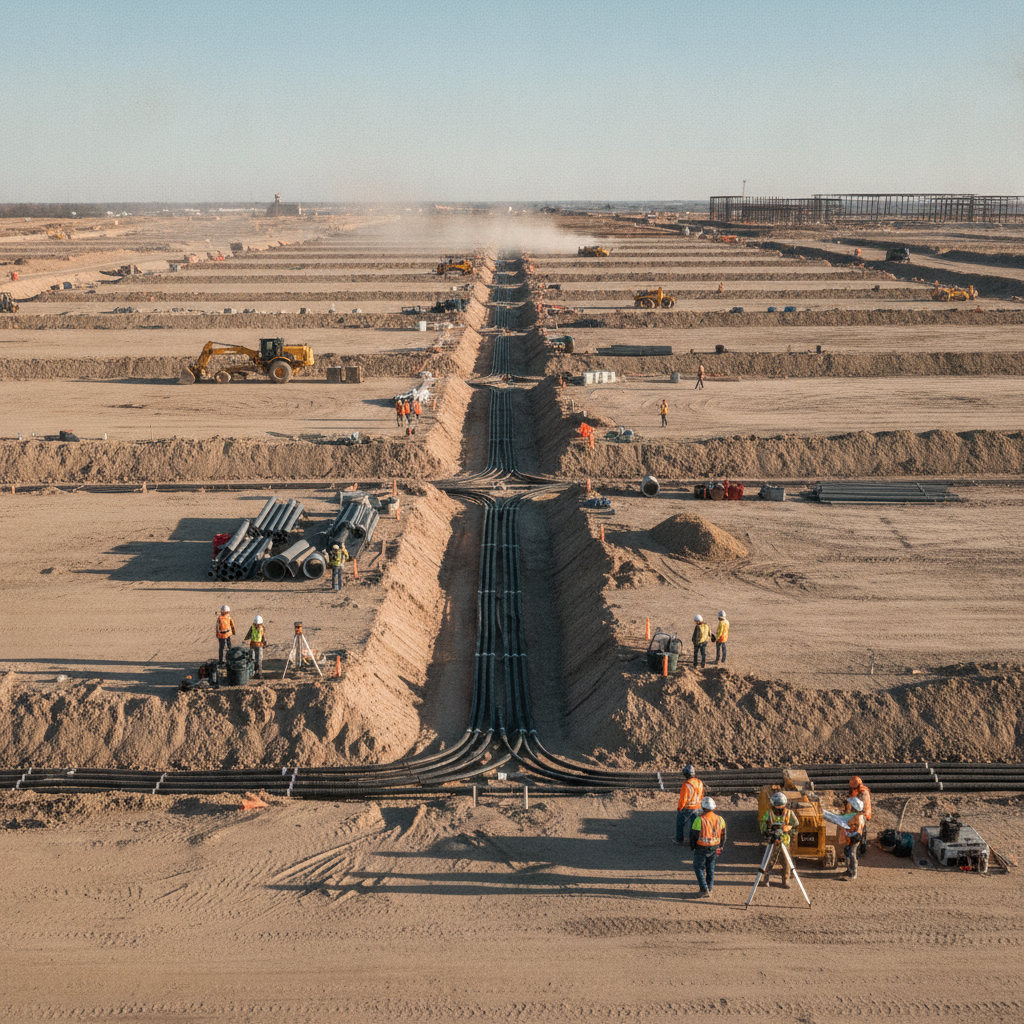
A hyperscale data center is defined by its immense scale and density. These facilities can occupy hundreds of acres, consume hundreds of megawatts of power, and house hundreds of thousands of servers. The civil engineering and site development challenges are correspondingly massive. The design must accommodate not just a single building, but a multi-phase campus build-out over many years, with robust internal circulation, utility corridors, and security perimeters. The engineering approach must account for extreme floor loads, vibration sensitivity for advanced equipment, and the massive thermal load generated by high-density computing. This translates to unique requirements for foundations, structural systems, and, most critically, the mechanical and electrical infrastructure that supports the facility. The land development plan must be flexible enough to adapt to future technology generations while being rigid enough to meet today’s stringent operational requirements.
Power Availability: The Primary Site Selection Constraint
Hyperscale Site Selection Criteria Matrix
| Criterion | Key Engineering Consideration | Risk Factor if Overlooked |
|---|---|---|
| Power Capacity | Proximity to 230kV+ transmission lines; land for dedicated substation; confirmed utility capacity. | Project non-viability; multi-year delays for new transmission infrastructure. |
| Fiber Connectivity | Presence of multiple, diverse long-haul fiber routes from different carriers. | High latency; lack of redundancy; inability to attract anchor tenants. |
| Water Supply & Discharge | Sufficient raw or potable water for cooling; clear pathway for discharge permitting (NPDES). | Inability to support high-density racks; significant operational cost increase; permitting roadblocks. |
| Site Acreage & Topography | 100+ contiguous acres with minimal grade changes to allow for campus layout and expansion. | Massive earthwork costs; constrained campus design; limited future expansion. |
| Geotechnical Conditions | Stable soils with adequate bearing capacity; low seismic and flood risk. | Expensive foundation solutions; long-term structural integrity risks; high insurance costs. |
| Permitting Pathway | Zoning allows for data center use; clear and predictable local and state permitting process. | Significant entitlement risk and project delays; potential for project-killing local opposition. |
For a hyperscale facility, power is the single most important site selection factor. We are not talking about standard commercial service; these projects require hundreds of megawatts, equivalent to the consumption of a small city. The primary consideration is proximity to high-voltage transmission lines and the capacity of the local utility grid to deliver this load reliably. A viable site must have a clear path to securing a dedicated, on-site electrical substation, which itself can require a significant land area. Effective utility coordination must begin at the earliest stages of due diligence. This involves detailed studies with the power provider to confirm available capacity, transmission pathways, and the timeline for delivering service. Redundancy is also non-negotiable, often requiring dual feeds from separate parts of the grid to ensure uptime. Power purchase agreements, utility easements, and interconnection standards vary by jurisdiction, and every project team must confirm the applicable requirements with the local, state, regional, and federal authorities that hold review authority over the site and the utility provider. A failure in power availability analysis can render an otherwise perfect site completely unusable.
Fiber Connectivity and Network Redundancy
A data center is a node on the global network, and its value is directly tied to the quality and diversity of its connectivity. A suitable hyperscale site must be located near multiple long-haul fiber optic routes operated by different carriers. This diversity is crucial for creating redundant, low-latency connections to major internet exchanges and end-users. The physical pathways for these fiber lines must also be protected and diverse, meaning they should enter the site from different directions to avoid a single point of failure, such as an accidental excavation. The civil engineering team is responsible for designing the on-site duct bank and telecommunications infrastructure to support these connections. This includes planning secure and accessible pathways from the property line to the facility’s meet-me rooms. Early utility coordination with telecom providers is essential to verify fiber availability, capacity, and the cost of extending service to the site. A lack of diverse fiber routes can be a deal-breaker for major cloud providers and enterprise clients.
Water Resources for Advanced Cooling Systems
As server density increases, so do cooling requirements. While air cooling is an option in some climates, many hyperscale facilities rely on water-based cooling systems for efficiency, especially for high-performance computing and AI workloads. This can create a demand for millions of gallons of water per day. The site selection process must therefore include a thorough analysis of water availability, including sourcing, water rights, and the capacity of local utility providers to deliver the required volume. Beyond supply, the project must also account for wastewater discharge. The permitting process for industrial water use and discharge can be complex, often involving NPDES permits under the Clean Water Act. The drainage design and stormwater management plan for the site must be integrated with the process water systems to ensure environmental compliance. If a sufficient water source is unavailable, the entire cooling strategy and facility design may need to be re-evaluated, impacting project viability.
Geotechnical and Topographical Suitability
Hyperscale campuses require vast, contiguous, and relatively flat tracts of land to minimize earthwork costs and construction timelines. A site with significant topographical relief can add millions of dollars in site grading and earthmoving expenses. Furthermore, the underlying soil conditions are critical. A thorough Geotechnical Engineering investigation is required to ensure the soil can support the immense weight of the data center structures, their foundations, and heavy equipment like generators and cooling towers. The geotechnical investigation, including extensive soil boring test analysis, will inform the foundation design and identify potential issues like collapsible soils, high water tables, or seismic risks. The civil engineering team uses this data to develop a balanced earthwork plan, aiming to use material excavated from one area as fill in another to reduce the need to import or export soil. Overlooking a critical geotechnical issue can lead to severe structural problems and long-term operational risks.
Zoning, Permitting, and Community Engagement
Even a technically perfect site is worthless without the proper entitlements. The site selection process must include a comprehensive review of local zoning compliance and land use regulations to ensure a data center is a permitted use. If a rezoning or special use permit is required, the project timeline and risk profile increase significantly. Early and transparent engagement with the local planning department and other authorities having jurisdiction is crucial. The permitting pathway for a hyperscale project is multifaceted, involving local site plan approvals, building permits, and often state and federal environmental reviews. Depending on the site’s characteristics, this could include reviews for impacts on wetlands, endangered species, or cultural resources. A proactive strategy for agency review and community outreach can help streamline the process and build local support, which is often vital for a project of this magnitude and impact.
The RSP Engineers Site Selection and Due Diligence Process
At RSP Engineers, we employ a phased approach to de-risk the site selection process for our clients. Our process begins with a high-level screening of potential regions and sites based on primary constraints like power and fiber. We then move into a detailed feasibility study for shortlisted sites. This phase involves deep engagement with utility providers, preliminary site plan design, and a thorough review of regulatory and environmental hurdles. Our due diligence reports provide clients with a clear, data-driven assessment of each site’s viability, potential costs, and development timeline. We model utility corridors, develop conceptual grading and drainage design plans, and identify all required permits. This allows our clients to make informed investment decisions and move into the entitlement and design phases with confidence. Our expertise in large-scale land development ensures that every critical factor is evaluated before significant capital is committed.
Common Challenges in Hyperscale Site Development
Despite careful planning, hyperscale projects can encounter significant challenges. One of the most common is a discrepancy between a utility provider’s initial capacity estimates and their ability to deliver power on schedule. This highlights the need for continuous and detailed utility coordination. Another frequent issue is the discovery of previously unknown environmental constraints, such as jurisdictional wetlands or protected species habitat, which can trigger lengthy federal permitting processes like a Clean Water Act Section 404 permit. Supply chain disruptions for critical electrical equipment, such as transformers and switchgear, can also impact timelines. Finally, local community or political opposition can emerge, especially if the project’s impacts on noise, water, or the electrical grid are not addressed proactively. Successful site development requires a project team that can anticipate these risks and develop contingency plans to keep the project on track. Frequently Asked Questions How much land is typically needed for a hyperscale data center campus? While it varies, a typical hyperscale campus often requires a minimum of 100 to 200 acres to accommodate the initial phase, future expansions, electrical substations, cooling infrastructure, and security buffers. Some of the largest campuses in development exceed 500 acres to support a long-term site development master plan. What is the biggest mistake developers make in early site selection? The most common and costly mistake is underestimating the complexity and timeline of securing high-voltage power. A developer might find a perfect piece of land, only to discover that the necessary power infrastructure will take 3-5 years and millions of dollars to build. Rigorous power availability due diligence is absolutely essential from day one. How early should we engage a civil engineering firm? You should engage a qualified civil engineering firm as soon as you have identified potential regions or specific properties. Early involvement allows the engineering team to conduct fatal-flaw analyses, initiate critical conversations with utility providers, and assess permitting feasibility before you invest significant resources in a site that may not be viable. What role does transportation and access play? Transportation is a key supporting factor. The site needs robust road access capable of handling heavy haul trucks delivering oversized equipment like generators and cooling modules during construction. It also requires reliable all-weather access for staff and fuel deliveries during operations. The roadway engineering analysis ensures the site can be built and operated efficiently. Can an existing industrial site be repurposed for a hyperscale data center? It’s possible, but often challenging. A brownfield site may have existing zoning and some infrastructure, but it rarely has the specific power and fiber capacity required for a hyperscale user. A full site development analysis is required to determine if the cost of retrofitting the site—including potential environmental remediation and utility upgrades—is more effective than developing a greenfield site.
Your Partner in Mission-Critical Site Development
Navigating the complexities of hyperscale site selection requires a partner with deep expertise in large-scale land development, intricate utility coordination, and complex entitlement processes. RSP Engineers provides the comprehensive civil engineering services needed to identify, evaluate, and develop premier sites for mission-critical facilities across the nation. From initial feasibility studies and due diligence to final permit submittals and construction administration, our team is dedicated to ensuring your project is built on a solid foundation. Contact us to discuss how we can support your next data center development.
Conclusion: Building the Foundation for the Digital Future
The site selection process for a hyperscale data center is a complex, high-stakes endeavor that sets the stage for the entire project. Success depends on a holistic approach that balances the critical requirements of power, fiber, water, and land with the practical realities of permitting and construction. By partnering with an experienced civil engineering firm, developers can mitigate risk, optimize their investment, and build the resilient infrastructure needed to power the digital economy. A data-driven site selection strategy is the essential first step toward a successful outcome.
FAQs
-
Data Center Site Selection for Hyperscale Facilities requires careful planning, qualified engineering, and compliance with the applicable codes and permits.
-
Getting Data Center Site Selection for Hyperscale Facilities right protects safety, supports regulatory compliance, and avoids costly redesigns or delays.
-
RSP Engineers provides licensed expertise and end-to-end support for Data Center Site Selection for Hyperscale Facilities, from early planning through permitting.