How to Address ADA Site Access in Florida Plans
Accessibility is more than a design requirement — it’s a legal and ethical obligation for every Florida development.
Under the Americans with Disabilities Act (ADA) and the Florida Accessibility Code, civil engineers play a key role in ensuring that all sites provide safe, compliant, and convenient access for all users.
This article explains how engineers integrate ADA requirements into site grading, walkways, ramps, and parking layouts to achieve full code compliance.
Why ADA Compliance Matters
Non-compliance with ADA site access standards can delay permits, trigger fines, or even halt construction.
In Florida, accessibility is regulated by both federal ADA standards (2010 ADA Standards for Accessible Design) and Florida Building Code – Accessibility (7th Edition, 2023).
These standards cover every aspect of exterior site design — from sidewalks to curb ramps and accessible parking.
For related site design elements, see:
Engineering Requirements for Single-Family vs. Multifamily Projects.
Key ADA Site Access Design Requirements
| Element | Requirement | Typical Engineering Considerations |
|---|---|---|
| Accessible Route | Continuous, unobstructed path from public right-of-way to building entrance. | Minimum 36” width, maximum 5% running slope, 2% cross slope. |
| Curb Ramps | Required where accessible routes cross curbs. | Max slope 1:12, detectable warning surface, minimum 4’ landing. |
| Accessible Parking | Spaces must connect to accessible route and meet dimensional standards. | 8’ min width, 5’ access aisle, firm and slip-resistant pavement. |
| Signage & Markings | Must display International Symbol of Accessibility (ISA). | Signs at least 60” above grade; pavement striping in blue/white. |
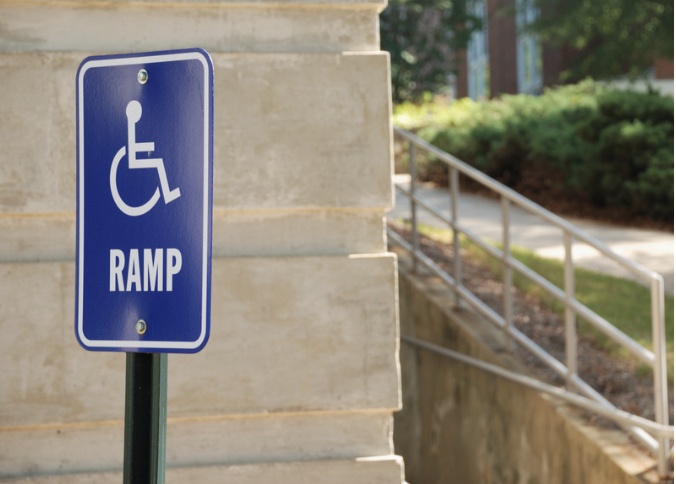
| Ramps | When slope exceeds 1:20, a ramp is required. | Max slope 1:12, 36” clear width, 60” landings at top and bottom. |
| Handrails | Required for ramps with rise > 6”. | 34–38” height, continuous gripping surface, 12” extensions. |
ADA in Civil Site Design
Civil engineers integrate ADA accessibility from the earliest grading plan stage, ensuring that slopes and elevations allow for compliant routes to every entrance, parking area, and amenity.
Key tasks include:
Designing sidewalk grades under 5% for accessible routes.
Verifying cross slopes under 2% on sidewalks and landings.
Coordinating elevations between curb ramps and parking stalls.
Selecting paving materials with proper slip resistance.
Ensuring stormwater inlets do not obstruct pedestrian pathways.
For drainage-related coordination, see:
Preparing a Drainage Statement for Miami-Dade.
Common ADA Design Mistakes
Slopes exceeding 5% along accessible routes (requiring ramps).
Missing or incorrectly placed truncated domes on curb ramps.
Uneven or ponded areas along pedestrian paths.
Incorrect parking stall grades (over 2% cross slope).
Misalignment between civil, architectural, and landscape plans.
A quick coordination review between disciplines often resolves these issues before permit submission.
ADA Requirements for Parking Lots
At least one accessible space per 25 total spaces.
Van-accessible space required for every 6 accessible spaces.
Spaces must be on the shortest accessible route to the entrance.
Surfaces must be stable, firm, and slip-resistant — asphalt or concrete preferred.
Engineers should also ensure the accessible aisle drains away from the building, avoiding puddling.
ADA Review During Permitting
In Florida, local building departments verify ADA compliance during plan review and site inspection.
Municipal reviewers check:
Grading plan slopes and contours.
Pavement and sidewalk details.
Ramp cross sections and elevations.
Accessible signage and striping layout.
For multi-jurisdictional projects, both local and state ADA compliance may apply.
Conclusion
ADA compliance starts at the engineering stage. Proper slopes, routes, and details make the difference between a compliant site and a costly redesign.
At RSP Engineers, we incorporate ADA standards into every Florida site plan — ensuring safe, accessible, and code-compliant site access for all users.
FAQs
-
5% for walkways; ramps require 1:12 slope with landings.
-
Yes — at all curb ramp transitions to vehicular ways.
-
Yes — all new construction and major renovations must comply.
-
Local building departments under the Florida Building Code – Accessibility.
Partnering With Florida Developers for Accessible Site Design
At RSP Engineers, we help ensure your site meets ADA and Florida Accessibility Code requirements through precise grading, layout design, and permitting coordination.