
What Makes Land Suitable for a Data Center Campus?
A guide to the essential civil engineering, utility, and regulatory factors for data center site selection, including power, fiber, water, zoning, and geotechnical needs.
Foundational Site Geometry and Topography
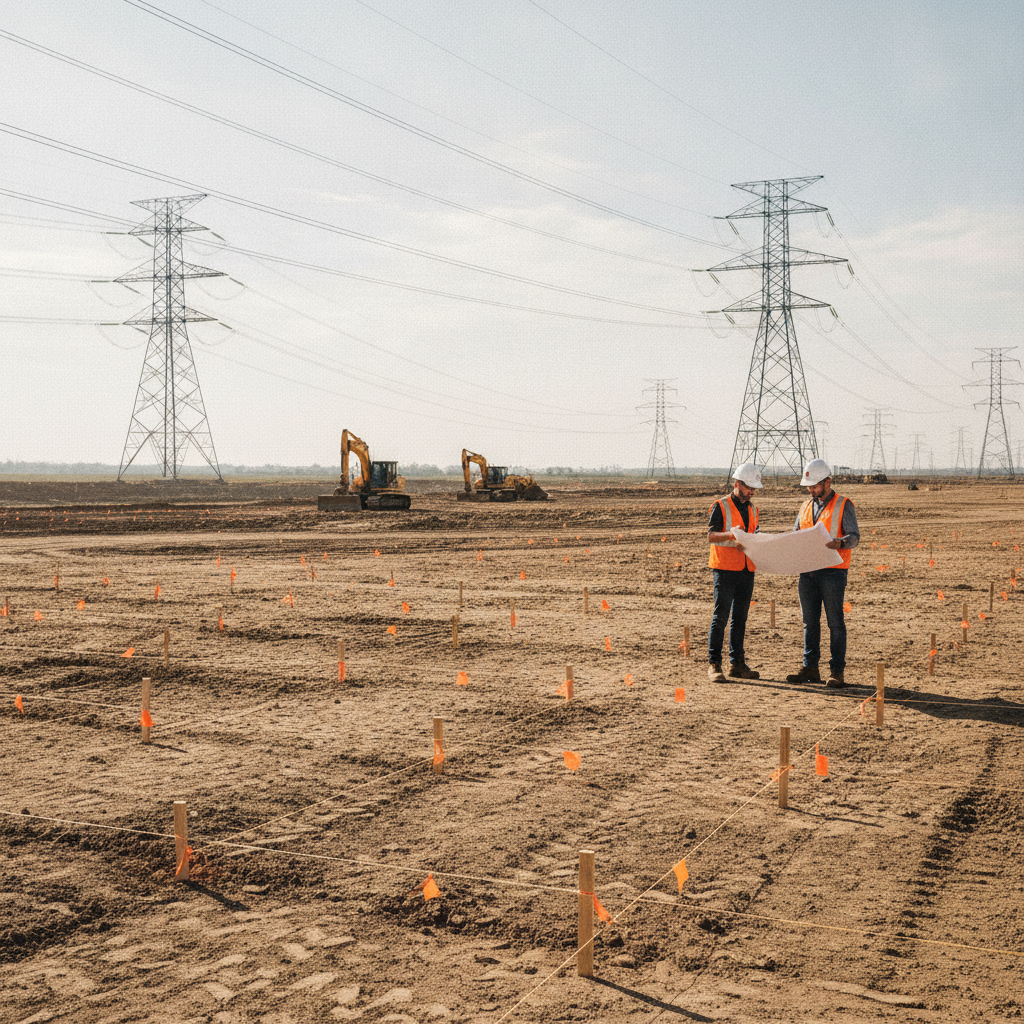
Before evaluating power or fiber, the fundamental physical attributes of the land must be considered. Data center campuses require large, contiguous tracts of land, often 50 to 100 acres or more, to accommodate the main facility, cooling infrastructure, electrical substations, and future expansion phases. The ideal parcel is a simple, rectangular shape, which maximizes usable area and simplifies site plan design and security perimeter planning. Irregularly shaped parcels can create inefficiencies and increase construction complexity. Topography is another critical factor. A relatively flat site is highly desirable as it minimizes the need for extensive earthwork and grading. Significant elevation changes across a property can dramatically increase site development costs, complicate foundation design, and extend construction timelines. A thorough topographic survey is one of the first steps in evaluating a site’s physical viability, allowing engineers to quantify the required cut-and-fill and identify potential grading challenges early in the process.
Geotechnical and Environmental Due Diligence
Data Center Site Suitability Matrix
| Attribute | Ideal Conditions | Challenging Conditions |
|---|---|---|
| Power Availability | Adjacent to redundant high-voltage transmission lines; clear path for new substation. | Significant distance from transmission lines; complex easement acquisition required. |
| Fiber Connectivity | On-net or near-net with multiple, diverse long-haul fiber providers. | Miles from the nearest fiber route, requiring expensive lateral builds. |
| Water/Sewer Capacity | Existing large-diameter water and sewer mains at the property line with confirmed capacity. | No existing service; requires major off-site extensions and system upgrades. |
| Site Acreage & Shape | 100+ contiguous acres in a regular, rectangular shape with minimal topographic relief. | Small or irregularly shaped parcels; significant slopes requiring major earthwork. |
| Zoning Designation | Zoned for industrial or data center use by-right. | Requires rezoning, a conditional use permit, or variance with potential for public opposition. |
| Geotechnical Profile | Soils with high bearing capacity; deep groundwater table and no shallow rock. | Poor soils requiring deep foundations; shallow rock complicating excavation. |
| Environmental | No jurisdictional wetlands, protected species habitat, or historical contamination. | Presence of wetlands or endangered species habitat requiring extensive permitting and mitigation. |
What lies beneath the surface is just as important as what is visible. A comprehensive Geotechnical Engineering investigation is non-negotiable. This involves performing a Soil Test and soil borings to determine the soil’s load-bearing capacity, identify the depth to groundwater, and check for the presence of rock. Poor soil conditions can necessitate expensive deep foundation systems, while shallow rock can make utility trenching and foundation excavation prohibitively expensive. The findings are compiled into a Geotechnical soil report, a critical document for structural and civil design. Simultaneously, environmental due diligence is essential for identifying potential liabilities and permitting hurdles. This begins with a Phase I Environmental Site Assessment (ESA) to check for historical contamination. It also includes a thorough evaluation for jurisdictional wetlands, streams, and potential habitats for threatened or endangered species. Discovering these features late in the process can trigger lengthy and complex permitting requirements under federal programs like the Clean Water Act, potentially derailing a project schedule. A proactive approach to environmental compliance is key to mitigating risk.
The ‘Big Three’ Utilities: Power, Fiber, and Water
Data centers are defined by their immense consumption of power and data. The availability of robust, redundant utility infrastructure is often the primary driver of site selection. A viable site must have direct access to high-voltage transmission lines from one or more utility providers to ensure reliability. The cost and timeline for building a new electrical substation and extending power to the site are major project components that require extensive utility coordination and planning. Equally important is fiber optic connectivity. A premier data center site must be located near multiple, diverse, long-haul fiber routes from different carriers. This network diversity provides redundancy and ensures low-latency connections, which are critical for performance. Proximity to these networks minimizes the high cost of lateral fiber construction. Finally, water and sewer capacity must be confirmed. While some modern data centers use closed-loop cooling, many still require a significant water supply for cooling towers. All facilities require adequate water and sanitary sewer service for operational and employee needs.
Stormwater Management and Drainage Infrastructure
A data center campus creates vast expanses of impervious surfaces, including massive rooftops and extensive pavement for service roads and parking. This significantly increases the volume and rate of stormwater runoff, which must be managed in compliance with local, state, and federal regulations. The civil engineering design must incorporate a robust stormwater management system, typically involving large detention or retention ponds, to collect runoff and release it at a controlled rate. A critical component of the site analysis is identifying a viable outfall—a point where the managed stormwater can be legally and effectively discharged, such as a public storm sewer system, a large ditch, or a natural water body. The capacity of the downstream system is a crucial consideration. Furthermore, the site must be evaluated for flood risk using FEMA floodplain maps. Development within a designated floodplain introduces significant design constraints, regulatory hurdles, and potential increases in insurance costs, making such sites far less desirable for mission-critical facilities.
Zoning, Permitting, and the Regulatory Pathway
A site may have perfect topography and utility access, but it is unbuildable without the proper zoning and entitlements. The ideal site is already zoned for industrial or a similar use that explicitly permits data centers by right. If a rezoning or special use permit is required, the project timeline can be extended by months or even years, introducing significant uncertainty. A thorough analysis of the local zoning ordinance and comprehensive plan is a critical first step. Permitting requirements vary by jurisdiction, and every project team should confirm the applicable standards with the local, state, regional, and federal authorities that hold review authority over the site. The permitting process involves a series of detailed submittals and reviews by multiple government agencies. This includes site plan review, building permits, environmental permits, and utility connection approvals. Engaging with a civil engineering firm near me that has experience navigating the specific agency review processes is crucial for developing a realistic project schedule and avoiding costly delays. Understanding the political climate and potential for community opposition is also a key part of the due diligence process.
RSP Engineers’ Site Selection and Due Diligence Process
At RSP Engineers, we employ a phased approach to help clients de-risk the site selection process. Our methodology is designed to identify fatal flaws early, before significant capital is invested. We work with some of the best Civil Engineering firms and professionals to deliver comprehensive results. Our process begins with a high-level desktop analysis, using GIS data, utility maps, and regulatory information to screen multiple potential sites against the client’s core criteria. Promising sites then move to a detailed feasibility study, which includes preliminary engineering concepts, initial agency consultations, and a more granular assessment of utility extension costs and timelines. For the final candidate sites, we provide full due diligence support, managing geotechnical investigations, environmental assessments, ALTA surveys, and the initial stages of the entitlement process. This structured approach provides the clarity and confidence needed to make informed acquisition decisions.
Common Pitfalls in Data Center Site Selection
Even sophisticated developers can encounter pitfalls when evaluating land for data centers. One of the most common is underestimating the timeline and cost of utility upgrades. Securing easements and constructing new substations or fiber routes can take years and cost millions, so early and direct engagement with utility providers is essential. Another frequent issue is discovering a fatal flaw—such as unexpected rock, wetland constraints, or insurmountable zoning opposition—after the land is already under contract. This highlights the importance of a thorough due-telligence period. Developers must also plan for future expansion. A site that can only accommodate the first phase of development is a strategic dead end. The civil engineering and master planning effort should account for the ultimate campus build-out from day one. Finally, failing to understand the local political and community landscape can lead to unexpected opposition during public hearings, jeopardizing the entire permitting process. Proactive community outreach and a clear articulation of the project’s benefits are key components of a successful entitlement strategy. Frequently Asked Questions How much land is needed for a typical data center campus? While a single data center can sometimes fit on 10-20 acres, a modern, multi-building campus often requires 50 to 200 acres or more. This provides space for the data halls, cooling infrastructure, on-site substation, security buffers, stormwater management facilities, and critical room for future expansion. What is the most common ‘deal-breaker’ in data center site selection? The lack of adequate power is the most frequent and definitive deal-breaker. If a site does not have access to sufficient high-voltage power with a clear path for redundancy, it is simply not viable for a large-scale data center, regardless of its other positive attributes. Fiber connectivity is a close second. How long does the site selection and permitting process typically take? This varies widely, but it’s a lengthy process. The initial site identification and due diligence can take 3-6 months. The subsequent zoning compliance and full entitlement/permitting process can take anywhere from 6 to 18 months, or even longer in complex regulatory environments, before construction can begin. What is a Geotechnical soil report and why is it critical? A Geotechnical soil report is a comprehensive document prepared by a Geotechnical engineer after conducting a subsurface investigation, including soil borings. It details soil types, strength, density, depth to rock, and groundwater levels. This report is critical for the structural engineer to design the building’s foundation and for the civil engineering team to design grading, pavements, and underground utilities.
Your Partner in Mission-Critical Site Development
Navigating the complexities of data center site selection requires a multidisciplinary team of experts. RSP Engineers provides the critical civil engineering, permitting, and land development expertise needed to transform a raw piece of land into a fully entitled, construction-ready site. Our team excels at conducting thorough due diligence, coordinating with utility providers, and guiding projects through complex regulatory approvals. We help clients identify the best sites, mitigate risks, and accelerate their speed-to-market.
Conclusion
Selecting the right land is the foundation of a successful data center project. The ideal site possesses a rare combination of favorable physical geography, robust and redundant utility infrastructure, and a clear and predictable regulatory pathway. A comprehensive evaluation of topography, geotechnical conditions, power, fiber, water, drainage, and zoning is not optional—it is essential for mitigating risk and ensuring project viability. Partnering with an experienced civil engineering team from the outset is the most effective way to navigate the complexities of site development and secure the right location for your next mission-critical investment.
FAQs
-
What Makes Land Suitable for a Data Center Campus? requires careful planning, qualified engineering, and compliance with the applicable codes and permits.
-
Getting What Makes Land Suitable for a Data Center Campus? right protects safety, supports regulatory compliance, and avoids costly redesigns or delays.
-
RSP Engineers provides licensed expertise and end-to-end support for What Makes Land Suitable for a Data Center Campus?, from early planning through permitting.