
Virginia Data Center Piedmont Soils
A technical guide for data center developers on the challenges of Virginia’s Piedmont soils, including saprolite, pinnacled rock, and micaceous soils. Learn foundation strategies.
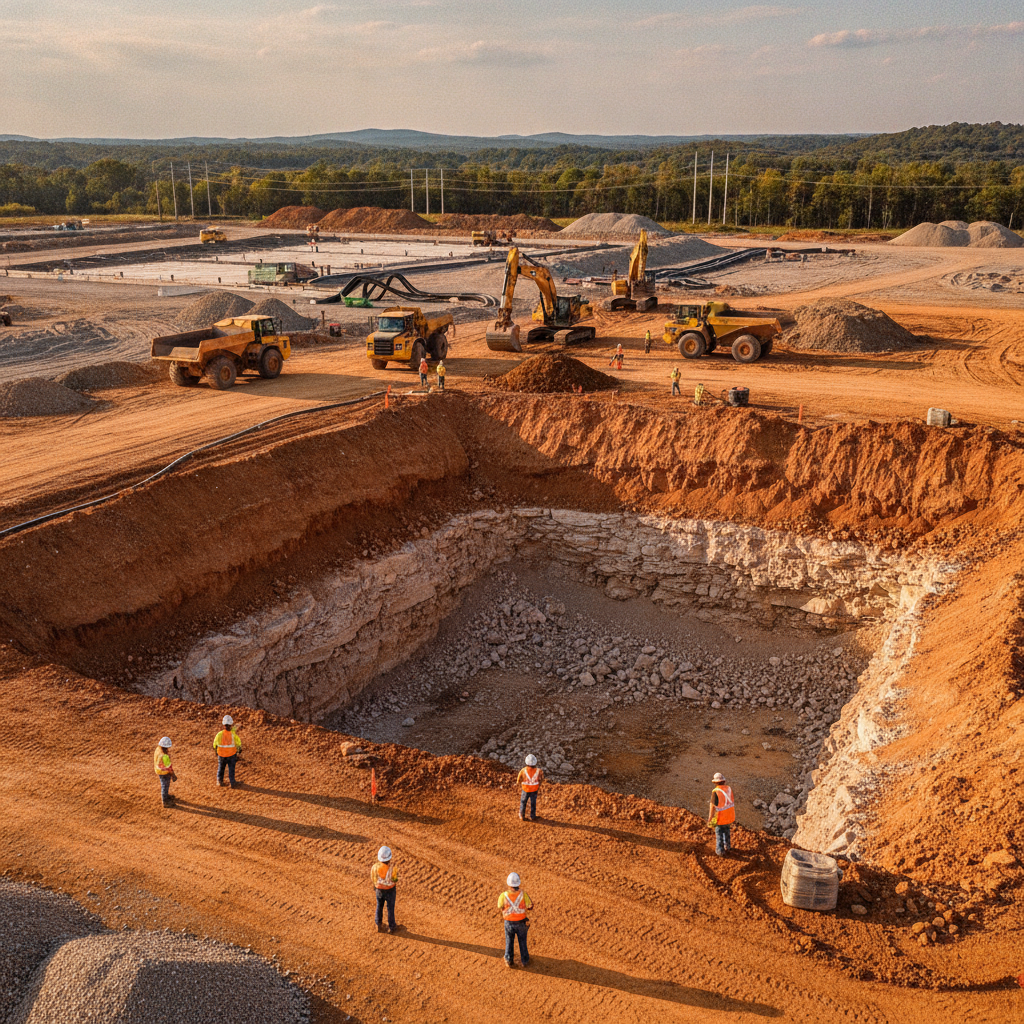
The Piedmont Geologic Profile: Residual Soils and Saprolite
The defining characteristic of the Piedmont physiographic province is its soil, which is primarily residual soil formed by the in-place chemical weathering of the underlying crystalline bedrock like gneiss, schist, and granite. This weathered material, known as saprolite, retains some of the structure and fabric of the parent rock but has the consistency and engineering properties of soil. It can extend to depths of over 100 feet, creating a complex transitional profile from soil to weathered rock to competent bedrock. This variability is the core challenge. Within a single data center pad, the depth, density, and strength of the saprolite can change dramatically. This requires a comprehensive Geotechnical Engineering investigation far beyond a simple grid of borings. Understanding the parent rock type is crucial, as it dictates the nature of the overlying saprolite and informs the entire site development strategy, from grading to foundation design.
The “Top of Rock” Problem: Pinnacled and Weathered Bedrock
Foundation Approach Suitability on Piedmont Sites
| Foundation Type | Ideal Subsurface Condition | Key Challenge in Piedmont Soils | Cost & Schedule Impact |
|---|---|---|---|
| Shallow Spread Footings | Consistent, high-bearing capacity soil at shallow depth. | High risk of differential settlement due to variable saprolite and pinnacled rock. | Lowest cost if feasible, but rarely suitable for entire footprint without ground improvement. |
| Mat Foundation | Moderately consistent soils where loads can be spread over a large area. | Can help bridge over minor variations but is still vulnerable to large-scale differential settlement from deep troughs or rock pinnacles. | Moderate to high initial cost; can reduce risk but may not eliminate it. |
| Drilled Piers (Caissons) | Competent bedrock is reachable, but too deep or variable for shallow foundations. | Excavation can be complicated by boulders, groundwater, and casing requirements in unstable soil. Requires specialized equipment. | High cost; schedule is sensitive to drilling conditions and rock depth. |
| Micropiles | Highly variable conditions, restricted access, or need to penetrate boulders/rock. | Can be an effective solution for pinnacled rock, but requires many individual installations. Load testing is critical. | Very high cost per unit, but offers design flexibility. Can have significant schedule impact. |
| Undercutting & Engineered Fill | Unsuitable or variable soils exist within a practical excavation depth (e.g., 10-20 feet). | Requires large volumes of earthwork and sourcing of suitable, non-micaceous fill material. Compaction control is critical. | High cost related to earthwork volume and material import; can extend grading schedule. |
Perhaps the most notorious feature of the Piedmont is the extremely erratic bedrock surface. The weathering process does not occur uniformly, resulting in a “pinnacled” top of rock, where sharp peaks of hard rock can sit adjacent to deep troughs of weathered saprolite. This creates significant risks for mass grading operations and foundation design. A building pad graded flat at the surface can have foundation elements bearing on solid rock at one column and on 50 feet of compressible soil just a few yards away. This condition is a primary driver of differential settlement, which is unacceptable for the massive, heavily loaded structures of data centers. Accurately mapping this unpredictable surface requires a dense pattern of soil boring test locations, often supplemented with geophysical methods. Failure to adequately characterize the top of rock can lead to costly change orders for unexpected rock excavation and foundation redesigns during construction.
Micaceous Soils and Their Impact on Settlement and Compaction
Many of the parent rocks in the Virginia Piedmont, particularly schists, are rich in mica. As these rocks weather, the resulting saprolite contains a high percentage of fine mica flakes. These micaceous soils are notoriously difficult to work with from a geotechnical perspective. The flat, plate-like shape of mica particles makes achieving adequate compaction during grading a significant challenge. Standard Proctor test results can be misleading, and the soil may exhibit elastic or “spongy” behavior under compaction equipment. Furthermore, even when compacted, micaceous soils are prone to long-term secondary compression and settlement under sustained loads. For a data center with heavy equipment and stringent floor levelness requirements, this poses a serious serviceability risk. Mitigating this often requires specialized ground improvement techniques or removing the problematic soil and replacing it with select engineered fill, impacting both the project budget and schedule. A detailed geotechnical soil report is essential to identify these materials early.
Rippability, Blasting, and the Economics of Rock Excavation
The transition from soil to rock in the Piedmont is rarely a distinct line. Instead, there is a gradient from saprolite to weathered rock to sound bedrock. The ability to excavate this material efficiently is a major cost factor. The term rippability refers to the capacity of a large dozer equipped with a single shank ripper to mechanically break up the rock without blasting. This is heavily dependent on the rock’s hardness, fracture spacing, and degree of weathering. Determining the likely volume of rippable rock versus rock requiring blasting is a critical part of the pre-construction analysis. Blasting introduces significant costs, permitting requirements, vibration monitoring, and schedule complexities. An experienced Geotechnical engineer uses data from borings, rock core samples, and sometimes seismic refraction surveys to estimate the quantities of earthwork, rippable rock, and mass rock excavation, allowing for more accurate bidding and financial planning.
Foundation Strategies for Variable Subsurface Conditions
Given the erratic subsurface, foundation design for data centers in the Piedmont must be robust and adaptable. There is no one-size-fits-all solution. Shallow foundations, such as conventional spread footings or a large mat foundation, may be feasible if the saprolite is consistently dense and the top of rock is relatively deep and uniform across the building footprint. However, this is often not the case. Where pinnacled rock and compressible soils are present, deep foundations are frequently required to transfer the massive structural loads to competent bearing material. Options include drilled piers (caissons) socketed into bedrock or high-capacity micropiles. Another common strategy is over-excavation or undercutting, where variable or unsuitable soils are removed from beneath the building pad and replaced with compacted, engineered fill to create a uniform structural base. The choice depends on a careful cost-benefit analysis informed by a thorough geotechnical investigation.
Stormwater Management and Erosion Control in Piedmont Clays
Beyond foundations, the fine-grained nature of Piedmont soils presents challenges for stormwater management. The clay and silt-rich saprolite generally has low permeability, limiting the effectiveness of infiltration-based stormwater solutions. This often necessitates the design of large surface detention or retention basins to manage runoff from the vast, impervious surfaces of data center roofs and parking lots. The drainage design must account for these soil properties to meet local and state water quality and quantity control regulations. During construction, these same soils are highly susceptible to erosion. A robust erosion and sediment control plan is not just a permitting requirement; it’s a critical component of site management. Without aggressive measures like silt fences, sediment traps, and temporary ground cover, significant soil loss can occur, leading to environmental compliance issues and impacting downstream properties. This is a key focus area for any civil engineering firm near me working on these large sites.
RSP’s Approach to Geotechnical Risk Mitigation
At RSP Engineers, we address the complexities of Piedmont sites with a proactive, risk-based approach. Our process begins long before detailed design, often during the due diligence phase. We start with a desktop analysis of geologic maps and existing data to identify potential red flags. This informs the scope for a phased Geotechnical Engineering investigation, designed to systematically uncover and map the site’s specific subsurface challenges. We advocate for a higher density of borings and rock cores than might be typical elsewhere to properly define the top of rock. Throughout the site plan design process, our Civil Engineers work in close collaboration with the geotechnical and structural teams. This integrated approach ensures that the grading plan, utility layouts, and foundation design are developed in concert, not in silos. By identifying areas of deep rock, shallow pinnacles, or problematic micaceous soils early, we can value-engineer solutions—such as slight shifts in building location or alternative foundation systems—that mitigate risk and provide cost and schedule certainty for our clients.
Common Pitfalls in Piedmont Data Center Site Development
Even with careful planning, Piedmont sites can present surprises. One of the most common issues is underestimating the quantity of rock excavation, which can lead to major budget overruns. Another frequent challenge is managing groundwater, which often seeps at the interface between the soil and the less permeable bedrock, complicating excavations and potentially affecting foundation construction. We also see issues with differential settlement appearing after construction, impacting sensitive equipment alignments and requiring costly remediation. Utility trenching can also be a hidden challenge; a trench that is easily dug in soil can abruptly encounter a rock pinnacle, requiring blasting or hoe-ramming and causing significant delays. Proactive planning by experienced site engineering services is the best defense against these common pitfalls, turning potential disasters into manageable construction items. Frequently Asked Questions What is saprolite and why is it a major concern for data centers? Saprolite is a residual soil formed from the in-place weathering of rock, common in the Virginia Piedmont. It’s a concern because its engineering properties, like density and strength, can be extremely variable over short distances. This variability can lead to differential settlement, which is a critical risk for the massive, rigid structures of data centers that house sensitive equipment. How many soil borings are needed for a data center site in the Piedmont? There is no magic number, but the density of borings must be significantly higher than on a geologically uniform site. A preliminary investigation might use a 200-foot grid, but the final design for the building pad and critical infrastructure often requires a much tighter grid, perhaps 50 to 75 feet on-center, with additional borings at each column location to accurately map the highly variable top of rock. Can we avoid rock blasting entirely on a Piedmont site? It is sometimes possible through careful site selection and a grading design that balances cut and fill to minimize deep cuts. However, on many sites, encountering rock that is not rippable is unavoidable, especially for deep utility trenches or basements. The goal of the Geotechnical Engineering investigation is to predict the quantities and locations of non-rippable rock so that blasting can be planned and budgeted for, rather than becoming a surprise. What is the biggest unexpected cost driver on these projects? Unexpected rock excavation and the need to change foundation strategies mid-construction are typically the largest sources of unforeseen costs. This is followed closely by issues related to unsuitable fill materials, such as highly micaceous soils, which may require removal and replacement with more expensive engineered fill. How does groundwater affect foundation design in the Piedmont? Groundwater often perches on top of the less permeable bedrock, creating a saturated zone at the soil-rock interface. This can destabilize excavations for foundations and utilities, requiring dewatering systems. For deep foundations like drilled piers, groundwater can complicate the drilling process and require the use of temporary casing, increasing costs and construction time. Why is a standard Soil Test not enough for these projects? A standard Soil Test might identify soil types, but it’s insufficient for the Piedmont’s complexity. A comprehensive investigation for a data center requires a detailed geotechnical soil report that includes extensive soil borings, rock coring to assess quality and rippability, laboratory testing for properties like mica content and compressibility, and a thorough analysis to create a subsurface model that informs the entire civil and structural design.
Partner with RSP Engineers for Your Mission-Critical Project
The success of a data center development in Virginia’s Piedmont region is directly tied to the quality of the upfront site investigation and engineering design. Navigating the challenges of pinnacled rock, micaceous soils, and variable saprolite requires a team with deep expertise. RSP Engineers provides the comprehensive site engineering services needed to de-risk your project. We coordinate the in-depth Geotechnical Engineering investigation, integrate the findings into a cost-effective site plan design, and provide expert Construction Management Services to ensure your project stays on schedule and on budget. Don’t let subsurface surprises dictate your project’s outcome. Contact us today to discuss your site development needs.
Conclusion
Developing data centers on Virginia’s Piedmont soils is a complex undertaking, but it is not an insurmountable one. The keys to success are acknowledging the inherent risks and investing in a thorough, upfront Geotechnical Engineering investigation. By understanding the nature of the saprolite, accurately mapping the top of rock, and planning for challenging materials and excavation conditions, developers can mitigate the primary sources of budget and schedule overruns. An integrated design process, led by experienced Civil Engineers who understand these unique conditions, transforms a high-risk site into a predictable and successful mission-critical facility.
FAQs
-
Virginia Data Center Piedmont Soils requires careful planning, qualified engineering, and compliance with the applicable codes and permits.
-
Getting Virginia Data Center Piedmont Soils right protects safety, supports regulatory compliance, and avoids costly redesigns or delays.
-
RSP Engineers provides licensed expertise and end-to-end support for Virginia Data Center Piedmont Soils, from early planning through permitting.