
Data Center Coastal Soil Conditions
A guide for data center developers on navigating Florida’s coastal soil challenges, including soft clays, liquefaction risk, and high groundwater. Learn about geotechnical solutions.
The Critical Role of Geotechnical Due Diligence
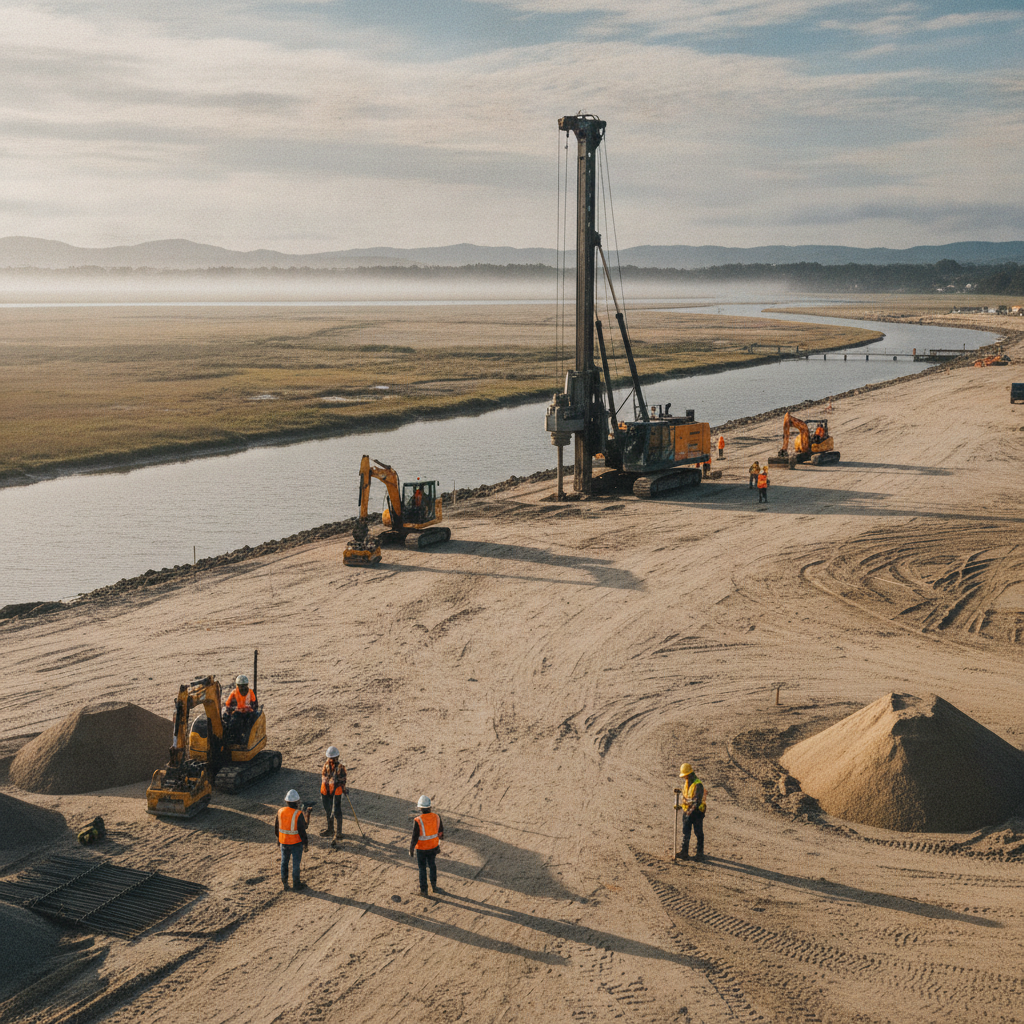
For a mission-critical facility like a data center, the geotechnical investigation is not a preliminary step; it is the foundational pillar of the entire project. The immense weight of server racks, cooling systems, and backup power infrastructure demands a subsurface that provides uniform and predictable support. Any degree of differential settlement can compromise sensitive fiber optic connections, crack concrete slabs, and misalign critical equipment, leading to costly downtime. This is why a comprehensive investigation, led by a qualified Geotechnical engineer, is non-negotiable. The process begins with a thorough review of existing geological data and historical site use, but quickly moves to a detailed subsurface exploration program. This involves conducting a series of soil boring tests across the proposed footprint to collect samples at various depths. These samples undergo laboratory analysis to determine key engineering properties like shear strength, compressibility, and permeability. The resulting geotechnical soil report provides the essential data that informs all subsequent site plan design, foundation engineering, and even stormwater management strategies.
Unpacking Florida’s Coastal Soil Profile: Soft Clays and Organics
Comparison of Ground Improvement and Foundation Strategies
| Strategy | Primary Application | Key Considerations | Relative Cost |
|---|---|---|---|
| Deep Foundations (Piles) | Transferring loads through weak soils to a competent bearing layer deep underground. | Effective for very poor soils (organics, deep clays). High reliability. Requires specialized equipment. | High |
| Surcharge with Wick Drains | Consolidating soft clays and silts by placing a temporary soil load and accelerating water removal. | Requires significant time (months) for settlement to occur. Best for large, open sites. | Medium |
| Vibro-Compaction / Stone Columns | Densifying loose granular soils (sands) or reinforcing weak cohesive soils. | Improves bearing capacity and mitigates liquefaction risk. Ground vibration can impact adjacent structures. | Medium-High |
| Rapid Impact Compaction (RIC) | Densifying shallow granular soils (up to 20 feet deep) using a hydraulic hammer. | Faster than surcharging. Effective for hydraulic fill and loose sands. | Medium |
| Shallow Foundations with Soil Removal | Excavating and replacing unsuitable soils with engineered fill for use with conventional foundations. | Only feasible if weak soil layers are relatively shallow (less than 10-15 feet). | Low-Medium |
Many of Florida’s coastal areas are characterized by geologically young soil deposits, including soft marine clays and highly compressible organic soils like peat and muck. These materials are problematic for heavy structures due to their low shear strength and high moisture content. When subjected to the significant loads of a data center, they tend to consolidate over time, leading to substantial and often unpredictable long-term settlement. This behavior poses a direct threat to the stringent stability requirements of the facility. Identifying the depth and extent of these weak soil layers is a primary objective of the geotechnical investigation. The presence of thick layers of organic material or soft clay often disqualifies the use of conventional shallow foundations. The civil engineering team must then evaluate more robust solutions, which can significantly impact the project’s budget and timeline. Ignoring these weak soils is not an option, as it will inevitably lead to structural distress and operational failure.
Managing High and Saline Groundwater Tables
A defining feature of coastal Florida is a pervasively high groundwater table, often just a few feet below the surface. This presents immediate challenges during construction, requiring extensive dewatering systems to keep excavations dry for foundation and utility installation. A high water table also exerts hydrostatic uplift pressure on subsurface structures, which must be accounted for in the structural design. The drainage design for the site must also be carefully considered, as high groundwater limits the effectiveness of traditional infiltration-based stormwater systems. Furthermore, coastal groundwater is often saline, introducing a significant corrosion risk. The chlorides in saltwater aggressively attack buried steel elements, such as rebar in concrete foundations, and metallic utilities. This necessitates the use of corrosion-resistant materials, specialized concrete mix designs with lower permeability, and protective coatings. Proper utility coordination is essential to ensure that all buried infrastructure is specified to withstand this harsh subterranean environment for the life of the facility.
The Hidden Risk of Liquefiable Sands and Hydraulic Fill
Beneath the surface of many coastal sites lie layers of loose, saturated sand. Under certain conditions, such as vibrations from construction equipment or seismic activity, these soils can experience soil liquefaction. This phenomenon causes the soil to lose its strength and behave like a liquid, resulting in a sudden and catastrophic loss of foundation support. Identifying liquefiable soil layers is a critical safety and risk-management task during the geotechnical analysis. Compounding this risk is the common presence of dredged or hydraulic fill material. Many coastal areas were created or expanded by dredging material from adjacent water bodies and placing it to raise elevations. This fill is often poorly compacted and highly variable, containing a mix of sand, silt, and shell fragments. Its unpredictable engineering properties make it unsuitable for supporting heavy structures without significant ground improvement, requiring specialized site engineering services to remediate.
Integrating Stormwater Management with Difficult Soils
The challenges of coastal soils extend directly to stormwater management, a critical component of any Florida land development project. The low permeability of marine clays and the high groundwater table severely restrict the use of infiltration-based Best Management Practices (BMPs) like swales and percolation ponds. Water simply cannot soak into the ground effectively, forcing a different approach to drainage design. As a result, designs often rely on lined wet detention ponds to store and treat stormwater runoff before it is discharged. In space-constrained urban sites, this may require complex underground exfiltration systems encased in aggregate and geotextile fabric. Navigating the stringent permitting requirements of Florida’s Water Management Districts with these site constraints demands experienced civil engineering and a design that is both compliant and constructible.
RSP Engineers’ Phased Approach to Coastal Site Feasibility
At RSP Engineers, we approach coastal data center sites with a rigorous, phased methodology to de-risk the project from day one. Our process ensures that critical decisions are based on robust data and sound engineering principles. This includes providing expert Construction Management Services. We are one of the leading Civil Engineering firms in the region. Our approach involves: Phase 1: Preliminary Geotechnical Assessment: We begin with a desktop study, reviewing geological maps, historical aerials, and public soil data to identify potential red flags before committing to extensive fieldwork. Phase 2: Comprehensive Subsurface Investigation: We develop and oversee a tailored Soil boring test program to characterize the site’s specific soil and groundwater conditions, followed by advanced laboratory testing. Phase 3: Engineering Analysis and Foundation Recommendations: Our team analyzes the data to evaluate bearing capacity, predict settlement, and assess liquefaction potential. We then provide clear, actionable recommendations for the most appropriate foundation systems and any required ground improvement. Phase 4: Integrated Site and Permit Design: The geotechnical findings are seamlessly integrated into the overall site plan design, informing everything from grading and drainage to utility layouts and pavement sections, ensuring a cohesive and compliant set of construction documents for agency review.
Common Pitfalls in Coastal Data Center Site Development
Even with a capable team, developing data centers on coastal sites is fraught with potential issues. A primary pitfall is underestimating the true extent and variability of unsuitable soils, leading to costly change orders during construction. Another common problem is an inadequate dewatering plan, which can halt foundation work and create unsafe site conditions. Failing to specify corrosion-resistant materials for utilities and foundations can lead to premature failure and expensive repairs. The most significant issue, however, is a lack of early integration between the geotechnical, structural, and civil engineering teams, resulting in a disjointed design that is difficult and expensive to build.
Partner with RSP Engineers for Your Mission-Critical Project
Successfully developing a data center on a challenging coastal site requires a partner with deep expertise in Florida’s unique geological and regulatory environment. RSP Engineers provides the integrated civil engineering and site development services necessary to navigate these complexities. From initial feasibility and geotechnical analysis to final permitting and construction administration, our team ensures your mission-critical facility is built on a solid foundation. We are the Civil Engineer near me that developers trust.
Conclusion: Building Resilient Data Infrastructure on Florida’s Coast
While Florida’s coastal regions present significant geotechnical hurdles, they are not insurmountable. A successful data center project depends on acknowledging these risks upfront and engaging in a meticulous process of investigation, analysis, and design. By prioritizing a comprehensive geotechnical investigation, selecting the appropriate ground improvement or foundation techniques, and integrating these solutions with a robust civil engineering design, developers can build resilient, stable, and highly reliable facilities. Proactive engineering is the key to transforming a challenging coastal site into a valuable asset for the digital age.
FAQs
-
The first step is a Phase I Environmental Site Assessment and a preliminary geotechnical assessment. This desktop study, combined with a limited number of soil borings, helps identify major risks like deep organic soils or potential contamination early, allowing you to make an informed go/no-go decision before significant investment.
-
A high water table significantly increases costs. It requires active dewatering during all excavation activities, which involves specialized equipment and continuous operation. It can also necessitate more expensive foundation designs to resist hydrostatic uplift and require waterproofing for any subsurface structures, impacting both material and labor costs.
-
Yes, but not without extensive engineering. Building directly on deep organic soil is not feasible due to massive settlement. The solution typically involves either removing the organic material and replacing it with engineered fill, or, more commonly, using a deep foundation system (like piles) to bypass the weak soil and transfer the building’s load to a competent stratum below.