
Vibration Isolation for Mission-Critical Equipment
A technical guide to vibration isolation for mission-critical facilities. Learn about spring vs. elastomeric isolators, inertia bases, and balancing isolation with seismic restraint.
The Fundamentals of Vibration Transmission and Isolation
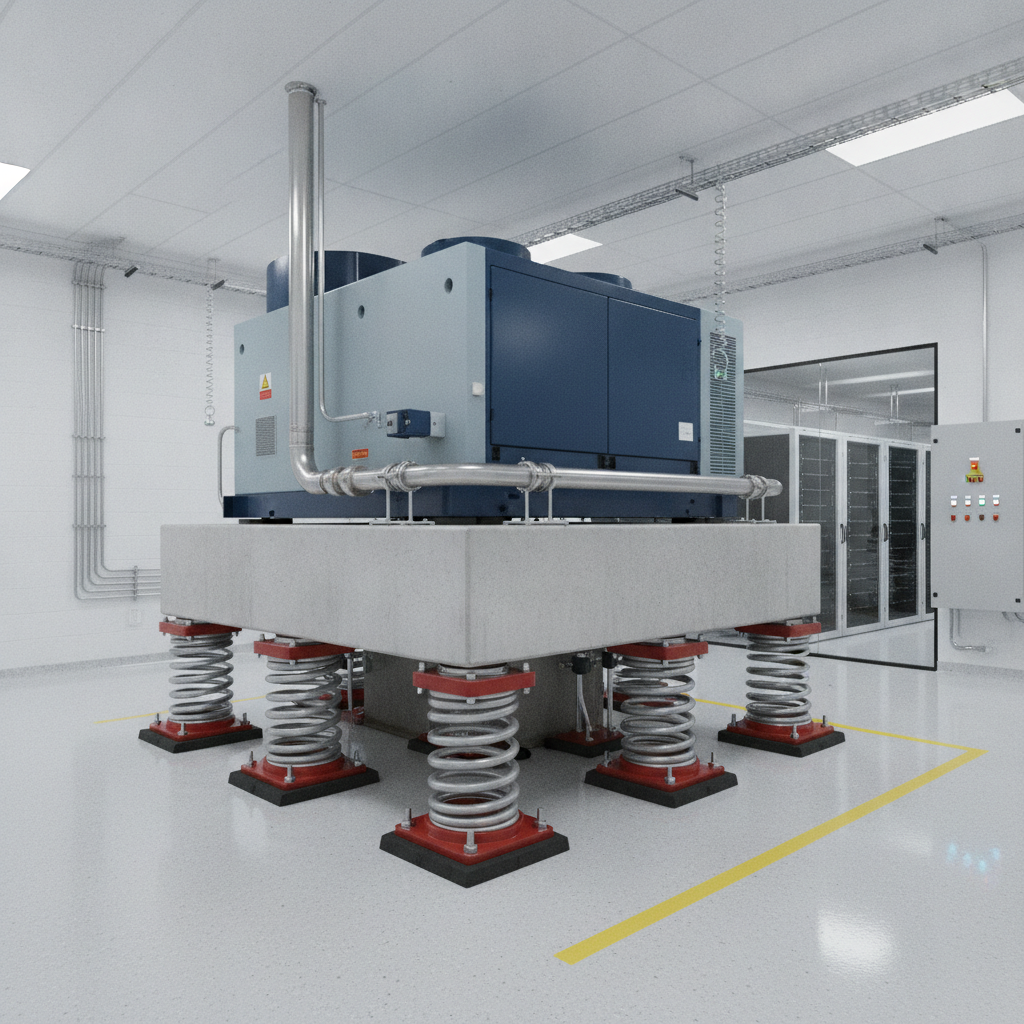
Every vibration problem can be broken down into three elements: the source, the path, and the receiver. The source is the piece of equipment generating the vibration (e.g., a generator). The path is the structure through which the vibration travels (e.g., the concrete slab). The receiver is the sensitive component or area being affected (e.g., a server rack or an operating room). The goal of vibration isolation is to interrupt the path. This is achieved by strategically inserting an isolation system—typically springs or elastomeric pads—between the equipment and the structure. The effectiveness of this system depends on the relationship between the equipment’s forcing frequency (how fast it vibrates) and the natural frequency of the isolation system. To achieve high isolation efficiency, the isolator’s natural frequency must be significantly lower than the equipment’s forcing frequency. This mismatch prevents the vibrations from being amplified and ensures they are absorbed and dissipated as heat within the isolator, a concept measured by transmissibility.
Selecting the Right Isolator: Springs vs. Elastomers
Isolator Selection Guide by Equipment Type
| Equipment Type | Typical Forcing Frequency | Recommended Isolator Type | Key Considerations |
|---|---|---|---|
| Large Centrifugal Chillers | Low (20-60 Hz) | Restrained Spring Isolators on Inertia Base | High mass requires significant static deflection. Seismic restraint is critical. |
| Cooling Towers | Low (5-20 Hz) | Large Deflection, Open Spring Isolators | Wind load restraint is often the governing design factor. Located outdoors. |
| Air Handling Units (AHUs) | Medium to High (15-100 Hz) | Elastomeric Pads or Housed Spring Isolators | Internal isolation of fan assembly is common. Location (slab vs. roof) matters. |
| Diesel Generators | Low (20-30 Hz) | High Deflection Spring Isolators on Inertia Base | Requires robust isolation for significant reciprocating forces and seismic anchoring. |
| Sensitive IT Racks / Servers | N/A (Receiver) | Elastomeric Pads or Specialty Server Isolation Platforms | Focus is on isolating the rack from floor vibration, not isolating a source. |
The two primary categories of isolators are steel springs and elastomers (like neoprene or rubber). The choice depends on the equipment’s weight, operating frequency, and the required isolation efficiency. A qualified Professional Engineer must evaluate these factors to specify the correct solution. Spring isolators are ideal for low-frequency vibrations, such as those from large, slow-speed pumps, chillers, and cooling towers. They offer high static deflection—the amount they compress under the equipment’s weight—which corresponds to a low natural frequency and thus better isolation for low-speed machinery. They are often housed in assemblies that may include vertical restraints for stability. In contrast, elastomeric isolators are better suited for high-frequency vibrations from smaller, faster equipment like fans and small pumps. They are cost-effective and provide excellent sound dampening but are less effective at isolating low-frequency disturbances and can be susceptible to degradation from oils and extreme temperatures.
Inertia Bases: Adding Mass for Enhanced Stability and Isolation
For large rotating or reciprocating equipment, an isolator alone is often insufficient. An inertia base—a steel frame filled with reinforced concrete—is installed between the equipment and the isolators. This added mass serves several critical functions. First, it lowers the combined center of gravity of the equipment and base, increasing stability and resisting movement from starting torque or operational forces. This is crucial for tall, top-heavy equipment. Second, the inertia base provides a rigid, level platform that prevents equipment flex and maintains alignment between components, such as a pump and its motor. Third, by increasing the total mass on the isolators, it allows for the selection of more stable, lower-frequency springs, significantly improving isolation efficiency. This integrated system ensures that powerful equipment remains stable while its vibrational energy is effectively contained, preventing it from disturbing the surrounding site development and building structure.
The Conflict: Balancing Isolation Efficiency with Seismic and Wind Restraint
One of the greatest challenges in structural and mechanical design is reconciling the need for flexibility in vibration isolation with the need for rigidity in resisting lateral loads from earthquakes or high winds. An effective isolation system must be soft enough to absorb vibrations, while a robust restraint system must be stiff enough to hold equipment in place during a seismic event. These are fundamentally opposing requirements. This conflict is resolved using specialized hardware like restrained spring isolators or by adding separate seismic snubbers. Restrained isolators incorporate a robust housing around the spring that allows for free vertical movement for isolation but engages during lateral or excessive vertical movement to anchor the unit. Snubbers are standalone devices installed around the equipment that feature a large air gap, permitting normal vibrational movement but preventing excessive motion during a seismic event. The design of these systems is highly regulated by building codes. Design requirements for seismic restraint and wind load resistance vary by jurisdiction, and every project team should confirm the applicable standards with the local, state, regional, and federal authorities that hold review authority over the site.
Decoupling Systems: The Role of Flexible Connections
Isolating the equipment at its base is only half the battle. Vibration can easily bypass the isolators through rigid connections, a phenomenon known as vibration flanking. All piping, ductwork, and electrical conduit connected to the isolated equipment must include flexible connectors to complete the decoupling from the building structure. These flexible connectors are engineered to absorb movement and vibration without failing. For piping, this may involve braided steel hoses or rubber expansion joints. For ductwork, flexible fabric collars are used. For electrical systems, flexible conduit is essential. Without these components, vibrational energy will travel directly into the building’s systems, rendering the base isolators ineffective and potentially causing fatigue and failure at the connection points. Proper utility coordination is critical to ensure these elements are included in the design.
Protecting Sensitive Environments from Mechanical Sources
In facilities with extremely sensitive equipment, such as data centers, research laboratories, or healthcare imaging suites, the goal may be to protect a room from vibrations generated elsewhere in the building. For instance, a large chiller plant on the roof can transmit low-frequency vibrations throughout the entire structure, which can be detrimental to the performance of hard drives or precision scientific instruments. In these cases, engineers may design isolated architectural systems, such as floating floors or isolated walls and ceilings. A floating floor, for example, consists of a secondary concrete slab poured on top of resilient isolators, completely decoupling it from the main structural slab. This creates a room-within-a-room that is shielded from structure-borne vibration. This level of design requires close collaboration between structural engineers, architects, and MEP engineers to ensure a fully integrated and effective solution.
RSP Engineers’ Approach to Vibration Control Design
At RSP Engineers, we treat vibration control as an integral part of the overall facility design, not an afterthought. Our process begins with a comprehensive vibration analysis to identify all potential sources and sensitive receivers. We work closely with the client, architect, and MEP engineers to establish performance criteria and select the most appropriate isolation strategies. Our team specifies isolators, inertia bases, and flexible connectors, ensuring full MEP coordination and integration with the structural design. We provide detailed drawings and specifications for contractors to ensure correct installation. Finally, we can assist with performance verification and commissioning, using field measurements to confirm that the installed systems meet the project’s design goals and protect our client’s critical operations.
Common Pitfalls in Vibration Isolation Implementation
Even with a solid design, implementation errors can compromise a vibration isolation system. One of the most common issues is vibration short-circuiting, where a rigid element bypasses the isolator. This can be a forgotten flexible pipe connection, a piece of debris left under an inertia base, or an electrical conduit clamped rigidly to both the equipment and the building structure. Another frequent problem is an isolator selection error, where isolators are chosen based on an incorrect weight or forcing frequency, leading to poor performance. Finally, a lack of proper commissioning can leave these issues undiscovered until after the facility is operational. Verifying that isolators are not bottomed out, that snubbers have the correct air gap, and that all flexible connections are installed correctly is a critical final step.
Partner with RSP Engineers for Your Mission-Critical Facility
Designing effective vibration control for mission-critical facilities requires a multidisciplinary approach that integrates structural, mechanical, and electrical engineering. The stakes are too high to leave it to chance. The team at RSP Engineers has the expertise to guide your project from initial analysis through final commissioning. We provide expert structural engineering, detailed MEP design coordination, and ensure full building code compliance for the most complex projects. Protect your investment and ensure operational uptime with an expertly engineered vibration isolation system.
Ensuring Operational Integrity Through Engineered Vibration Control
In conclusion, a successful vibration control strategy is a fundamental component of modern facility design. It is an engineered system that requires a holistic view, from selecting the right isolators and designing robust inertia bases to ensuring complete system decoupling with flexible connectors. By balancing the competing demands of isolation and seismic restraint, engineers can protect valuable assets and ensure the long-term reliability of mission-critical operations. Proactive design and diligent verification are key to achieving a quiet, stable, and resilient facility.
FAQs
-
Isolation efficiency is the percentage of vibration force that is blocked by the isolation system. A target of 90-95% is common for standard applications, but for highly sensitive environments, engineers may design for over 98% efficiency. This requires careful selection of spring isolators with the correct static deflection.
-
Yes, this is what restrained spring isolators are designed for. They contain a free-moving spring for vibration control within a rugged housing that engages to provide seismic restraint during a lateral event. However, in some very high-seismic areas, separate seismic snubbers may be required in addition to the vibration isolators.
-
An inertia base adds mass and rigidity. This lowers the system’s center of gravity for stability, prevents the pump’s frame from twisting under load, and allows for the use of more effective, lower-frequency isolators. It’s a critical component for ensuring the long-term reliability of large, powerful equipment.