
Differential Settlement Control at Data Center Equipment Yards
Learn how to control differential settlement in data center equipment yards. Expert guidance on geotechnical investigation, foundation design, and utility connections for mission-critical facilities.
The Unique Geotechnical Challenges of Equipment Yards
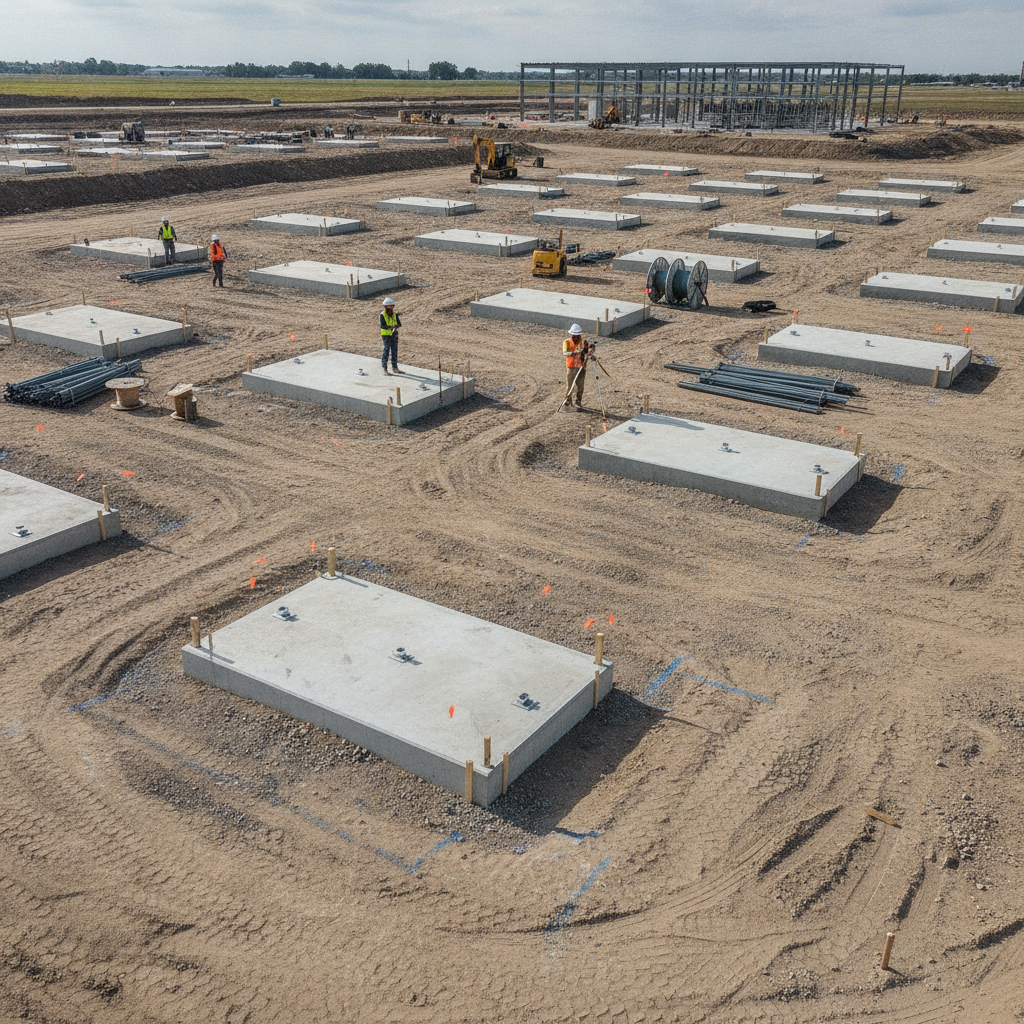
Data center equipment yards present a unique challenge for civil engineering and geotechnical design due to their highly variable load profiles. A single yard may contain a massive, static transformer on one pad, a bank of generators producing significant dynamic and vibrational loads on another, and a large but relatively lighter fuel tank nearby. This creates concentrated load points adjacent to lightly loaded access lanes and open areas. This disparity is the primary driver of differential settlement. The problem is compounded by site grading. Equipment pads are often built on structural fill to achieve the required elevation and stability, while adjacent areas may remain on native, less-compacted soils. The transition between these two zones is a classic point of failure. Over time, the heavily loaded fill areas may experience minimal settlement, while the surrounding native ground consolidates differently, creating a shearing effect on buried utilities. A comprehensive site development plan must account for these transitions and ensure that the subgrade preparation is uniform and capable of supporting all loads without harmful movement.
The Critical Role of the Geotechnical Investigation
Comparison of Settlement Mitigation Techniques
| Technique | Primary Application | Key Considerations | Relative Cost |
|---|---|---|---|
| Over-excavation & Replacement | Shallow (5-15 ft) deposits of weak or compressible soil. | Requires space for soil stockpiling; dependent on availability of suitable engineered fill. Best for uniform improvement. | Low to Moderate |
| Dynamic Compaction | Deep loose granular soils (sands and gravels). | Generates significant ground vibration, requiring careful monitoring and exclusion zones. Not suitable for cohesive clays. | Moderate |
| Aggregate Piers / Stone Columns | Improving weak cohesive soils (clays, silts) to increase bearing capacity and control settlement. | Specialized installation equipment required. Provides excellent vertical drainage path for consolidating soils. | Moderate to High |
| Deep Foundations (Piles) | Very heavy loads or very deep weak soil layers where shallow methods are not feasible. | Transfers loads to deeper, competent soil or bedrock. Higher cost and longer installation schedule. | High |
| Preloading / Surcharging | Large sites with compressible clays where construction schedule allows for a long settlement period. | Involves placing a temporary soil surcharge to induce settlement before construction. Can take months to be effective. | Low |
A robust foundation design is impossible without a comprehensive understanding of the subsurface conditions. The cornerstone of any settlement control strategy is a thorough geotechnical investigation performed by a qualified Geotechnical engineer. This investigation goes far beyond simply determining bearing capacity; it aims to characterize the soil’s compressibility, consolidation properties, and variability across the entire equipment yard footprint. The process typically involves a grid of soil borings, laboratory testing of soil samples (Soil Test), and analysis of groundwater conditions. The resulting Geotechnical soil report provides the essential data for the civil engineering team to model expected settlement and design appropriate mitigation measures. It identifies layers of weak or compressible soils, such as soft clays or loose sands, that must be removed or improved. Geotechnical requirements and reporting standards can vary by jurisdiction, and every project team should confirm the applicable standards with the local, state, regional, and federal authorities that hold review authority over the site. Investing in a detailed upfront investigation is the single most effective way to prevent costly change orders, construction delays, and long-term performance issues.
Subgrade Preparation and Ground Improvement Strategies
Once the subsurface conditions are understood, the focus shifts to creating a stable, uniform subgrade. The goal is to eliminate variability and ensure that the ground beneath the entire equipment yard responds to loads in a predictable manner. The most common approach is over-excavation and replacement, where unsuitable native soils are removed and replaced with compacted engineered fill placed in controlled lifts. The depth of the over-excavation is determined by the Geotechnical soil report and the magnitude of the applied loads. For sites with deeper weak soil layers or more challenging conditions, advanced ground improvement techniques may be necessary. Methods like dynamic compaction, aggregate piers (stone columns), or soil stabilization with cement or lime can densify and strengthen the native soils in place, creating a rigid foundation for the equipment pads and surrounding areas. The selection of the right technique depends on the soil type, groundwater level, and project budget. Proper drainage design is also critical during this phase to prevent water from compromising the compacted subgrade during and after construction.
Foundation Design for Varying Equipment Loads
With a stable subgrade established, the structural engineer can design the concrete foundations for the equipment. These are typically reinforced concrete mat foundations or large isolated footings designed to spread the concentrated equipment loads over a wide area, reducing the bearing pressure on the soil. The design must account for all load types: dead loads (the equipment’s self-weight), live loads, and especially the dynamic and vibrational loads from operating generators. Close utility coordination between the civil, structural, and MEP engineers is essential at this stage. The foundation design must incorporate blockouts, sleeves, and embedded conduits for all electrical and mechanical connections. The structural engineer of record will use data from the Geotechnical soil report to calculate the anticipated total settlement and ensure the foundation is rigid enough to prevent it from translating into damaging differential settlement across the pad itself.
Designing for Resilient Utility and Conduit Connections
Even with the best ground improvement and foundation design, some minor settlement is inevitable. The most vulnerable components in an equipment yard are the rigid connections between equipment pads and the buried utilities that serve them. A small amount of differential settlement between a generator pad and an adjacent electrical duct bank can easily shear rigid conduits, causing an outage. The same risk applies to fuel lines, cooling water pipes, and communication cables. The solution is to design for movement. The site plan design must include details for flexible connections at every point where a utility crosses from a structure to the surrounding ground. This can be achieved with flexible couplings, expansion joints, or by providing slack in the line within a vault or junction box. For critical electrical duct banks, encasing the conduits in a reinforced concrete “beam” that spans from the foundation to a stable point can also prevent shearing. This level of detail in the civil engineering plans is a hallmark of a well-designed, resilient data center.
Construction-Phase Monitoring and Quality Control
A successful design is only effective if it is executed correctly in the field. A rigorous construction quality assurance (CQA) program is essential for settlement control. This begins with monitoring the subgrade preparation, including observing proof-rolling and verifying that every lift of engineered fill meets the specified compaction density through systematic testing. A Professional Engineer should be involved in this oversight. Once foundations are poured and equipment is set, a settlement monitoring program should be implemented. This involves installing permanent monitoring points on foundations, pads, and surrounding structures. A surveyor takes baseline readings before loads are applied and continues to take periodic readings throughout the equipment loading process and into the facility’s operational life. This data provides early warning of any unexpected movement, allowing for corrective action before it becomes a critical problem and validates the performance of the Geotechnical Engineering design.
How RSP Engineers Approaches Settlement Control
At RSP Engineers, our approach to controlling differential settlement is proactive and integrated. We begin every project by working with the owner and a qualified Geotechnical engineer to define a scope for the subsurface investigation that addresses the specific challenges of a data center equipment yard. Our team of Civil Engineers uses this data to develop a comprehensive site plan design that includes detailed grading, drainage, and utility plans focused on resilience. We believe in a collaborative process, coordinating closely with the structural, mechanical, and electrical design teams to ensure our site design seamlessly integrates with their foundation and equipment requirements. During construction, we provide robust Construction Management Services and quality assurance oversight to verify that the work in the field conforms to the design intent. This end-to-end involvement, from initial Soil Test review to final construction verification, ensures that our clients’ mission-critical facilities are built on a foundation of stability and long-term reliability.
Common Issues and Pitfalls in Equipment Yard Design
Despite best intentions, several common issues can compromise the stability of a data center equipment yard. The most frequent is an inadequate geotechnical investigation, where a project team tries to save money upfront, only to face massive costs from unforeseen soil issues during construction. Another pitfall is inconsistent compaction of engineered fill, creating hard and soft spots that lead directly to differential settlement. Poor site drainage is another major culprit. If water is allowed to saturate the subgrade beneath foundations, it can significantly reduce the soil’s bearing capacity and lead to settlement. Finally, a simple but critical oversight is neglecting to specify and detail flexible utility connections. Many design teams focus solely on the foundations, forgetting that the small conduits and pipes connecting them are often the first components to fail when movement occurs. Avoiding these pitfalls requires experience and a holistic view of the entire site development process. Frequently Asked Questions What is an acceptable level of differential settlement for a data center? Acceptable settlement is extremely low and depends on the equipment’s tolerance and the nature of utility connections. Generally, total settlement is limited to about one inch, with differential settlement between adjacent foundations often restricted to half an inch or less. These limits must be established early in the design process in coordination with equipment manufacturers and the structural engineer. How does groundwater affect foundation design and settlement? A high water table can significantly reduce the bearing capacity of granular soils and can increase the potential for consolidation or settlement in certain clays. The Geotechnical soil report must accurately identify the seasonal high groundwater level. The drainage design may need to include underdrains or other measures to control groundwater and protect the integrity of the subgrade. Can we phase the equipment installation to manage settlement? Yes, a phased installation can be a deliberate strategy. By placing the heaviest equipment first (a process sometimes related to preloading), a significant portion of the expected settlement can be induced before final utility connections are made. This requires a carefully planned settlement monitoring program to track ground movement and confirm that the subgrade has stabilized before proceeding. What happens if excessive settlement is discovered after construction? Remediation is complex and extremely expensive. Options can include underpinning foundations, using compaction or chemical grouting to improve the underlying soil, or completely rebuilding sections of the equipment yard. This scenario underscores the importance of a proper upfront geotechnical investigation and CQA program to prevent the problem from ever occurring. How does the Geotechnical soil report influence the civil engineering design? The Geotechnical soil report is a foundational document for the civil engineering team. It dictates the requirements for subgrade preparation, the type of fill material to be used, temporary and permanent slope stability, and the design of stormwater and groundwater control systems. It directly informs the grading and drainage design to ensure long-term site stability. Who is responsible for monitoring settlement during construction? The responsibility is typically defined in the construction contract and CQA plan. Usually, the general contractor hires a third-party surveyor to take the measurements. The results are then provided to the owner, the contractor, and the engineering team (both civil engineering and geotechnical) for review to ensure the observed performance matches the design predictions.
Your Partner for Mission-Critical Site Engineering
Ensuring the long-term stability of your data center equipment yard requires specialized expertise and a proactive approach. The team at RSP Engineers provides the expert civil engineering, site development, and Geotechnical Engineering coordination needed to navigate these complex challenges. From the initial site assessment and permitting to detailed design and Construction Management Services, we are your trusted partner in building resilient, high-performance facilities. Contact us today to discuss how we can protect your critical infrastructure investment from the ground up.
Conclusion
Controlling differential settlement in a data center equipment yard is a non-negotiable requirement for ensuring operational continuity. It is a complex challenge that demands a multidisciplinary engineering effort, grounded in a thorough geotechnical investigation and executed with rigorous quality control. By focusing on uniform subgrade preparation, robust foundation design, and resilient utility connections, developers can mitigate the risks of ground movement. Ultimately, a proactive investment in expert civil engineering and site design provides the stable foundation necessary to protect mission-critical assets and guarantee long-term performance.
FAQs
-
Differential Settlement Control at Data Center Equipment Yards requires careful planning, qualified engineering, and compliance with the applicable codes and permits.
-
Getting Differential Settlement Control at Data Center Equipment Yards right protects safety, supports regulatory compliance, and avoids costly redesigns or delays.
-
RSP Engineers provides licensed expertise and end-to-end support for Differential Settlement Control at Data Center Equipment Yards, from early planning through permitting.