
Underground Stormwater Storage for Space-Constrained Data Centers
Explore underground stormwater storage options for data centers. Learn about pipe galleries, vaults, structural loading, permitting, and maintenance from the civil engineering experts at RSP Engineers
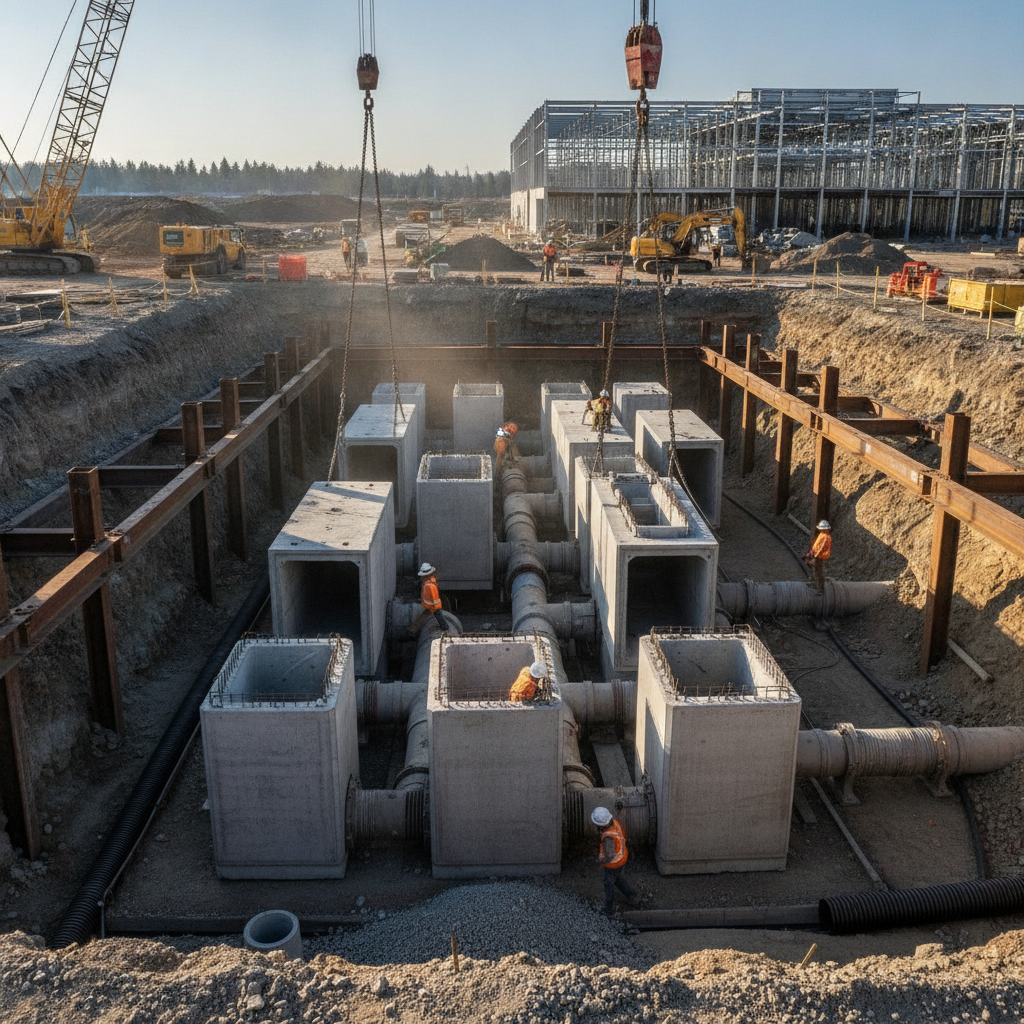
The Imperative for Subsurface Stormwater Management at Data Center Sites
The decision to use underground storage is driven by the unique economics and operational needs of data center development. Every square foot of land is a valuable asset, and dedicating acres to a surface pond can be financially unviable. Subsurface systems, installed beneath parking lots, drive aisles, or other paved areas, reclaim this space. This approach is essential for maximizing the facility’s footprint, accommodating future expansion phases, and maintaining the extensive security perimeters and setbacks required for these high-value assets. The large, contiguous impervious areas typical of data centers generate significant peak runoff rates during storm events, making effective stormwater management a primary design and permitting challenge. Furthermore, regulatory drivers are a major factor. Local, state, and federal regulations, such as the National Pollutant Discharge Elimination System (NPDES) program, mandate control of both the quantity and quality of stormwater runoff. Drainage design must demonstrate compliance with these rules to secure a permit. Permitting requirements vary by jurisdiction, and every project team should confirm the applicable standards with the local, state, regional, and federal authorities that hold review authority over the site. A well-designed underground system provides the necessary storage volume and can incorporate water quality treatment features, ensuring full zoning compliance and environmental stewardship while supporting the project’s core mission.
Common Types of Underground Stormwater Systems
Comparison of Underground Stormwater Storage Technologies
| System Type | Key Advantages | Primary Considerations | Typical Loading Capacity |
|---|---|---|---|
| Large-Diameter Pipe Galleries | High structural strength; suitable for linear footprints under roadways. | Can be less space-efficient for volume compared to vaults; requires careful joint sealing. | Excellent (AASHTO HS-25+) |
| Precast Concrete Vaults | Maximum volume in a minimal footprint; extremely high load capacity; rapid installation. | Higher material and transportation costs; requires heavy lifting equipment. | Exceptional (Custom engineered for heavy equipment) |
| Modular Chamber Systems | Lightweight and highly configurable; lower material cost; can fit irregular spaces. | Performance is highly dependent on proper installation and stone backfill compaction. | Good to Excellent (AASHTO HS-25) |
| Permeable Pavement Systems | Integrates storage directly into the pavement section; reduces peak runoff. | Requires specialized installation and maintenance; potential for clogging in high-traffic areas. | Variable (Designed for standard vehicle traffic) |
| Cast-in-Place Concrete Cisterns | Fully customizable shape and size; highest possible structural integrity. | Highest cost; longest construction duration on-site; complex formwork. | Exceptional (Engineered to any specification) |
Several proven technologies are available for underground stormwater storage, each with distinct advantages and applications. The selection depends on site-specific factors like available depth, soil conditions, required storage volume, and, critically, the anticipated surface loading. A Professional Engineer experienced in site development can model and specify the optimal solution. Large-Diameter Pipe Galleries Pipe galleries consist of a series of large-diameter corrugated metal, concrete, or plastic pipes laid horizontally in an excavated trench and connected by a manifold system. They are a robust and time-tested solution, capable of storing large volumes of water. Their linear nature makes them well-suited for installation along roadways or in long, narrow areas of a site. The structural integrity of these pipes allows them to be installed under heavy-duty pavements designed for truck and emergency vehicle traffic, a common requirement for data center civil engineering. Precast Concrete Vaults For maximum storage in a compact footprint, precast concrete vaults are an excellent choice. These are large, box-like structures, often modular, that are delivered to the site and assembled in a large excavation. They offer immense structural strength, making them ideal for placement under heavy equipment pads, loading docks, or critical fire access lanes. While often having a higher initial material cost, their efficient use of space and rapid installation can offer schedule advantages during construction administration. Modular Chamber Systems Modular systems, typically made from high-strength plastic or composite materials, consist of numerous individual arched chambers that are assembled on-site to create a large, interconnected underground storage bed. These systems are lightweight, which can reduce shipping and installation costs. They are highly configurable and can be shaped to fit irregular areas of a site, offering significant design flexibility. Proper installation, including the surrounding stone backfill and geotextile fabric, is critical to their long-term structural performance and drainage design function.
Critical Design Factor: Structural Loading and Burial Depth
Perhaps the most critical consideration for underground systems at data centers is their ability to withstand extreme surface loads. These facilities have constant traffic from heavy trucks delivering equipment, fuel, and maintenance supplies. Fire lanes must support the weight of the heaviest emergency vehicles. The civil engineering design must account for these live loads, as well as the dead load of the pavement section and overlying soil. Systems are typically designed to meet or exceed standards like AASHTO HS-20 or HS-25 loading. The design must also carefully balance minimum and maximum burial depth requirements specified by the manufacturer. Insufficient cover can lead to structural failure under load, while excessive depth can crush the system. This requires close utility coordination to avoid conflicts with deep sanitary sewer lines or telecommunications conduits. A detailed Geotechnical Engineering investigation is non-negotiable; the Geotechnical engineer will provide recommendations on soil bearing capacity, potential settlement, and groundwater levels, all of which directly influence the structural design and feasibility of the chosen system.
Integrating Pretreatment and Water Quality Components
Modern stormwater management regulations focus on more than just flood control; they require the treatment of runoff to remove pollutants like sediment, oils, and heavy metals before discharge. Underground storage systems must be paired with a robust pretreatment strategy. Runoff from parking lots and service areas carries a high pollutant load, and without pretreatment, this sediment and debris would quickly clog the storage system, rendering it ineffective and creating a significant maintenance burden. Effective pretreatment can be achieved through several methods integrated into the drainage design. Hydrodynamic separators are vortex-based systems that spin water to separate out sediment and floating oils. Filter cartridges placed in upstream manholes can capture finer particles and dissolved pollutants. A simple but effective method is a sediment forebay—a small, accessible chamber at the inlet of the system designed to capture the heaviest solids for easy removal. Including these elements is essential for long-term performance and for meeting the water quality requirements of state and federal permitting programs.
The RSP Engineers Approach to Underground System Design
At RSP Engineers, our process for designing underground stormwater systems for mission-critical facilities is comprehensive and collaborative. We begin with a thorough site feasibility analysis, evaluating constraints like utility locations, geotechnical conditions, and regulatory setbacks. This initial due diligence is crucial for identifying the most viable site development strategy. Our team of Civil Engineers then performs detailed hydrologic and hydraulic modeling to accurately calculate the required storage volume and conveyance pipe sizes based on local rainfall data and land use. We work closely with the project’s Geotechnical engineer and structural engineer to ensure the selected system can safely support all anticipated loads. This collaborative approach prevents costly redesigns and ensures a safe, durable installation. We prepare comprehensive permit submittals with clear drawings and supporting calculations to facilitate a smooth agency review process. During construction, we provide Construction Management Services, including site inspections and review of contractor submittals, to verify that the system is installed precisely according to the design specifications, safeguarding the owner’s investment.
Common Challenges in Underground Stormwater Projects
Even with a robust design, underground stormwater projects can face challenges during construction. The most common issue is unforeseen utility coordination conflicts. Despite extensive record research, unknown or incorrectly located utilities are often discovered during excavation, requiring immediate redesign and field adjustments. A high groundwater table is another significant challenge, which can complicate excavation, require extensive dewatering operations, and exert buoyant forces on the installed system if not properly addressed in the design. Value engineering, while important, can sometimes lead to issues if not carefully managed. Substituting specified materials, such as the geotextile fabric or stone backfill, can compromise the system’s structural integrity and filtration capacity. Finally, ensuring proper construction sequencing and quality control is paramount. Inadequate compaction of the stone envelope around modular chambers is a leading cause of premature failure. Experienced civil engineering oversight during construction is the best way to mitigate these risks and ensure the project’s long-term success.
Partner with RSP Engineers for Your Mission-Critical Site
Designing and permitting a data center is a complex undertaking where every decision impacts the project’s viability and timeline. Choosing the right stormwater management strategy is critical. At RSP Engineers, we provide the expert civil engineering and site development services needed to navigate these challenges. Our team specializes in creating efficient, compliant, and cost-effective underground storage solutions tailored to the unique demands of mission-critical facilities. From initial feasibility studies and permitting to final construction oversight, we are your trusted partner. Contact us today to discuss how we can optimize your next project through expert utility coordination and innovative site design.
Conclusion
For space-constrained data center projects, underground stormwater storage is not just an alternative; it is often an enabling technology. It allows developers to meet stringent environmental regulations while maximizing the revenue-generating potential of their property. The success of these complex systems hinges on a deep understanding of structural loads, geotechnical conditions, and long-term maintenance requirements. By engaging an experienced civil engineering firm early in the process, developers can ensure their stormwater management solution is a durable, compliant, and valuable asset that supports the core mission of the facility. Proper design and execution are key to navigating the permitting process and achieving a successful site development outcome.
FAQs
-
While the direct construction cost of an underground system is typically higher than a surface pond, the true financial impact is measured in land value. By freeing up valuable acreage for development, the underground system can provide a significant return on investment, especially on high-value commercial or industrial land. The cost analysis must include the value of the reclaimed, usable land, which often makes the subsurface option more profitable for the overall site development.
-
Generally, no. Installing stormwater storage systems directly under a building foundation is highly discouraged and often prohibited by building code compliance. It introduces significant risks related to soil bearing capacity, potential leaks, and maintenance access. These systems are almost always located under paved areas like parking lots, drive aisles, or non-critical landscape areas.
-
With proper design, installation, and maintenance, modern underground systems are designed to last 50 years or more. The lifespan depends on the material—concrete systems often have the longest design life, while high-grade plastics and coated metals also offer excellent durability. The key to longevity is a consistent inspection and maintenance program to prevent sediment buildup, which is the primary threat to long-term stormwater management performance.