
Selecting Between Wet and Dry Stormwater Ponds
Explore the key civil engineering differences between wet and dry stormwater ponds for data center development. Learn about footprint, maintenance, water quality, and permitting.
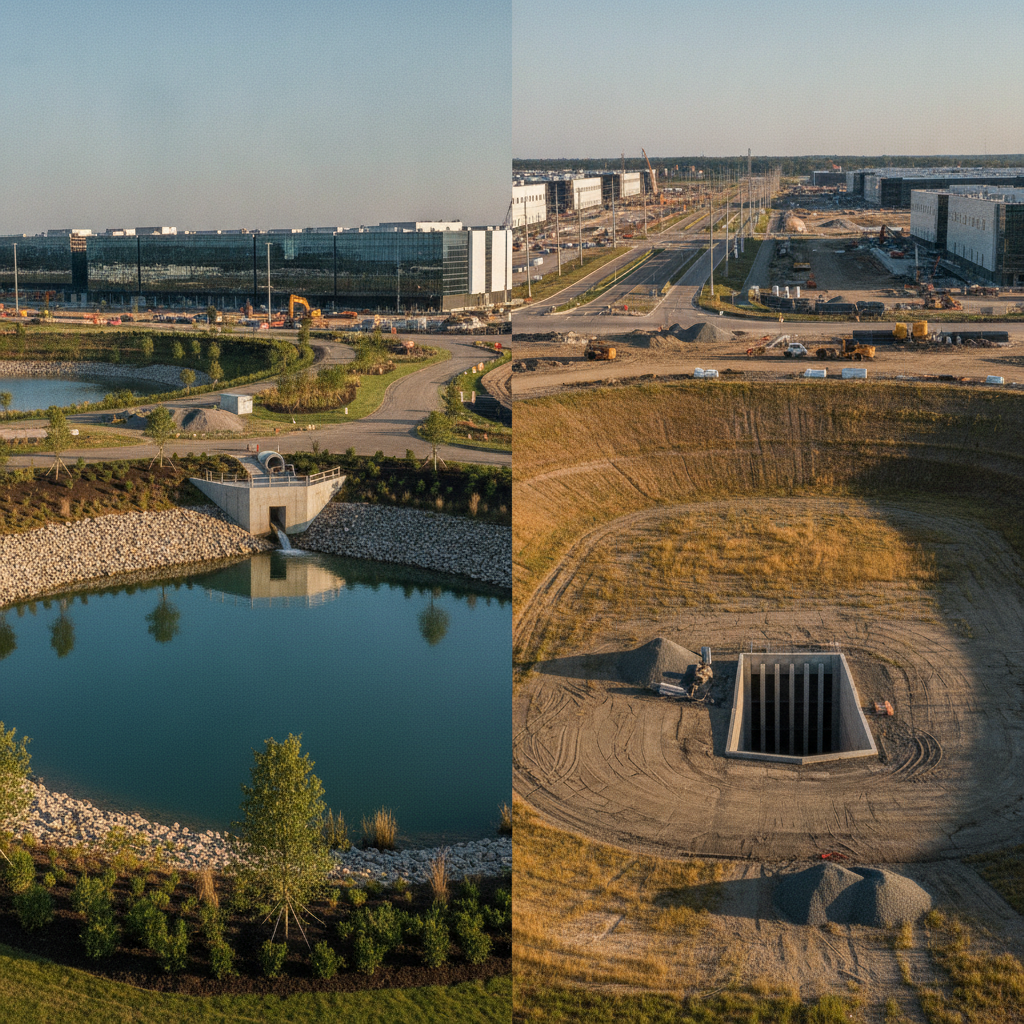
Core Functional Differences: Retention vs. Detention
At the most basic level, the difference between a wet and dry pond lies in its normal operating state. A wet pond, also known as a retention basin, is designed to maintain a permanent pool of water. Runoff from a storm event enters the pond, raising the water level, and is released slowly through an outlet structure. The permanent pool provides continuous water quality treatment through biological processes. This design is highly effective for both managing flood risk and improving water quality. A dry pond, or detention basin, is designed to be dry between storm events. It temporarily impounds stormwater runoff, holding it and releasing it at a controlled rate to prevent downstream flooding. While it provides excellent peak flow attenuation, its water quality treatment capabilities are primarily limited to the settling of coarse sediments while water is temporarily ponded. Once the detained volume has been released, the basin floor is exposed, often resembling a large, grassy depression.
Regulatory Compliance and Permitting Pathways
Comparison: Wet Retention vs. Dry Detention for Data Center Sites
| Feature | Wet Pond (Retention) | Dry Pond (Detention) |
|---|---|---|
| Primary Function | Peak flow control and robust water quality treatment. | Peak flow control with limited water quality treatment. |
| Footprint | Generally larger due to permanent pool and gentler side slopes. | Potentially smaller and deeper, offering better land use efficiency. |
| Water Quality Performance | High performance for sediment, nutrients, and other pollutants via biological processes. | Lower performance, primarily limited to sedimentation of coarse particles. |
| Groundwater Sensitivity | Well-suited for sites with high groundwater tables. | Challenging on sites with high groundwater; may require underdrains. |
| Soil Condition Preference | Requires less permeable soils or a liner to maintain permanent pool. | Suitable for a wider range of soil types, but very sandy soils can cause side slope stability issues. |
| Maintenance Demands | Aquatic vegetation management, algae control, periodic dredging. | Regular mowing, debris removal, erosion control, outlet inspection. |
| Safety & Security | Requires fencing and safety measures due to permanent open water. | Lower risk between storms but can fill rapidly; fencing is often still required. |
Both wet and dry ponds are engineered systems designed to meet local, state, and federal regulations governing stormwater discharge, including requirements under the National Pollutant Discharge Elimination System (NPDES) program. The design criteria for volume, discharge rates, and pollutant removal efficiency are established by the authority having jurisdiction. These criteria dictate the required size and features of the pond. Permitting requirements for stormwater management systems vary by jurisdiction, and every project team should confirm the applicable standards with the local, state, regional, and federal authorities that hold review authority over the site. The permitting process involves submitting detailed civil engineering plans and drainage calculations for agency review. Reviewers will scrutinize the design to ensure it meets all applicable codes for flood control, water quality, and safety. The choice between a wet or dry pond can influence the complexity of the permit submittals, particularly if the site has environmental constraints like wetlands or sensitive habitats that favor one approach over the other.
Water Quality Treatment Mechanisms and Performance
Wet ponds are generally considered superior for water quality treatment. The permanent pool allows for significant pollutant removal through several natural processes. Sedimentation allows fine particles like silt and attached pollutants to settle out of the water column. Biological uptake by algae and aquatic plants removes nutrients like nitrogen and phosphorus. The extended holding time in a wet pond provides a more robust treatment train for a wider range of contaminants commonly found in urban runoff. Dry ponds offer more limited treatment. Their primary mechanism is sedimentation of heavier particles while water is temporarily stored. Some designs incorporate features like a micropool or a forebay to enhance this process, but they typically cannot match the nutrient removal performance of a wet pond. For sites where regulations demand high levels of treatment for total suspended solids (TSS) and nutrients, a wet pond or another form of enhanced treatment may be required.
Site Constraints: Geotechnical and Groundwater Considerations
Subsurface conditions are a critical factor in pond selection. A high seasonal groundwater table can make a dry pond design challenging or infeasible. If groundwater is too close to the surface, the dry pond may not dewater properly, creating a marshy, difficult-to-maintain area. In these situations, an expensive underdrain system may be necessary. Conversely, a wet pond is often a natural fit for sites with high groundwater, as the groundwater helps maintain the permanent pool. On the other hand, highly permeable soils, such as sand, can make it difficult for a wet pond to hold water. In these cases, an impermeable liner may be required to prevent water from seeping away, adding significant cost to the project. A thorough Geotechnical Engineering investigation, including a detailed Geotechnical soil report based on a soil boring test, is essential early in the site plan design phase to identify these constraints and inform the most practical and cost-effective stormwater solution.
Footprint, Depth, and Land Use Efficiency
For data center developers, maximizing the usable area of a site is paramount. Wet ponds typically require a larger surface area or footprint than dry ponds to achieve the same storage volume. This is due to the need for gentler side slopes for safety and to establish a littoral shelf for aquatic vegetation. The permanent pool itself occupies land that cannot be used for any other purpose. Dry ponds can often be designed with steeper side slopes, allowing them to be deeper and occupy a smaller footprint. While the floor of a dry pond at a data center is unlikely to be used for active purposes, its smaller size can free up valuable land for building expansion, parking, or equipment yards. This difference in footprint efficiency is a major consideration in the overall land development strategy and must be weighed against other factors like treatment performance and maintenance.
Operational and Maintenance Requirements
The long-term cost and effort of maintenance are significant concerns for facility operators. Both pond types require regular inspection and upkeep. Wet ponds require management of aquatic vegetation to prevent overgrowth, control of algae, and periodic sediment removal (dredging) every 10-20 years. The outlet structure must be kept clear of debris to function correctly. Dry ponds require routine mowing of the basin floor and side slopes, removal of trash and debris that can clog the outlet, and erosion repair. The low-flow channel and outlet must be inspected regularly to ensure they are not blocked by sediment. While daily or weekly maintenance may seem simpler, major long-term maintenance, such as removing accumulated sediment to restore storage volume, is still required.
RSP Engineers’ Approach to Stormwater System Design
At RSP Engineers, our process begins with a comprehensive site analysis to understand the unique opportunities and constraints of your project. This includes a thorough review of topographic data, a Geotechnical Engineering evaluation, and an assessment of regulatory requirements. We use advanced hydrologic and hydraulic modeling software to simulate storm events and design a stormwater management system that is both compliant and cost-effective. We work collaboratively with data center developers and mission-critical facility owners to weigh the pros and cons of different approaches, including wet ponds, dry ponds, and underground systems. Our goal is to deliver a solution that integrates seamlessly with the overall site plan design, minimizes the land footprint, and meets long-term operational goals. We manage the entire permitting process, from initial submittals and responding to agency review comments to securing final approvals.
Common Challenges in Stormwater Pond Implementation
Even with a solid design, challenges can arise during construction and operation. One common issue is encountering unexpected subsurface conditions, such as rock or a higher-than-anticipated groundwater table, which can necessitate costly design changes. During the construction administration phase, it’s critical to ensure the contractor builds the pond exactly to plan, as small deviations in elevation or outlet configuration can have major impacts on performance. Another challenge is navigating conflicting comments from different regulatory agencies during the review process. An experienced civil engineering team can help resolve these issues efficiently. Finally, ensuring a clear plan for long-term maintenance is crucial. Without proper upkeep, even the best-designed pond will fail over time, leading to potential flooding, compliance violations, and expensive remediation.
Partner with RSP Engineers for Your Data Center Site Development
Choosing the right stormwater solution is a critical step in the successful development of any mission-critical facility. The team at RSP Engineers provides the expert civil engineering guidance needed to navigate this complex decision. We specialize in site development for data centers, offering integrated services that include stormwater management, utility coordination, and comprehensive permitting support. Let us help you optimize your site plan design for performance, compliance, and long-term value. Contact us today to discuss your project needs.
Conclusion
The decision between a wet and a dry stormwater pond is not one-size-fits-all. It is a strategic civil engineering choice that balances land use efficiency, regulatory compliance, site-specific geotechnical constraints, and long-term operational costs. For data center projects where reliability and optimal use of space are paramount, a thorough analysis is essential. Engaging an experienced civil engineering firm early in the process ensures that your stormwater management system supports the overall goals of your site development project, protecting your investment for years to come.
FAQs
-
For wet ponds, the main concern is the presence of permanent open water, which requires security fencing and clear signage, especially on a 24/7 operational site like a data center. For dry ponds, the risk involves rapid filling during a storm and potentially unstable, saturated soil on the side slopes. Both types require controlled access and regular inspection of safety features.
-
A high groundwater table often makes a wet pond the more practical choice, as it naturally supports the permanent pool. A dry pond in such conditions may fail to drain completely, becoming a swampy area that is difficult to maintain and may not meet its design objectives without an expensive engineered underdrain system.
-
Generally, a wet pond offers significantly better water quality treatment. The permanent pool supports biological processes that remove dissolved pollutants like nutrients, in addition to allowing fine sediments to settle. A dry pond’s treatment is mostly limited to the settling of larger particles during the short time water is impounded.