
Data Center Retention Systems in High-Infiltration Soils
A technical guide for data center developers on designing stormwater retention systems in high-infiltration soils. Learn about infiltration testing, design rates, and permitting.
The Strategic Advantage of Infiltration for Mission-Critical Facilities
For data center developers, leveraging a site’s natural infiltration capacity is more than just a drainage strategy; it’s a strategic asset. An infiltration-based stormwater management system, commonly known as a retention basin, is designed to hold a specific volume of water with no surface outlet, relying entirely on percolation into the underlying soil. This approach offers several key advantages for large-scale land development projects. By eliminating the need for a controlled discharge structure and extensive downstream conveyance systems, it can reduce construction complexity and costs. Furthermore, promoting groundwater recharge can be an environmental benefit that aids in securing project approvals. From a risk management perspective, a properly designed retention system contains storm events entirely on-site, mitigating the risk of off-site flooding and potential liability. This level of control is paramount for mission-critical infrastructure, where operational continuity is non-negotiable. The success of this strategy hinges on a robust and accurate understanding of the site’s subsurface conditions, making expert civil engineering and geotechnical analysis indispensable.
Site Characterization and Geotechnical Investigation
Key Design Parameters for Infiltration-Based Retention Systems
| Parameter | Design Consideration | Typical Requirement or Best Practice |
|---|---|---|
| Infiltration Rate Factor of Safety | Accounts for long-term performance degradation and soil variability. Applied to the field-measured infiltration rate. | 2.0 to 5.0 (or higher), depending on testing method and soil type. |
| Separation to SHWT/Bedrock | Protects groundwater quality and ensures a hydraulic gradient for infiltration. Measured from the basin bottom. | 2 to 4 feet minimum. Varies significantly by jurisdiction. |
| Stormwater Pretreatment | Removes sediment, oils, and debris to prevent clogging of the infiltration surface. | Required. Options include vegetated swales, forebays, or manufactured treatment devices. |
| System Recovery Time | Ensures storage is available for subsequent storm events. | Typically 36 to 72 hours maximum to drain the design storm volume. |
| Side Slope Stability | Ensures basin embankments are stable, safe for maintenance access, and resistant to erosion. | Typically 3:1 (Horizontal:Vertical) or flatter for vegetated slopes. |
| Maintenance Access | Provides a route for equipment to perform sediment removal and vegetation management. | A stabilized access ramp with a maximum slope (e.g., 10:1) is often required. |
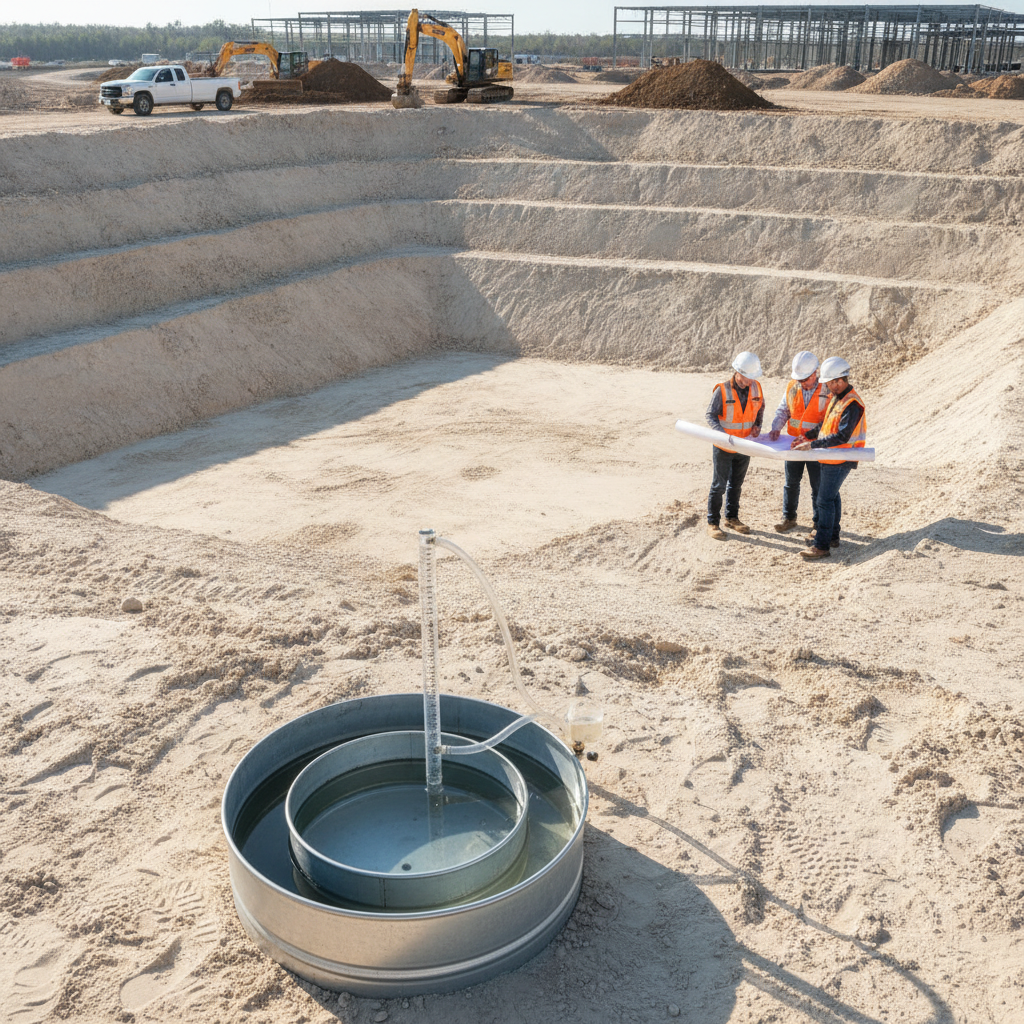
The viability of a stormwater retention system is determined long before any earth is moved. A thorough site characterization and Geotechnical Engineering investigation are the foundational first steps. This process goes far beyond simply identifying soil types; it involves quantifying their hydraulic properties under real-world conditions. The primary tool for this is in-situ permeability testing, often conducted using methods like the double-ring infiltrometer. These tests measure the rate at which water percolates into the soil, providing the raw data for all subsequent drainage design calculations. The investigation must also identify the depth to the seasonal high water table (SHWT) and the presence of any confining layers, such as clay or bedrock, that could impede infiltration. A detailed Geotechnical soil report, incorporating data from multiple Soil boring test locations, is essential for creating a comprehensive model of the site’s subsurface. Design and permitting requirements for these systems vary by jurisdiction, and every project team should confirm the applicable standards with the local, state, regional, and federal authorities that hold review authority over the site. This early, data-driven approach is critical for avoiding costly redesigns and ensuring regulatory compliance.
Designing for Infiltration Rate, Volume, and Safety Factors
Translating raw field data into a functional and compliant design requires careful engineering analysis. The measured infiltration rate from a Soil Test is never used directly in calculations. Instead, a significant factor of safety is applied to account for potential soil compaction during construction, long-term siltation, and natural variability in soil conditions. This conservative approach ensures the system will perform reliably throughout its design life. The resulting design infiltration rate is then used to calculate the required bottom area of the retention basin needed to infiltrate the runoff volume from a specific design storm event. The total storage volume of the basin must be sufficient to hold the entire runoff volume without overtopping. This involves detailed hydrologic modeling that considers the data center’s large impervious footprint, rainfall intensity, and storm duration. The goal of this civil engineering exercise is to balance the required storage volume with the available infiltration area, optimizing the system’s footprint while meeting all regulatory criteria for stormwater volume control and peak discharge attenuation (which, in a full retention system, is zero).
Critical Design Constraints: Groundwater and Bedrock Separation
A fundamental requirement for any infiltration system is maintaining adequate vertical separation between the bottom of the basin and underlying sensitive layers. Regulators mandate a minimum distance to the seasonal high water table (SHWT) to protect groundwater quality from potential pollutants in the stormwater runoff and to ensure the hydraulic gradient necessary for infiltration is maintained. If the water table is too high, the soil’s capacity to accept more water is diminished, a condition known as “mounding,” which can lead to system failure. Similarly, a minimum separation to bedrock or any other impermeable soil layer is required to provide sufficient soil volume for water to percolate effectively. These separation requirements are non-negotiable elements of zoning compliance and environmental permitting. They directly influence the maximum allowable depth of the retention basin and can be a primary constraint in the overall site plan design, potentially impacting site grading and the location of other critical infrastructure.
System Recovery Time and Sequential Storm Events
A critical performance metric for a retention system is its recovery time—the duration required for the basin to completely drain after a storm event. Most regulatory agencies specify a maximum allowable recovery time, often between 36 and 72 hours. This ensures that the system’s full storage volume is restored and available before the next storm arrives. For a mission-critical facility like a data center, designing for resilience against sequential or clustered storm events is a crucial aspect of risk mitigation. The recovery time calculation is a direct function of the design infiltration rate and the total storage volume. A slower infiltration rate or a larger volume will result in a longer recovery period. Civil engineers must carefully model this behavior to demonstrate compliance and ensure the facility is not left vulnerable. Failure to meet recovery time standards is a common reason for comments from a reviewing agency review and can delay project approvals.
Pretreatment Strategies to Prevent System Clogging
The long-term performance of an infiltration system is entirely dependent on preserving the porosity of the native soils. The single greatest threat to this is clogging from fine sediments, debris, and hydrocarbons washed off impervious surfaces. Therefore, effective stormwater pretreatment is not an optional add-on; it is an integral component of the design. Pretreatment measures are designed to capture pollutants before they can reach and foul the primary infiltration surface. Common strategies include a sediment forebay, which is a small, deep pool at the basin’s inlet where heavier particles can settle out. Vegetated filter strips or grassed swales can slow runoff velocity and trap suspended solids. For sites with high pollutant loads, such as parking lots, manufactured treatment devices (MTDs) like hydrodynamic separators or media filters may be necessary. The choice of pretreatment technology depends on the specific pollutants of concern, the site layout, and the long-term maintenance plan.
The RSP Engineers Approach to Data Center Stormwater Design
At RSP Engineers, we recognize that data center site development demands precision, foresight, and a deep understanding of both engineering principles and regulatory landscapes. Our process for designing infiltration-based stormwater systems begins with a comprehensive due diligence and feasibility analysis, including hands-on management of the Geotechnical Engineering investigation to ensure we gather the right data from the start. We believe that a project’s success is built on a foundation of accurate subsurface information. Our team of Civil engineers then integrates the stormwater management system seamlessly into the overall site plan design, working collaboratively with architects and other disciplines to optimize the layout for operational efficiency and safety. We navigate the complexities of the permitting process, preparing clear and defensible permit submittals that anticipate agency concerns. Throughout construction, we provide robust construction administration services to verify that the system is built in strict accordance with the design, protecting the sensitive infiltration surfaces from compaction and ensuring long-term performance.
Common Challenges in High-Infiltration System Permitting and Construction
Even with a sound design, developing stormwater retention systems in high-infiltration soils can present challenges. During permitting, regulatory agencies often apply intense scrutiny to the infiltration rate calculations and the applied factor of safety. Demonstrating the long-term viability and providing a robust maintenance plan are key to securing approvals. Variability in soil conditions across a large data center campus can also complicate design, sometimes requiring multiple smaller, distributed systems instead of one large basin. During construction, the most critical challenge is protecting the infiltration surface. Heavy equipment operating within the basin footprint can compact the soil, drastically reducing its permeability and jeopardizing the entire system. A strict construction sequencing plan and clear demarcation of protected zones are essential. Another common issue is the discovery of previously unidentified perched water tables or rock outcroppings during excavation, which can force last-minute design changes and require close collaboration between the contractor and the Professional Engineer of record. Frequently Asked Questions (FAQ) What is the difference between a retention and a detention system? A retention system is designed to capture a specific volume of stormwater and dispose of it through infiltration into the ground, with no surface water discharge. A detention system is designed to temporarily store stormwater runoff and release it slowly over time through a controlled outlet structure to a downstream water body or storm sewer system. How is the design infiltration rate determined? The design infiltration rate is derived from field testing, typically using a double-ring infiltrometer or similar device to measure the saturated hydraulic conductivity of the soil. This raw field rate is then reduced by applying a factor of safety (typically 2.0 or greater) to account for long-term clogging and soil variability, resulting in a conservative rate used for the final drainage design. What happens if the soil infiltration capacity degrades over time? This is a primary risk managed through design and maintenance. Pretreatment systems are designed to minimize sediment load. However, if performance degrades, maintenance is required. This can involve scraping and removing the top few inches of clogged soil, tilling the surface to break up compacted layers, and re-establishing vegetation. This is why a clear maintenance plan is a critical part of the permit submittals. Can infiltration systems be used on sites with steep slopes? It can be challenging. Infiltration systems require relatively flat bottoms to promote even water distribution. On a sloped site, significant grading and terracing may be required to create a suitable area for the basin. The stability of embankments is also a major design consideration, often requiring detailed Geotechnical Engineering analysis. How does the data center’s heat output affect the stormwater design? While the direct impact on infiltration rates is minimal, the significant heat generated by data centers can lead to higher pavement and rooftop temperatures. This can affect the temperature of the initial stormwater runoff, which may be a consideration for water quality and environmental permitting in some sensitive watersheds. What kind of permits are typically required for these systems? Permits often include a site development or land disturbance permit from the local authority, a stormwater permit from a state or regional environmental agency (often under the federal NPDES program), and potentially other permits related to floodplain impacts or utility crossings. The specific requirements for agency review are highly dependent on the project’s location and scale.
Partner with RSP for Your Mission-Critical Site Development
Designing and permitting a stormwater retention system for a data center requires a specialized skill set that merges geotechnical science with advanced civil engineering. The stakes are too high for a one-size-fits-all approach. The team at RSP Engineers has the nationwide experience to navigate these complex projects. We provide comprehensive site engineering services, from initial due diligence and utility coordination to final construction oversight. If you are planning a mission-critical facility, contact us to ensure your stormwater management system is resilient, compliant, and built for the long term.
Conclusion
For data center projects on sites with suitable soils, infiltration-based retention is a superior stormwater management strategy. It offers a sustainable, efficient, and reliable method for handling runoff from large impervious areas. However, its success is not guaranteed. It demands meticulous geotechnical investigation, conservative drainage design practices, and a commitment to long-term maintenance. By partnering with experienced Civil Engineering firms, developers can unlock the full potential of their site’s natural assets, ensuring regulatory compliance and protecting their critical infrastructure investment for decades to come.
FAQs
-
Data Center Retention Systems in High-Infiltration Soils requires careful planning, qualified engineering, and compliance with the applicable codes and permits.
-
Getting Data Center Retention Systems in High-Infiltration Soils right protects safety, supports regulatory compliance, and avoids costly redesigns or delays.
-
RSP Engineers provides licensed expertise and end-to-end support for Data Center Retention Systems in High-Infiltration Soils, from early planning through permitting.