
Data Center Detention Pond Sizing Fundamentals
Learn the fundamentals of sizing detention ponds for data centers. Our civil engineering experts explain storage volume, outlet controls, and balancing footprint with developable land.
The Critical Role of Stormwater Management in Data Center Site Development
The operational demands of a data center—uninterrupted power, cooling, and connectivity—are directly linked to the stability of its physical site. Effective stormwater management is a non-negotiable component of that stability. A poorly designed system can lead to localized flooding, saturated soils that compromise foundations, and erosion that damages critical infrastructure. Given the high percentage of impervious coverage on a typical data center campus, the volume and velocity of runoff during a storm event are magnified significantly compared to undeveloped land. The primary objective of the detention system is to manage the peak discharge rate of stormwater leaving the site. By capturing runoff in a basin and releasing it slowly, the system flattens the peak of the storm’s hydrograph, protecting downstream properties and infrastructure. This is a fundamental requirement of nearly all land development regulations across the country. For a mission-critical facility, this also ensures that the site itself remains accessible and operational during and after major storm events, preventing costly downtime.
Establishing Design Storms and Allowable Discharge Rates
Detention Pond Design Criteria Comparison
| Design Parameter | Typical Requirement or Method | Impact on Data Center Site |
|---|---|---|
| Allowable Discharge Rate | Match pre-development peak runoff rates for multiple storm frequencies (e.g., 2, 10, 25, 100-year). | Directly determines the complexity of the outlet control structure and influences required storage volume. |
| Required Storage Volume | Calculated via hydrograph routing in H&H software. | The primary driver of the pond's overall footprint and land consumption. |
| Freeboard | 1 to 2 feet above the 100-year storm water surface elevation. | Increases the required embankment height and overall earthwork volume. |
| Side Slopes | Typically 3:1 or 4:1 (H:V) for stability and maintenance. | Steeper slopes reduce the footprint but may require retaining walls and more complex construction. |
| Outlet Control Structure | Multi-stage design with orifices, weirs, and an emergency spillway. | A complex OCS is necessary for performance but requires precise construction and regular inspection. |
| Maintenance Access | A dedicated ramp and perimeter berm wide enough for equipment. | Adds to the overall footprint but is essential for long-term functionality and regulatory compliance. |
The foundation of any detention pond design is a clear understanding of the regulatory performance standards it must meet. This begins with identifying the required design storm frequency events, such as the 25-year, 24-hour storm or the 100-year, 24-hour storm, which represent statistical rainfall depths for a given duration. The specific design storms and performance criteria are dictated by the governing authorities. Permitting requirements vary by jurisdiction, and every project team should confirm the applicable standards with the local, state, regional, and federal authorities that hold review authority over the site. A key step in the process is a detailed hydrologic analysis to determine the site’s pre-development, or natural, runoff characteristics. This establishes the baseline for the allowable discharge rate. The post-development stormwater management system must then be designed to ensure that runoff leaving the developed site does not exceed this pre-development rate for each required design storm. This is the core principle of peak shaving and is demonstrated through detailed stormwater modeling submitted to the reviewing agency.
Calculating Required Storage Volume Through Stormwater Routing
Once the allowable discharge rates are established, the next step is to calculate the required storage volume for the detention pond. This is not a simple volumetric calculation; it is determined through a dynamic process called hydrograph routing. Using specialized hydrologic and hydraulic (H&H) modeling software, civil engineers develop a post-development hydrograph, which is a graph of the runoff flow rate over time, based on the site’s impervious areas, soil types, slopes, and time of concentration. This inflow hydrograph is then electronically “routed” through the proposed detention pond model. The model accounts for the controlled outflow through the designed outlet structure. The difference between the peak inflow rate and the allowable outflow rate, integrated over time, determines the maximum volume of water that must be stored. This storage volume calculation is performed for all required design storms to find the controlling scenario that dictates the pond’s ultimate size. The accuracy of this model depends on precise inputs, including the site’s runoff coefficient and grading plan.
Designing the Outlet Control Structure for Multi-Stage Release
The heart of a detention pond’s functionality is its outlet control structure (OCS). This engineered structure is responsible for regulating the discharge rate to meet the allowable targets for multiple storm events. A simple pipe is insufficient, as it cannot provide the necessary control across a range of storm intensities. Instead, data center ponds typically require a multi-stage orifice and weir system to achieve the required performance. A typical OCS might include: A low-flow orifice at the bottom to handle small, frequent storms and slowly dewater the pond. A primary control, such as a larger orifice or a rectangular weir, set at a higher elevation to manage the primary design storms (e.g., 10-year and 25-year). An emergency spillway at the top, designed to safely pass extreme flows from events exceeding the 100-year storm, preventing the pond’s embankment from overtopping and failing. This sophisticated weir design ensures that the pond meets regulatory requirements across the full spectrum of storm frequencies, protecting both the development and downstream areas.
Key Design Parameters for Detention Pond Geometry
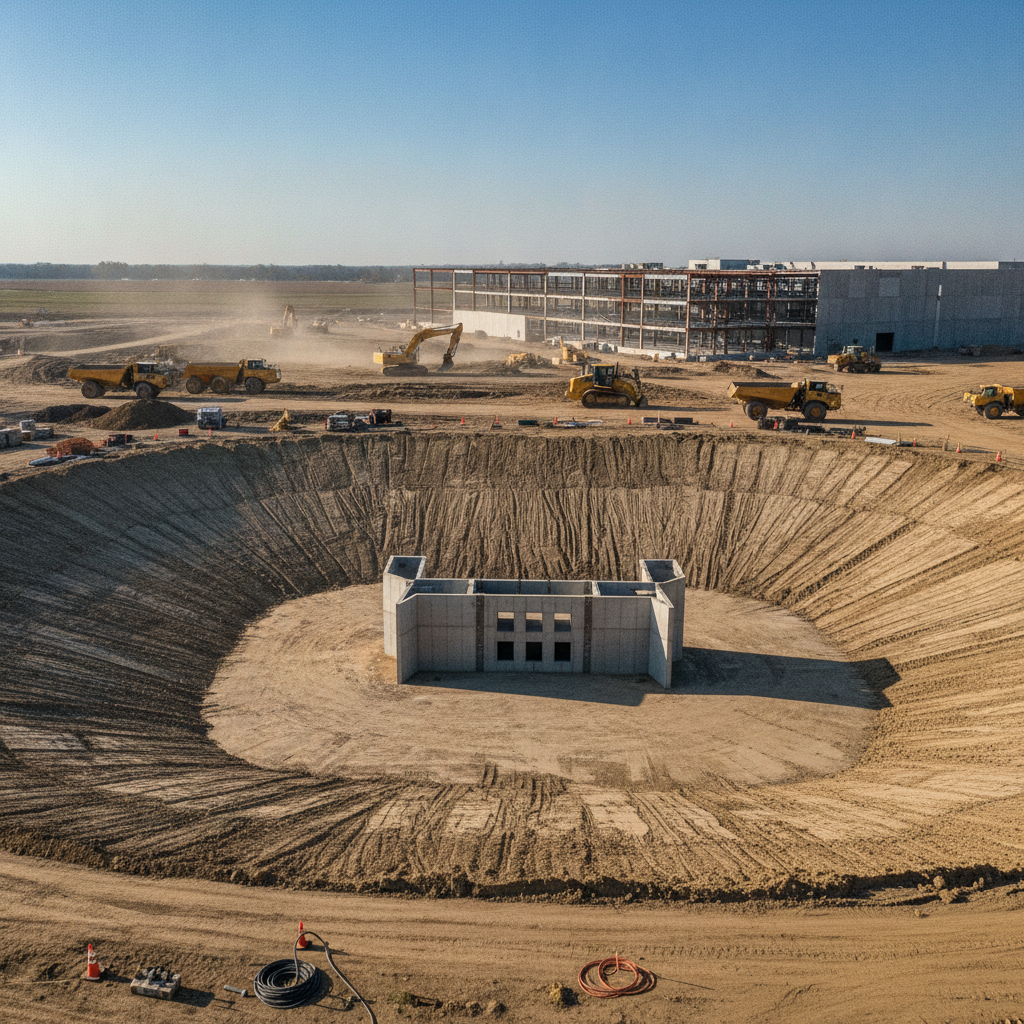
The required storage volume directly influences the pond’s physical footprint, but several other geometric parameters are critical for safety, stability, and long-term maintenance. One of the most important is freeboard, which is the vertical distance between the maximum water surface elevation during the largest design storm and the top of the pond’s embankment. This safety factor, often one to two feet, prevents waves or minor surges from overtopping the berm. The steepness of the pond’s banks, or side slope grading, is another crucial factor. Slopes are typically designed to be no steeper than 3:1 (horizontal to vertical) or 4:1 to ensure embankment stability and allow for safe mowing and maintenance access. Flatter slopes are safer but require a larger land area. Finally, a dedicated maintenance access ramp and a perimeter berm are often required so that equipment can reach the pond bottom and outlet structure for sediment removal and repairs.
Balancing Pond Footprint with Developable Land Area
For a data center developer, every square foot of land is valuable. A large, sprawling detention pond can consume acres of real estate that could otherwise be used for server buildings, cooling infrastructure, or future expansion phases. Therefore, a key part of the civil engineering design process is site optimization to minimize the pond’s footprint while still meeting all storage and safety requirements. Several strategies can achieve this land use efficiency. Where site constraints are tight, engineers may design the pond with steeper side slopes, which would then be stabilized using retaining walls or geogrid reinforcement, a solution that requires careful Geotechnical Engineering analysis. In extremely dense urban environments or on sites with very high land values, developers may opt for underground detention systems. These systems, which consist of large-diameter pipes or modular storage chambers installed beneath parking lots, are significantly more expensive but can free up the entire surface for development.
The RSP Engineers Approach to Data Center Stormwater Design
At RSP Engineers, our process begins with a comprehensive site investigation and regulatory analysis to establish a clear basis of design. We perform detailed hydrologic and hydraulic modeling to accurately quantify stormwater runoff and size the detention system for full compliance. Our team collaborates closely with data center developers, architects, and other consultants to integrate the stormwater facilities into the overall site plan design seamlessly. We understand the critical need for site optimization on mission-critical projects. Our engineers explore innovative solutions, from precisely graded ponds to underground systems, to maximize our clients’ return on their land investment. We manage the entire permitting process, preparing robust permit submittals and proactively addressing comments from the reviewing agencies to secure approvals efficiently. Our goal is to deliver a resilient, compliant, and cost-effective stormwater solution that supports the long-term operational goals of the facility.
Common Issues in Detention Pond Permitting and Construction
Even with a solid design, challenges can arise during the permitting and construction phases. A common issue during agency review is navigating conflicting requirements from different departments, such as environmental and public works agencies. This can lead to multiple rounds of revisions and requires experienced engineers who can negotiate practical solutions. During construction, encountering poor soil conditions can necessitate costly over-excavation and replacement with structural fill to ensure embankment stability. Another frequent challenge is achieving the precise invert elevations and orifice dimensions specified for the outlet control structure. Minor deviations can significantly impact the pond’s discharge rate and performance. This makes thorough construction administration and as-built surveys critical for verifying compliance. Finally, ensuring proper erosion and sediment control measures are maintained throughout the construction process is vital for avoiding fines and protecting water quality.
Partner with RSP Engineers for Your Mission-Critical Project
Successfully navigating the complexities of data center site development requires an experienced engineering partner. The team at RSP Engineers provides the expert civil engineering, stormwater management, and land development services needed to bring your mission-critical project from concept to completion. We specialize in optimizing site layouts, securing complex permits, and delivering designs that are resilient, compliant, and cost-effective. Contact us today to discuss your project’s unique challenges and learn how our site engineering services can help you achieve your goals.
Conclusion
Sizing a detention pond for a data center is a sophisticated engineering discipline that is fundamental to the project’s success. It requires a deep understanding of hydrology, precise stormwater modeling, and a practical approach to balancing regulatory compliance with the economic realities of site development. By focusing on accurate analysis, robust outlet control design, and smart site integration, developers can ensure their facilities are protected from flooding and meet all environmental obligations. Partnering with a qualified civil engineering firm near me is the first step toward achieving a resilient and successful mission-critical facility.
FAQs
-
A data center’s high percentage of impervious coverage (roofs, roads, parking) dramatically increases the volume and peak rate of stormwater runoff compared to undeveloped land. This larger runoff volume directly translates to a larger required storage volume calculation for the detention pond to attenuate the flow back to pre-development rates.
-
A detention pond is designed to be normally dry. It temporarily stores stormwater and releases it slowly through an outlet structure. A retention pond, or wet pond, is designed to maintain a permanent pool of water. While both manage runoff, retention ponds also offer water quality benefits through biological processes, but they often have a larger footprint and more complex maintenance requirements.
-
Yes. Underground detention systems are an excellent solution for sites with extreme space constraints or very high land costs. These systems use large pipes, concrete vaults, or modular plastic chambers installed below parking lots or other open areas. While effective for site optimization, they have a significantly higher capital cost than surface ponds and require specialized maintenance access.