
Tree Preservation Planning on Data Center Sites
Learn the civil engineering and permitting strategies for effective tree preservation on data center projects. Balance buildable area with local ordinances, CRZ protection, and mitigation requirements
The Regulatory Landscape of Tree Preservation Ordinances
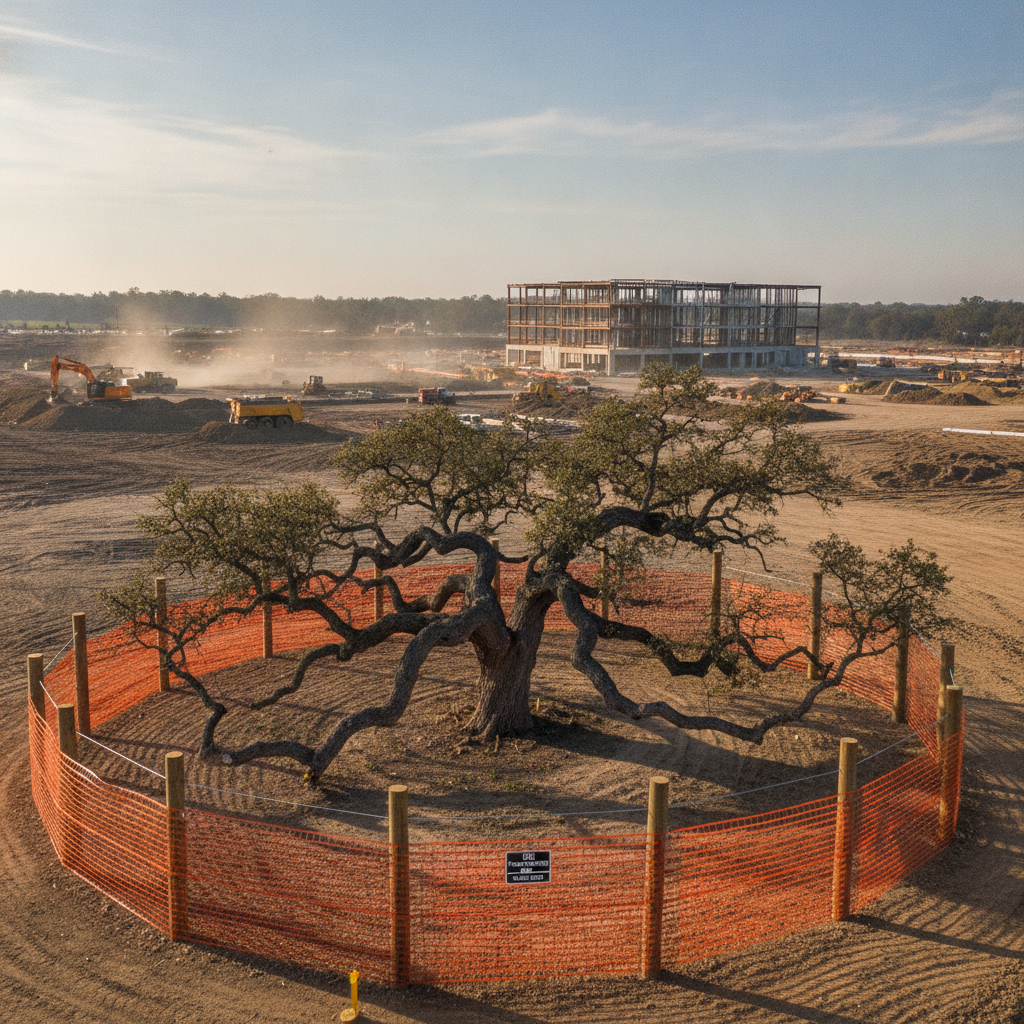
Across the United States, local governments are increasingly enacting and enforcing tree preservation ordinances to protect their community’s natural canopy. These regulations are a key part of the zoning compliance and land development process, establishing rules for the removal, replacement, and protection of trees. Ordinances typically identify certain trees for protection based on species, size (diameter at breast height or DBH), age, or historical significance, often classifying them as “specimen,” “heritage,” or “significant” trees. Removing such a tree without a permit can result in significant fines and project delays. The permitting process for tree removal often requires a detailed justification, an arborist’s report, and a mitigation plan. Permitting requirements vary by jurisdiction, and every project team should confirm the applicable standards with the local, state, regional, and federal authorities that hold review authority over the site. This early engagement with the agency review boards is crucial for understanding expectations regarding tree replacement ratios, contributions to tree mitigation banks, and on-site protection measures. A knowledgeable civil engineering consultant can help navigate these diverse regulatory frameworks to keep the project on track.
Conducting a Comprehensive Tree Survey and Inventory
Comparison of Tree Protection Measures During Construction
| Protection Method | Description | Best For | Key Considerations |
|---|---|---|---|
| Tree Protection Fencing (TPF) | Highly visible, rigid fencing (e.g., chain-link) installed at the edge of the Critical Root Zone. | Establishing a clear, non-negotiable boundary for all trees designated for preservation. | Must be installed before any clearing or grading begins. Signage should be included. Durability is key. |
| Root Pruning | A clean, vertical cut of roots along the limit of disturbance using a rock saw or similar equipment. | When construction must occur very close to the CRZ, preventing root tearing from excavation. | Must be supervised by a certified arborist. Timing is critical to allow for tree recovery. |
| Mulching and Irrigation | Applying a thick layer of mulch within the TPF and providing supplemental water. | Reducing soil compaction from incidental foot traffic and mitigating drought stress during construction. | Mulch should not be piled against the trunk. Irrigation schedule must be based on weather and soil conditions. |
| Construction Monitoring | Regular site visits by a certified arborist to inspect protection measures and tree health. | All projects, especially large-scale sites with numerous preserved trees and complex phasing. | Arborist should have authority to stop work if violations occur. Reports provide documentation for permit compliance. |
| Soil Compaction Prevention | Using ground protection mats or a thick layer of wood chips for temporary access routes near the CRZ. | When temporary access for equipment or materials is absolutely necessary near a protected tree. | Requires careful planning of construction logistics and limits the weight of vehicles that can use the path. |
The foundational step in any tree preservation plan is a comprehensive tree survey and inventory, typically performed by a certified arborist. This survey goes beyond a simple count, documenting the precise location, species, size (DBH), and health condition of every significant tree on the property. This data is then provided to the civil engineering team for integration into the project’s base map. The survey is essential for identifying which trees are protected under local ordinances and which are viable candidates for preservation based on their health and structural integrity. This detailed inventory directly informs the initial site plan design. By overlaying the tree survey with topographic data, utility easements, and proposed building footprints, the project team can immediately identify areas of conflict and opportunity. This allows for strategic adjustments to the site layout, access road alignments, and stormwater management facilities to avoid impacting high-value trees. An accurate survey prevents costly surprises during the later stages of design and permitting, ensuring that the development plan is based on a realistic understanding of the site’s constraints.
Designing Around the Critical Root Zone (CRZ)
Successfully preserving a tree involves protecting not just its trunk and canopy but also its root system. The Critical Root Zone (CRZ) is the area of soil around a tree where the essential roots for nutrient and water absorption are located. As a general rule, the CRZ is a circle with a radius of one foot for every inch of the tree’s diameter. Any disturbance within this zone—such as grading, trenching for utility coordination, soil compaction from heavy equipment, or chemical spills—can severely damage or kill the tree, even if the effects aren’t visible for several years. Effective civil engineering design treats the CRZ as a strict no-go area. The design team must carefully plan grading to avoid cutting or filling soil within the CRZ. Utility corridors for water, sewer, and power must be routed around these zones. In cases where encroachment is unavoidable, specialized techniques like directional boring for utilities or the use of retaining walls to manage grade changes can minimize impact. A successful drainage design will also ensure that changes in surface water flow do not starve or inundate the root systems of preserved trees.
Balancing Buildable Area with Preservation Goals
The primary tension in data center site design is maximizing the usable, flat area for the main facility while adhering to tree preservation requirements. This requires a collaborative and iterative design process involving the developer, architect, arborist, and civil engineer. Early in the process, the team can explore multiple site layout configurations to find a solution that achieves the necessary building footprint, parking counts, and utility access while minimizing the impact on protected trees. This is a core function of professional site engineering services. Creative solutions are often necessary. For example, parking lots can be designed with irregular shapes to curve around significant tree stands. Stormwater management ponds or infiltration basins can be located in areas with less significant tree cover. In some cases, a slightly less efficient layout that preserves a prominent heritage tree can significantly smooth the path through the public hearing and permitting process, providing a net benefit to the project schedule. This strategic approach demonstrates a commitment to responsible land development and can foster goodwill with local review agencies.
Construction Phase Protection and Monitoring
A well-designed tree preservation plan is only effective if it is rigorously implemented in the field. The construction administration phase is where the plan succeeds or fails. The first step is the installation of robust, highly visible tree protection fencing around the CRZ of every preserved tree. This fencing must be erected before any clearing, grading, or demolition begins and must remain in place throughout the entire construction process. Pre-construction meetings with all contractors are essential to communicate the importance of these protected zones. Ongoing monitoring is also critical. A certified arborist should conduct regular site inspections to ensure that protection measures are intact and effective. They can identify signs of tree stress early and recommend corrective actions, such as supplemental watering or soil treatments. This third-party oversight provides valuable documentation for the owner and helps ensure building code compliance and adherence to permit conditions. Any accidental damage to a protected tree must be reported to the arborist and the permitting agency immediately to determine the necessary remediation steps.
How RSP Engineers Integrates Tree Preservation into Site Design
At RSP Engineers, we view tree preservation as an integral part of a successful land development strategy. Our process begins during the earliest stages of site selection and due diligence, where we identify potential regulatory hurdles and opportunities related to a site’s natural features. We collaborate with certified arborists to conduct thorough tree inventories and use that data to inform our initial concept layouts. This proactive approach minimizes costly redesigns and streamlines the entitlement process. Our team of Civil engineers utilizes advanced design software to optimize the site plan design, balancing the project’s programmatic needs with the preservation of valuable trees. We carefully engineer grading, drainage, and utility systems to avoid impacts to Critical Root Zones. Throughout the permitting and agency review process, we serve as a dedicated advocate for our clients, clearly communicating the project’s preservation strategy. During construction, we provide diligent construction administration to ensure that the approved plans are executed faithfully in the field.
Common Challenges in Data Center Tree Preservation
Even with careful planning, data center projects can face several common challenges related to tree preservation. One of the most frequent issues is underestimating the long-term impact of grade changes near a tree’s CRZ; a tree may survive construction only to die a few years later due to root suffocation or dehydration. Another challenge is contractor non-compliance, where crews inadvertently store materials or park vehicles inside protected areas, causing soil compaction and root damage. Discovering a previously unidentified heritage tree late in the design process can force significant and expensive redesigns. Furthermore, conflicts can arise between the ideal routing for large-diameter utility mains and the location of a stand of protected trees, requiring complex utility coordination and creative engineering solutions. Addressing these challenges requires a project team with deep experience in large-scale site development and a commitment to proactive problem-solving.
Partner with RSP Engineers for Sustainable Site Development
Navigating the complexities of tree preservation on large-scale data center projects requires specialized expertise and a proactive approach. The team at RSP Engineers is ready to help you integrate sustainable design practices into your next mission-critical facility. We provide comprehensive site engineering services, from initial due diligence and permitting to detailed civil engineering design and construction administration. Contact us today to discuss how we can help you achieve your project goals while protecting valuable natural resources.
Conclusion: A Strategic Approach to Site Harmony
Ultimately, tree preservation is not an obstacle to data center development but a key component of a smart and sustainable site strategy. By addressing tree ordinances, CRZ protection, and mitigation requirements early in the design process, developers can avoid costly delays and create facilities that are both technologically advanced and environmentally responsible. An integrated approach, led by an experienced civil engineering team, ensures that the goals of the project are achieved in harmony with the surrounding landscape. This commitment to responsible site development enhances the project’s value and builds a positive legacy in the community, all while delivering the critical digital infrastructure of the future.
FAQs
-
A specimen or heritage tree is a tree that a local ordinance designates for protection due to its size, age, species, or historical significance. The exact criteria for this designation are defined in local zoning compliance codes and can vary significantly from one jurisdiction to another. These trees typically have the highest level of protection, often requiring special permits for any work within their vicinity.
-
Transplanting large, mature trees is technically possible but is an extremely expensive, high-risk, and logistically complex operation. It requires specialized equipment and a long-term care plan to ensure survival. While it can be an option in some cases, it is often more feasible from a cost and risk perspective to adjust the site plan design to preserve the tree in its original location.
-
If a contractor damages a tree protected under a local ordinance, the consequences can be severe. This can include stop-work orders, significant financial penalties (often calculated based on the value of the tree), and mandatory mitigation requirements, such as planting multiple replacement trees. Proper construction administration and clear communication with all on-site personnel are the best ways to prevent such incidents.