
Brownfield Redevelopment for Data Center Facilities
Explore the civil engineering challenges and opportunities of redeveloping brownfield sites for data centers. Learn about ESAs, remediation, and permitting.
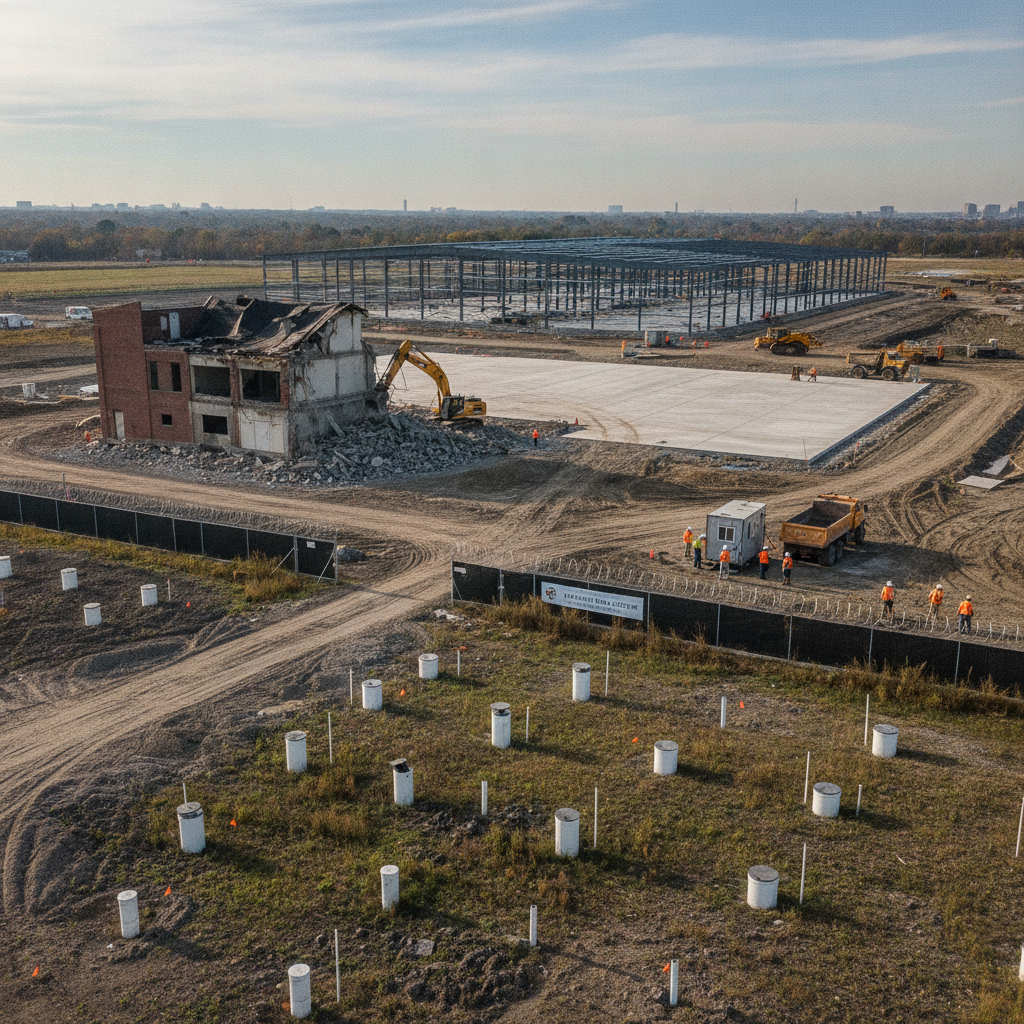
The Strategic Advantage of Brownfield Sites for Data Centers
At first glance, brownfield sites may seem like a liability. However, for data center developers, they can represent a strategic opportunity. Many of these properties are located in or near urban areas, providing low-latency connectivity to population centers. Decades of prior industrial use often means the sites are equipped with or adjacent to the high-capacity electrical power and water service that data centers demand, reducing the timeline and cost associated with major utility coordination and off-site improvements. Furthermore, redeveloping a brownfield is a sustainable practice that revitalizes underutilized land, prevents sprawl, and may be supported by local and federal incentives. The key to unlocking this value lies in a comprehensive due diligence process. A successful project hinges on accurately identifying environmental risks and developing a cost-effective plan for remediation that aligns with the data center’s specific design and operational requirements. This requires a multidisciplinary team capable of navigating complex regulatory landscapes and integrating environmental solutions into the core site plan design from day one.
Phase I & Phase II Environmental Site Assessments (ESAs)
Comparison of Common Remediation Technologies
| Remediation Technology | Primary Application | Key Considerations for Data Center Projects |
|---|---|---|
| Excavation & Disposal | Soils with high contaminant concentrations (e.g., metals, petroleum). | Fastest method to achieve closure but can be very expensive and disruptive to site logistics. Requires careful coordination with mass grading and site development activities. |
| Soil Vapor Extraction (SVE) | Volatile organic compounds (VOCs) in unsaturated soils. | Minimally disruptive to the surface. Can operate during early construction phases but requires long-term power and maintenance. Must address vapor intrusion pathways. |
| In-Situ Chemical Oxidation (ISCO) | Organic contaminants (solvents, fuels) in soil and groundwater. | Can be very effective and relatively fast, but injection process requires careful planning around foundation and utility installation. Potential for temporary groundwater changes. |
| Engineered Capping | Contains low-mobility contaminants in place. | Cost-effective for large areas. The cap (e.g., clean soil, asphalt, building slab) must be integrated into the final drainage design and site grading plan and maintained indefinitely. |
| Monitored Natural Attenuation (MNA) | Low-level, stable contaminant plumes in groundwater. | Lowest cost but longest timeline. Requires long-term monitoring and may involve institutional controls, which could impact future site modifications. Often used with other remedies. |
The foundation of any brownfield project is the Environmental Site Assessment (ESA). The process begins with a Phase I ESA, a non-intrusive investigation designed to identify potential or existing environmental contamination. This involves reviewing historical records (such as aerial photographs, property deeds, and industrial directories), conducting a thorough site reconnaissance, and interviewing past owners or operators to identify Recognized Environmental Conditions (RECs). The goal is to understand the site’s history and what types of contaminants might be present based on its former use. If the Phase I ESA reveals RECs, a Phase II ESA is required. This is a subsurface investigation involving the collection and analysis of soil, groundwater, and sometimes soil vapor samples. A Geotechnical engineer often works in tandem with environmental scientists during this phase, as soil borings can serve both environmental and geotechnical purposes, such as providing data for foundation design. The results of the Phase II ESA quantify the nature and extent of contamination, which is critical for developing a remedial action plan and estimating cleanup costs. This data forms the basis for all subsequent remediation and design decisions.
Navigating the Regulatory Framework for Brownfield Cleanup
The regulatory path for brownfield cleanup is complex and involves oversight from multiple agencies. Most states have established Voluntary Cleanup Programs (VCPs) or similar frameworks that provide a structured process for assessment, remediation, and closure. These programs offer significant incentives, including liability protection for developers who follow the approved process, often in the form of a “No Further Action” letter upon completion. This protection is crucial for securing financing and insurance for the project. Successfully navigating these programs requires deep expertise in environmental regulations and strong relationships with agency reviewers. The specific requirements for investigation, cleanup levels, and public notification vary by jurisdiction, and every project team should confirm the applicable standards with the local, state, regional, and federal authorities that hold review authority over the site. A key part of this process is developing a Remedial Action Plan (RAP) that details the proposed cleanup strategy. This plan undergoes rigorous agency review and must demonstrate that the chosen remedy will be protective of human health and the environment for the intended land use—in this case, a mission-critical data center. Effective permitting strategy and clear communication are essential to keep the project on schedule.
Common Remediation Strategies for Contaminated Sites
Once the contamination is characterized, the project team selects a remediation strategy. The choice depends on the type of contaminants, soil and groundwater conditions, project timeline, budget, and the final civil engineering design. One common approach is excavation and disposal, often called “dig and haul,” where contaminated soil is physically removed and transported to a licensed disposal facility. While straightforward, it can be costly and generate significant truck traffic. Alternatively, in-situ (in-place) treatments address contamination without excavation. These methods include technologies like in-situ chemical oxidation (ISCO), which uses chemical reagents to destroy contaminants in the ground, and bioremediation, which uses microorganisms to break them down. For contaminants that produce harmful vapors, a vapor intrusion mitigation system, such as a sub-slab depressurization system or a vapor barrier, is often integrated into the building’s foundation design. This is a critical consideration for data centers to protect sensitive electronic equipment and ensure a safe environment for personnel.
Engineering and Institutional Controls: Long-Term Site Management
Not all contamination is removed from a brownfield site. In many cases, it is more practical and cost-effective to manage the remaining contamination in place using a combination of engineering and institutional controls. Engineering controls are physical measures designed to contain or isolate contaminants. For a data center, this could include the building’s foundation slab acting as a cap, a specialized vapor barrier installed beneath the building, or a permanent stormwater management system designed to prevent infiltration through a contaminated area. Institutional controls are non-physical, legal, or administrative measures that limit site use to prevent exposure to any remaining contamination. Examples include deed restrictions that prohibit the use of groundwater for drinking, or a requirement to maintain an engineered cap. These controls are recorded in public land records and are binding on future owners. The civil engineering team must ensure the final site plan design fully incorporates and documents these long-term obligations.
Integrating Site Remediation with Data Center Construction
One of the greatest challenges in brownfield redevelopment is the integration of remediation activities with the construction schedule. Phasing is critical. For example, soil excavation may need to be completed in certain areas before foundation work can begin, while an in-situ treatment system might operate concurrently with utility installation in another part of the site. This requires meticulous planning and construction administration. A site-specific Health and Safety Plan (HASP) is mandatory to protect workers and the surrounding community during all ground-disturbing activities. The plan outlines procedures for air monitoring, personal protective equipment (PPE), and the management of excavated soils and dewatering effluent. The civil engineering plans must include details for stockpiling, testing, and properly disposing of contaminated materials, as well as managing clean and contaminated stormwater runoff in compliance with the project’s NPDES permit.
RSP Engineers’ Approach to Brownfield Data Center Projects
At RSP Engineers, we guide clients through the entire brownfield redevelopment lifecycle. Our process begins with comprehensive due diligence support, helping clients understand the environmental liabilities and development potential of a site before acquisition. We manage and oversee Phase I and II ESAs, working with trusted environmental partners to accurately characterize site conditions. Our team then develops a strategic Remedial Action Plan that aligns with both regulatory requirements and our client’s business objectives. Our core strength lies in integrating the remediation strategy directly into the civil engineering design. We ensure that engineering controls are seamlessly incorporated into the site plan design, drainage design, and utility layouts. We handle the complex permit submittals to environmental and land use agencies, advocating for our clients to achieve timely approvals. During construction, our Construction Management Services provide oversight to ensure that remediation and site work are executed safely, correctly, and in compliance with the approved plans.
Overcoming Common Hurdles in Brownfield Redevelopment
Developers pursuing brownfield projects should be prepared for potential challenges. The most common hurdle is the discovery of unexpected contamination, which can lead to significant cost overruns and schedule delays. A thorough Phase II ESA minimizes this risk, but a healthy contingency in the project budget is always prudent. Regulatory standards can also change over time, potentially affecting cleanup goals or requiring additional assessment mid-project. Securing financing and insurance can be more difficult for brownfield sites due to perceived environmental liabilities. A clear and regulator-approved Remedial Action Plan, along with evidence of liability protection through a VCP, is essential for giving lenders and insurers confidence. Finally, community engagement is vital. Proactively communicating the project’s safety measures and long-term benefits can help build support and streamline the local zoning compliance and approval process.
Partner with RSP Engineers for Your Mission-Critical Brownfield Project
Transforming a contaminated brownfield into a high-performance data center is a complex undertaking that demands specialized expertise. The team at RSP Engineers provides the integrated site engineering services needed to navigate these challenges. We manage everything from initial environmental due diligence and remedial planning to final civil engineering design and complex permitting. Our goal is to de-risk your investment, streamline the development process, and deliver a site that is safe, compliant, and ready for your mission-critical infrastructure. Contact us today to discuss your brownfield redevelopment project.
Conclusion: Transforming Liabilities into Assets for the Digital Age
Brownfield sites, with their strategic locations and existing infrastructure, represent a significant and sustainable opportunity for data center development. While the path is paved with environmental regulations, subsurface uncertainties, and logistical complexities, these challenges are surmountable with the right expertise. A successful project is built on a foundation of thorough due diligence, a smart and integrated remediation strategy, and a proactive approach to regulatory compliance. By partnering with an experienced civil engineering firm, developers can confidently transform these legacy industrial sites from environmental liabilities into valuable assets for the digital age.
FAQs
-
The timeline varies dramatically based on the type and extent of contamination, the chosen remediation technology, and the agency review process. A simple excavation project might take a few months, while an in-situ groundwater treatment project could require years of operation and monitoring. The schedule is a critical component of the initial site development feasibility analysis.
-
The primary risks are financial and logistical. These include unexpected cleanup costs that exceed the budget, schedule delays caused by regulatory hurdles or unforeseen site conditions, and potential long-term liability if the remediation is not completed properly. A robust due diligence process and a well-structured VCP agreement are the best tools to mitigate these risks.
-
Often, yes. This is a major advantage of many brownfield sites. However, all existing utilities must undergo a thorough condition assessment. This includes verifying capacity, physical integrity, and location. It’s also critical to ensure that utility corridors are not located within heavily contaminated zones or that any necessary trenching can be performed safely and in compliance with the HASP.