
Texas Data Center Expansive Soils
A technical guide for data center developers on mitigating risks from Texas expansive clay soils. Learn about geotechnical investigation, soil stabilization, and foundation design.
Understanding Expansive Clay and Shrink-Swell Behavior
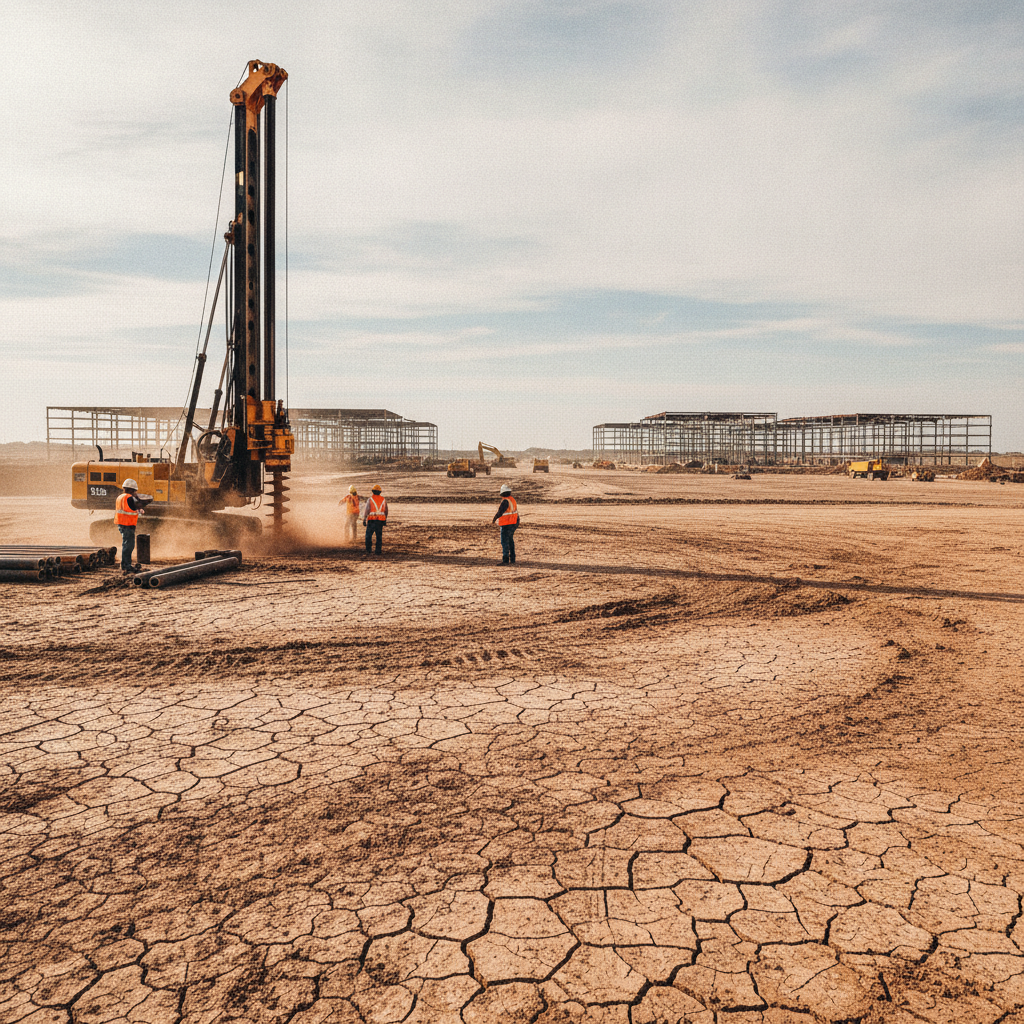
Expansive soils contain a high concentration of certain clay minerals, primarily montmorillonite, which can absorb large quantities of water. This absorption causes the soil volume to increase significantly—a phenomenon known as heave. Conversely, during dry periods, the soil loses moisture and shrinks, often leading to deep cracks in the ground. This cyclical shrink-swell behavior exerts immense pressure on structures built upon it, leading to differential movement that can cripple a facility as precise as a data center. The key metric for quantifying this potential is the Plasticity Index (PI), a measure of the soil’s plasticity range. Higher PI values generally indicate a greater potential for expansion. For a data center, the consequences of unmitigated soil movement are severe. Differential heave can cause concrete floor slabs to crack and tilt, misaligning server racks and damaging sensitive equipment. It can also shear underground utility conduits, including critical power and fiber optic lines, leading to catastrophic outages. Therefore, a primary goal of the site plan design is to isolate the facility from this movement or to engineer the ground itself to be more stable. This requires a deep understanding of the site’s specific soil profile, which can only be obtained through a thorough investigation by a qualified Geotechnical engineer.
The Critical Role of Geotechnical Investigation
Comparison of Foundation Mitigation Strategies for Expansive Soils
| Mitigation Strategy | Ideal Application | Key Design Considerations | Relative Cost |
|---|---|---|---|
| Moisture Control & Site Grading | Low PVR sites (<1 inch); used in conjunction with all other methods. | Positive drainage away from foundation; roof runoff control; irrigation management; potential for moisture barriers. | Low |
| Select Fill Replacement | Moderate PVR sites (1-3 inches); where suitable fill is available locally. | Depth of removal; compaction specifications for fill; quality control of imported material. | Moderate |
| Lime Stabilization | Moderate to high PVR sites; soils with appropriate chemistry for reaction. | Lime application rate; mixing depth; moisture conditioning; mellowing period; compaction requirements. | Moderate to High |
| Stiffened Slab-on-Grade | Moderate PVR sites where soil treatment is not fully sufficient. | Beam depth and spacing; steel reinforcement design; requires careful analysis by a structural engineer. | High |
| Drilled Pier & Structural Slab | High PVR sites (>3 inches); when zero movement tolerance is required. | Pier depth and diameter; reinforcement; void space design to accommodate heave; highest level of engineering. | Very High |
A comprehensive geotechnical investigation is the foundational first step in any data center project on a site with suspected expansive soils. This is not an area for cutting corners; the data gathered here will dictate the entire site development strategy and budget. The investigation, detailed in a Geotechnical soil report, provides the essential data needed for a Professional Engineer to design effective mitigation measures. The process involves multiple phases of both field and laboratory work. Field investigation typically includes drilling a series of soil boring test locations across the proposed building footprint and infrastructure areas. Soil samples are collected at various depths to create a detailed subsurface profile. In the lab, these samples undergo a battery of tests to determine their engineering properties. Key tests include Atterberg limits to find the Plasticity Index (PI), moisture content analysis, and one-dimensional swell tests to measure the pressure exerted by the soil as it hydrates. The results of this Soil Test are synthesized to predict the site’s Potential Vertical Rise (PVR), the maximum amount of heave the foundation could experience.
Assessing Potential Vertical Rise (PVR) and Its Impact on Slabs
Potential Vertical Rise (PVR) is the single most important metric derived from the geotechnical investigation. It represents the predicted maximum vertical movement of the ground surface if the soil moisture content were to increase from a dry to a fully saturated state. This value is calculated based on the swell potential of each soil layer, its thickness, and its initial moisture condition. For mission-critical facilities like data centers, a PVR of more than one inch is generally considered unacceptable for conventional slab-on-grade foundations and requires significant engineering intervention. The goal of the site engineering services is to reduce the effective PVR to a manageable level. The impact of a high PVR on a data center’s massive, flat floor slab is profound. Heave is rarely uniform across a large footprint, leading to differential movement that bends and cracks the concrete. This can disrupt the precise alignment of server racks, damage sensitive cooling and power distribution systems, and create tripping hazards. Furthermore, movement can strain and break utility connections at the building perimeter. The entire civil engineering design, from grading to foundation selection, must be focused on mitigating this PVR and ensuring the long-term structural stability of the slab.
Mitigation Strategy 1: Moisture Control and Site Grading
The most direct way to prevent soil swell is to maintain a constant moisture content in the soil beneath the foundation. If the soil never gets significantly wetter, it cannot heave. This principle is the basis for the first line of defense: aggressive moisture control. This strategy begins with a meticulous drainage design that ensures surface water is collected and swiftly routed away from the building footprint. This includes proper roof drainage, surface swales, and subsurface drains designed to prevent water from ponding near the foundation. Site grading plays a crucial role, with the ground surface sloped away from the building on all sides to promote positive drainage. In many cases, this is supplemented with vertical and horizontal moisture barriers. A vertical barrier, often a geomembrane, can be installed in a trench around the building perimeter to a depth below the active zone, blocking lateral water migration. A horizontal barrier may be placed beneath the building and surrounding flatwork. Careful planning of landscaping is also essential; large trees with extensive root systems should be kept far from the foundation, and irrigation systems must be designed to prevent oversaturation. This is a core component of the services provided by leading Civil Engineering Firms.
Mitigation Strategy 2: Soil Treatment and Replacement
When passive moisture control is insufficient, the next strategy is to alter the soil itself to reduce its swell potential. The most common methods are removal-and-replacement and chemical stabilization. In a removal-and-replacement scenario, a predetermined depth of the expansive clay (e.g., 4-8 feet) is excavated from the building pad and replaced with a low-plasticity, non-expansive material known as select fill. This creates a stable buffer layer that absorbs some of the pressure from deeper expansive soils and distributes loads more evenly. Alternatively, lime stabilization is a widely used chemical treatment process. Quicklime or hydrated lime is mixed into the native expansive soil, triggering a chemical reaction that permanently alters the clay minerals, reducing the soil’s Plasticity Index and swell potential. This process requires careful execution, including proper pulverization, mixing, moisture conditioning, and compaction to achieve the desired engineering properties. The effectiveness of lime stabilization is highly dependent on the specific soil chemistry and must be confirmed through laboratory testing during the design phase. This type of earthwork is a specialty of experienced Land Development companies in Texas.
Mitigation Strategy 3: Advanced Foundation and Slab Design
In cases of very high PVR or when soil treatment is not feasible, the foundation and slab must be designed to either withstand or completely isolate themselves from soil movement. A common approach for moderate swell potential is a stiffened slab-on-grade, often called a waffle slab or a slab with integrated grade beams. These foundations are reinforced with a grid of deep, steel-reinforced concrete beams that provide the rigidity needed to resist bending and differential heave, allowing the slab to ‘float’ over minor movements. For the most severe conditions, a structurally supported slab is the preferred solution. This design completely decouples the slab from the ground. The foundation system consists of deep foundations, such as drilled concrete piers or piles, that extend through the active expansive soil layer into a stable, non-expansive stratum below. The building’s structural slab is then poured on top of these piers, with a void space (often created using cardboard void forms that degrade over time) left between the slab’s underside and the expansive soil. This allows the ground to swell and shrink freely without ever touching or exerting pressure on the data hall floor, providing the highest level of protection.
The RSP Engineers Approach to Geotechnical Risk Mitigation
At RSP Engineers, we approach data center projects on expansive soils with a risk-based, integrated methodology. Our process begins with a peer review of the Geotechnical soil report and close collaboration with the project’s Geotechnical engineer to fully understand the site’s constraints and potential. We believe that early integration of geotechnical findings into the overall site plan design is critical to developing a cost-effective and reliable solution. Our team of Civil Engineers then develops a holistic site strategy that combines robust drainage design, precise grading, and utility layout to support the chosen foundation approach. We model stormwater behavior to ensure our designs prevent water infiltration near the foundation under extreme weather events. During the design and permitting phases, we provide detailed plans and specifications for earthwork, soil treatment, and utility coordination. We also offer Construction Management Services to provide quality assurance during critical construction phases, verifying that soil treatment and foundation installation meet the project’s stringent engineering requirements.
Common Issues: Overlooking Long-Term Moisture Management and Utility Interfaces
A frequent oversight in projects on expansive soils is focusing solely on the initial construction while neglecting long-term performance. The ground does not stop moving after the certificate of occupancy is issued. Post-construction issues like plumbing leaks, poorly managed irrigation, or blocked drainage systems can reintroduce moisture into the subgrade, reactivating the swell potential and compromising the initial design. A comprehensive site maintenance plan is crucial for the long-term health of the facility. Another critical issue is the interface between the building and its underground utilities. As the soil heaves and settles, it can create shear points on rigid utility conduits, such as electrical duct banks and chilled water lines. This can lead to breaks that are difficult and expensive to repair. Designs must incorporate flexible connections and transition details where utilities enter the building or connect to manholes to accommodate the anticipated differential movement. This level of detail in utility coordination is a hallmark of experienced site engineering services. Frequently Asked Questions (FAQ) What is an acceptable Plasticity Index (PI) for a data center site in Texas? While there’s no single magic number, a Plasticity Index (PI) below 20 is generally considered low risk, 20-40 is moderate, and above 40 is high. For a mission-critical data center, any soil with a PI above 25-30 will likely require significant engineering and mitigation, such as lime stabilization or a structural slab foundation. How deep do soil borings need to go for a geotechnical investigation? The depth of the soil boring test depends on the anticipated foundation type and the depth of the active moisture zone. For data centers, borings often extend 30 to 50 feet or more to ensure they penetrate well below the zone of seasonal moisture fluctuation and identify a stable bearing stratum for potential deep foundations. Can lime stabilization be performed in any weather? No, weather has a significant impact. Lime stabilization is best performed in dry, warm conditions. Heavy rain can oversaturate the soil, making it impossible to achieve proper mixing and compaction. Cold temperatures can significantly slow the chemical reactions that are essential for stabilization, reducing the effectiveness of the treatment. Is a structural slab always better than a slab-on-grade on expansive soils? A structurally supported slab offers the highest level of protection but is also the most expensive solution. It is not always necessary. For sites with low to moderate PVR, a combination of moisture control, soil treatment, and a properly designed stiffened slab-on-grade can provide a reliable and more cost-effective solution. The choice depends on a risk-benefit analysis guided by the Geotechnical soil report. How does expansive soil affect underground utility design? Expansive soils can exert significant force on underground utilities. The utility coordination and design process must account for potential movement. This often involves specifying flexible pipe materials, using swing joints or flexible couplings where pipes enter structures, and bedding conduits in non-expansive sand or gravel to create a buffer against soil pressure.
Your Partner for Mission-Critical Site Development in Texas
Developing a data center on Texas’s challenging expansive soils demands a civil engineering partner with deep technical expertise and a proactive, risk-aware mindset. RSP Engineers provides the comprehensive site development services needed to navigate these complexities. From initial due diligence and collaborating on the geotechnical investigation to detailed utility coordination and construction oversight, our team ensures your project is built on a foundation of stability and resilience. Don’t let subsurface risks jeopardize your mission-critical investment. Contact us today to discuss how we can support your next data center project.
Conclusion
Building data centers on Texas expansive soils is a complex but entirely manageable engineering challenge. Success is not about avoiding these sites, but about addressing the risks head-on with a strategy founded on thorough investigation and proven engineering principles. By prioritizing a comprehensive geotechnical investigation, implementing a multi-layered mitigation strategy that includes moisture control and soil treatment, and selecting an appropriate foundation system, developers can construct facilities that are resilient for the long term. Ultimately, a proactive approach to site design and collaboration with experienced Civil Engineers are the keys to protecting these invaluable digital infrastructure assets from the ground up.
FAQs
-
Texas Data Center Expansive Soils requires careful planning, qualified engineering, and compliance with the applicable codes and permits.
-
Getting Texas Data Center Expansive Soils right protects safety, supports regulatory compliance, and avoids costly redesigns or delays.
-
RSP Engineers provides licensed expertise and end-to-end support for Texas Data Center Expansive Soils, from early planning through permitting.