
Settlement Analysis for Data Center Buildings
A deep dive into settlement analysis for data centers. Learn about consolidation, tolerable limits, ground improvement, and foundation design for mission-critical facilities.
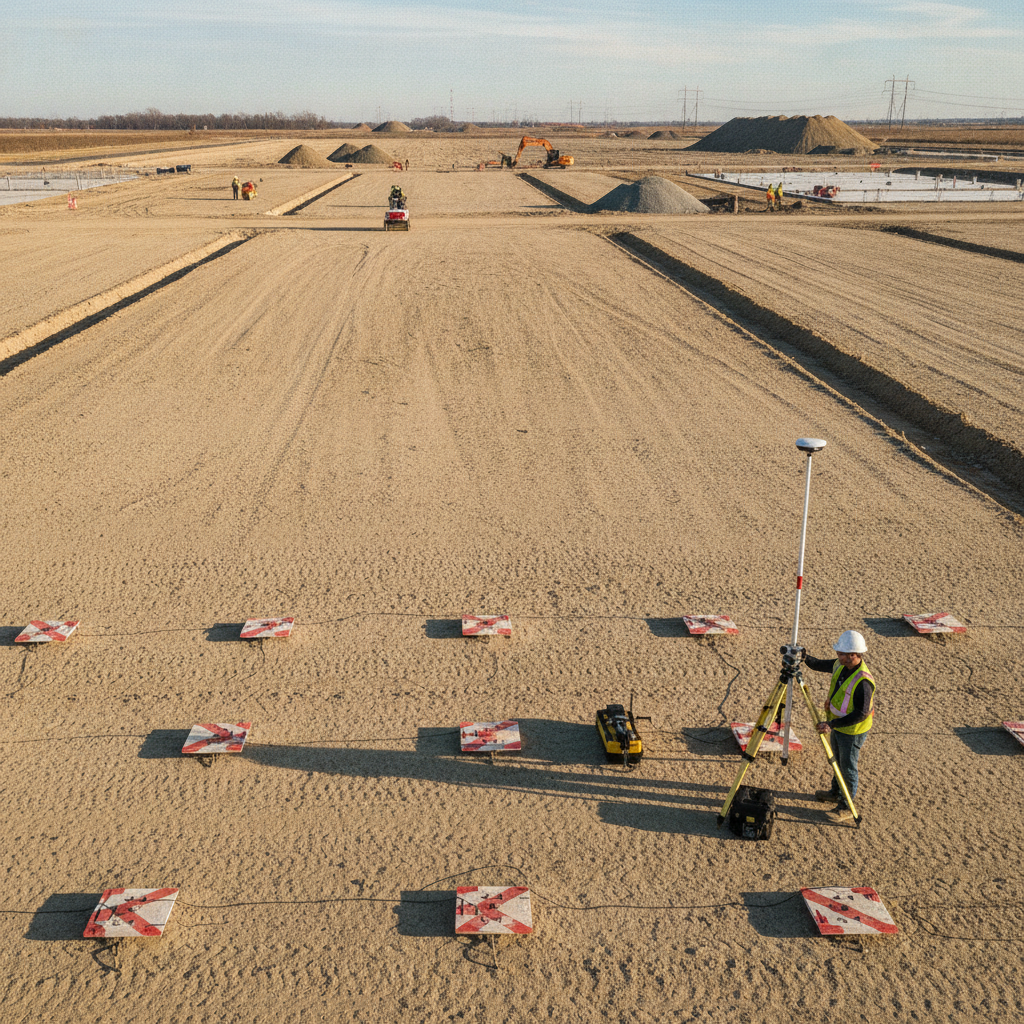
Understanding the Mechanisms of Soil Settlement
Soil settlement is the vertical movement of the ground surface caused by the application of structural loads. For a massive, heavily loaded structure like a data center, this process is complex and occurs in three distinct phases. Understanding each phase is critical for accurate prediction and mitigation. The first is immediate settlement, an elastic compression that occurs rapidly as loads are applied, most prominently in granular soils like sand and gravel. The second and often most significant phase is primary consolidation. This time-dependent process occurs in saturated fine-grained soils, such as clays and silts. The building’s weight increases the pore water pressure within the soil, causing water to slowly drain out and the soil skeleton to compress. The final phase is secondary compression or creep, a long-term rearrangement of soil particles under a constant load that continues after primary consolidation is complete. A comprehensive Geotechnical Engineering study is essential to identify the dominant settlement mechanisms at a specific site.
Geotechnical Investigation for Accurate Settlement Prediction
Comparison of Common Ground Improvement Methods
| Technique | Primary Application (Soil Type) | Key Advantage | Potential Constraint |
|---|---|---|---|
| Preloading / Surcharging | Soft, compressible clays and silts | Cost-effective for large areas; uses common materials. | Requires significant time (months to years) for consolidation. |
| Vibro-Compaction | Loose, clean granular soils (sands) | Rapid treatment and immediate strength gain. | Ineffective in soils with high fines (silt/clay) content. |
| Aggregate Piers / Stone Columns | Soft clays, silts, and loose sands | Increases bearing capacity and accelerates consolidation. | Requires specialized equipment and quality control. |
| Deep Soil Mixing | Soft to medium stiff clays, silts, and organic soils | Creates high-strength, low-permeability soil-cement columns. | Can be costly; requires careful management of spoils. |
| Deep Foundations (Piles) | All soil types, especially very weak or deep compressible layers | Bypasses problematic soils to transfer loads to competent strata. | Typically the highest cost option; involves vibration or noise. |
A reliable settlement analysis is built upon a foundation of high-quality subsurface data. A comprehensive geotechnical investigation is the first and most critical step, involving a detailed program of soil borings, in-situ testing, and laboratory analysis. Techniques like the Standard Penetration Test (SPT) and Cone Penetration Test (CPT) provide real-time data on soil density and strength, while undisturbed soil samples are collected for laboratory testing. These investigations are fundamental to creating an accurate subsurface model for the site plan design. In the lab, tests such as the oedometer test are performed to determine the compressibility characteristics of soil layers, which are essential for calculating consolidation settlement. The data gathered informs the entire design process, from foundation selection to the need for ground improvement. Geotechnical investigation requirements and reporting standards can vary by jurisdiction, and it is crucial to confirm all applicable criteria with the local, state, and federal authorities overseeing the project. A thorough investigation minimizes surprises during construction and provides the necessary parameters for a robust foundation design.
Estimating Settlement Magnitude and Time Rate
Once subsurface conditions are defined, engineers can begin estimating the two key components of settlement: magnitude and time rate. The magnitude includes both total settlement (the overall drop in elevation) and, more critically, differential settlement—the uneven movement between different parts of the foundation. It is differential settlement that causes structural distress, cracks in slabs and walls, and misalignment of sensitive equipment and utility connections. Calculating the time rate of settlement, particularly for primary consolidation in clay soils, is equally important. This analysis predicts how long it will take for the majority of the settlement to occur, which can range from months to many years. This forecast is vital for planning construction sequencing, especially when large fills or surcharge loads are used to pre-compress the soil. Advanced modeling software helps engineers simulate the effects of complex loading conditions and predict long-term foundation performance.
Tolerable Settlement Criteria for Mission-Critical Facilities
Data centers operate with exceptionally strict tolerable settlement criteria. While a standard warehouse might withstand an inch or more of differential settlement, a data center’s tolerance is often an order of magnitude smaller. The key metric is angular distortion, or the ratio of differential settlement to the distance between two points. Excessive angular distortion can compromise the structural frame, break sensitive utility conduits, and misalign server rack systems that rely on precise leveling. These stringent requirements necessitate a performance-based approach to foundation design. The design team, including structural and Geotechnical engineers, must establish clear performance criteria at the project’s outset. These criteria guide the selection of foundation systems and any necessary ground improvement techniques to ensure that post-construction movement remains well within the acceptable limits for the facility’s entire operational life.
Settlement Mitigation and Ground Improvement Techniques
When the native soils cannot meet the strict settlement criteria of a data center, engineers turn to ground improvement and specialized foundation systems. The goal of these techniques is to strengthen, densify, or stiffen the underlying soils to reduce post-construction settlement and increase bearing capacity. The selection of a method depends on the soil type, the required performance, the project schedule, and the budget. Common strategies include preloading, where temporary fill (a surcharge) is placed on the site to induce settlement before the building is constructed. For granular soils, vibro-compaction can be used to densify the soil. In cohesive soils, techniques like deep soil mixing or the installation of aggregate piers (stone columns) create stiff reinforcing elements within the soil mass. These methods effectively transfer structural loads to deeper, more competent strata, providing a stable base for the site development.
The Role of Foundation Design in Managing Settlement
The choice of foundation is a critical decision in controlling settlement. For data centers, a rigid mat foundation is often preferred over isolated spread footings. A mat foundation is a large, thick, heavily reinforced concrete slab that underlies the entire building. Its rigidity helps to average out variations in soil support and distribute the massive building loads more evenly, significantly reducing differential settlement. In cases where compressible soils are very deep or ground improvement is not feasible, deep foundations are required. This involves driving or drilling piles or shafts through the weak soil layers into underlying bedrock or a dense, incompressible stratum. While more expensive, pile foundations provide the highest level of certainty in settlement control, effectively isolating the structure from the behavior of the problematic upper soils. The decision between a mat slab and deep foundations is a key outcome of the geotechnical investigation.
Construction-Phase Settlement Monitoring and Verification
A settlement analysis does not end with the design drawings. A robust settlement monitoring program during construction is essential to verify that the foundation is performing as predicted. This involves installing and regularly surveying monitoring points, such as settlement plates and pins on columns and foundation elements. The data collected is compared against the predicted settlement curves from the design phase. This program serves as a critical quality control measure. If settlement rates exceed predictions, it provides an early warning, allowing the project team to implement pre-planned contingency measures. This proactive approach to construction administration protects the owner’s investment and ensures the facility’s long-term performance, providing a documented record of as-built foundation behavior.
How RSP Engineers Manages Settlement Risk
At RSP Engineers, we approach settlement risk with an integrated, multi-disciplinary strategy. Our process begins with a comprehensive Geotechnical Engineering investigation tailored to the unique demands of mission-critical facilities. Our Civil engineers and geotechnical team collaborate closely with structural engineers from the earliest stages of site plan design to establish performance criteria and evaluate foundation options. We utilize advanced geotechnical modeling software to predict settlement magnitude and time rates with a high degree of accuracy. During construction, our team provides rigorous construction administration and settlement monitoring services to ensure the design is executed flawlessly and the foundation performs as intended, safeguarding the project from start to finish.
Common Challenges in Data Center Settlement Analysis
Even with a robust plan, data center projects present unique challenges. Highly variable subsurface conditions across a large site can complicate analysis and require more extensive investigation. Aggressive construction schedules can limit the time available for settlement-inducing ground improvement techniques like preloading. The immense and often non-uniform loading from equipment, cooling infrastructure, and electrical gear requires complex load modeling. Finally, future expansions or changes in equipment can alter loading conditions, requiring a forward-looking approach to the initial foundation design and analysis.
Partner with RSP for Your Mission-Critical Facility
Ensuring the foundational stability of your data center requires specialized expertise and a proactive approach. The team at RSP Engineers provides comprehensive site engineering services, from initial site selection and geotechnical investigation to detailed foundation design and construction-phase monitoring. We understand the low-risk tolerance of mission-critical projects and deliver engineering solutions that provide certainty and long-term reliability. Contact us to discuss how our integrated approach to site development can support your next project.
Conclusion: A Foundation for Digital Infrastructure
In the world of digital infrastructure, stability is paramount. A thorough and precise settlement analysis is the bedrock upon which a reliable data center is built. By investing in expert Geotechnical Engineering, advanced analysis, and a carefully considered foundation design, developers can mitigate long-term risks, protect high-value assets, and ensure the uninterrupted operation of their mission-critical facilities. This foundational work is essential for building the resilient infrastructure our digital world depends on.
FAQs
-
Total settlement is the uniform, downward movement of the entire structure. Differential settlement is the uneven movement between different parts of the foundation. While some total settlement is expected, excessive differential settlement is the primary cause of structural damage and operational issues in data centers.
-
The timeline varies significantly based on soil type. Immediate settlement in sands happens as the load is applied. Consolidation settlement in clays is a long-term process that can continue for months or even years after construction is complete, as water slowly drains from the soil pores.
-
The goal of ground improvement is to reduce post-construction settlement to within tolerable limits, not to eliminate it entirely. It works by inducing a large portion of the expected settlement before the structure is built or by reinforcing the soil to better resist the applied loads. Some minor long-term settlement, or creep, may still occur.