
Bearing Capacity Evaluation for Data Center Foundations
A guide to evaluating soil bearing capacity for data center foundations. Learn about ultimate vs. allowable capacity, settlement analysis, and construction verification for mission-critical facilities
Defining Soil Bearing Capacity: Ultimate vs. Allowable
At its core, soil bearing capacity refers to the ability of the underlying soil to support the loads imposed upon it by a foundation. This concept is broken down into two primary values. The ultimate bearing capacity is the theoretical maximum pressure the soil can withstand before shear failure occurs—the point at which the ground physically gives way. However, engineers never design to this limit due to inherent uncertainties in soil properties and loading conditions. Instead, design is based on the allowable bearing capacity. This value is calculated by dividing the ultimate bearing capacity by a factor of safety, which typically ranges from 2.5 to 3.0 for standard foundations. This factor provides a necessary buffer, accounting for variations in soil conditions across the site, potential load changes over the building’s life, and the limitations of the analytical models used. The final foundation design provided by the structural engineer relies on this allowable value to ensure the structure remains safe and stable.
The Critical Role of Geotechnical Investigation
Key Parameters in Foundation Design Analysis
| Parameter | Typical Commercial Warehouse | Multi-Story Data Center |
|---|---|---|
| Typical Allowable Bearing Pressure | 2,000 - 4,000 psf | 4,000 - 8,000+ psf (or deep foundations) |
| Primary Design Driver | Shear Strength (Bearing Capacity) | Settlement (Total and Differential) |
| Differential Settlement Tolerance | ~0.75 to 1.0 inch | <0.5 inch (often stricter) |
| Typical Foundation System | Shallow spread footings, slab-on-grade | Heavy isolated footings, mat foundations, or deep foundations (piles, piers) |
| Geotechnical Investigation Scope | Standard borings based on building footprint | Deeper borings, extensive in-situ testing (CPT), and advanced lab testing |
| Construction Verification | Standard proof-rolling and compaction testing | Rigorous subgrade inspection, plate load tests, continuous observation |
Determining a site’s bearing capacity is impossible without a comprehensive geotechnical investigation. This process involves a detailed exploration of the subsurface conditions to classify soil and rock, determine their engineering properties, and identify the groundwater level. A qualified Geotechnical engineer directs this investigation, which typically includes drilling soil borings and conducting in-situ tests like the Standard Penetration Test (SPT) or Cone Penetration Test (CPT). The scope and methodology of a geotechnical investigation are tailored to the project’s specific needs, considering the proposed structure’s size, load profile, and sensitivity to settlement. The requirements for these investigations, including the number and depth of borings and the type of laboratory testing, can vary by jurisdiction, and every project team must confirm the applicable standards with the local, state, regional, and federal authorities that hold review authority over the site. The findings are compiled into a Geotechnical soil report, which provides the foundational data for all subsequent site development and structural design efforts.
Factors Influencing Bearing Capacity Calculations
The bearing capacity of a soil is not a single, fixed number; it is influenced by a complex interplay of factors. The primary variable is the soil type itself—dense sands, stiff clays, and solid bedrock have significantly higher capacities than loose sands or soft clays. The analysis must also account for the geometry of the foundation. A wider footing distributes the load over a larger area, which can increase capacity, but its influence extends deeper, potentially engaging weaker underlying soil strata. Other critical factors include the depth of the foundation below the ground surface (embedment), the position of the groundwater table, and the overall soil profile. A high water table can significantly reduce the effective strength of granular soils, lowering the allowable bearing capacity. A layered soil profile, with alternating strong and weak layers, requires careful analysis to ensure that loads are not inadvertently transferred to a compressible layer deep beneath the foundation, which could lead to long-term settlement issues.
Why Settlement Often Governs Data Center Foundation Design
For most conventional buildings, the foundation design is governed by shear strength—ensuring the soil doesn’t fail. For data centers, however, settlement analysis is frequently the controlling factor. The soil may be strong enough to support the building’s weight without a shear failure, but the resulting settlement could still exceed the strict tolerances required for mission-critical equipment. The primary concern is differential settlement, where one part of the foundation settles more than another. Differential settlement can warp structural frames, misalign server racks, crack concrete slabs, and damage sensitive utility and data connections. Data center equipment, particularly in high-density computing environments, is interconnected with rigid busways and cooling pipes that cannot tolerate movement. Therefore, the geotechnical investigation must not only determine the allowable bearing capacity but also provide detailed estimates of total and differential settlement under the anticipated loads, allowing the structural engineer to design a foundation system that ensures a stable, level platform for the life of the facility.
Heavy and Concentrated Loads: The Data Center Challenge
Data centers impose unique loading conditions that demand rigorous analysis. Unlike a warehouse with a relatively uniform floor load, a data center features extremely heavy and concentrated loads from equipment. Multi-ton chillers, backup generators, UPS systems, and batteries create massive point loads that must be transferred safely to the ground. Inside the data hall, rows of server racks can create significant line loads on the structural floor and, by extension, the foundations below. This loading profile requires a departure from simplified design assumptions. The foundation design must be carefully coordinated with the facility’s mechanical, electrical, and plumbing (MEP) layouts. The Geotechnical engineer and structural engineer must work together to analyze the influence of these concentrated loads, ensuring that the foundations are sized and positioned to prevent localized settlement and maintain the integrity of the entire structure. This level of utility coordination and integrated design is paramount.
Construction Phase: Verifying Assumed Bearing Values
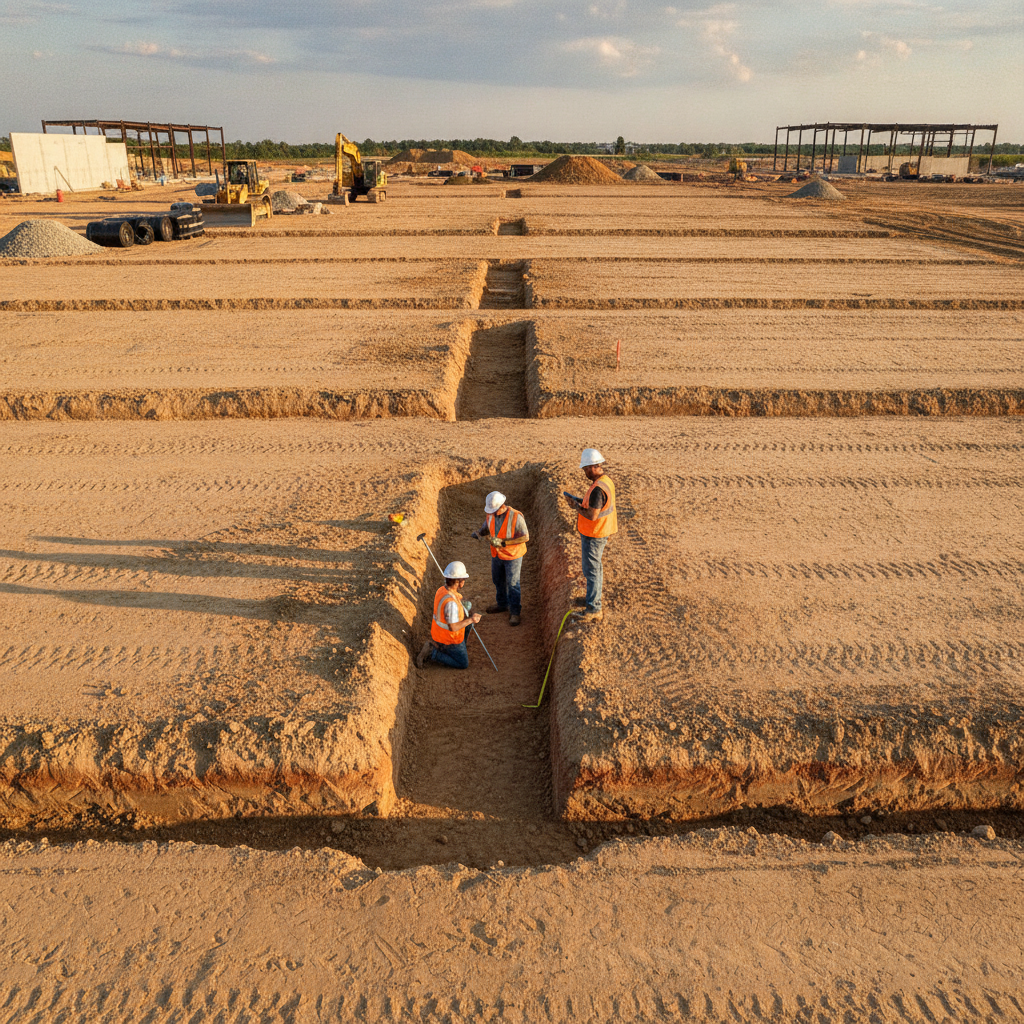
A Geotechnical soil report provides design recommendations based on data from a limited number of boring locations. The construction phase is where these assumptions are verified across the entire building pad. Before any concrete is poured, the exposed foundation subgrade must be meticulously inspected by a Geotechnical engineer or their representative. This critical step confirms that the soil conditions encountered during excavation match those anticipated in the report. Verification methods may include visual inspection, hand-auger probes, and in-situ tests like the Dynamic Cone Penetrometer (DCP) to confirm soil density and strength. For large footings, a plate load test may be specified to directly measure the load-settlement response of the subgrade. This construction administration oversight ensures that the foundations are built on competent material that meets the project’s design specifications for bearing capacity, preventing costly change orders or long-term performance issues.
RSP Engineers’ Approach to Bearing Capacity Analysis
At RSP Engineers, our approach to bearing capacity evaluation for data centers is systematic and risk-focused. We recognize that a robust foundation is non-negotiable for mission-critical facilities. Our process involves a multi-disciplinary team of Civil Engineers and geotechnical experts to deliver reliable and cost-effective solutions. Our process includes: Comprehensive Site Assessment: We begin with a thorough review of geological data and site history before developing a tailored exploration plan. Advanced Field and Lab Testing: We specify and oversee a detailed geotechnical investigation, utilizing methods like CPT and pressuremeter testing, supplemented by advanced laboratory tests to accurately characterize soil behavior under data center loads. Integrated Engineering Analysis: Our team performs rigorous bearing capacity and settlement analysis, using sophisticated software to model soil-structure interaction and predict foundation performance. Clear and Actionable Reporting: The Geotechnical soil report we deliver provides clear, concise recommendations for foundation type, allowable bearing pressures, and estimated settlements, giving the structural design team the confidence to proceed. Construction Support: We provide essential construction administration services, including subgrade verification and materials testing, to ensure the design intent is fully realized in the field.
Common Pitfalls in Foundation Design and Construction
Several common issues can compromise the foundation of a data center. An inadequate initial geotechnical investigation, often done to save costs upfront, is a primary cause of problems. This can lead to the discovery of unforeseen conditions like soft soil pockets, undocumented fill, or a higher-than-expected water table during construction, resulting in significant delays and cost overruns. Another pitfall is a failure to properly prepare and verify the foundation subgrade. Simply excavating to depth is not enough. The exposed soil must be evaluated for firmness, moisture content, and any signs of disturbance. Proceeding with concrete placement on a soft or improperly compacted subgrade will inevitably lead to settlement problems. Finally, poor communication between the geotechnical, civil, and structural engineering teams can result in a design that doesn’t fully account for the site’s specific challenges or the facility’s unique loading requirements.
Partner with RSP Engineers for Mission-Critical Foundation Design
Ensuring the long-term stability of your data center starts from the ground up. A precise and thorough bearing capacity evaluation is the first step toward a successful project. The team at RSP Engineers provides the expert Geotechnical Engineering and site development services needed to navigate complex subsurface challenges. From initial site selection and investigation to construction administration, we deliver the data-driven insights you need to build with confidence. Don’t leave your mission-critical investment on uncertain ground. Contact RSP Engineers today to discuss your project’s unique foundation requirements and learn how our integrated approach can mitigate risk and ensure performance.
Conclusion: Ensuring Stability for the Digital Future
The evaluation of bearing capacity for data center foundations is a specialized discipline that goes far beyond simple calculations. It requires a deep understanding of soil mechanics, a rigorous geotechnical investigation, and a keen awareness of the extremely low settlement tolerances of mission-critical facilities. For these projects, settlement, not shear failure, is almost always the governing design factor. By prioritizing a comprehensive site investigation and diligent construction-phase verification, developers can ensure their facilities are built on a solid, stable foundation capable of supporting the demands of the digital age. This commitment to quality in foundation design is fundamental to protecting the long-term value and operational integrity of the asset.
FAQs
-
A typical factor of safety against bearing capacity failure for data center foundations is between 2. 5 and 3. 0. The specific value depends on the reliability of the soil data, the variability of the site conditions, and the criticality of the structure. For settlement calculations, a factor of safety is not directly applied; instead, the analysis uses best-estimate soil parameters to predict expected movement.
-
Yes, if the native soils have insufficient bearing capacity or are too compressible, various ground improvement techniques can be employed. These methods include over-excavation and replacement with compacted engineered fill, dynamic compaction, vibro-compaction, or the installation of aggregate piers or stone columns to reinforce the soil and increase its stiffness.
-
The depth of a Soil boring test must extend significantly below the foundation level to investigate all soil strata that will be affected by the building’s load. A common rule of thumb is to drill to a depth where the stress increase from the foundation is less than 10% of the existing overburden stress, or until competent bedrock is confirmed. For large, heavy data centers, this can mean depths of 50 to 100 feet or more.