
Laboratory Soil Testing for Data Center Design
Explore the critical laboratory soil tests for data center design, from strength and consolidation to corrosivity. Learn how geotechnical data informs foundation, earthwork, and infrastructure decisio
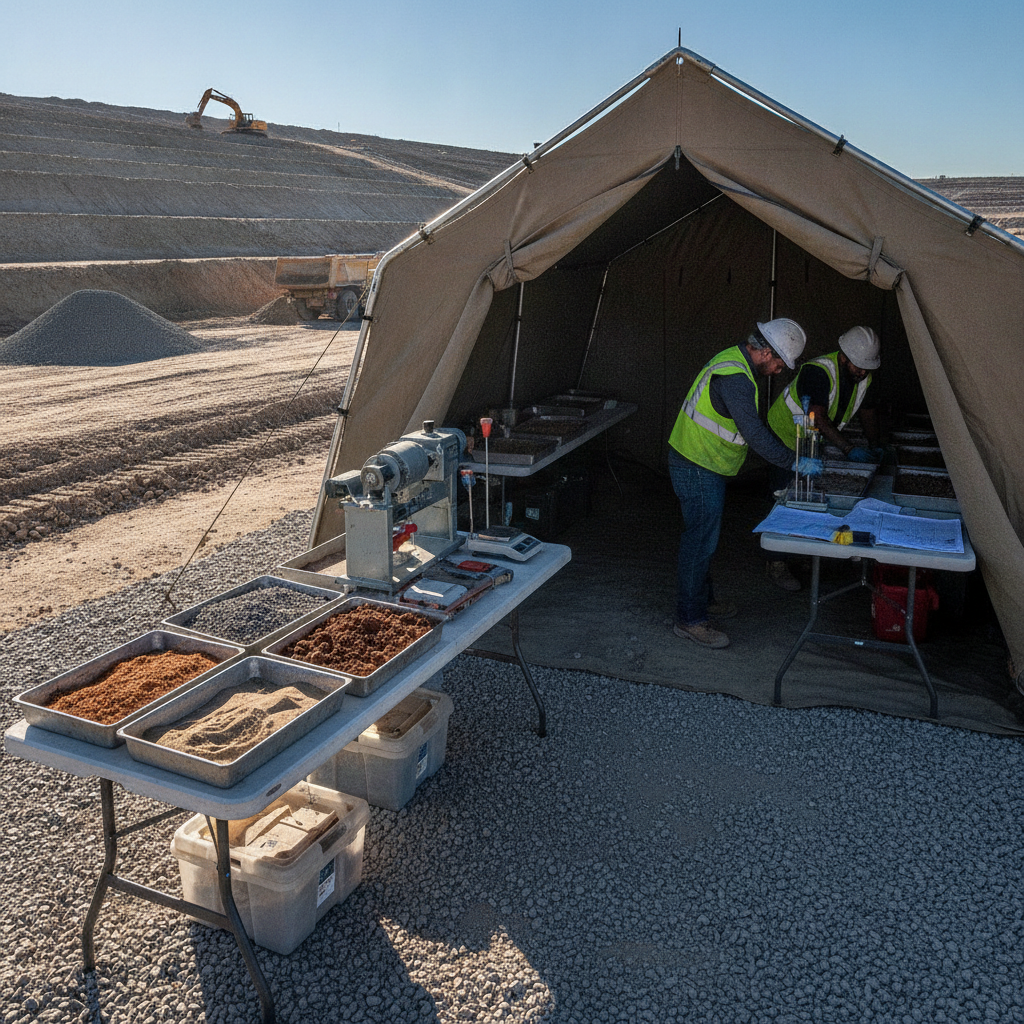
The Critical Role of Geotechnical Investigation in Mission-Critical Facilities
Unlike typical commercial buildings, data centers have exceptionally low tolerance for differential settlement. Even minor movements can compromise sensitive equipment, disrupt fiber optic connections, or cause structural distress. A thorough geotechnical investigation provides the essential data to prevent these outcomes. The goal is to characterize the soil and rock strata beneath the site to inform a reliable and cost-effective foundation design. The investigation moves beyond simple classification to quantify key engineering properties. This includes the soil’s strength, compressibility, and permeability. For data centers, which feature heavy, vibrating equipment and require massive, stable concrete slabs, this level of detail is non-negotiable. A robust laboratory testing program, based on high-quality samples obtained from a field exploration program using methods like the Soil boring test, is the cornerstone of a successful site development strategy for these high-stakes projects.
Soil Classification and Index Property Testing
Mapping Laboratory Soil Test Results to Data Center Design Decisions
| Laboratory Test | Key Parameter Measured | Direct Impact on Data Center Design |
|---|---|---|
| Particle Size Analysis & Atterberg Limits | Soil Classification (USCS), Plasticity | Foundation type selection (shallow vs. deep), pavement subgrade suitability, earthwork and dewatering planning. |
| Moisture-Density Relationship (Proctor) | Optimal Moisture Content & Max Dry Density | Compaction specifications for structural fill, utility trench backfill, and pavement base/subbase layers. |
| Consolidation Test | Compression Index, Preconsolidation Pressure | Prediction of total and differential settlement for foundations and slabs-on-grade. |
| Triaxial / Direct Shear Test | Cohesion and Internal Friction Angle | Calculation of foundation bearing capacity, retaining wall design parameters, and slope stability analysis. |
| Chemical / Corrosivity Series | pH, Sulfates, Chlorides, Resistivity | Concrete mix design (e.g., sulfate-resistant cement), selection of protective coatings for pipes and rebar. |
| Thermal Resistivity | Thermal Resistance (°C-cm/Watt) | Design of underground high-voltage duct banks to ensure proper heat dissipation from power cables. |
| Electrical Resistivity | Electrical Resistance (Ohm-meter) | Design of the facility's electrical grounding grid for personnel safety and equipment protection. |
The first step in understanding a soil’s behavior is classification. Laboratory tests determine the fundamental physical characteristics of the soil samples, known as index properties. These tests typically include particle size analysis (sieve and hydrometer tests) to determine the distribution of gravel, sand, silt, and clay, and Atterberg limits tests to measure the soil’s plasticity—its response to changes in moisture content. The results are used to classify the soil according to a standardized system, such as the Unified Soil Classification System (USCS). This classification provides the initial framework for engineering analysis. It helps the Geotechnical engineer anticipate potential issues, such as the shrink-swell potential of expansive clays or the drainage characteristics of sandy soils. Moisture content testing is also performed to understand the soil’s in-situ condition. These index properties are foundational inputs for the complete Geotechnical soil report and guide the selection of more advanced tests needed for detailed engineering design.
Moisture-Density Relationship and Compaction Control
Proper soil compaction is essential for the performance of building foundations, concrete slabs, and pavements. To achieve predictable results during earthwork, the project team must establish a target for compaction. This is accomplished in the laboratory using a Proctor test (either Standard or Modified, per ASTM standards), which establishes the moisture-density relationship for a given soil type. The test identifies the optimal moisture content at which the soil can achieve its maximum dry density when compacted with a specific energy. This data becomes the benchmark for quality control during construction. Field technicians use this laboratory-derived curve to perform in-place density tests, ensuring that all structural fill and subgrade materials meet the project’s engineering specifications. Proper compaction control is critical for minimizing future settlement, ensuring slab support, and providing a stable base for heavy-duty pavements. It is important to note that earthwork specifications and local code requirements for fill material vary by jurisdiction, and every project team should confirm the applicable standards with the local, state, regional, and federal authorities that hold review authority over the site.
Assessing Soil Strength and Consolidation Characteristics
Beyond classification and compaction, the design of data center foundations requires a quantitative understanding of how soil will behave under immense structural loads. This is determined through specialized strength and consolidation testing. Shear Strength Testing Shear strength is a measure of a soil’s ability to resist forces that would cause its internal particles to slide past one another. It is a fundamental parameter for calculating foundation bearing capacity, designing retaining walls, and analyzing slope stability. Common laboratory tests to determine shear strength include the direct shear test and the triaxial shear test. These tests provide the soil’s cohesion and friction angle, which are direct inputs into engineering formulas used by the structural and geotechnical design teams. Consolidation Testing For fine-grained soils like clays and silts, it is critical to predict how much they will compress over time under a sustained load—a phenomenon known as consolidation. The one-dimensional consolidation test is performed on an undisturbed soil sample to measure its compressibility characteristics. The results allow engineers to perform a settlement analysis, predicting both the total amount of settlement and the time it will take to occur. For data centers with their strict settlement tolerances, this analysis is vital for mitigating risks to the structure and its sensitive equipment.
Chemical and Electrical Property Analysis
A data center’s infrastructure extends deep underground, with extensive networks of utilities, grounding systems, and concrete foundations. The chemical and electrical properties of the soil can have a significant impact on the durability and performance of these buried components. Soil Corrosivity Testing Certain chemical properties can make soil aggressive toward concrete and steel. A soil corrosivity series of tests measures parameters like pH, sulfates, chlorides, and resistivity. High sulfate concentrations, for example, can lead to severe degradation of concrete foundations, while low resistivity and high chloride content can accelerate the corrosion of buried steel pipes and reinforcing bars. These results guide material selection, such as specifying sulfate-resistant cement or requiring protective coatings for underground utilities, ensuring the project’s long-term infrastructure durability. Thermal and Electrical Resistivity Testing Data centers rely on massive amounts of power, often delivered through underground high-voltage duct banks. The soil’s thermal resistivity governs how effectively heat generated by these cables can dissipate. High thermal resistivity can cause cables to overheat, reducing their efficiency and lifespan. Laboratory testing provides the data needed for proper duct bank design. Similarly, electrical resistivity is a critical parameter for designing the facility’s grounding system, which is essential for electrical safety and protecting sensitive equipment from electrical disturbances. This data ensures the grounding grid provides a low-resistance path to earth.
The RSP Engineers Geotechnical Laboratory Program
At RSP Engineers, our approach to Geotechnical Engineering for data centers is comprehensive and integrated. We understand that a laboratory testing program is not a one-size-fits-all service. Our process begins with a thorough review of the project requirements and a tailored field exploration plan to obtain high-quality soil and rock samples. A Professional Engineer oversees the development of the laboratory testing scope to ensure it targets the specific questions that need to be answered for the project’s design. Our team coordinates the entire process, from sample logging and transportation to the execution of ASTM-compliant tests. We believe in collaborative analysis, where our geotechnical team works directly with the civil engineering and structural design teams to translate complex soil data into actionable design recommendations. The final deliverable is a comprehensive Geotechnical soil report that provides clear parameters for foundation design, earthwork specifications, pavement sections, and other critical site development components.
Common Challenges in Soil Testing for Data Centers
Even with a well-planned program, challenges can arise. Sample disturbance during collection or transport can alter the soil’s properties, leading to inaccurate test results. This is particularly critical for sensitive tests like consolidation. Another common issue is site variability; soil conditions can change significantly across a large data center campus, necessitating a more extensive investigation to avoid unforeseen conditions during construction. Interpreting complex or conflicting data requires an experienced Geotechnical engineer who can apply sound judgment. Finally, effectively communicating the implications of the test results to the broader project team—including developers, architects, and contractors—is crucial. A clear report that explains not just the data, but also the associated risks and design recommendations, is essential for making informed decisions that balance performance, cost, and schedule. This is a core component of our site engineering services.
Partner with RSP for Your Mission-Critical Project
Ensure your data center is built on a foundation of certainty. The expert team at RSP Engineers provides comprehensive geotechnical investigation, advanced laboratory testing analysis, and integrated civil engineering solutions for mission-critical projects nationwide. We deliver the data-driven insights you need for every phase, from initial site development and due diligence to construction administration. Contact us today to discuss your project’s unique geotechnical requirements and build with confidence.
Conclusion
Laboratory soil testing is far more than a preliminary procedure; it is a critical investment in the resilience, safety, and long-term performance of a data center. By translating raw soil samples into precise engineering parameters, this process provides the essential data for a robust foundation design, efficient earthwork strategies, and durable infrastructure. For mission-critical facilities where failure is not an option, a comprehensive geotechnical investigation is the first and most important step toward a successful project.
FAQs
-
Soil properties can vary dramatically over very short distances due to geologic factors. Relying on off-site data is a significant risk that can lead to an unsafe or overly conservative (and expensive) design. A site-specific geotechnical investigation is essential for accurately characterizing the conditions directly beneath your facility’s footprint.
-
The timeline depends on the scope and complexity of the tests. Basic classification and index property tests can be completed in a few days. However, more advanced tests like consolidation testing, which measures soil compression over time, can take several weeks to run properly. A typical program, from sample receipt to the final report, often takes two to four weeks.
-
A Soil Test may refer to a single, specific analysis, like a moisture content test. A full geotechnical investigation is a comprehensive engineering process that includes a site reconnaissance, a planned program of field exploration (like a Soil boring test), a full suite of laboratory testing, and detailed engineering analysis. The investigation culminates in a Geotechnical soil report with specific design and construction recommendations.