
Rock Coring for Data Center Foundation Design
Learn why rock coring is critical for data center development. Explore RQD, core recovery, lab testing, and how geotechnical data informs foundation design and construction.
When Standard Soil Borings Aren’t Enough: Triggering Rock Coring
A typical preliminary geotechnical investigation involves advancing a hollow stem auger and performing Standard Penetration Tests (SPT) to assess soil properties. When the drill encounters a very dense layer or rock, it results in “SPT refusal.” This simply means the sampler cannot be advanced under the specified hammer weight. While this indicates the presence of hard material, it fails to answer critical questions for a data center’s foundation design. Is it a massive, competent bedrock formation, or is it a large boulder, a thin rock ledge, or a highly weathered and fractured rock mass? This uncertainty is unacceptable for a high-value, zero-downtime facility. Relying on refusal data alone can lead to overly conservative (and expensive) foundation designs or, worse, an under-designed foundation susceptible to settlement. Therefore, auger refusal is not an endpoint but a trigger for the next phase of investigation: rock coring. This specialized drilling method is essential to physically retrieve rock samples and accurately characterize the material that will support the structure, ensuring the site development proceeds on solid ground.
The Rock Coring Process: From Field Extraction to Laboratory Analysis
Rock Coring Data and Foundation Design Implications
| Geotechnical Parameter | Typical Finding | Foundation and Construction Implication |
|---|---|---|
| High RQD (>90%) & High UCS | Massive, competent, strong rock near the surface. | Excellent bearing capacity. Suitable for conventional spread footings or mat foundations, minimizing foundation costs. Excavation may require blasting or heavy hammering. |
| Moderate RQD (50-90%) | Fractured but generally competent rock. | May still be suitable for spread footings, but likely with a reduced allowable bearing pressure. Grouting may be required to stabilize fractures. |
| Low RQD (<50%) | Highly fractured, blocky, or weathered rock. | Poor bearing capacity. Spread footings are likely unsuitable. Requires deep foundations like drilled shafts (caissons) socketed into deeper, competent rock. |
| Presence of Karst/Voids | Visible cavities, solution features, or soft clay infill in cores. | High risk of sinkholes and differential settlement. Requires extensive investigation (e.g., microgravity surveys) and specialized foundation solutions like deep foundations or extensive ground improvement. |
| Deep Weathering Profile | Rock quality improves significantly with depth. | Shallow foundations are not feasible. Deep foundations (drilled shafts, micropiles) are required to transfer loads past the weathered zone to competent rock. Increases excavation and foundation costs. |
| High Water Table in Fractures | Water observed seeping from fractures in the core. | Indicates potential for significant dewatering requirements during excavation and construction. May influence foundation waterproofing and basement design. |
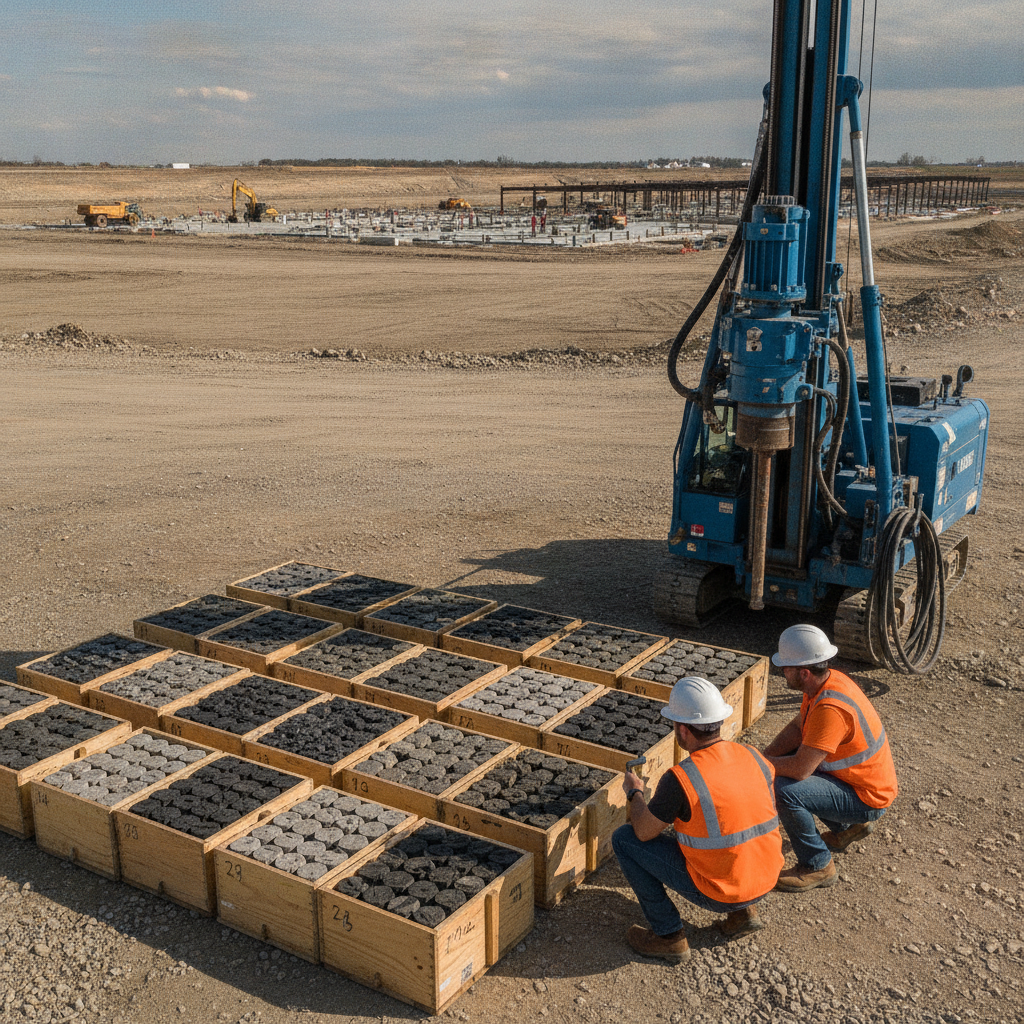
Rock coring utilizes a specialized drill rig equipped with a diamond-tipped, double- or triple-tube core barrel. As the barrel rotates and advances, it cuts an annular ring into the rock, preserving a cylindrical sample—the “core”—within the inner tube. This process is carefully managed by a Geotechnical engineer or geologist on-site to ensure sample quality and accurate logging. The goal is to retrieve a continuous, relatively undisturbed sample of the rock mass as it exists in the ground. Once extracted, the core is carefully placed in a core box in the correct sequence and orientation. The field professional meticulously logs every detail: depths, recovery lengths, fractures, seams, mineralogy, and signs of weathering. This field log is the first layer of analysis and is a critical component of the final Geotechnical soil report. The physical samples provide irrefutable evidence of the subsurface conditions, allowing the entire design team to understand the challenges and opportunities presented by the site’s geology. This detailed record is fundamental to the civil engineering design process.
Key Geotechnical Metrics from Rock Cores: RQD and Core Recovery
Two of the most important metrics derived from rock coring are Total Core Recovery (TCR) and Rock Quality Designation (RQD). TCR is the simplest measure: it is the ratio of the total length of core recovered to the total length of the core run, expressed as a percentage. A low TCR suggests the rock is highly fractured, contains voids, or is composed of soft, erodible material that was washed away during drilling. This points to potential instability and challenges with foundation design. Rock Quality Designation (RQD) provides a more refined assessment of the rock mass quality. It is a modified recovery percentage that only considers pieces of intact, solid core that are 10 cm (approximately 4 inches) or longer. This metric effectively filters out the smaller, broken fragments, giving a better indication of the structural integrity of the rock mass. A high RQD (e.g., >90%) generally indicates excellent quality rock suitable for supporting heavy loads, while a low RQD (<50%) signals a poor, fractured rock mass requiring more robust engineering solutions. The standards for what constitutes acceptable RQD and the subsequent foundation design requirements can vary by jurisdiction. Project teams must confirm all applicable geotechnical and structural standards with the local, state, regional, and federal authorities overseeing the project’s building code compliance.
Interpreting the Core: Identifying Weathering, Seams, and Voids
Beyond quantitative metrics like RQD, a detailed visual and tactile examination of the rock core by an experienced Geotechnical engineer is invaluable. This analysis identifies critical features that influence foundation performance and construction methods. The weathering profile—the gradual transition from soil to competent rock—is a key observation. A deep or irregular weathering profile can create differential settlement risks and significantly increase excavation volumes and costs. The core also reveals discontinuities that can compromise the rock’s strength. These include soft seams of clay or silt, open or infilled fractures, and solution voids, which are common in karst geological settings. Each of these features represents a potential plane of weakness or a pathway for groundwater intrusion. Identifying their frequency, orientation, and condition is essential for assessing the overall stability of the rock mass and is a critical input for the site engineering services team when designing foundations and underground infrastructure.
Laboratory Testing for Rock Strength and Characteristics
While field logging provides a qualitative assessment, quantitative data is needed for precise engineering calculations. Select, representative samples from the rock cores are sent to a geotechnical laboratory for a battery of tests. The most common and important test is the Unconfined Compressive Strength (UCS) test. This test measures the maximum axial load a rock sample can withstand before failing, providing a direct measure of its strength. This value is a primary input for calculating the bearing capacity for shallow foundations or the skin friction for deep foundations. Other laboratory tests may include Point Load Strength Index, which offers a quick, correlated estimate of UCS, and Splitting Tensile Strength, which measures the rock’s ability to resist tensile forces. Petrographic analysis can also be performed to identify the rock’s mineral composition, which can inform its long-term durability and reactivity. This comprehensive data set, compiled in the Geotechnical soil report, empowers the structural and civil engineering teams to design foundations with confidence and an appropriate factor of safety.
From Data to Design: Implications for Foundations and Site Work
The data gathered from rock coring directly shapes the entire site development strategy. If coring confirms shallow, high-quality bedrock, the team can confidently proceed with cost-effective spread footings or a mat foundation. This is often the best-case scenario for a data center project. However, if the rock is deep, weathered, or of poor quality, the design must pivot to a deep foundation system, such as drilled shafts or micropiles, which are designed to transfer the immense structural loads to a competent bearing stratum far below the surface. The findings also have profound implications for construction means and methods. The rock’s hardness, determined by UCS testing, dictates the difficulty and cost of excavation. Hard, massive rock will likely require blasting or sustained use of large hydraulic hammers, which are slow, expensive, and can have off-site vibration impacts. This information is critical for accurate cost estimating and scheduling. Furthermore, the cost of trenching for utilities like power, water, and fiber is dramatically higher in rock than in soil, a key consideration for the utility coordination and overall site budget.
How RSP Engineers Manages the Geotechnical Investigation Process
At RSP Engineers, we view the geotechnical investigation as a foundational step in de-risking a project. We collaborate with trusted, specialized Geotechnical engineer partners to develop a comprehensive subsurface exploration plan tailored to the unique demands of data center facilities. Our role extends beyond just commissioning the work; we actively manage the process and critically review the findings. Our senior engineers analyze the boring logs, rock core data, and laboratory results, integrating this critical information into the broader civil engineering design. We translate the Geotechnical soil report into actionable design parameters for grading, drainage, utilities, and foundation systems. By identifying subsurface challenges like poor rock quality or groundwater issues early in the land development process, we help our clients make informed decisions, avoid costly construction-phase surprises, and optimize the site plan design for long-term performance.
Common Issues and Challenges in Rock Coring
Even with advanced techniques, rock coring can present challenges. Core loss in highly fractured or soft zones is a common issue, creating gaps in the data that require careful interpretation. Misidentifying a large, isolated boulder as contiguous bedrock can lead to significant design errors if not caught by coring at multiple locations. Another challenge is encountering an unexpectedly deep or erratic weathering profile, which can complicate excavation and foundation design, leading to change orders during construction. Groundwater can also pose a significant problem. If coring reveals water-bearing fractures, it signals the need for a robust dewatering plan during construction and potentially permanent subsurface drainage systems. Addressing these challenges requires an experienced team that understands the nuances of geology and can adapt the investigation and design strategy in response to field conditions. Proper planning and oversight are key to overcoming these potential hurdles in the permitting and construction phases.
Partner with RSP for Your Mission-Critical Site Development
Navigating the complexities of a data center site requires a partner with deep expertise in every facet of land development. At RSP Engineers, we specialize in managing complex geotechnical investigations and translating subsurface data into robust, efficient designs. Our team provides comprehensive site engineering services, from initial due diligence and permitting to final construction administration. We ensure your foundation design is optimized for your site’s specific geological conditions. Contact us to discuss how we can support your next mission-critical project with expert civil engineering and utility coordination.
Conclusion: Building on a Solid Foundation
In data center development, the mantra is “measure twice, cut once.” Rock coring embodies this principle. It is an indispensable tool that moves beyond the ambiguity of auger refusal to provide clear, actionable data about the subsurface. By investing in a thorough geotechnical investigation that includes rock coring, developers can mitigate significant risks, optimize foundation design, and control construction costs. Ultimately, a solid understanding of the ground beneath is the first and most critical step in building a resilient and successful mission-critical facility.
FAQs
-
Relying on refusal is a gamble. It doesn’t tell you the quality of the rock, its thickness, or what lies beneath it. For a mission-critical facility, this level of uncertainty is a major risk. Rock coring provides a physical sample, turning an unknown variable into a known design parameter for the foundation design.
-
Total Core Recovery (TCR) measures all the material retrieved, including small, broken pieces. Rock Quality Designation (RQD) is a more selective metric that only counts intact pieces of core longer than 4 inches (10 cm). RQD is a better indicator of the rock mass’s structural integrity and its ability to support heavy loads for site development.
-
While rock coring adds an upfront cost and time to the geotechnical investigation phase, it is an investment in risk mitigation. Discovering poor rock conditions during construction can cause major delays and budget overruns far exceeding the initial investigation cost. Identifying these issues early allows for accurate budgeting, scheduling, and design optimization.