
Cone Penetration Testing on Data Center Sites
Explore the role of Cone Penetration Testing (CPT) in data center site development. Learn how CPT provides critical data for foundation design, settlement analysis, and liquefaction assessment.
The Mechanics of Cone Penetration Testing
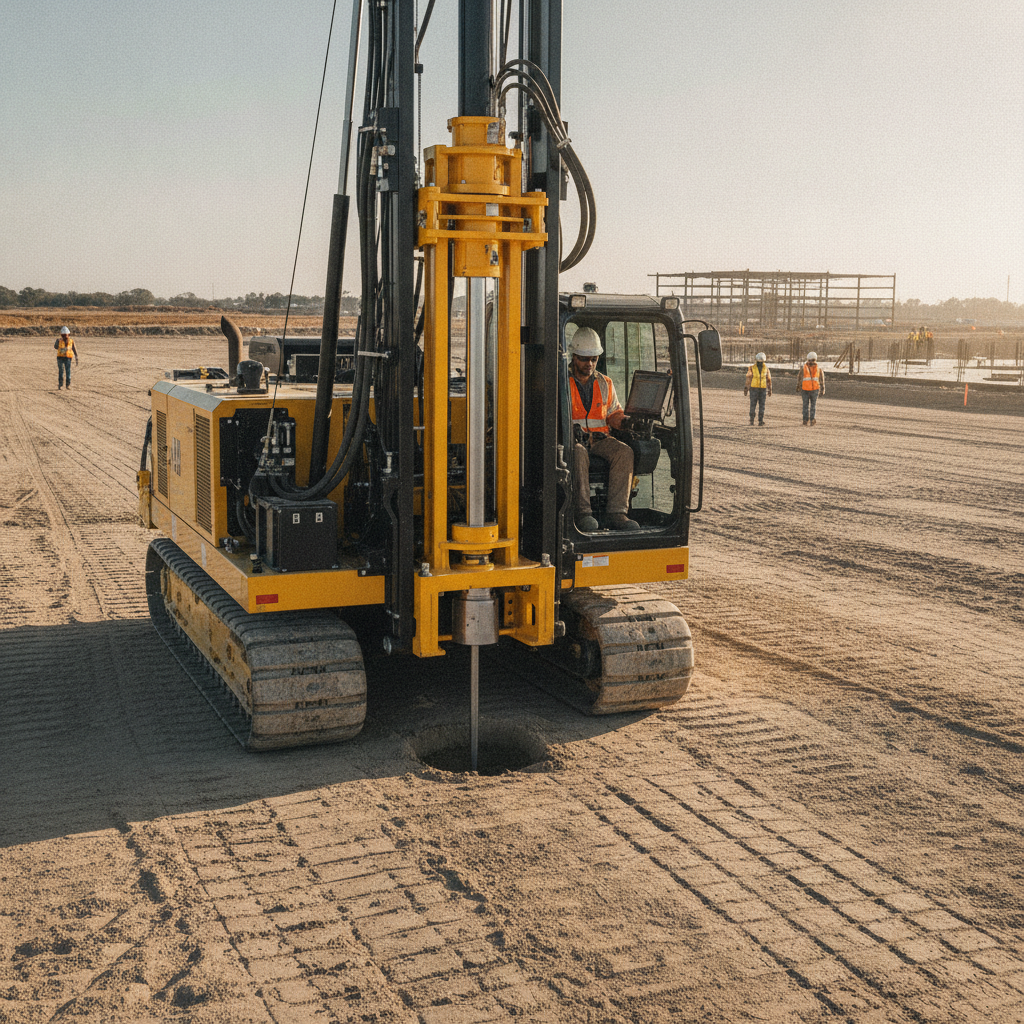
Cone Penetration Testing is an in-situ testing method used to determine the geotechnical properties of soils. The process involves hydraulically pushing a standardized conical instrument tip into the ground at a constant rate of penetration. This cone is instrumented with sensors that continuously measure three key parameters: tip resistance (qc), which is the force required to push the cone; sleeve friction (fs), the frictional force on the sleeve above the tip; and pore water pressure (u2), the water pressure generated as the cone advances. Unlike traditional methods that collect data at discrete intervals, CPT provides a continuous profile of these measurements with depth. This high-density data stream is transmitted to a digital acquisition system in real-time, allowing engineers to visualize subsurface stratigraphy with remarkable detail. This continuous profiling is a significant advantage, as it can identify thin layers of weak or problematic soils that might be missed by other testing methods, a critical factor in site development for sensitive structures.
Interpreting CPT Data for Soil Behavior Type (SBT)
Comparison: CPT vs. Standard Penetration Test (SPT)
| Feature | Cone Penetration Testing (CPT) | Standard Penetration Test (SPT) |
|---|---|---|
| Data Resolution | Continuous, real-time electronic measurements | Discrete data points, typically at 5-foot intervals |
| Testing Speed | High; multiple soundings per day are common | Slower; involves drilling, sampling, and hammer counts |
| Soil Sampling | No physical sample is recovered | Provides a disturbed split-spoon sample for visual classification and lab testing |
| Operator Influence | Minimal; automated and highly repeatable | Higher; results can be influenced by hammer efficiency and operator technique |
| Liquefaction Analysis | Considered a primary and highly reliable method | Can be used, but generally considered less direct than CPT |
| Site Disturbance | Minimal; small diameter cone is pushed into the ground | Moderate; requires drilling a borehole |
| Best Use Case | Rapid site characterization, identifying thin layers, settlement and liquefaction analysis | Obtaining physical samples, testing in very dense/gravelly soils, rock coring |
The raw data from CPT is not just a set of numbers; it’s a detailed story about the soil. Geotechnical engineers use established correlations to translate the measurements of tip resistance, sleeve friction, and pore pressure into a profile of Soil Behavior Type (SBT). By plotting these parameters on standardized classification charts, we can infer the soil’s characteristics—distinguishing between cohesive soils like clays and silts and cohesionless soils like sands and gravels. The friction ratio (Rf), calculated as the ratio of sleeve friction to tip resistance, is a primary indicator. Low friction ratios typically suggest coarse-grained, cohesionless soils, while high friction ratios indicate fine-grained, cohesive soils. This detailed classification is fundamental to subsequent engineering analyses, including bearing capacity calculations, foundation settlement analysis, and assessing the site’s response to seismic activity. The precision of SBT classification from CPT data far exceeds what can be inferred from visual inspection of disturbed samples alone.
Key Advantages of CPT for Mission-Critical Facilities
Data center projects operate on compressed schedules and with little tolerance for error, making the advantages of CPT particularly valuable. The primary benefit is the speed and efficiency of data acquisition. A CPT rig can perform multiple soundings in a single day, covering a large site far more quickly than traditional drilling methods. This rapid data collection accelerates the geotechnical investigation phase, providing critical information to the design team earlier in the project lifecycle. Furthermore, the continuous data profile generated by CPT is invaluable for identifying subtle but critical variations in soil layers. For a data center foundation supporting heavy server racks and cooling equipment, even a thin, undetected layer of soft clay can lead to differential settlement and operational issues. The high repeatability and reduced operator dependency of the electronic CPT system also ensure consistent, high-quality data across the entire site, which is essential for a reliable site plan design and foundation strategy.
CPT in Geotechnical Engineering Analysis
The data gathered from CPT is directly applied to several critical engineering analyses essential for data center design. These analyses form the basis of the final Geotechnical soil report and guide the structural and civil engineering teams. The required scope and specific parameters for these analyses often depend on local building codes and seismic design criteria. It is important to note that design and permitting requirements vary by jurisdiction, and every project team should confirm the applicable standards with the local, state, regional, and federal authorities that hold review authority over the site. Foundation Settlement Analysis CPT data provides an excellent basis for predicting foundation settlement. The continuous soil stiffness profile allows engineers to develop precise models for both immediate and long-term consolidation settlement under the heavy, sustained loads of a data center. This is crucial for designing foundations for generator pads, cooling towers, and the main building slab to prevent differential settlement that could damage sensitive equipment or utility connections. Liquefaction Potential Assessment In seismically active regions, liquefaction analysis is a primary concern for data center resilience. CPT is widely recognized as one of the most reliable in-situ methods for assessing liquefaction potential. The continuous measurements of tip resistance and sleeve friction are used in empirical procedures to evaluate the soil’s susceptibility to strength loss during an earthquake. This analysis directly informs seismic design, foundation selection, and the potential need for ground improvement measures to ensure the facility remains stable and operational during and after a seismic event.
Integrating CPT with Traditional Soil Borings
While CPT is a powerful tool, it does not provide a physical soil sample. For this reason, the most robust geotechnical investigation programs for data centers pair CPT with a limited number of traditional soil borings using methods like the Standard Penetration Test (SPT). This hybrid approach combines the best of both worlds. CPT provides the continuous, high-resolution stratigraphic data, while the borings yield physical samples for laboratory testing. These physical samples are essential for confirming the CPT-based soil classifications and for conducting specific laboratory tests, such as Atterberg limits, moisture content, grain size analysis, and shear strength tests. The SPT also provides a direct measure of penetration resistance that has been a design standard for decades. By correlating the CPT data with the results from adjacent borings, engineers can develop a highly confident and detailed model of the subsurface, leading to a more optimized and reliable foundation design.
Our Geotechnical Investigation Process for Data Centers
At RSP Engineers, our approach to data center site investigation is systematic and tailored to the unique demands of mission-critical facilities. We leverage advanced tools like CPT to provide clients with the certainty they need for their investments. Our process includes: Preliminary Site Assessment: We begin with a thorough review of existing geological data, historical site use, and project requirements to identify potential geotechnical risks. Customized Investigation Plan: We develop a site-specific exploration plan that strategically combines CPT soundings, soil borings, and a targeted laboratory testing program to efficiently characterize the site’s subsurface conditions. Field Execution and Data Acquisition: Our experienced field crews, working with a qualified Geotechnical engineer, execute the plan using calibrated equipment, ensuring the highest quality data is collected safely and efficiently. Advanced Engineering Analysis: Our team analyzes the field and lab data to perform critical evaluations, including bearing capacity, foundation settlement, seismic considerations like liquefaction, and recommendations for earthwork and ground improvement. Comprehensive Reporting: We deliver a clear and concise Geotechnical soil report that presents our findings, analyses, and actionable recommendations for foundation design, site preparation, and construction, providing a solid foundation for the entire site development project.
Common Challenges and Limitations of CPT
Despite its many advantages, CPT is not without limitations. The test can meet ‘refusal’ in very dense soils, cemented layers, or gravelly deposits, preventing the cone from advancing further. In these conditions, traditional drilling methods are necessary to penetrate the hard layers and investigate the materials below. Because CPT does not retrieve a physical sample, it cannot be used for certain types of analysis, such as environmental soil sampling or rock quality designation (RQD) in bedrock. The equipment is also more specialized and sensitive than standard drilling rigs, requiring experienced operators and proper calibration to ensure data accuracy. A successful geotechnical investigation recognizes these limitations and intelligently integrates CPT with other methods to create a complete and reliable picture of the subsurface, mitigating risks associated with unforeseen ground conditions during construction.
Partner with RSP for Your Next Mission-Critical Project
A successful data center project begins from the ground down. A thorough and precise understanding of subsurface conditions is essential to designing a resilient and cost-effective foundation system. RSP Engineers provides expert Geotechnical Engineering and site engineering services to support the development of mission-critical facilities nationwide. Our team leverages advanced technologies like Cone Penetration Testing to deliver the critical data you need to manage risk and make informed decisions. From initial site selection and geotechnical investigation to final foundation design and construction support, we are your trusted partner. Contact us today to discuss your project’s unique challenges.
Conclusion
Cone Penetration Testing has become an indispensable tool in modern Geotechnical Engineering, particularly for demanding projects like data centers. Its ability to provide rapid, repeatable, and continuous subsurface data allows for a more detailed characterization of soil conditions than was previously possible. When integrated intelligently with traditional soil borings, CPT enables a comprehensive geotechnical investigation that directly supports a robust, reliable, and optimized foundation design, ultimately protecting your critical infrastructure investment for years to come.
FAQs
-
The main difference is how data is collected. CPT pushes a sensor-equipped cone into the ground to gather continuous electronic data on soil properties but retrieves no physical sample. A standard soil boring uses an auger or drill to create a hole from which discrete soil samples are collected at intervals for visual inspection and lab testing.
-
CPT is most effective in soils ranging from soft clays to dense sands. It may not be suitable for sites with extensive gravel, cobbles, boulders, or shallow bedrock, as the cone can be damaged or meet refusal. A preliminary site review helps determine if CPT is the right tool for the geotechnical investigation.
-
The continuous soil stiffness and strength profile from CPT allows for highly accurate foundation settlement calculations. This ensures that foundations for heavy equipment like generators, chillers, and UPS systems are designed to prevent differential settlement, which could damage the equipment or connecting infrastructure.