
Reducing Imported Fill Requirements on Data Center Projects
Learn practical civil engineering and geotechnical strategies to reduce imported fill on data center projects, saving costs and time. Explore site grading, material reuse, and ground improvement.
The Financial and Logistical Drivers for On-Site Earthwork Balancing
The decision to minimize imported fill is driven by compelling financial and operational factors. The most obvious is the direct cost of purchasing, loading, and hauling material, which can represent a multimillion-dollar line item in a project budget. Beyond the material cost, the logistical complexity of coordinating a constant stream of dump trucks creates significant challenges. This heavy traffic impacts local roadways, increases noise and dust in the surrounding community, and can lead to public relations issues and strained relationships with the local jurisdiction. Furthermore, reliance on off-site borrow pits introduces schedule vulnerabilities. Material availability, trucking capacity, and weather-related access issues can all create delays that have a cascading effect on the overall project timeline. A well-executed earthwork balancing plan, where the volume of cut soil closely matches the volume of required fill, mitigates these risks. This approach transforms site development from a logistics-heavy import operation into a more controlled, self-contained construction activity, providing greater control over both budget and schedule.
Strategic Site Grading and Pad Elevation Optimization
Comparison of Fill Reduction Strategies
| Strategy | Primary Benefit | Key Considerations | Typical Cost Impact |
|---|---|---|---|
| Grading & Pad Elevation Optimization | Low-cost, high-impact reduction in overall fill deficit. | Must be done early in design. May be constrained by drainage or utility service elevations. | Minimal design cost, significant construction savings. |
| On-Site Material Reuse | Reduces both import costs and disposal costs. | Requires thorough geotechnical investigation and on-site quality control. Moisture content is critical. | Moderate cost for screening/processing, but high ROI. |
| Excavated Rock Processing | Converts a waste product (rock) into a valuable resource (fill/aggregate). | Requires space for crushing operations and adherence to local noise/dust ordinances. | Significant initial cost for equipment, but massive savings on import/disposal. |
| Ground Improvement | Eliminates the need for over-excavation and replacement in poor soil conditions. | Highly site-specific. Requires specialized contractors and detailed geotechnical analysis. | High upfront cost but often cheaper than massive over-excavation and import. |
| Stockpiling and Phasing | Allows for strategic use of cut material from later phases to fill earlier phases. | Requires a large site with available space for long-term stockpiles. Involves double-handling material. | Low initial cost, but incurs re-handling expenses. |
One of the most effective tools for reducing fill import is meticulous grading design. The goal is to strategically set the finished floor elevation (FFE) of the data center building pad to best match the existing topography. A minor adjustment of six inches or a foot in the pad elevation can alter the required fill volume by tens of thousands of cubic yards. This process involves more than just picking a number; it requires sophisticated mass haul analysis using 3D modeling software. Civil engineers create a detailed digital terrain model of the site and then simulate various pad elevations and grading scenarios. This analysis calculates the precise cut and fill volumes associated with each option, factoring in stormwater ponds, access roads, and utility trenches. The optimal design finds the sweet spot that minimizes the earthwork deficit while still meeting critical operational requirements, such as ensuring positive drainage design away from the building and complying with ADA compliance standards for accessible routes. This early-stage optimization is a cornerstone of efficient site development.
Geotechnical Investigation and On-Site Material Reuse
A comprehensive Geotechnical Engineering investigation is non-negotiable for any large-scale project, but its value extends far beyond foundation design. The geotechnical soil report provides a detailed inventory of the materials that exist on-site, classifying them based on their suitability for use as engineered fill. This information is critical for developing a material reuse strategy. Soils that might otherwise be considered waste, such as marginal clays or silts, can sometimes be amended, blended, or moisture-conditioned to meet compaction requirements. This process often involves setting up on-site screening and processing operations to remove organic material, debris, or oversized rock. The resulting processed soil can then be placed and compacted under the supervision of a geotechnical engineer to create a stable building pad. Material reuse standards and specifications for engineered fill can vary by jurisdiction, and it is crucial to confirm all requirements with the applicable local, state, regional, and federal authorities overseeing the project. A successful reuse program not only eliminates the cost of imported fill but also saves on the cost of hauling away and disposing of unsuitable materials.
Processing and Reusing Excavated Rock
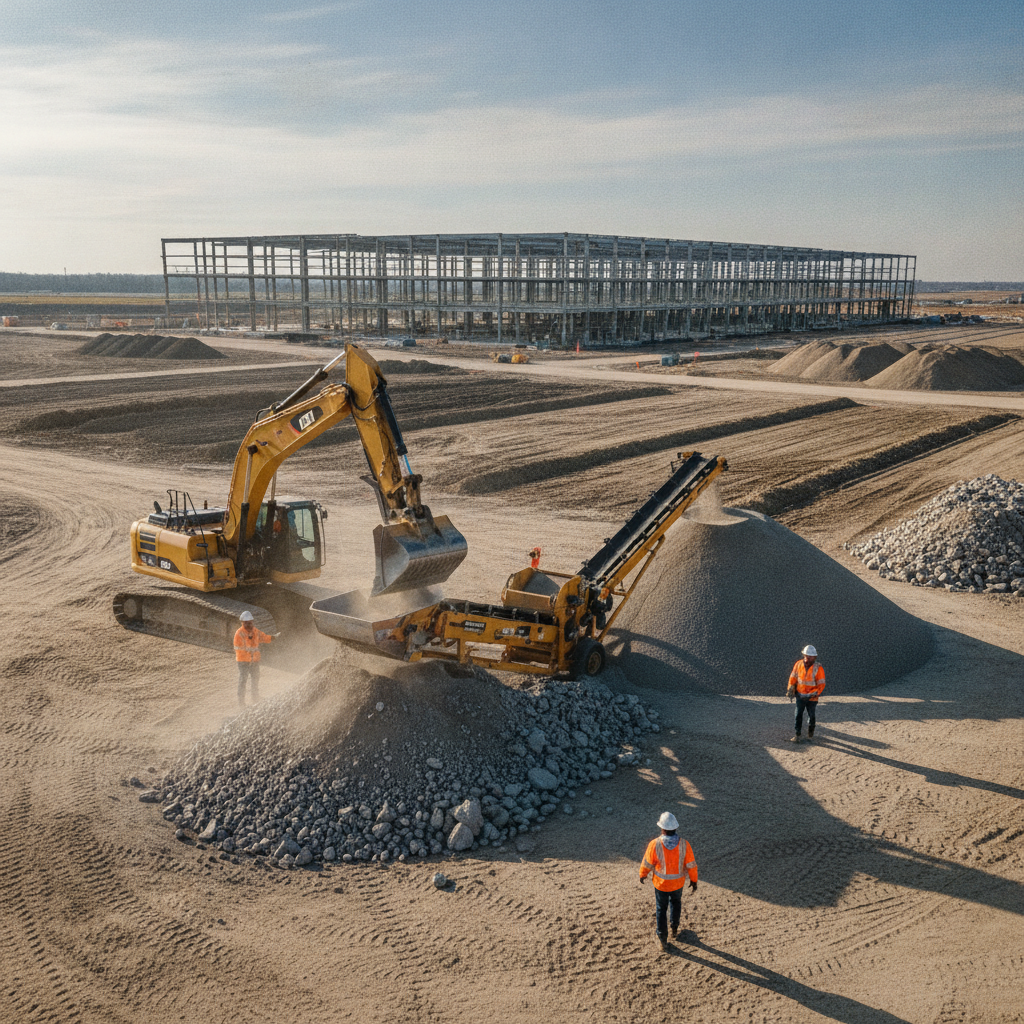
On sites with significant bedrock, what initially appears to be a costly excavation challenge can be turned into a valuable asset. Instead of blasting and hauling rock off-site at great expense, a value engineering approach involves processing it on-site. Mobile crushing and screening plants can be brought in to break down excavated rock into various gradations suitable for use as structural fill, pipe bedding, or road base material. This strategy creates a closed-loop system where a site liability is converted into a project resource. The benefits are threefold: it eliminates the high cost of rock disposal, it creates a high-quality source of on-site fill and aggregate, and it removes the need to import these materials. This approach requires careful planning and coordination between the civil engineering team, the geotechnical consultant, and the earthwork contractor to ensure the processed material meets all project specifications and that the crushing operations comply with local noise and dust regulations.
Ground Improvement Techniques as an Alternative to Over-Excavation
In situations with deep deposits of weak or unsuitable soils, the traditional approach is over-excavation and replacement. This involves digging out the poor material and replacing it with imported structural fill—a costly and time-consuming process. However, modern ground improvement techniques offer a powerful alternative. Methods like deep dynamic compaction, vibro-compaction, aggregate piers, and soil mixing can strengthen weak soils in place, increasing their bearing capacity to support heavy data center loads. By treating the soil in-situ, ground improvement can eliminate the need for massive over-excavation and replacement, drastically reducing or even eliminating the need for imported fill. The feasibility of these techniques is highly dependent on the specific soil profile, groundwater conditions, and structural loading, making a detailed Geotechnical Engineering analysis essential. When applicable, it represents one of the most impactful strategies for optimizing a site’s earthwork budget and schedule.
Our Process: A Holistic Approach to Earthwork Management
At RSP Engineers, we integrate earthwork strategy into the earliest stages of project planning. Our process begins during due diligence, where we perform a preliminary analysis of topography and publicly available soils data to identify potential earthwork challenges and opportunities. Once a project moves forward, we commission a comprehensive geotechnical investigation to build a detailed subsurface model. Using this data, our Civil engineers leverage advanced 3D modeling software to run multiple grading design scenarios, working collaboratively with the client and architect to optimize the site layout and building elevation. We develop a clear earthwork management plan that outlines strategies for material handling, processing, and reuse. Throughout the permitting and construction phases, we provide continuous oversight and construction administration to ensure the plan is executed correctly and that all materials meet the required engineering specifications.
Common Challenges in Minimizing Imported Fill
Even with a robust plan, challenges can arise. One of the most common is encountering unexpected pockets of unsuitable materials not identified in the initial soil borings. This requires quick adaptation, potentially involving localized over-excavation or targeted soil stabilization. Another frequent issue is managing soil moisture content. Soil that is too wet or too dry cannot achieve the required compaction requirements, necessitating costly and time-consuming drying or wetting operations. Regulatory constraints can also pose a challenge. For example, environmental permitting may place restrictions on on-site rock crushing or soil screening operations. Finally, the site grading plan must be carefully coordinated with the stormwater management system. The elevations of ponds, swales, and pipes can create fixed points in the design that limit the flexibility to adjust the overall site grades for better earthwork balance, requiring a truly integrated civil engineering approach.
Partner with RSP Engineers for Efficient Site Development
Optimizing earthwork on a data center project is a complex challenge that demands expertise and foresight. The RSP Engineers team specializes in large-scale site development for mission-critical facilities nationwide. We provide the integrated civil engineering, permitting, and utility coordination services necessary to develop a cost-effective and constructible site plan. Our proactive approach to grading design and material management can significantly reduce your reliance on imported fill, saving critical budget dollars and streamlining your project schedule. Contact us to discuss how we can bring value to your next data center development.
Conclusion: Strategic Earthwork as a Project Cornerstone
In conclusion, minimizing imported fill is more than a line-item cost-saving measure; it is a fundamental strategy for de-risking a data center project. By embracing a holistic approach that integrates detailed geotechnical analysis with sophisticated grading design and on-site material management, developers can gain greater control over their budget, schedule, and community impact. A balanced site is an efficient site, and achieving that balance begins with expert civil engineering in the earliest stages of planning. This strategic focus on earthwork provides a solid foundation for a successful project.
FAQs
-
Ideally, during the site selection and due diligence phase. A preliminary analysis of a site’s topography and geology can provide a high-level estimate of potential earthwork costs and challenges, influencing the overall financial viability of the site before acquisition.
-
No. Soils with high organic content, certain types of expansive clays, or material contaminated with debris are typically unsuitable. A geotechnical investigation is essential to classify on-site soils and determine which can be reused as-is, which may require amendment, and which must be removed from the site.
-
It generally has a positive impact. Reducing truck traffic and eliminating reliance on off-site sources removes major logistical bottlenecks and weather-related risks. While on-site processing takes time, it is often more predictable and controllable than coordinating hundreds or thousands of truck deliveries, leading to a more reliable construction administration timeline.