
Protecting Data Center Sites From Off-Site Runoff During Earthwork
A civil engineering guide to protecting data center construction sites from off-site runoff. Learn about diversion berms, temporary channels, and erosion control plans.
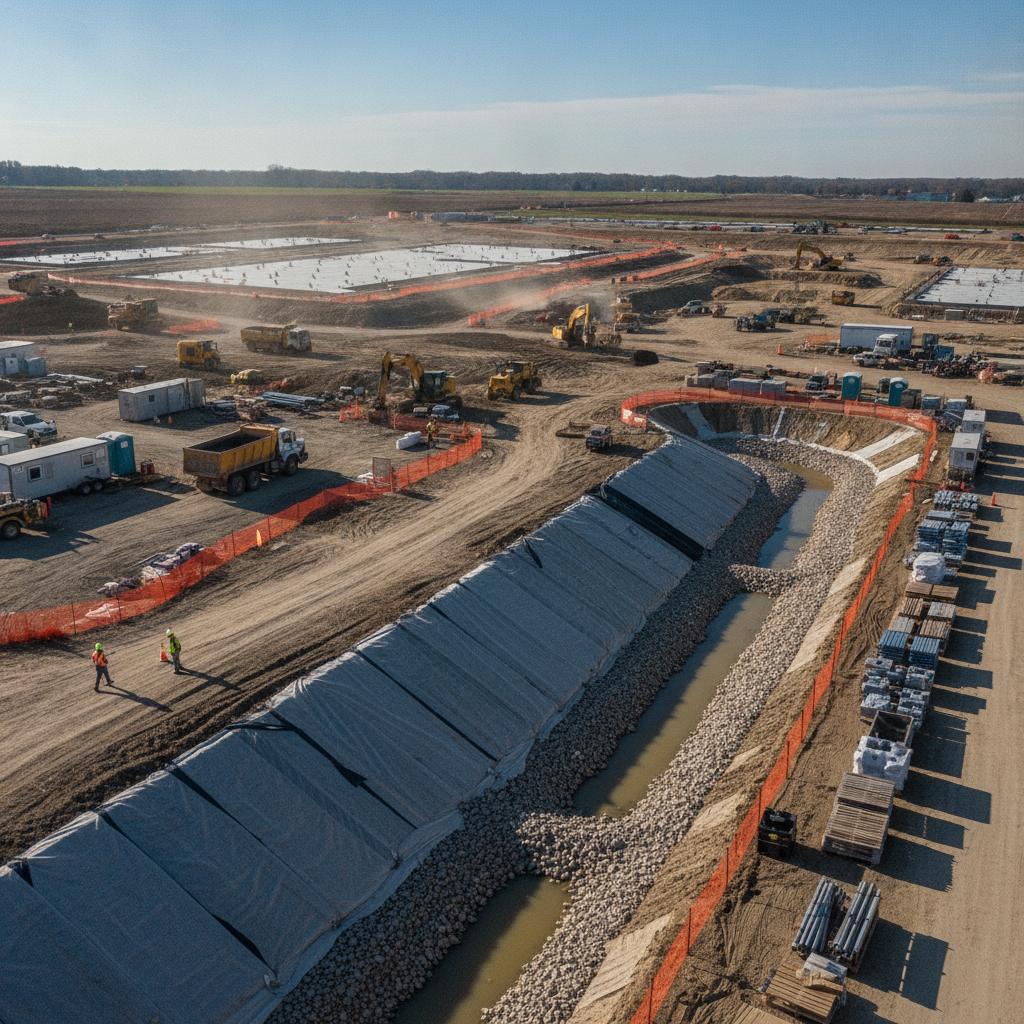
Understanding the Threat: Why Off-Site Runoff is a Critical Risk
During mass grading and utility installation, a data center site is an open expanse of exposed soil, deep excavations, and compacted building pads. The permanent stormwater management system is not yet functional, leaving the site exposed. Off-site runoff, originating from neighboring commercial properties, undeveloped land, or even public roadways, can introduce a massive volume of water that the site’s temporary measures may not be designed to handle. This can lead to catastrophic failures, including the collapse of trench walls, erosion of structural fill, and the contamination of expensive, engineered subgrade materials. The primary risk is saturation of the building pad subgrade. Data centers require exceptionally stable foundations, and the soil beneath them is often chemically treated or mechanically compacted to precise specifications. If this conditioned subgrade becomes saturated, its structural properties are compromised, potentially requiring costly removal, replacement, and re-testing. This not only impacts the budget but can also cause significant delays, disrupting the entire construction sequence. Effective drainage design during the construction phase is not a luxury; it’s a critical component of risk management for mission-critical facilities.
The Foundational Role of the Erosion and Sediment Control Plan
Comparison of Temporary Runoff Control Measures
| Measure | Primary Function | Key Design Considerations | Common Failure Points |
|---|---|---|---|
| Diversion Berm | Intercept and redirect upstream sheet flow at the site perimeter. | Compacted soil, adequate height (freeboard), positive grade to an outlet, stabilization on steep slopes. | Overtopping from undersizing, erosion due to lack of stabilization, breaches from construction traffic. |
| Temporary Swale/Channel | Convey intercepted water around the work area. | Stable side slopes, appropriate lining (e.g., grass, erosion blanket, riprap), non-erosive velocity. | Scour from high-velocity flow, sediment accumulation reducing capacity, improper grade causing ponding. |
| Slope Drain | Carry concentrated flow safely down a steep slope. | Secure anchoring, watertight connections, energy dissipation at the outlet, proper inlet protection. | Pipe separation or collapse, inlet clogging with debris, outlet erosion undermining the system. |
| Silt Fence | Filter sediment from small areas of sheet flow (not for concentrated flow). | Proper trenching and backfilling of fabric, post spacing, placement along contours. | Used improperly in channels, overtopping, collapse from high flow or sediment load. |
| Check Dam | Reduce velocity and promote sediment settling within a channel. | Stone or manufactured product, proper spacing, center lower than edges (weir). | Undercutting or end-around flow, spacing too far apart, collapse from excessive flow. |
Every major construction project operates under an Erosion and Sediment Control Plan (ESCP), often as part of a Stormwater Pollution Prevention Plan (SWPPP) required under the National Pollutant Discharge Elimination System (NPDES) program. This plan provides the blueprint for managing stormwater and preventing soil loss. However, a standard ESCP may focus primarily on sediment leaving the site, not the water entering it. A robust plan for a data center must explicitly address the interception of off-site flows. This requires a thorough upstream drainage analysis by a Professional Engineer to quantify the potential volume and velocity of runoff from adjacent properties during various design storm events. The ESCP must detail the specific temporary measures for diverting these flows, including the location, dimensions, and construction specifications for diversion berms, swales, and temporary channels. Permitting requirements for these plans vary by jurisdiction, and every project team should confirm the applicable standards with the local, state, regional, and federal authorities that hold review authority over the site. This proactive planning ensures that the permit submittals accurately reflect the on-the-ground strategy and that the contractor has a clear, actionable plan to protect the site from day one of earthwork operations.
Key Interception Strategy: Diversion Berms and Swales
The first line of defense against off-site runoff is interception. This is typically achieved by constructing temporary diversion berms or swales along the upstream perimeter of the project site. A diversion berm is a compacted earthen embankment, while a swale is a shallow excavated channel. Their purpose is to act as a dam, capturing sheet flow and concentrated runoff from adjacent properties before it can enter the active construction zone. The effectiveness of these measures depends entirely on proper civil engineering design and construction. Key considerations include the height and cross-section of the berm, the slope and stabilization of the swale, and ensuring a continuous, positive grade to a designated discharge point. The berms must be well-compacted to prevent failure and may require reinforcement with synthetic liners or turf reinforcement mats in areas of high-velocity flow. The design must account for the contributing off-site drainage area and be sized to handle a specific design storm without overtopping, which is a critical aspect of site development planning.
Conveyance Solutions: Temporary Channels and Slope Drains
Once off-site runoff is intercepted, it must be safely conveyed around or through the project site to a suitable discharge point, such as an existing storm drain inlet or a stabilized natural watercourse. This is the job of temporary channels and slope drains. Temporary channels are excavated ditches, often lined with grass, erosion control blankets, or riprap, that carry the diverted flow at a non-erosive velocity. Their alignment is critical to avoid interference with construction traffic and laydown areas, requiring careful utility coordination and phasing. In areas with significant changes in elevation, such as along the side of a deep excavation or a steep embankment, slope drains are used. These are flexible or rigid pipes that carry concentrated flow down a slope without causing erosion. The inlets and outlets of these pipes must be heavily stabilized with rock or other energy dissipation devices to prevent scour. The entire conveyance system, from the interception swale to the final outlet, must function as an integrated part of the overall drainage design to prevent localized flooding or erosion within the project limits.
Sizing and Design for Construction-Phase Storms
A common mistake is underestimating the storm events that can occur during the construction phase. While permanent stormwater management systems are designed for large, infrequent storms (e.g., the 25-year or 100-year event), temporary erosion control measures are often designed for smaller, more frequent storms (e.g., the 2-year or 5-year event). For a high-value asset like a data center, a more conservative approach is warranted. The civil engineering team must analyze the risk and recommend a design storm that balances cost with the potential financial impact of a system failure. The hydraulic calculations for these temporary systems are just as important as those for the permanent infrastructure. Engineers must determine the peak flow rate from the off-site area and size the berms, channels, and pipes accordingly. Factors like the slope, soil type, and ground cover of the upstream area all influence the runoff calculations. Proper sizing ensures the system has adequate capacity, preventing overtopping and the catastrophic failure of the entire runoff management strategy. This is a key element of successful site engineering services.
Protecting Critical Areas: Subgrade and Foundation Excavations
The ultimate goal of managing off-site runoff is to protect the most critical and vulnerable areas of the site: the building pad subgrade and open foundation excavations. Any water that reaches these areas can compromise soil stability and halt progress. In addition to perimeter diversions, secondary protective measures are often necessary. This can include smaller berms or swales immediately surrounding the building pad or a dedicated dewatering system with sump pumps for deep excavations. Protecting the conditioned subgrade is paramount. Once the soil has been prepared, it should be crowned or sloped to shed any incidental rainwater and covered with a protective membrane if it will be exposed for an extended period. The Geotechnical engineer on the project will provide strict specifications for moisture content and compaction, and any deviation caused by water intrusion must be addressed immediately. This level of detailed protection is a hallmark of quality construction administration for mission-critical projects.
RSP Engineers’ Proactive Approach to Construction-Phase Water Management
At RSP Engineers, we treat construction-phase water management with the same rigor as permanent site plan design. Our approach begins during the initial due diligence phase, where we identify potential off-site drainage risks through topographic analysis and field reconnaissance. We integrate a robust temporary runoff control strategy directly into our civil engineering plans and the ESCP, providing clear, constructible details for the contractor. Our process involves close collaboration between our design team, the Geotechnical engineer, and the construction team. We model the upstream hydrology to correctly size diversion and conveyance systems, ensuring they are designed for an appropriate level of risk. During construction, our team provides responsive construction administration, conducting regular site visits to verify that measures are installed correctly and are being maintained. This proactive oversight helps identify potential issues before they become costly problems, keeping the project on schedule and protecting the integrity of the site.
Common Challenges in Managing Off-Site Runoff
Even with a well-designed plan, challenges can arise in the field. One of the most common issues is a lack of maintenance. Temporary measures can be damaged by construction traffic or become filled with sediment after a storm, rendering them ineffective. Regular inspection and repair are crucial. Another challenge is an unexpected change in upstream conditions; for example, if an adjacent property owner begins their own earthwork, it can alter the drainage patterns and volumes directed toward your site. Finally, contractors may be tempted to cut corners on temporary measures to save time or money. This is a false economy. The cost of installing a properly sized and stabilized diversion channel is minuscule compared to the cost of removing and replacing a saturated building pad. Clear communication of the risks and strict enforcement of the approved erosion control plan are essential for overcoming these challenges and ensuring a successful project outcome. Frequently Asked Questions (FAQ) How do you determine the size of a temporary diversion channel? The size of a temporary channel is determined through hydraulic modeling. A Professional Engineer calculates the peak runoff from the upstream drainage area for a specific design storm. Using this flow rate, along with the channel’s proposed slope and lining material (which determines its roughness), we can calculate the required depth and width to convey the flow without overtopping or causing erosion. What is the difference between erosion control and sediment control? Erosion control is proactive; it involves measures like diversion berms, channel linings, and surface stabilization to prevent soil from detaching in the first place. Sediment control is reactive; it involves measures like silt fences and sediment traps designed to capture soil particles after they have already been eroded. A comprehensive stormwater management plan requires both. Who is responsible for maintaining these temporary measures during construction? The general contractor is typically responsible for the installation and maintenance of all measures shown on the Erosion and Sediment Control Plan. This responsibility is a contractual obligation and is often a condition of the project’s environmental or land development permits. The owner’s civil engineer often performs inspections to verify compliance. Can the permanent stormwater system be used during construction? Sometimes, but it requires careful planning. Portions of the permanent system, like underground pipes and inlets, can be installed early and used to manage construction-phase runoff. However, they must be protected from construction traffic and, most importantly, from being clogged with sediment. Using temporary filters in inlets is a common practice, but the system must be thoroughly cleaned and inspected before project completion. How does a high water table affect off-site runoff management? A high water table can complicate matters significantly by saturating soils from below, reducing their ability to absorb rainfall and increasing the volume of surface runoff. It also makes excavations more difficult and prone to collapse. A thorough Geotechnical soil report is essential to identify the seasonal high water table elevation, which informs both the drainage design and the dewatering strategy for the site. What happens if an upstream property owner alters their drainage during our project? This is a significant risk that requires immediate attention. If an upstream owner’s actions increase the flow or concentrate it in a new location, your temporary systems may be overwhelmed. The project team should immediately document the change and engage the owner’s civil engineering team to coordinate a solution. This often requires modifying the approved erosion control plan and may have legal or contractual implications.
Partner with RSP Engineers for Mission-Critical Site Development
Protecting a multi-million dollar data center investment starts with controlling the site during its most vulnerable phase. Don’t let off-site runoff compromise your project’s schedule and budget. The team at RSP Engineers provides expert civil engineering, comprehensive stormwater management solutions, and proactive construction administration to navigate the complexities of mission-critical facility development. We deliver robust, compliant, and constructible designs that protect your asset from the ground up. Contact us today to discuss your next project and learn how our site engineering services can ensure its success.
Ensuring Site Integrity Through Strategic Runoff Control
In conclusion, the successful management of off-site runoff is a non-negotiable element of data center construction. It requires more than just a standard erosion control plan; it demands a proactive and comprehensive civil engineering strategy. By accurately identifying upstream threats, designing robust interception and conveyance systems, and ensuring diligent installation and maintenance, developers can safeguard their investment. This focus on construction-phase drainage design and stormwater management is fundamental to keeping the project on track and delivering a stable, secure foundation for mission-critical infrastructure.
FAQs
-
Protecting Data Center Sites From Off-Site Runoff During Earthwork requires careful planning, qualified engineering, and compliance with the applicable codes and permits.
-
Getting Protecting Data Center Sites From Off-Site Runoff During Earthwork right protects safety, supports regulatory compliance, and avoids costly redesigns or delays.
-
RSP Engineers provides licensed expertise and end-to-end support for Protecting Data Center Sites From Off-Site Runoff During Earthwork, from early planning through permitting.