
Planning Domestic Water Service for Data Center Campuses
A comprehensive guide for data center developers on planning domestic water service. Learn about sizing, utility coordination, pressure boosting, and backflow prevention.
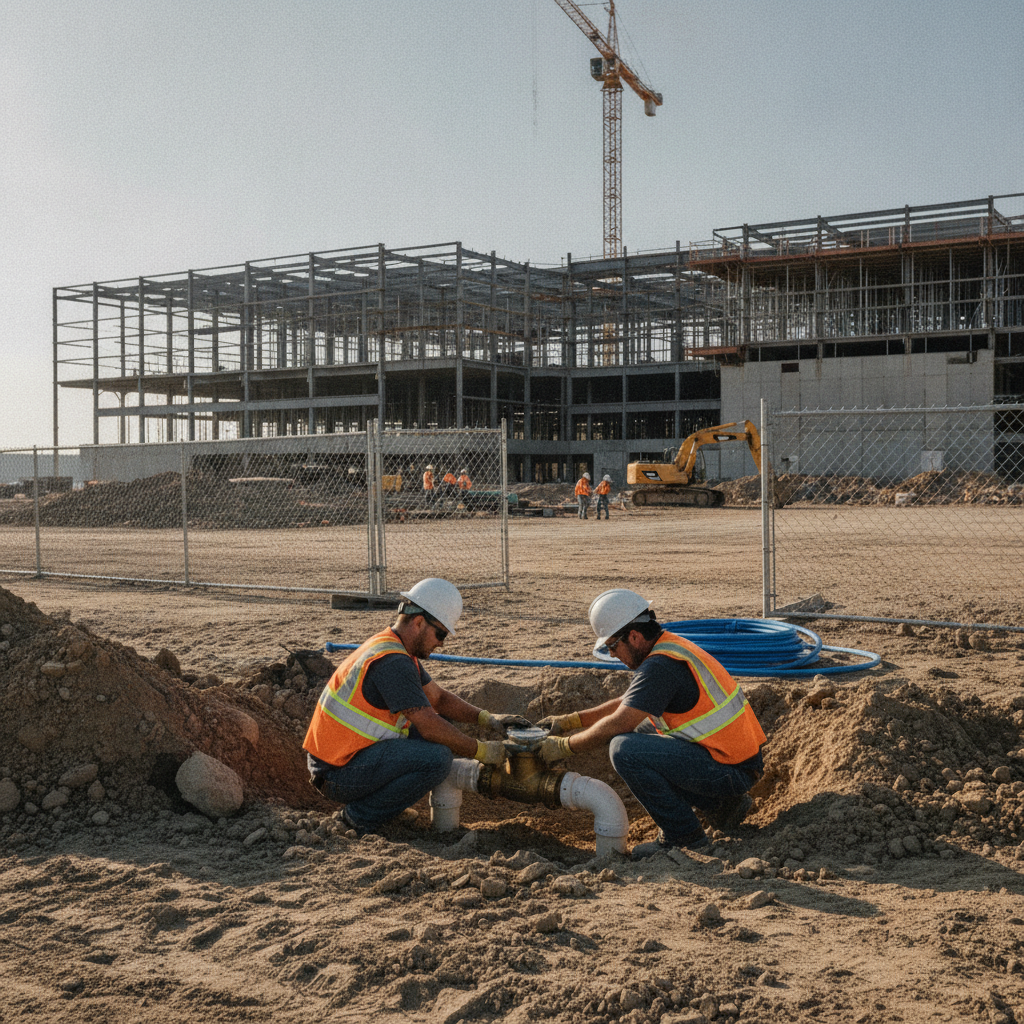
Differentiating Water Systems: Domestic, Fire, and Process Cooling
A common misconception in early-stage site development is to view water as a single utility. In reality, a data center campus relies on at least three distinct water systems, each with its own purpose, pressure requirements, and regulatory framework. Domestic water is designated for human consumption and sanitation (potable water), fire protection water is for life safety and suppression systems, and process water is used for cooling equipment. Keeping these systems physically and hydraulically separate is a fundamental principle of sound civil engineering. The primary reason for this separation is to protect public health. The domestic water system must be rigorously protected from contamination by the non-potable fire and process systems through robust cross-connection control measures. Furthermore, each system has unique operational demands. Fire systems require high pressures and flows on demand, while domestic systems need consistent, regulated pressure for daily use. Blending these functions can compromise the performance and building code compliance of all three systems.
Sizing and Demand Calculations for Domestic Water
Key Design Considerations for Domestic Water Systems
| Design Element | Key Engineering Consideration | Impact on Campus Operations |
|---|---|---|
| Service Sizing | Based on peak demand calculated from fixture unit counts and support facility needs. | Prevents pressure drops during high-usage periods and ensures adequate flow for all campus functions. |
| Metering & Vaults | Compliance with utility provider standards for meter type, size, and vault construction. | Ensures accurate billing, provides a clear point of demarcation, and allows for safe utility access. |
| Pressure Boosting | Analysis of utility pressure vs. building height and friction losses in the on-site network. | Guarantees code-required pressure at all fixtures, ensuring functionality of restrooms, kitchens, and safety equipment. |
| Backflow Prevention | Selection of an appropriate assembly (e.g., RPZ) based on hazard level and local codes. | Protects public health by preventing campus contaminants from entering the municipal water supply. Critical for permitting. |
| Material Selection | Evaluation of pressure requirements, soil corrosivity, and cost. Common materials include DIP and PVC. | Ensures long-term durability of the underground infrastructure, minimizing risks of leaks and costly repairs. |
| System Redundancy | Implementation of looped mains and strategic placement of isolation valves. | Enhances operational resilience by allowing sections of the system to be isolated for maintenance without a full campus shutdown. |
Accurately forecasting domestic water demand is a critical first step. This process goes far beyond simply counting employees. The calculation must account for all points of use across the entire campus, including administrative offices, security stations, maintenance buildings, and any future expansion areas. The analysis is typically based on fixture unit counts as defined by the applicable plumbing codes, which assign a weighted value to each fixture (e.g., toilets, sinks, showers, kitchen equipment). A thorough site plan design must also consider peak demand scenarios, such as shift changes, as well as continuous but lower-volume uses like irrigation for landscaping. A Professional Engineer will aggregate these demands to determine the required flow rate (gallons per minute) and total daily volume. This data is essential for sizing the main service line, the water meter, and any on-site storage or pressure-boosting equipment, ensuring the system can perform reliably without being oversized and inefficient.
Utility Coordination and Service Connection Strategy
Engaging the local water utility provider early and often is paramount to a successful project. The initial phase of utility coordination involves submitting a formal request for a water availability letter. This document confirms the utility’s capacity to serve the project and provides critical data, including the location of the nearest suitable main, available static and residual pressures, and any known system limitations. This information dictates the feasibility of the proposed point of connection (POC) and informs the entire on-site design. The coordination process also involves navigating the utility’s specific standards for materials, meter vault construction, and tap procedures. Permitting requirements vary by jurisdiction, and every project team should confirm the applicable standards with the local, state, regional, and federal authorities that hold review authority over the site. This includes detailed permit submittals for the service connection, backflow prevention assembly, and any work within the public right-of-way. Proactive communication with the utility’s engineering department can prevent significant delays during the agency review process.
On-Site Distribution: Routing, Materials, and Redundancy
Once the service connection is established, the focus shifts to designing the on-site distribution network. On a dense data center campus, the underground environment is crowded with critical infrastructure, including high-voltage power, fiber optic conduits, and gravity sewer lines. The domestic water layout must be carefully routed to maintain required horizontal and vertical separation from these utilities, preventing conflicts and ensuring future maintenance access. This complex routing is a core task of site engineering services. Material selection is another key consideration. Ductile iron pipe (DIP) is often used for its strength and durability, while certain types of PVC may be suitable in other applications, depending on pressure requirements and local soil corrosivity identified in the Geotechnical soil report. For enhanced reliability, many mission-critical facilities incorporate a looped water main design. A looped system provides redundancy by allowing water to reach any point from two directions, ensuring that a single pipe break does not cause a complete service outage for the entire campus.
Pressure Management and Booster Pump Systems
Municipal water pressure is rarely perfectly suited for a large, sprawling campus with multi-story buildings. If the utility’s pressure at the POC is insufficient to serve the highest fixture in the tallest building, a domestic water booster pump system is required. This system consists of a series of pumps, a hydro-pneumatic tank, and controls that increase water pressure to a consistent, usable level throughout the site’s distribution network. The drainage design and topography of the site can also create different pressure zones. A civil engineering analysis will determine if pressure-reducing valves (PRVs) are needed in lower-elevation areas to prevent excessive pressure that could damage fixtures and piping. Proper pressure management is crucial for user satisfaction, equipment longevity, and water conservation, ensuring compliance with plumbing codes and operational standards.
Cross-Connection Control and Backflow Prevention
Protecting the public water supply from contamination is a non-negotiable regulatory requirement. A cross-connection is any point where the potable domestic water system could potentially come into contact with a non-potable source, such as an irrigation system, fire sprinkler system, or cooling tower makeup line. To prevent backflow—the undesirable reversal of flow—a certified backflow prevention assembly must be installed immediately downstream of the water meter. The most common device required for high-hazard applications like a data center campus is a Reduced Pressure Zone (RPZ) assembly. The specific type and location of the device are dictated by the local utility and plumbing codes. The design must include provisions for the significant pressure loss across the device and accommodate the periodic discharge of water during testing and operation. Regular inspection and testing of the backflow prevention device by certified personnel are mandatory to ensure continued protection and compliance.
Our Process: A Systematic Approach to Domestic Water Design
At RSP Engineers, we approach domestic water design with a systematic process honed over years of experience with mission-critical projects. Our process begins with a comprehensive utility due diligence study to confirm service availability and identify constraints. We then perform detailed demand calculations and hydraulic modeling to size the system correctly. Our civil engineers work collaboratively with architects and MEP engineers to integrate the water system into the overall site plan design. We manage the entire permitting process with the utility provider and other regulatory agencies, and we provide full construction administration support to ensure the system is built to specification.
Common Challenges in Domestic Water Planning
Even with careful planning, data center projects can encounter challenges. One common issue is discovering that the available pressure in the public main is lower than initially reported, necessitating a late-stage addition of a booster pump system. Another frequent problem is uncovering unforeseen utility conflicts during excavation, requiring costly and time-consuming redesigns. Navigating inconsistent or poorly documented standards from utility providers can also lead to delays in agency review and approval. Mitigating these risks requires an experienced civil engineering firm that can anticipate issues and engage in proactive problem-solving.
Partner with RSP Engineers for Mission-Critical Utility Design
Designing a reliable domestic water system is a complex task that requires deep expertise in civil engineering, utility coordination, and regulatory compliance. The team at RSP Engineers has a proven track record of delivering robust and efficient utility infrastructure for data center campuses nationwide. We manage every phase of the process, from initial due diligence and permitting to final design and construction support. Contact us to discuss how we can ensure your project’s foundational utilities are engineered for success.
Conclusion: Securing a Reliable Foundation for Campus Operations
While it may not have the high-volume demand of a cooling system, domestic water service is an indispensable component of a data center’s infrastructure. Proper planning, accurate demand forecasting, and proactive utility coordination are essential to developing a system that is reliable, safe, and compliant. By focusing on the details of pressure management, backflow prevention, and resilient distribution, developers can ensure their campus is fully supported. Investing in expert civil engineering for this critical system provides a solid foundation for long-term operational success.
FAQs
-
You should engage a civil engineer during the site selection or due diligence phase. Early involvement allows for a thorough utility availability assessment, which can identify potential ‘fatal flaws’ related to water service before significant capital is invested in a property.
-
Generally, no. While some jurisdictions may allow for combined services on smaller projects, it is standard practice and often a requirement on large campuses to have completely separate service lines for domestic water and fire protection. This separation ensures reliability and prevents cross-contamination.
-
If the municipal pressure is too low, the design will incorporate an on-site booster pump system. This system will take the incoming water and increase its pressure to meet the demands of the campus, ensuring all plumbing fixtures operate correctly.