
Estimating Water Demand for Data Center Facilities
A guide for data center developers on estimating total water demand, including cooling, domestic use, and fire protection. Learn how civil engineering analysis impacts site selection and utility plann
Deconstructing Total Water Demand: Key Components
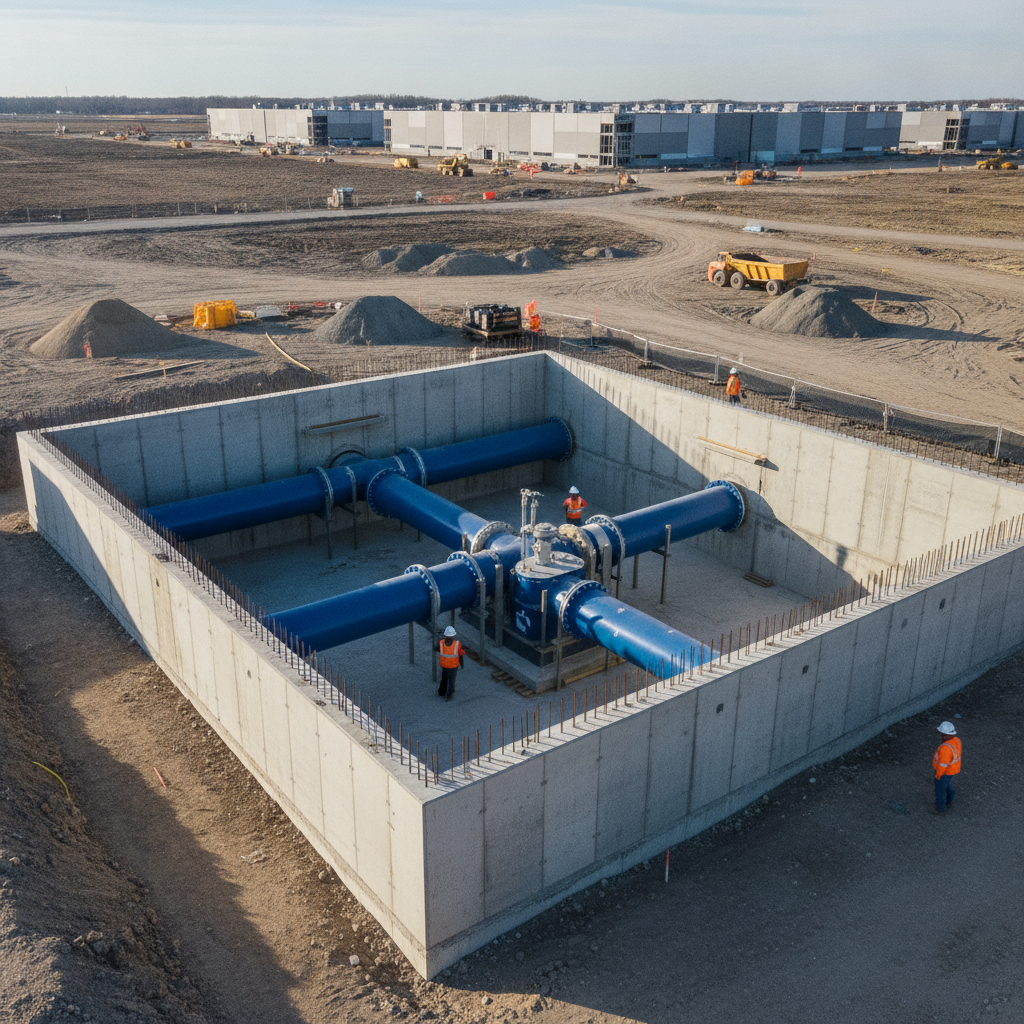
A data center’s total water demand is not a single, static figure. It is a composite of several distinct, variable needs that must be individually calculated and then aggregated. A Professional Engineer will typically break down the analysis into three primary categories: cooling system make-up, domestic use, and fire protection. Understanding the unique characteristics of each is essential for accurate infrastructure planning and utility coordination. The overwhelming majority of a data center’s water consumption—often over 90%—is dedicated to cooling system make-up. This is the water required to replenish what is lost through evaporation and blowdown in evaporative cooling systems. Domestic use, which covers restrooms, sinks, and kitchens for on-site staff, represents a much smaller but consistent demand. Finally, fire protection systems require a significant volume of water to be available instantly, dictating the minimum required flow rate and pressure from the public main or on-site storage.
The Critical Role of Cooling Technology in Water Consumption
Data Center Water Demand Component Comparison
| Component | Primary Driver | Demand Profile | Key Design Standard / Method |
|---|---|---|---|
| Cooling System Make-up | IT Heat Load (MW) & Cooling Technology | Continuous, with high seasonal variation | Mechanical Engineering Heat Load Calculations & Climate Data |
| Domestic Use | Employee & Visitor Count | Consistent, low-volume daily use | Plumbing Code Fixture Unit Counts |
| Fire Protection | Building Size & Hazard Classification | High-volume, short-duration (emergency/testing) | NFPA 13, NFPA 24, and Local Fire Code |
| Site Irrigation | Landscaped Area & Plant Types | Seasonal, intermittent use | Local Landscaping and Water Conservation Ordinances |
| System Testing & Maintenance | Commissioning & Operational Protocols | Intermittent, planned high-volume events | Manufacturer Specifications & Commissioning Plans |
The single largest factor driving water demand is the facility’s chosen cooling technology. While some designs utilize air-cooled chillers or closed-loop systems with lower water needs, many large-scale data centers rely on evaporative cooling via cooling towers for their efficiency, especially in managing high heat loads. This method uses the evaporation of water to dissipate heat, making it highly effective but also water-intensive. The efficiency of cooling towers is directly influenced by ambient climate conditions like temperature and humidity. In arid regions, evaporation rates are higher, increasing water consumption. Conversely, in humid climates, the cooling effect is less efficient. Newer technologies like direct liquid cooling (DLC) or hybrid systems aim to reduce water dependency, but they come with different infrastructure and cost profiles. The choice of cooling system is therefore a critical input for any civil engineering analysis of water demand and a key consideration during the site selection process.
Calculating Cooling Make-up Water Demand
Calculating the demand for make-up water is a technical exercise that requires close collaboration between mechanical and civil engineers. The primary inputs include the data center’s total IT heat load (measured in megawatts), the design’s operational efficiency, and local climate data, specifically the average and peak wet-bulb temperatures. This data helps determine the rate of evaporation required to dissipate the waste heat. Another key concept is cycles of concentration, which measures how many times water can be cycled through the system before mineral buildup requires it to be drained (a process called blowdown) and replaced. Higher cycles of concentration improve water efficiency but may require on-site water treatment. The discharged blowdown water must also be managed, often requiring a pretreatment process before it can be sent to the sanitary sewer system. Water quality standards and discharge permit requirements for blowdown often vary by jurisdiction, and it is crucial to confirm all applicable regulations with the local, state, regional, and federal authorities that hold review authority over the site. This can involve securing an NPDES permit or meeting specific local pretreatment standards.
Quantifying Domestic and Fire Protection Water Needs
While smaller in volume, domestic and fire protection demands are critical for code compliance and life safety. Domestic water demand is calculated based on the projected number of employees and visitors, using fixture unit counts as defined in the applicable plumbing codes. This calculation informs the sizing of smaller-diameter service lines and internal plumbing, and it contributes to the overall average daily demand figure provided to the utility. Fire flow requirements are determined by national standards, such as those from the National Fire Protection Association (NFPA), and are enforced by the local fire marshal. These requirements dictate the minimum flow rate (gallons per minute) and residual pressure that must be available for a specific duration to fight a potential fire. This demand often sets the required size of the main water line serving the site. If the public utility cannot guarantee the required fire flow, the project may need to incorporate expensive on-site water storage tanks and fire pumps, a significant consideration for the site plan design.
Water Usage Effectiveness (WUE) as a Key Performance Metric
In an era of increasing focus on sustainability and environmental stewardship, Water Usage Effectiveness (WUE) has become a critical performance metric for data center operators. Defined by The Green Grid, WUE is calculated by dividing the facility’s annual water usage by the energy consumption of its IT equipment (measured in liters per kilowatt-hour). A lower WUE value signifies greater water efficiency. This metric is a powerful tool for internal benchmarking and communicating sustainability performance to stakeholders and investors. From a planning perspective, targeting a specific WUE can guide decisions on cooling technology selection and operational strategies. For developers considering sites in water-scarce regions, demonstrating a commitment to a low WUE can be a significant advantage during the permitting and public approval process. It allows project teams to compare the long-term water impact of different designs and make informed choices that balance performance with responsible resource management.
Peak vs. Average Demand: Planning for All Scenarios
When presenting water needs to a utility provider, it is crucial to differentiate between average and peak demand. Average daily demand is used to forecast long-term consumption and is often the basis for utility billing. It provides a baseline understanding of the facility’s typical operational footprint. However, infrastructure—pipes, pumps, and treatment plants—must be sized to handle the absolute highest demand the facility could ever place on the system. This is where peak demand calculations become critical. Peak demand represents the maximum simultaneous water draw, which could occur on a hot day when cooling systems are running at full capacity and a fire suppression system is being tested. This figure, which can be many times higher than the average, is what engineers use for the hydraulic modeling and sizing of water mains. Providing a thorough utility capacity analysis that includes both average and peak scenarios is essential for securing a service commitment from the local water authority.
The RSP Engineers Approach to Water Demand Analysis
At RSP Engineers, our process begins with a thorough due diligence and site feasibility analysis. We work with the client’s design team to understand the proposed cooling strategy, IT load, and operational goals. Our team of Civil Engineers then develops a detailed water demand model that quantifies each component—cooling, domestic, and fire flow—under both average and peak conditions. This model becomes the foundation of our utility coordination efforts. We prepare comprehensive utility capacity request letters that present this data clearly to the relevant water and wastewater authorities. This proactive engagement allows us to identify potential system shortfalls early in the process and collaborate with the utility on solutions, whether that involves public infrastructure upgrades or the design of on-site systems like storage tanks and pumps. Our goal is to de-risk the project by securing firm service commitments and ensuring all utility-related permitting is addressed efficiently.
Common Challenges in Estimating and Securing Water Supply
Even with careful planning, data center projects can face significant hurdles related to water supply. One of the most common is discovering that the existing utility infrastructure near a preferred site is undersized and cannot deliver the required pressure or flow, necessitating costly and time-consuming off-site improvements. In some regions, developers may encounter water scarcity issues, leading to development moratoriums or strict conservation requirements that can render a site unviable. The permitting process for large-diameter water services and wastewater connections can also be complex and lengthy, involving multiple agency reviews. Finally, discrepancies between the theoretical demand calculated during design and the actual water usage post-commissioning can lead to operational inefficiencies or issues with utility service agreements. Engaging experienced Civil Engineering firms early can help identify and mitigate these risks before they impact the project schedule and budget.
Partner with RSP for Your Mission-Critical Utility Planning
Securing a reliable water supply is a critical-path item for any data center development. Missteps in demand estimation or utility negotiations can cause significant delays and budget overruns. The team at RSP Engineers provides the expert site engineering services needed to navigate these complexities. We specialize in comprehensive utility coordination, detailed demand modeling, and strategic permitting support for mission-critical projects nationwide. Let us help you ensure your project has the foundational resources it needs to succeed.
Conclusion: Accurate Demand Modeling is Non-Negotiable
In conclusion, estimating water demand for a data center is a complex but essential task that underpins the entire development process. A successful project requires a detailed understanding of how cooling technology choices, operational parameters, and life-safety requirements translate into specific water flow and volume needs. By separating demand into its core components and planning for both average and peak demand scenarios, developers can engage with utilities from a position of strength. Ultimately, early and continuous collaboration with an experienced civil engineering firm is the best way to mitigate risks associated with water supply. A proactive approach to demand analysis, utility capacity confirmation, and permitting ensures that this critical resource becomes a project enabler, not a limitation.
FAQs
-
A preliminary water demand analysis should be conducted as part of the initial site selection due diligence. A high-level estimate can quickly determine if a site is potentially viable by comparing its needs to the known capacity of local utilities, preventing wasted time and resources on sites that cannot be serviced.
-
If the public system is deficient, particularly for fire flow, the solution often involves designing and constructing on-site water storage tanks and dedicated fire pumps. This adds significant cost and a larger physical footprint to the site development plan but ensures the facility is self-reliant for emergency needs.
-
Wastewater capacity is directly linked to water demand. Nearly all water brought to the site for domestic use and cooling tower blowdown must be discharged as sewage. Therefore, the utility capacity analysis must confirm that the downstream sanitary sewer system has adequate capacity to accept the projected effluent from the data center.