
Navigating South Florida’s Complex Parking Ratio Requirements
A guide for developers on navigating South Florida’s complex parking ratio requirements, including zoning codes, ADA compliance, and stormwater management. Learn how RSP Engineers can help.
The Foundation: Understanding Zoning Code and Land Use Designations
The starting point for any parking analysis is the local municipal zoning code. Each city and county in South Florida has its own unique set of rules that dictate the minimum—and sometimes maximum—number of parking spaces required for a given development. These regulations are directly tied to the property’s land use designation and zoning district. For example, the requirements for a commercial property zoned C-1 in Fort Lauderdale will differ significantly from a mixed-use property in a Transit-Oriented Development (TOD) corridor in Miami. Our first step in any project is a thorough zoning compliance review. We analyze the specific municipal code to identify the controlling factors for parking, which could be based on gross floor area, number of dwelling units, seating capacity, or even the number of employees. This initial due diligence is crucial for establishing a realistic project scope and avoiding fundamental design flaws. A deep understanding of these local nuances is what separates a smooth permitting process from one fraught with delays and agency review comments.
Calculating Base Parking Ratios: More Than Just Square Footage
South Florida Parking Ratio Comparison by Use Type
| Use Type | Typical Ratio Basis | Common Range in South Florida | Key Engineering Considerations |
|---|---|---|---|
| Retail / Commercial | Per 1,000 SF GFA | 4.0 - 5.5 spaces | High turnover, peak weekend demand, ADA compliance at storefronts, truck loading zones. |
| Office | Per 1,000 SF GFA | 3.0 - 4.0 spaces | Peak weekday demand, potential for shared parking analysis with evening uses, employee vs. visitor parking. |
| Multifamily Residential | Per Dwelling Unit | 1.5 - 2.25 spaces | Guest parking requirements, garage vs. surface lot design, integration with amenity areas. |
| Restaurant | Per 100 SF or Per Seat | Varies widely (e.g., 1 per 4 seats) | High evening/weekend peaks, valet operations, employee parking, utility coordination for grease traps. |
| Industrial / Warehouse | Per 1,000 SF GFA | 1.0 - 2.5 spaces | Separation of employee parking from truck circulation, large turning radii for semi-trucks, durable pavement design. |
Once the land use is confirmed, the next step is the parking ratio calculation itself. While it may seem straightforward, the methodology varies widely. For an office building, the ratio is typically expressed as a number of spaces per 1,000 square feet of gross floor area (GFA). For a multifamily residential project, it’s calculated per dwelling unit, often with different requirements for studio, one-bedroom, and two-bedroom units. Restaurants or theaters may have their parking calculated based on seating capacity or public assembly area. A Professional Engineer must carefully interpret the code’s definitions. Does ‘gross floor area’ include hallways, mechanical rooms, and lobbies? The answer can dramatically alter the required parking count. This phase of civil engineering requires meticulous attention to detail to ensure the development plan is based on accurate calculations. Failing to do so can trigger a cascade of issues during the site plan approval process, as city planners will rigorously check these figures against their code.
Critical Adjustments: Shared Parking, Reductions, and Variances
Meeting the base parking requirement is not always feasible or desirable, especially on constrained urban sites. Fortunately, many South Florida municipalities offer provisions for parking reductions. A shared parking analysis is a powerful tool for mixed-use developments where different tenants have peak parking demands at different times of day. For instance, an office building’s peak demand is during weekday business hours, while a restaurant’s is in the evening. A detailed study can justify a significant reduction in the total number of required spaces, saving valuable land and construction costs. Developments located within a Transit-Oriented Development (TOD) zone or near major public transit hubs may also qualify for administrative reductions. The logic is that proximity to transit reduces reliance on personal vehicles. In cases where no administrative reduction is possible, a developer can apply for a zoning variance. This is a more intensive process that requires demonstrating a practical hardship and proving that the variance will not negatively impact the community. Success often depends on a robust technical justification prepared by an experienced engineering consultant.
ADA Compliance and Accessible Parking Design
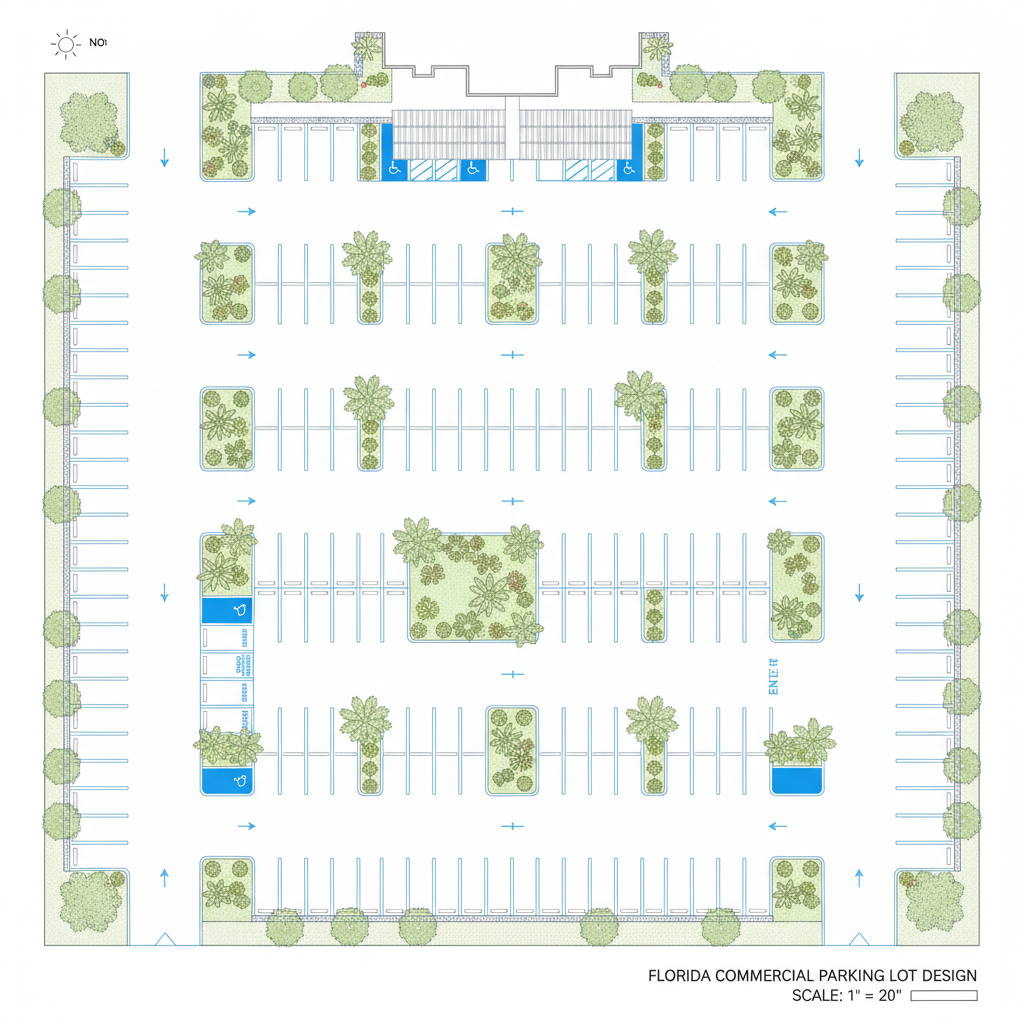
Beyond the sheer number of spaces, every parking lot must strictly adhere to federal and state accessibility laws. ADA compliance is non-negotiable and is governed by the Americans with Disabilities Act and the Florida Building Code. These regulations dictate the minimum number of accessible spaces, including van-accessible stalls, based on the total parking count. The design requirements are highly specific, covering everything from stall dimensions and access aisle widths to signage, slope, and the path of travel to the building entrance. Our site engineering services team ensures that every detail of accessible parking is correctly implemented in the design documents. This includes verifying that curb ramps have the correct slope, accessible routes are free of obstructions, and stall markings are compliant. Failure to meet these standards not only risks permit denial but also exposes the property owner to potential legal action. Proper ADA compliance is a cornerstone of responsible and defensible site development.
Integrating Stormwater Management into Parking Lot Design
A parking lot is essentially a large impervious surface, which creates significant challenges for stormwater management in rainy South Florida. Runoff from parking lots can carry pollutants into local waterways and contribute to flooding if not managed properly. Modern drainage design integrates stormwater solutions directly into the parking lot layout. This can include using pervious pavers that allow water to infiltrate the ground, designing landscaped islands as small retention or detention areas, or installing underground exfiltration trenches beneath the parking stalls. These solutions must be designed to meet the stringent criteria of the local municipality and the regional water management district (like the SFWMD). The design must account for water quality treatment and water quantity control to prevent adverse impacts downstream. Effective integration of stormwater management is a hallmark of sophisticated civil engineering and is essential for gaining permit approval for any significant paving project.
Geometric Design and Traffic Circulation
A functional parking lot is about more than just storage; it’s about safe and efficient movement. The geometric design of a parking facility dictates its usability and safety for both vehicles and pedestrians. This involves specifying appropriate stall dimensions, aisle widths for one-way or two-way traffic, and ensuring adequate turning radii for passenger vehicles and, critically, emergency vehicles like fire trucks. A poorly designed traffic circulation plan can create congestion, confusion, and safety hazards. During the site plan design phase, we model vehicle movements to ensure functionality. We also incorporate pedestrian walkways, crosswalks, and other safety features to create a secure environment. This aspect of roadway engineering within a site is closely scrutinized by municipal reviewers during the site plan approval process. They will verify that the layout meets their standards for safety, access, and emergency response.
The RSP Engineers Approach to Parking Optimization
At RSP Engineers, we treat parking design as an integrated process, not a standalone task. Our approach ensures that all regulatory and functional requirements are addressed cohesively from day one. We begin with a comprehensive review of the applicable zoning code to establish a clear baseline. From there, we develop a preliminary site plan design that explores various layouts to maximize efficiency and yield. Where applicable, we proactively identify opportunities for parking reductions through shared parking analysis or TOD provisions. Our engineers work in parallel to integrate stormwater management and drainage design directly into the parking layout, creating a sustainable and compliant site. Throughout the process, we manage utility coordination to avoid conflicts with underground infrastructure. This holistic approach streamlines the preparation of construction documents for permit submittals and minimizes comments from agency reviewers.
Common Pitfalls in Parking Design and Permitting
Even experienced developers can encounter issues with parking design. One of the most common pitfalls is misinterpreting the nuances of a specific municipal code, leading to a design that is fundamentally non-compliant. Another frequent issue is underestimating the stringent requirements for ADA compliance, particularly regarding slopes and paths of travel, which can force costly rework during construction. Poor drainage design is a major red flag for reviewers and can cause significant delays if the stormwater calculations are incorrect. Conflicts with existing underground infrastructure are also a common problem. Failing to perform adequate due diligence on the location of water, sewer, and power lines can lead to major redesigns. Finally, neglecting to account for fire department access, including turning radii and fire lane requirements, is a critical error that can halt a project during the permitting phase. Proactive coordination and expert engineering are the best defense against these common issues.
Partner with RSP Engineers for Your South Florida Development
Successfully navigating South Florida’s parking regulations requires a deep understanding of local codes and a multidisciplinary engineering approach. Don’t let parking challenges derail your project. The team at RSP Engineers provides the expert guidance needed to optimize your site layout, ensure regulatory compliance, and streamline the path to approval. From initial feasibility and site plan design to final permitting and construction administration, we are your trusted partner. Contact us today to discuss how our expertise in zoning compliance, stormwater management, and traffic engineering can maximize the value and viability of your next land development project. Let’s build a successful project together.
Conclusion: Strategic Parking Design is Key to Project Success
In the competitive South Florida market, strategic parking design is a critical driver of project success. It directly influences site efficiency, construction costs, and the user experience. A well-designed parking plan goes beyond meeting minimum space counts; it integrates seamless traffic flow, robust stormwater management, and full ADA compliance. Achieving this requires a proactive and knowledgeable approach from the very beginning of the land development process. By partnering with an experienced civil engineering firm, developers can navigate complex municipal codes, identify opportunities for optimization, and avoid common pitfalls that lead to delays and budget overruns. Ultimately, a thoughtful and compliant parking strategy is a foundational element of a profitable and sustainable development.
FAQs
-
Yes, it is possible to obtain a zoning variance, but it is not guaranteed. You must typically demonstrate a practical hardship unique to your property that prevents you from meeting the code. The process involves a formal application, public hearings, and proving that the variance won’t negatively affect public welfare. A strong technical justification prepared by a Professional Engineer is essential for a successful application.
-
This is an evolving area of regulation. Many South Florida municipalities now require a certain percentage of parking spaces to be ‘EV-Ready’ or have charging stations installed. These spaces typically count toward your minimum required parking. The implementation requires careful utility coordination to ensure adequate power supply is brought to the parking area, which should be factored into the initial site development budget.
-
A shared parking study is a technical analysis that justifies a reduction in the total required parking for a mixed-use development. It demonstrates that the peak parking demand of the different uses (e. g. , office and retail) occurs at different times, so they can ‘share’ a common pool of spaces. You need one when you are formally requesting a parking reduction based on this principle, and it must be certified by a qualified engineer or planner.