
Florida’s Wind Load Requirements: A Civil Engineering Guide to FBC Compliance
A detailed guide from RSP Engineers on navigating the Florida Building Code’s wind load requirements for land development, including risk categories, design pressures, and permitting.
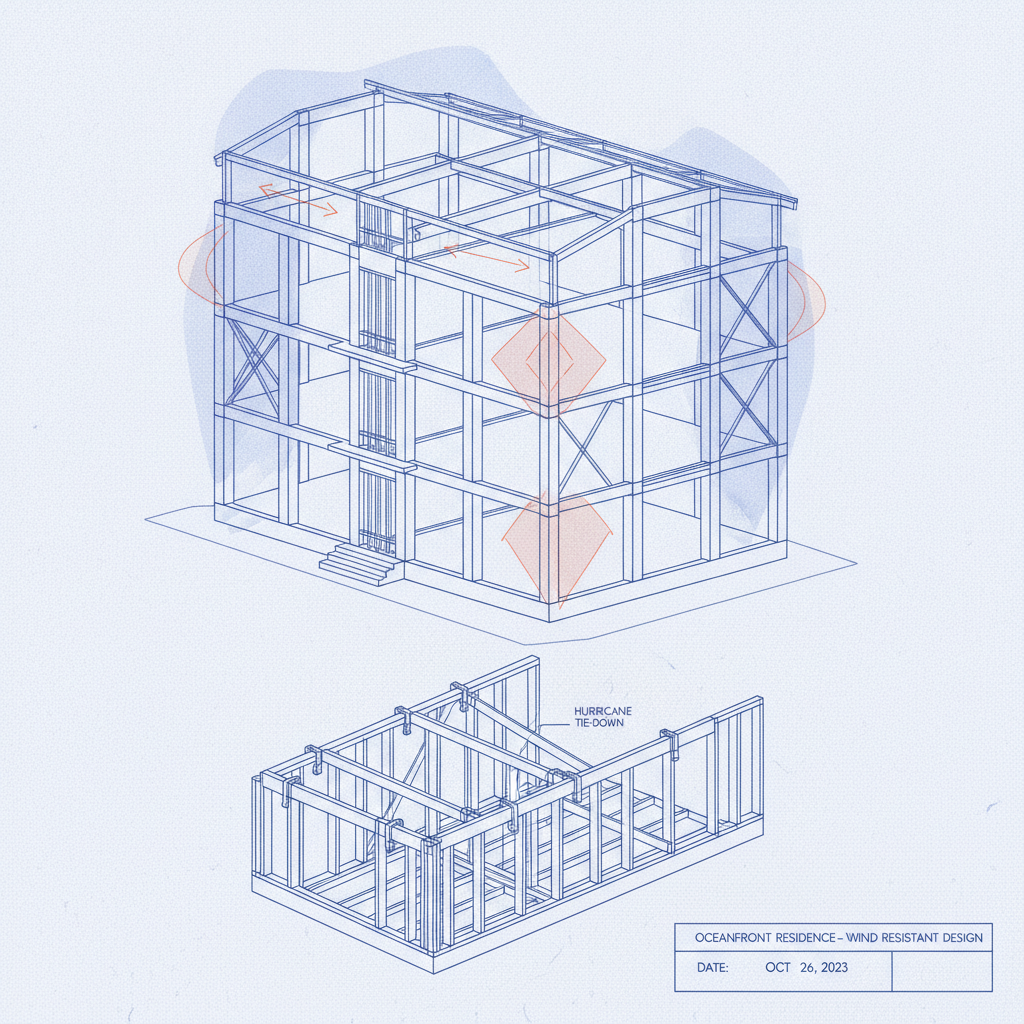
The Foundation of Wind Design: The Florida Building Code and ASCE 7
The cornerstone of wind-resistant design in Florida is the Florida Building Code (FBC), which directly adopts and often amends standards from the American Society of Civil Engineers (ASCE). The primary reference document is ASCE 7, titled “Minimum Design Loads and Associated Criteria for Buildings and Other Structures.” It is crucial for design professionals to use the specific edition of ASCE 7 referenced by the current FBC, as these standards are updated periodically to incorporate new research and data from past storm events. This integration ensures that Florida projects benefit from the latest advancements in structural engineering. The FBC and ASCE 7 work together to provide a performance-based approach to wind design. Rather than prescribing a one-size-fits-all solution, the codes require engineers to perform project-specific wind load calculations based on a building’s location, shape, size, and intended use. This detailed analysis is a non-negotiable part of the site development process and forms the basis of the structural design, influencing everything from the foundation to the roof sheathing and its connections.
Determining Your Project’s Risk Category
Wind Design Parameters by Risk Category
| Risk Category | Typical Structures | Key Design Implications | Wind Load Importance Factor (Iw) |
|---|---|---|---|
| Category I | Agricultural facilities, temporary structures, minor storage facilities. | Lowest design wind loads. Represents a low hazard to human life in the event of failure. | 0.87 (ASCE 7-16) |
| Category II | Single-family homes, multifamily residential, office buildings, retail stores. | Standard design requirements for most common buildings. This is the baseline for most site development projects. | 1.00 (ASCE 7-16) |
| Category III | Schools, assembly halls (>300 occupants), healthcare facilities with 50+ resident patients, power-generating stations. | Increased design wind loads to ensure higher performance and occupant safety. Requires a more robust structural engineering design. | 1.15 (ASCE 7-16) |
| Category IV | Hospitals, fire stations, police stations, emergency communication centers, hurricane shelters. | Most stringent requirements. Structures must remain operational during and after a design-level storm event. Critical for community resilience. | 1.15 (ASCE 7-16) |
Before any calculations can begin, a project must be assigned a Risk Category (I through IV) as defined in ASCE 7. This classification is based on the building’s use and occupancy and the potential consequences of its failure. A higher risk category imposes more stringent design requirements, including higher design wind speeds. This initial determination is a critical step that influences the entire structural design and the permitting pathway. For example, Risk Category I includes structures with a low risk to human life in the event of failure, such as agricultural buildings. Risk Category II encompasses most typical buildings, including single-family homes, apartments, and office buildings. Risk Category III is for structures with a substantial number of occupants, like schools and theaters. Finally, Risk Category IV is reserved for essential facilities, such as hospitals, fire stations, and hurricane shelters, which must remain operational during and after a major storm. Misclassifying a building can lead to significant agency review comments and redesign requirements, impacting both budget and schedule.
Mapping Wind Speeds and Exposure Categories
Florida’s wind load requirements are geographically specific. The FBC provides detailed wind speed maps that delineate design wind speeds across the state, with the highest values found along the coastline, particularly in South Florida and the Panhandle. These maps are based on historical hurricane data and probabilistic analysis. A Professional Engineer must use the correct ultimate design wind speed for the project’s precise location as the starting point for all wind load calculations. In addition to wind speed, the site’s immediate surroundings, or Exposure Category, must be determined. Exposure B applies to urban and suburban areas with numerous closely spaced obstructions. Exposure C applies to open terrain with scattered obstructions, such as flat, open country or grasslands. Exposure D is the most severe, reserved for sites directly on the coast or other large bodies of water. The choice of Exposure Category significantly impacts the calculated wind pressures and is a key consideration in any civil engineering site assessment.
Calculating Wind Pressures: The Main Wind-Force Resisting System (MWFRS)
The Main Wind-Force Resisting System (MWFRS) is the structural skeleton of a building—the collection of shear walls, diaphragms, and structural frames designed to transfer wind loads from the exterior surfaces down to the foundation. The design of the MWFRS ensures the building can resist overall uplift, shear, and overturning forces generated by wind. Engineers use procedures outlined in ASCE 7 to calculate the design wind pressures acting on the MWFRS. These calculations are complex, involving factors such as the basic wind speed, an importance factor (tied to the Risk Category), exposure and topographic factors, a gust-effect factor, and aerodynamic pressure coefficients that vary based on the building’s shape and roof angle. The resulting pressures are then used to design the primary structural elements. A thorough analysis of the MWFRS is fundamental to achieving zoning compliance and securing a building permit.
Components and Cladding (C&C): Protecting the Building Envelope
While the MWFRS handles the overall structural load, Components and Cladding (C&C) refer to the elements that form the building envelope. This includes roofing, windows, doors, wall siding, and soffits. These components do not carry the primary structural load of the building but are subject to intense, highly localized wind pressures, especially at corners, eaves, and roof ridges. The failure of a C&C element, such as a window blowing out, can lead to internal pressurization of the building, dramatically increasing the loads on the MWFRS and potentially causing a catastrophic failure. Because of this risk, the FBC has stringent requirements for C&C, including specific testing and certification standards. Products used in Florida, particularly in high-wind zones, must often have a Florida Product Approval or a Miami-Dade Notice of Acceptance (NOA). During the permit submittals phase, design documents must clearly specify the approved products and their installation details to demonstrate compliance.
The Role of Site Characteristics in Wind Load Design
A project’s site plan and grading design, typically handled by a Civil Engineer near me, can directly influence wind load requirements. The site’s topography, elevation, and proximity to open water or even large, man-made features can alter the effective wind exposure. For instance, a building constructed on a prominent hill or escarpment will experience higher wind speeds than one on flat terrain, a factor that must be accounted for in the calculations. Furthermore, the layout of a development can create wind-tunneling effects or altered exposures for adjacent buildings. The design of large, open stormwater management basins can also change the local terrain from a sheltered Exposure B to a more open Exposure C for a nearby structure. This highlights the importance of integrated design, where civil engineering and structural engineering disciplines collaborate early in the site development process to identify and mitigate potential issues.
RSP Engineers’ Approach to Wind Load Analysis and Design
At RSP Engineers, we integrate wind load considerations from the earliest stages of project planning. Our process begins with a thorough site assessment to establish the correct Risk Category, design wind speed, and Exposure Category. This foundational data informs our civil engineering design and allows for effective collaboration with the project’s architect and structural engineer. Our team performs detailed wind load calculations in accordance with the latest FBC and ASCE 7 standards, ensuring all aspects of the design, from the MWFRS to the C&C, are fully compliant. We prepare comprehensive and clear documentation for permit submittals, minimizing the risk of delays from agency review comments. During construction, we offer construction administration services to verify that specified materials and installation methods are correctly implemented, ensuring the final build matches the approved resilient design.
Common Issues and Pitfalls in Wind Load Compliance
Even experienced teams can encounter challenges with Florida’s complex wind load requirements. Some of the most common issues we see include using outdated wind speed maps from a previous FBC edition, incorrectly assigning the Exposure Category by failing to account for future development, and providing insufficient documentation for C&C product approvals. Another pitfall is value engineering that inadvertently weakens the Main Wind-Force Resisting System (MWFRS) by substituting non-equivalent materials or connections. Furthermore, overlooking topographic effects, such as hills or escarpments, can lead to an under-designed structure. These errors are often caught during the municipal or county plan review, leading to costly redesigns and project delays. Partnering with experienced Florida Licensed Engineers who specialize in local codes and conditions is the most effective way to avoid these common pitfalls. Frequently Asked Questions About Florida Wind Load Requirements How often does the Florida Building Code update its wind load provisions? The Florida Building Code is updated on a three-year cycle. These updates often include the adoption of a newer version of ASCE 7, which can introduce significant changes to wind speed maps, design coefficients, and calculation methodologies. It is essential to design every project based on the code edition in effect at the time of permit application. Does my single-family home have the same wind load requirements as a commercial building? Not necessarily. While both would likely fall under Risk Category II, the complexity of the structure, its geometry, and its location will lead to different wind load calculations. Additionally, the FBC provides some prescriptive paths for simple residential structures, but a custom-engineered design is often required, especially in high-wind zones or for complex architectural designs. What is a ‘Florida Product Approval’ and why is it important? A Florida Product Approval is a certification from the Florida Building Commission indicating that a product, such as a window, door, or roofing material, has been tested and found to comply with the state’s specific requirements for wind resistance and impact protection. Using products with this approval is mandatory for many applications and simplifies the permitting process by providing clear evidence of compliance. Can my site’s landscaping affect my wind load calculations? Generally, landscaping is not considered a reliable windbreak for the purposes of determining the Exposure Category, as trees can be removed or destroyed in a storm. The determination is based on the permanent topography and surrounding buildings. However, the overall site plan design and grading can have a significant impact. What happens if my plans are rejected due to incorrect wind load calculations during the permitting process? If a plan reviewer finds deficiencies in the wind load calculations or documentation, they will issue comments that must be addressed before a permit can be issued. This typically requires the engineer of record to revise the calculations and structural drawings, which can lead to project delays and potential redesign costs. A thorough initial submittal is the best way to avoid this.
Partner with RSP Engineers for Compliant and Resilient Development
Navigating the complexities of the Florida Building Code requires specialized expertise and meticulous attention to detail. At RSP Engineers, we provide the comprehensive site engineering services needed to ensure your project not only meets but exceeds Florida’s stringent wind load requirements. From initial site analysis and utility coordination to final permit submittals, our team is dedicated to delivering designs that are safe, resilient, and ready for a smooth agency review. Don’t let code compliance become a bottleneck for your project. Contact us today to discuss how our engineering expertise can support your next development in Orlando, Tampa, or anywhere in Florida.
Conclusion: Building for Resilience in the Sunshine State
In Florida, wind load design is not an afterthought; it is a central component of responsible development. Adherence to the Florida Building Code and ASCE 7 is paramount for protecting lives and investments. The process requires a clear understanding of Risk Categories, accurate determination of wind speeds and exposures, and a dual focus on both the Main Wind-Force Resisting System (MWFRS) and the building’s Components and Cladding. By partnering with an experienced civil engineering firm, developers can confidently navigate the regulatory landscape, ensuring their projects are built to withstand the forces of nature and stand the test of time.
FAQs
-
Florida’s Wind Load Requirements: A Civil Engineering Guide to FBC Compliance requires careful planning, qualified engineering, and compliance with the applicable codes and permits.
-
Getting Florida’s Wind Load Requirements: A Civil Engineering Guide to FBC Compliance right protects safety, supports regulatory compliance, and avoids costly redesigns or delays.
-
RSP Engineers provides licensed expertise and end-to-end support for Florida’s Wind Load Requirements: A Civil Engineering Guide to FBC Compliance, from early planning through permitting.