
Navigating High Groundwater: A Civil Engineering Guide for Miami-Dade Development
Expert guide from RSP Engineers on civil engineering strategies for dealing with high groundwater in Miami-Dade, covering stormwater design, permitting, and foundation challenges.
Understanding Miami-Dade’s Unique Hydrogeology
The primary reason for Miami-Dade’s high groundwater is its position atop the Biscayne Aquifer, a highly porous and shallow limestone formation that acts like a massive subterranean sponge. This aquifer is the region’s primary source of drinking water and is in direct hydraulic connection with surface water bodies, including canals, wetlands, and the Atlantic Ocean. Consequently, the water table—the level below which the ground is saturated with water—is often just a few feet below the surface. This condition is exacerbated by two factors: intense seasonal rainfall and sea-level rise. During the wet season, the aquifer quickly recharges, pushing groundwater levels even higher. Compounding this, rising sea levels create a persistent backpressure that prevents the aquifer from draining efficiently, a phenomenon known as saltwater intrusion. A thorough Geotechnical soil report is the first step in quantifying these site-specific conditions, providing the foundational data for all subsequent site plan design and engineering.
The Critical Role of Site Investigation and Groundwater Monitoring
Groundwater Mitigation Technique Comparison
| Mitigation Technique | Primary Engineering Function | Typical Application | Permitting Complexity |
|---|---|---|---|
| Exfiltration Trench | Provides stormwater storage and promotes infiltration over a large surface area. | Parking lots, site perimeters, and linear green spaces. | Moderate; requires detailed calculations for storage, infiltration, and water quality, subject to DERM and SFWMD review. |
| Pervious Pavement Systems | Reduces runoff volume at the source by allowing direct infiltration through the surface. | Parking stalls, sidewalks, and low-traffic driveways. | Moderate to High; requires specific soil suitability analysis and a long-term maintenance plan as part of the permit submittals. |
| Raised/Pile Foundations | Elevates structures above the SHWT and transfers loads to stable soil layers. | All building types, especially in low-lying areas or where basements are desired. | Low (from a water management perspective); primarily a structural and building permit issue. |
| Subsurface Drainage (French Drains) | Intercepts and redirects shallow groundwater away from structures and sensitive areas. | Protecting building foundations, retaining walls, and landscape areas. | Low; often considered part of the overall site drainage design and not permitted separately unless a large discharge is created. |
| Active Dewatering System | Temporarily lowers the water table to allow for safe, dry excavation. | Construction of deep foundations, utility trenches, and underground structures. | High; requires a specific dewatering permit, water quality testing, and a certified discharge plan. |
A successful project begins with a robust understanding of site-specific groundwater behavior. A generic assumption is insufficient for design and will be rejected during agency review. The essential first step is a detailed geotechnical investigation, which must include soil boring tests to determine soil stratigraphy and the installation of piezometers for direct groundwater level measurement. This isn’t a one-time measurement; data must be collected over time to establish the Seasonal High Water Table (SHWT). The SHWT is a regulatory elevation that represents the highest anticipated level of the water table during the wet season. This elevation, not the average or dry-season level, governs nearly every aspect of site development in Miami-Dade. It dictates the minimum elevation of roadways, the feasibility of underground utilities, and, most critically, the design parameters for the entire stormwater management system. Without accurate, professionally certified SHWT data, moving forward with any meaningful design is impossible.
Advanced Stormwater Management Strategies for High Water Tables
Conventional stormwater solutions like deep wet detention ponds are often impractical in Miami-Dade because the high water table leaves little to no vertical separation for infiltration and water quality treatment. This necessitates specialized drainage design approaches. The goal is to manage stormwater volume and quality control requirements as mandated by the South Florida Water Management District (SFWMD) and Miami-Dade County’s Department of Environmental Resources Management (DERM). Effective strategies include exfiltration trench systems, which are long, gravel-filled trenches that provide storage and promote infiltration over a large linear area. Another common solution is the use of pervious pavement systems (like porous concrete or permeable pavers) for parking lots and low-traffic areas, allowing rainfall to infiltrate directly into a sub-base reservoir. In some cases, complex systems involving pumps and control structures may be required. The selection of the appropriate system depends on the project’s size, land use, and the specific limitations imposed by the SHWT, all of which must be documented in detailed permit submittals.
Foundation and Structural Design Implications
High groundwater exerts significant hydrostatic pressure on any structure built below the water table. This force can cause basement walls to crack, lead to chronic water intrusion, and even cause buoyant forces strong enough to lift underground structures like fuel tanks or empty pools. Therefore, foundation design must be closely coordinated between the Civil Engineer near me and the structural engineer. Common solutions include designing foundations on piles that transfer the building load to deeper, more stable soil layers, or constructing heavily reinforced mat-slab foundations designed to resist uplift pressures. Comprehensive waterproofing and damp-proofing systems are non-negotiable for any below-grade or at-grade structures. Furthermore, the Florida Building Code mandates minimum finished floor elevations (FFEs) relative to the crown of the road and flood criteria, which are directly influenced by the site’s groundwater and drainage design.
Utility Coordination and Installation Challenges
Installing underground utilities like water mains, sanitary sewers, and electrical conduits is significantly more complex in high groundwater conditions. Standard trenching operations are impossible without active dewatering to keep the excavation dry and stable. This process itself requires careful planning and, often, a separate permit. The constant presence of water also increases the risk of trench collapse, requiring stringent adherence to OSHA safety standards. Material selection is also critical. For example, sanitary sewer systems may require buoyancy calculations to ensure pipes do not float or shift after backfilling. Manholes and other structures must be sealed to prevent groundwater infiltration, which can overwhelm wastewater treatment facilities. Effective utility coordination with agencies like Miami-Dade Water and Sewer (WASD) and FPL is paramount to ensure all design and construction methods meet their stringent requirements for work in saturated conditions.
Dewatering Permitting and Construction Best Practices
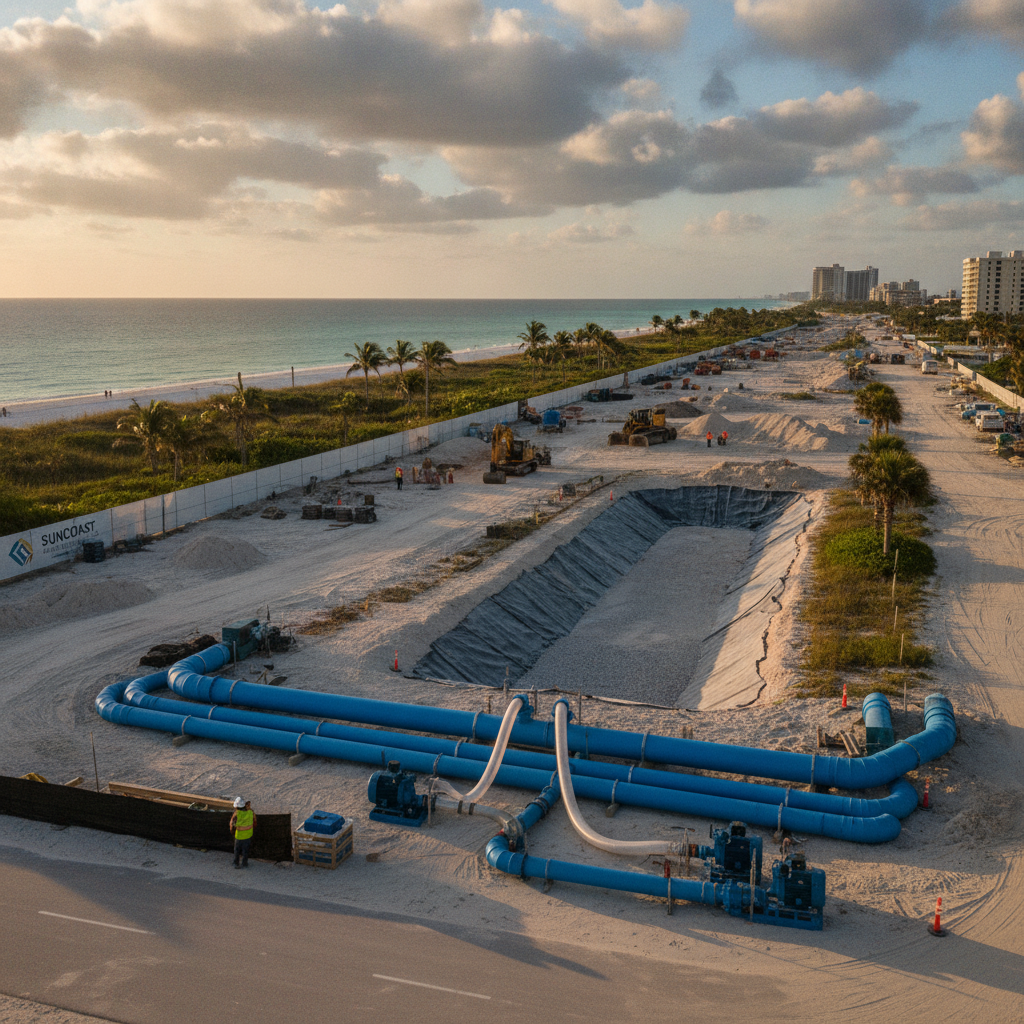
When construction requires excavation below the water table, a dewatering plan is necessary. This involves pumping groundwater out of the construction zone and discharging it to an approved location. In Miami-Dade, this is a regulated activity requiring a permit to ensure the discharged water is free of contaminants and does not cause off-site erosion or flooding. The quality of the water being pumped must be tested, especially on sites with a history of industrial use. During construction administration, the Professional Engineer must oversee the dewatering process to ensure compliance with the permit conditions. Best Management Practices (BMPs), such as using filter bags or sediment traps, must be employed to treat the water before discharge. Improper dewatering can result in hefty fines and stop-work orders, making it a critical component of the construction phase that must be planned for during the initial site engineering services.
Our Process: RSP Engineers’ Approach to High Groundwater Sites
At RSP Engineers, we address high groundwater challenges with a systematic, data-driven process. Our approach begins with commissioning a comprehensive Geotechnical Engineering investigation to establish a reliable Seasonal High Water Table (SHWT). This data becomes the bedrock of our design. We then integrate this information into our site plan design, utilizing advanced stormwater modeling software to develop efficient and compliant drainage design solutions, such as exfiltration trenches or pervious systems tailored to the site. Our team excels at proactive agency review and coordination with DERM, SFWMD, and local utility providers. We prepare meticulous permit submittals with clear calculations and exhibits to minimize review comments and accelerate approval timelines. During construction, we provide robust construction administration services, including oversight of dewatering operations and foundation installation, to ensure the design is executed correctly and the project remains in compliance.
Common Issues and Pitfalls to Avoid
The most common mistake we see is underestimating the true SHWT based on a single, dry-season observation. This leads to a cascade of design failures, from undersized stormwater systems to flooded structures. Another frequent issue is failing to budget for the high costs and extended timelines associated with dewatering and specialized foundation work. Developers must account for these realities early in the pro-forma. Finally, incomplete or poorly justified permit submittals can get stuck in a cycle of comments from Miami-Dade DERM, one of the most stringent regulatory bodies in Florida. A lack of detailed soil boring data, flawed infiltration calculations, or an inadequate pollution control plan are common reasons for rejection. Partnering with experienced Civil Engineers who understand these local requirements is the best way to avoid these costly pitfalls.
Your Partner for Complex South Florida Projects
Successfully developing a project in Miami-Dade’s high groundwater environment requires specialized expertise and a proactive approach. The team at RSP Engineers has a proven track record of navigating these complex challenges. We provide comprehensive site engineering services, from initial feasibility and Geotechnical Engineering coordination to final permitting and construction administration. Don’t let subsurface conditions derail your project. Contact us today to discuss how our expert stormwater management and land development solutions can ensure your project is built on a solid foundation.
Conclusion
High groundwater is an unchangeable reality of land development in Miami-Dade County. Rather than an obstacle, it should be treated as a core design parameter from day one. By investing in thorough site investigation, employing advanced stormwater management techniques, and designing resilient foundations and utilities, projects can not only meet the stringent regulatory requirements but also achieve long-term success. Proactive planning and collaboration with an experienced civil engineering firm are the keys to transforming this challenge into a well-managed component of a successful site development project.
FAQs
-
The Seasonal High Water Table (SHWT) is the highest level the groundwater is expected to reach during the year, typically in the wet season. It’s a regulatory elevation used by agencies like DERM to set design constraints. All stormwater management systems, foundation designs, and utility installations must be designed relative to the SHWT to ensure functionality and prevent flooding.
-
Generally, no. Standard septic systems require a minimum vertical separation between the drain field and the SHWT to function properly and prevent contamination. In most high groundwater areas of Miami-Dade, this separation cannot be achieved, necessitating an engineered system like a mound system or, more commonly, a connection to the municipal sanitary sewer system.
-
High groundwater significantly impacts both. It requires more extensive upfront investigation (e. g. , a Geotechnical soil report), more complex and expensive designs for foundations and drainage, and specialized construction techniques like dewatering. These factors add direct costs and can extend the construction schedule, which must be factored into project planning.