
Navigating Florida’s Urban Service Boundaries: A Guide for Land Development
A guide for developers on Florida’s Urban Service Boundaries (USB). Learn how USBs impact zoning, utilities, permitting, and the process for amendment.
The Foundation: Urban Service Boundaries and Florida’s Comprehensive Plans
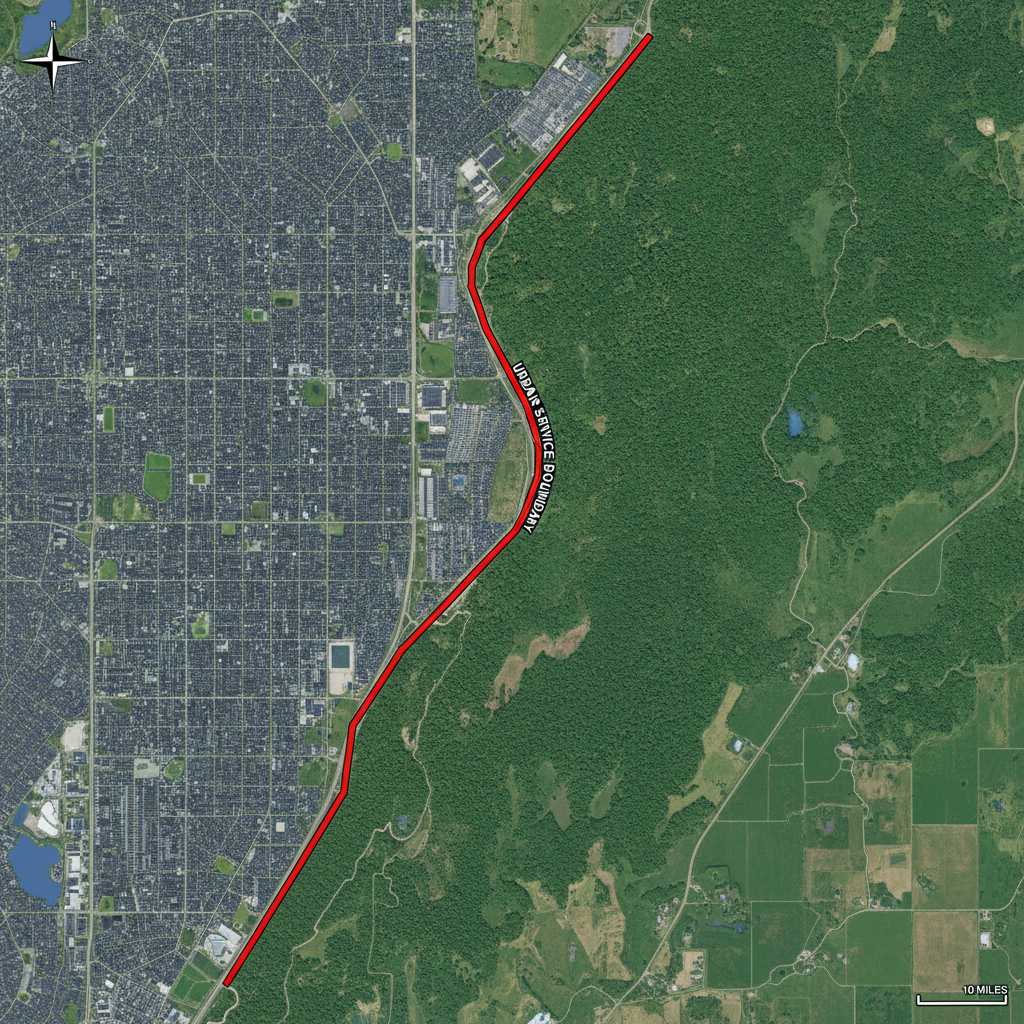
The concept of the Urban Service Boundary is deeply rooted in Florida’s statewide growth management laws, primarily governed by the Community Planning Act. Each county and municipality is required to adopt a Comprehensive Plan, which serves as a long-range blueprint for future development. The USB is a key component of the plan’s Future Land Use Element (FLUE) and is visually represented on the Future Land Use Map (FLUM). Its primary purpose is to promote compact, contiguous development, prevent urban sprawl, and protect rural and environmentally sensitive lands. By concentrating growth within a defined area, local governments can provide services more efficiently and cost-effectively. Extending utility lines and emergency services deep into rural areas is expensive and places a heavy burden on taxpayers. The USB ensures that new development occurs where infrastructure capacity either exists or is planned, supporting a logical and fiscally responsible growth pattern. This framework provides predictability for both the public and private sectors, guiding public infrastructure investments and private development decisions. For a developer, the Comprehensive Plan and its associated USB are not mere suggestions; they are legally binding documents that dictate land use. The zoning on a property must be consistent with its Future Land Use designation. Therefore, a property outside the USB will have a FLUM designation like ‘Agricultural’ or ‘Rural Residential,’ which severely limits development intensity. Achieving any significant change requires navigating the complex process of a Comprehensive Plan Amendment, a challenging and resource-intensive undertaking.
Inside vs. Outside the Boundary: Core Development Implications
Justification Factors for an Urban Service Boundary Amendment
| Factor | Description | Engineering and Planning Evidence Required |
|---|---|---|
| Demonstration of Need | Proving that the existing supply of developable land within the USB is insufficient to meet projected residential or commercial demand for a specific planning horizon (e.g., 5-10 years). | Land supply analysis, market studies, population and employment projections, absorption rate calculations for vacant land within the current USB. |
| Infrastructure Availability & Financial Feasibility | Demonstrating that urban services (water, sewer, roads) can be extended to the site in a timely and economically viable manner without burdening existing taxpayers. | Utility capacity analysis, conceptual utility extension plans, traffic impact study, and a financial plan showing how infrastructure will be funded (e.g., developer contributions, special assessments). |
| Environmental Suitability | Showing that the land is suitable for development and that any impacts to wetlands, protected species, floodplains, or other sensitive resources can be acceptably mitigated. | Environmental site assessment (Phase I ESA), wetland delineation survey, listed species survey, and a conceptual stormwater management plan. |
| Avoidance of Urban Sprawl | Justifying that the expansion is a logical, contiguous extension of the existing urban pattern, rather than creating a leapfrog development pattern. | Location maps showing proximity to existing development, analysis of contiguity, and a planning statement explaining how the project supports compact growth. |
| Compatibility with Adjacent Uses | Ensuring the proposed future land uses are compatible with surrounding properties, providing appropriate transitions and buffers between different intensities (e.g., between commercial and rural residential). | Conceptual site plan, aerial photography analysis, and a written narrative describing proposed buffers, setbacks, and design features that ensure compatibility. |
| Public Benefit | Articulating the positive impacts of the expansion, such as providing needed housing, creating jobs, increasing the tax base, or enabling the development of a key community facility. | Economic impact analysis, statement of public benefits, and documentation of support from community stakeholders or economic development agencies. |
The distinction between developing a property inside versus outside the Urban Service Boundary is stark. For a parcel within the USB, the path to development is relatively straightforward. The property is typically designated for urban uses, allowing for higher residential densities or commercial and industrial zoning. Crucially, it is eligible for connection to municipal water and sewer systems, a prerequisite for most large-scale projects. The permitting process, while still rigorous, follows a predictable track based on established zoning compliance and utility availability. Conversely, a property located outside the USB faces a completely different set of rules. Development is generally restricted to very low densities, such as one dwelling unit per 5, 10, or even 20 acres. Commercial development is often prohibited or severely limited. Instead of municipal utilities, projects must rely on individual septic systems and private wells, which come with their own set of environmental regulations and physical limitations. The cost and logistical challenges of providing private infrastructure can make many projects economically unfeasible, effectively preserving the land for rural or agricultural use as intended by the Comprehensive Plan. This clear division has a profound impact on land valuation and investment strategy. Land just inside the boundary can be exponentially more valuable than an adjacent parcel just outside. Developers and investors must conduct thorough due diligence to verify a property’s location relative to the USB before acquisition. Misinterpreting this boundary can lead to costly mistakes, turning a promising site development project into a non-starter.
The Critical Role of Utility Availability and Infrastructure Planning
Perhaps the most significant function of the Urban Service Boundary is to direct utility coordination and infrastructure planning. Municipalities use the USB to define their service area and plan for the long-term expansion of water, sewer, and reclaimed water systems. For a project inside the USB, a developer can typically obtain a ‘will-serve’ letter from the utility provider, confirming that capacity is available or will be made available to serve the proposed development. This is a critical milestone in the site plan design and approval process. For projects outside the USB, securing municipal utilities is exceptionally difficult, if not impossible. A utility provider is generally under no obligation to extend services beyond its designated boundary. In rare cases, a developer might be able to negotiate a utility extension agreement, but this often requires the developer to bear the full, substantial cost of designing and constructing miles of new water mains and sewer force mains. Furthermore, such an extension often requires its own set of political approvals and may be seen as encouraging sprawl, leading to opposition from planning staff and elected officials. The financial implications are enormous. Within the USB, developers pay standardized impact fees and connection fees to tie into the existing system. Outside the USB, the cost of designing and installing large-scale private water treatment and wastewater facilities or extending public lines can add millions to a project budget. This infrastructure barrier is a primary mechanism through which the USB enforces the county’s growth management strategy, making dense development outside the boundary economically prohibitive.
Stormwater Management and Environmental Constraints Across the USB
The Urban Service Boundary also influences the approach to stormwater management and environmental permitting. Inside the USB, development occurs within a more urbanized watershed, and projects often discharge into established Municipal Separate Storm Sewer Systems (MS4s). The drainage design must meet the local jurisdiction’s criteria as well as the standards of the regional Water Management District, but the context is one of managing urban runoff. The focus is on water quality treatment and flood prevention within a developed landscape. Outside the USB, the environmental context is often more sensitive. These areas may contain significant wetlands, wildlife habitats, agricultural lands, or groundwater recharge zones. Consequently, the environmental regulations can be more stringent. A stormwater management system for a project in a rural area may face higher standards for nutrient removal to protect downstream water bodies or be required to maintain pre-development hydrology to a greater extent. The permitting process may involve more intense scrutiny from environmental agencies concerned with protecting rural resources from the impacts of development. Furthermore, the lack of public drainage infrastructure outside the USB means that a developer is solely responsible for managing all stormwater on-site or securing off-site drainage easements. This can increase the land area needed for ponds and other drainage features, reducing the developable area of a site. A thorough environmental assessment is critical for any project, but it takes on special importance when considering development outside the established urban core, where the potential for impacting sensitive systems is greater.
The Process of Amending an Urban Service Boundary
Expanding the Urban Service Boundary is not a simple rezoning application; it is a major legislative action that requires a Comprehensive Plan Amendment (CPA). This is a formal, quasi-judicial process that is often lengthy, costly, and politically charged. The burden of proof is on the applicant to demonstrate that there is a clear public need for the expansion and that the proposed change is consistent with Florida’s growth management principles. The process involves multiple steps and extensive coordination with planners, engineers, and legal counsel. The typical CPA process begins with a pre-application meeting with county planning staff, followed by the submission of a detailed application package. This package must include extensive justification, including population projections, an analysis of land supply within the existing USB, infrastructure impact studies, and environmental assessments. The application is then reviewed by various government departments and agencies. It must go through multiple public hearings, typically before a local planning agency or board and ultimately before the Board of County Commissioners for a final vote. A qualified Professional Engineer is essential for preparing the technical reports that support the application. Because a USB amendment is a change to the foundational planning document, it is subject to a high level of scrutiny. The applicant must prove that the existing boundary is insufficient to accommodate projected growth and that the subject property is a logical and suitable area for expansion. This often involves demonstrating that the project will not result in urban sprawl, that services can be provided cost-effectively, and that environmental impacts will be minimized. The entire process can take a year or more and has no guarantee of success, making it a significant risk for any developer.
RSP Engineers’ Approach to USB Analysis and Land Development Strategy
At RSP Engineers, we recognize that the Urban Service Boundary is a foundational element of site development strategy in Florida. Our process begins with comprehensive due diligence during the property evaluation phase. We provide clients with a clear analysis of a property’s location relative to the USB and other critical planning boundaries. This initial assessment is crucial for establishing realistic development expectations and identifying major risks before significant capital is invested. If a property is outside the USB but holds strong potential, we conduct a detailed feasibility study to evaluate the viability of a Comprehensive Plan Amendment. This involves a preliminary review of land supply data, infrastructure proximity, and environmental constraints. We work collaboratively with land use attorneys and planners to build a cohesive strategy, leveraging our technical expertise to prepare the necessary engineering reports. Our team provides critical analysis on utility coordination, traffic impacts, and drainage design to build a strong, data-driven case for the amendment. Our role extends beyond the initial application. We represent our clients at staff meetings and public hearings, clearly articulating the technical merits of the project. As one of the leading Civil Engineering Firms in the region, we understand the nuances of local government review and the political sensitivities surrounding growth management. Our goal is to provide the strategic engineering support needed to navigate the complex regulatory landscape and position our clients’ projects for success, whether that means optimizing a site within the USB or undertaking the challenge of expanding it.
Common Pitfalls and Challenges in USB-Related Projects
Navigating projects near an Urban Service Boundary is fraught with potential challenges that can derail even well-conceived plans. A primary pitfall is underestimating the political nature of a USB amendment. These decisions are not made in a vacuum; they are subject to intense public scrutiny and can become focal points for anti-growth sentiment. Strong community opposition can sway elected officials, regardless of the technical merits of an application. A proactive community outreach strategy is often essential. Another common issue is a failure to secure firm commitments for utilities. A developer might assume that because a sewer line is only half a mile away, an extension is guaranteed. However, without a formal utility extension agreement and confirmation of downstream capacity, the project lacks a fundamental requirement. This can lead to significant delays or even a complete halt to the project after substantial investment in design and permit submittals. Thorough utility capacity analysis must be performed early in the due diligence process. Finally, developers can be caught off guard by unexpected environmental constraints or inadequate technical justification. Discovering a significant wetland system or habitat for a protected species late in the process can necessitate a costly redesign or render the project unviable. Similarly, submitting a CPA application with a weak needs analysis or a flawed infrastructure plan is a recipe for denial. Overcoming these challenges requires a proactive, multidisciplinary approach and a team of experienced consultants, including a civil engineering firm adept at Florida’s unique regulatory environment.
Your Partner for Strategic Land Development in Florida
Successfully navigating Florida’s Urban Service Boundaries requires more than just a good site plan; it requires a strategic partner who understands the intersection of engineering, planning, and policy. At RSP Engineers, we provide the expert guidance needed to assess development potential and overcome regulatory hurdles. Whether your project is firmly within the urban core or on the rural fringe, our team offers comprehensive site engineering services, from initial due diligence and feasibility studies to final construction administration. We specialize in complex utility coordination and crafting the robust technical reports needed for successful permit submittals. Don’t let a line on a map dictate your project’s future. Contact RSP Engineers today to discuss how we can help you achieve your development goals.
Conclusion
The Urban Service Boundary is a cornerstone of Florida’s growth management framework, acting as a critical control on the pattern and pace of development. For developers, it is a fundamental factor that shapes project feasibility, dictating everything from allowable density and land use to the availability of essential infrastructure. Understanding the location of the USB and its implications is the first step in any successful land development venture in the state. While amending the boundary is a challenging endeavor, a well-prepared application grounded in sound engineering and planning principles can unlock significant opportunities. Ultimately, navigating these regulations requires a proactive approach and the guidance of an experienced civil engineering team that can provide the necessary technical expertise for complex zoning compliance and permitting pathways.
FAQs
-
A city limit is a legal, political boundary that defines the geographic area of an incorporated municipality. An Urban Service Boundary is a planning boundary, established in a county’s Comprehensive Plan, that defines where urban-level services and infrastructure are planned. A USB can be larger than, smaller than, or coterminous with a city’s limits, and often encompasses unincorporated areas the county plans to service.
-
Generally, it is very difficult. Utility providers typically restrict service extensions to areas within the designated USB to manage growth and control costs. While a utility extension agreement may be technically possible in some rare circumstances, it is often prohibitively expensive for the developer and requires significant political and regulatory approval, with no guarantee of success.
-
The process for a Comprehensive Plan Amendment to change a USB is lengthy. A small-scale amendment might take 6 to 9 months, but a large-scale amendment that requires state agency review can easily take 12 to 18 months or longer from application submittal to final adoption, assuming no major delays or legal challenges.