
Beyond the Baseline: Code Minimums vs. Best Practices in Florida Drainage Design
Discover why meeting Florida’s minimum drainage code isn’t enough. Learn how civil engineering best practices for stormwater management protect your development’s value.
Defining the Baseline: Florida’s Minimum Drainage Requirements
The minimum standards for drainage design in Florida are established by a combination of regulatory bodies. The Florida Building Code provides a foundational set of rules, but the most detailed criteria often come from the state’s Water Management Districts (WMDs)—such as the South Florida Water Management District (SFWMD) or the Southwest Florida Water Management District (SWFWMD)—and individual municipal or county ordinances. These regulations are primarily focused on two things: flood control and water quality. They dictate the required performance of a stormwater management system during specific, hypothetical design storm events. Typically, these code minimums require engineers to demonstrate that post-development runoff does not exceed pre-development peak flow rates for a given storm (e.g., a 25-year, 24-hour storm). They also mandate a certain level of water quality treatment to remove pollutants before stormwater is discharged off-site. While essential, these standards represent the absolute floor of acceptable performance. They are reactive measures intended to prevent widespread flooding and environmental harm, but they often fall short of addressing the day-to-day functionality and resilience of a specific site.
The Limitations and Risks of a Code-Minimum Approach
Drainage Design Comparison: Code Minimum vs. Best Practice
| Feature | Code-Minimum Approach | Best-Practice Approach |
|---|---|---|
| Design Storm Focus | Primarily focused on passing the 25-year storm event to prevent off-site flooding and obtain the permit. | Analyzes performance during 5- and 10-year storms to ensure site functionality and minimize nuisance ponding. |
| Pavement Drainage | Inlets sized to capture runoff without overflowing into the street during the design storm. No subgrade consideration. | Inlets sized for higher intensity, with added underdrains to dewater the pavement subgrade and extend its lifespan. |
| Modeling Software | Uses simplified spreadsheet calculations (e.g., Rational Method) sufficient for agency review. | Employs dynamic modeling (e.g., ICPR) to simulate complex tailwater conditions and interconnected systems. |
| Common Area Drainage | Grading directs water to inlets, but some temporary ponding in turf areas is considered acceptable. | Includes area drains, French drains, or subtle swales in landscaped areas to keep them usable soon after rain. |
| Water Quality | A single large wet detention pond is designed to meet the minimum WMD treatment requirements. | Uses a treatment train approach, incorporating Low Impact Development (LID) features like bioswales for pre-treatment. |
| Long-Term Maintenance | Focuses on the functionality of major structures like control weirs and pond banks. | Considers ease of maintenance for the entire system, including specifying cleanouts for underdrains and durable landscape materials. |
Relying solely on code minimums for your site development project introduces significant long-term risks. These standards often don’t account for the realities of Florida’s climate, such as high groundwater tables, frequent intense thunderstorms outside of major design storms, or back-to-back rainfall events that saturate the soil. This can lead to chronic nuisance flooding in parking lots, walkways, and amenity areas, diminishing the user experience and potentially creating safety hazards. Furthermore, a saturated subgrade is a leading cause of premature pavement failure. When the base layer beneath asphalt or concrete is constantly wet, it loses its structural capacity, leading to cracking, potholes, and costly repairs. A code-minimum drainage design might prevent the main road from flooding during a 25-year storm, but it may do little to keep the parking lot subgrade dry enough to last its intended design life. These persistent issues can harm a property’s reputation, increase operational costs, and ultimately lower its market value, turning a short-term cost saving into a long-term financial liability.
Best Practice #1: Designing for Higher-Frequency Storms and Durations
One of the most effective best practices is to design for a higher level of service than the code requires. While the WMD might require a system to handle a 25-year return period storm without adverse off-site impacts, a best-practice approach involves analyzing how the system performs during more frequent events, like the 5-year or 10-year storm. The goal is to ensure the site remains fully functional—with minimal standing water in key areas—during the type of heavy rain that occurs every few years, not just during a major event. This often involves using larger pipes, more inlets, or designing retention and detention ponds with additional freeboard. Another advanced technique is analyzing longer storm durations (e.g., 48-hour or 72-hour events) to better simulate the effects of slow-moving tropical systems. This analysis provides critical insights into groundwater mounding and soil saturation, allowing for a more resilient drainage design that anticipates real-world conditions, protecting pavement, foundations, and landscaping from chronic water issues.
Best Practice #2: Advanced Stormwater Modeling and Analysis
Many code-minimum designs can be justified using simplified calculation methods. However, best practices often involve the use of more sophisticated dynamic modeling software, such as ICPR or SWMM. These tools allow engineers to simulate the complex interactions of a drainage system over time, accounting for factors that simpler methods ignore. For instance, a dynamic model can accurately represent interconnected ponds, the influence of tidal cycles on outfall pipes (tailwater conditions), and the precise timing of runoff from different parts of a site. This level of detail is invaluable for complex projects, especially those in flat, low-lying coastal areas common in Florida. Advanced modeling helps identify potential bottlenecks in the system that wouldn’t be apparent otherwise. It allows our Civil Engineers to optimize the placement and size of every component, from the first catch basin to the final control structure, ensuring the entire stormwater management system works in concert to protect the development effectively and efficiently.
Best Practice #3: Integrating Low Impact Development (LID) Techniques
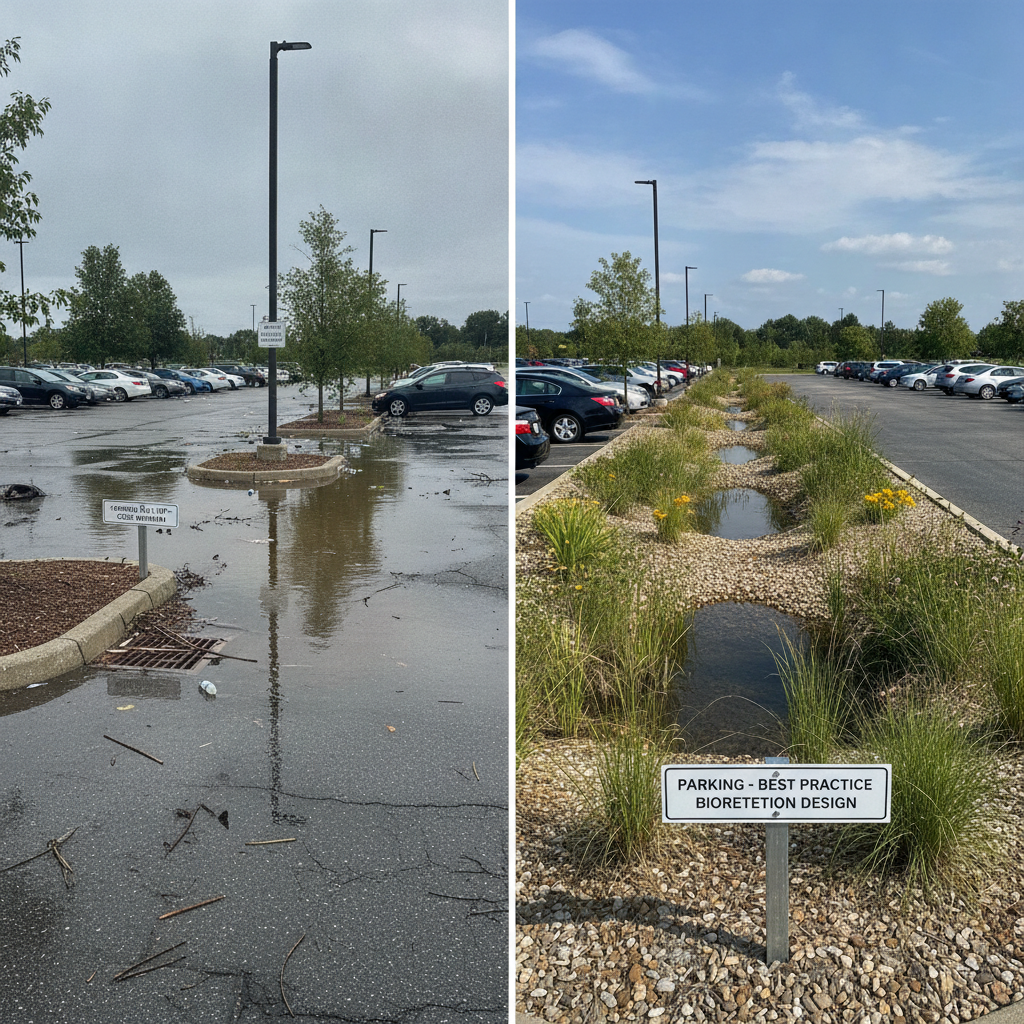
Modern, forward-thinking drainage design moves beyond the conventional approach of simply collecting water in pipes and storing it in a large pond. Low Impact Development (LID) is a philosophy that treats stormwater as a resource by managing it at the source. Instead of rapidly conveying water away, LID techniques focus on infiltration, filtration, and storage distributed across the site. This approach not only improves water quality but also reduces the peak runoff volume that the primary infrastructure must handle. Practical examples of LID include bioretention swales (landscaped channels that filter and slow down runoff), permeable pavements in low-traffic areas like parking stalls, and vegetated filter strips along the edge of parking lots. Integrating these features requires more thoughtful civil engineering during the site planning phase but offers significant benefits. It can reduce the required footprint of large, fenced-off retention ponds, create more attractive green spaces, and result in a more sustainable and resilient site.
Best Practice #4: Proactive Subsurface Drainage and Utility Coordination
A comprehensive drainage design addresses more than just surface water. In Florida, high groundwater levels can create persistent problems if not properly managed. A best-practice approach includes a plan for subsurface drainage to protect critical infrastructure. This often involves installing a network of underdrains beneath pavement sections, building foundations, and sensitive areas like athletic fields. These perforated pipes collect and carry away excess groundwater, keeping the subgrade stable and preventing water from wicking up into structures. This work must be seamlessly integrated with all other site utilities. Proactive and detailed utility coordination is essential to prevent costly conflicts during construction. A Professional Engineer must ensure that drainage lines, underdrains, and stormwater structures are placed in harmony with water, sewer, power, and communications conduits. This holistic view of the subsurface environment is a hallmark of high-quality site engineering services and is critical for avoiding change orders and ensuring long-term performance.
RSP’s Approach to Resilient Drainage Design
At RSP Engineers, we view drainage design as a foundational element of a project’s long-term success. Our process begins with understanding the client’s goals beyond simply achieving zoning compliance and securing permits. We start with a thorough site analysis, including a review of geotechnical reports and historical rainfall data, to identify the unique challenges and opportunities of each property. Our team of Florida Licensed Engineers then uses advanced modeling tools to simulate various scenarios, allowing us to design a stormwater management system that is both robust and cost-effective. We believe in a collaborative approach, presenting clients with clear options that weigh the upfront costs against long-term benefits and risk reduction. Throughout the permitting and agency review process, we provide clear documentation and justification for our design, ensuring a smooth path to approval while delivering a superior final product.
Common Issues When Relying Solely on Code Minimums
Projects that cut corners by sticking to the bare minimum drainage requirements often face a predictable set of problems. The most common issue is persistent ponding in parking lots and pedestrian areas, leading to customer complaints and slip-and-fall risks. Another frequent problem is the premature deterioration of asphalt due to a constantly saturated subgrade, forcing owners into expensive milling and resurfacing projects years ahead of schedule. During construction, unforeseen groundwater can lead to significant change orders and delays if not anticipated by the civil engineering design. Ultimately, these issues translate to higher maintenance budgets, lower tenant satisfaction, and a diminished asset value.
Partner with RSP Engineers for a Future-Proof Site Design
Navigating the complexities of Florida’s environmental regulations requires deep expertise. Don’t settle for a design that just checks a box. The team at RSP Engineers specializes in creating intelligent, resilient, and forward-thinking solutions for stormwater management. We partner with developers to deliver a comprehensive drainage design that not only secures permitting but also enhances the value and longevity of your project. From initial due diligence and Site plan design to final construction administration, we are your trusted partner. Contact us today to discuss how our expert civil engineering services can protect your next land development project.
Conclusion
In Florida land development, the choice between meeting code minimums and adopting best practices for drainage is a choice between short-term compliance and long-term value. While a baseline design may be sufficient to obtain a permit, it leaves a project vulnerable to a host of costly and frustrating issues. By investing in a more robust and thoughtful drainage design, developers can create a more resilient, functional, and valuable asset. This proactive approach to civil engineering is the cornerstone of successful and sustainable site development in Florida’s unique environment.
Related Insights from Our Florida Engineering Experts
Navigating Florida’s Environmental Resource Permitting (ERP) Process Key Considerations for Utility Coordination in Multifamily Developments The Developer’s Guide to Florida’s Water Management Districts
FAQs
-
There can be a modest increase in upfront construction costs, such as for additional inlets or underdrains. However, this investment is often recovered many times over through reduced long-term maintenance and repair costs, especially for pavement. A well-executed drainage design should be seen as a value-add, not just a cost center.
-
No, quite the opposite. A thorough and well-documented design that clearly exceeds minimum requirements often streamlines the agency review process. Reviewers from the WMD or local municipality can quickly see that the design is robust, which can lead to fewer comments and a faster approval timeline for your permit submittals.
-
Yes. While sandy soils offer good infiltration, Florida’s high water table can limit this benefit, especially during the rainy season. On flat sites, positive flow is critical and difficult to achieve. A best-practice approach would carefully consider finished floor elevations and might use a combination of shallow swales and subsurface drainage to keep the site dry and functional.