
Designing to Meet Low Impact Development (LID) Goals in Florida
A guide for Florida developers on Low Impact Development (LID) design. Learn about bioretention, permeable pavements, and navigating stormwater permitting with RSP Engineers.
The Regulatory Framework for LID in Florida
Florida’s approach to stormwater management is governed by a complex web of state, regional, and local regulations, with a clear trend toward encouraging or requiring LID practices. The Florida Department of Environmental Protection (FDEP) and the state’s five Water Management Districts (WMDs)—such as the South Florida Water Management District (SFWMD) and the Southwest Florida Water Management District (SWFWMD)—are the primary drivers of these standards. Their Environmental Resource Permitting (ERP) programs often contain specific criteria for water quality treatment and peak flow attenuation that are more easily met using LID techniques. Many local municipalities have gone further, incorporating LID standards directly into their land development codes and comprehensive plans. Achieving zoning compliance may involve demonstrating how a project utilizes practices like bioretention or permeable pavement to reduce its environmental footprint. In some jurisdictions, incorporating LID can even lead to benefits like density bonuses or an expedited agency review process. A knowledgeable civil engineering partner is essential to navigate these evolving requirements and leverage LID to a project’s advantage, ensuring all permit submittals are robust and compliant from the outset.
Core LID Technique: Bioretention and Rain Gardens
Comparison of Common LID Stormwater BMPs
| LID Technique | Primary Function | Ideal Application | Key Design Consideration |
|---|---|---|---|
| Bioretention Cells | Water Quality Treatment & Infiltration | Parking lot islands, landscape buffers, residential rain gardens | Engineered soil media composition and underdrain requirements based on native soil. |
| Permeable Pavement | Volume Reduction & Peak Flow Control | Low-traffic parking areas, walkways, patios, fire lanes | Subgrade soil infiltration rate and depth of the aggregate storage layer. |
| Vegetated Swales | Conveyance, Filtration & Infiltration | Replacing curb and gutter along roadways and parking perimeters | Longitudinal slope, cross-section geometry, and vegetation type to ensure non-erosive velocities. |
| Green Roofs | Volume Reduction & Runoff Delay | Urban/dense developments with limited ground-level space | Structural load capacity of the building and waterproofing membrane integrity. |
| Rainwater Harvesting | Volume Reduction & Water Conservation | Buildings with large roof areas and significant irrigation demand | Cistern size relative to roof area and water demand; utility coordination for distribution. |
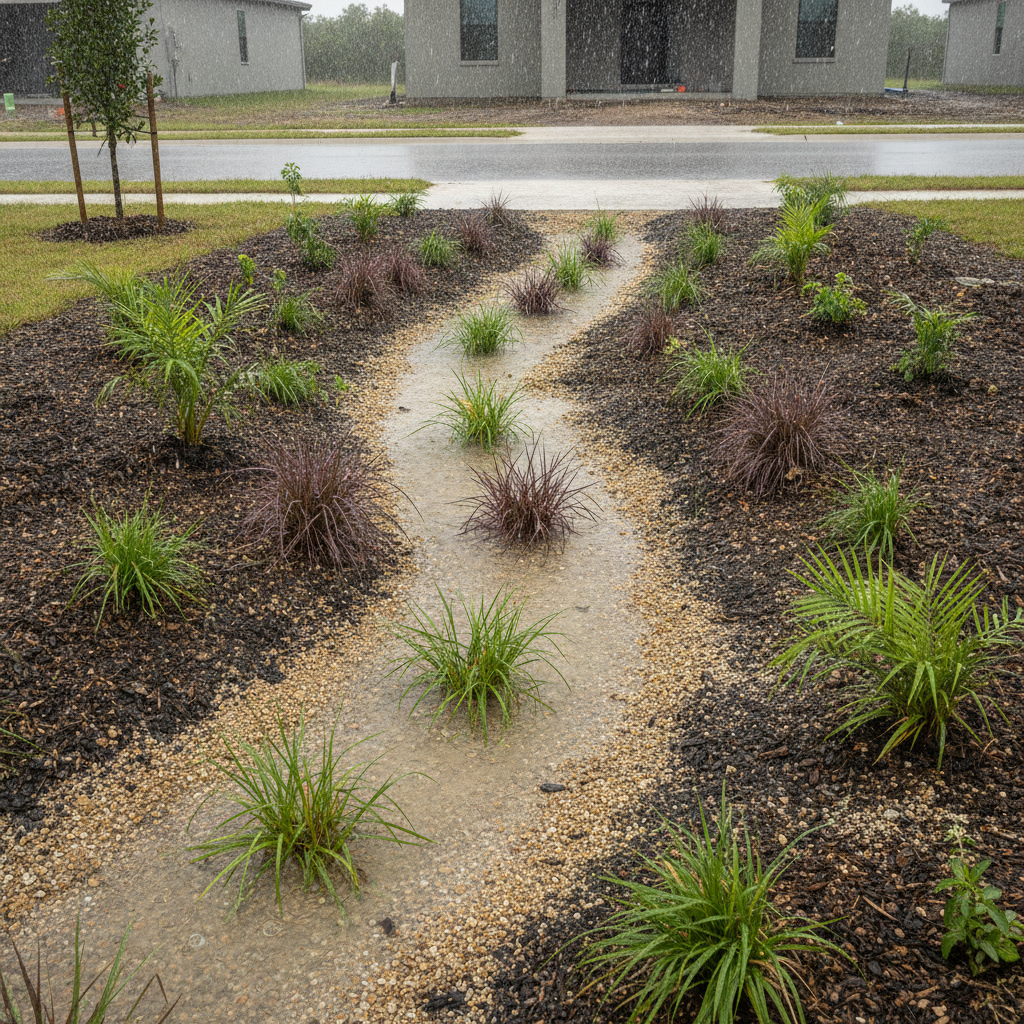
At the heart of many LID strategies are bioretention cells, also known as rain gardens. These are shallow, landscaped depressions designed to capture, treat, and infiltrate stormwater runoff. Unlike a simple grassy swale, a bioretention cell is a highly engineered system. It typically consists of a layer of mulch, a specialized engineered soil media designed for nutrient removal, and a variety of native, water-tolerant plants whose root systems help absorb pollutants and maintain soil porosity. For sites with less permeable soils or high water tables, an underdrain system is often included to prevent oversaturation and convey treated water away. The primary functions of bioretention cells are to improve water quality by filtering pollutants like nitrogen and phosphorus and to reduce runoff volume through infiltration and evapotranspiration. This makes them a cornerstone of modern drainage design. From a site development perspective, they can be integrated into parking lot islands, landscape buffers, and open spaces, turning necessary stormwater infrastructure into a site amenity. Proper design requires careful consideration of the contributing drainage area, soil infiltration rates, and plant selection to ensure long-term performance and compliance with WMD water quality standards.
Integrating Permeable Pavement Systems
Impervious surfaces like asphalt and concrete are a primary source of stormwater runoff in urbanized areas. Permeable pavement systems offer a direct solution by allowing rainwater to pass through the surface and into an underlying stone reservoir, where it can be temporarily stored and infiltrated into the ground. Common types include pervious concrete, porous asphalt, and permeable interlocking concrete pavers (PICPs). These systems effectively transform a parking lot or walkway from a runoff generator into a stormwater management facility. The successful implementation of permeable pavement requires a holistic approach to site engineering services. A thorough geotechnical investigation, including a Soil Test, is critical to confirm the underlying soil’s infiltration capacity and determine the necessary depth of the aggregate base. The design must also account for overflow systems in case of extreme storm events. While historically viewed as a higher-cost option, permeable pavement can reduce or eliminate the need for traditional ponds and conveyance systems, freeing up valuable land for development and potentially lowering overall infrastructure costs. Proper construction oversight and a long-term maintenance plan are crucial to prevent clogging and ensure functionality.
Green Roofs and Cisterns for Volume Reduction
While not as common in all parts of Florida, green roofs and rainwater harvesting systems are powerful LID tools for reducing runoff volume, particularly in ultra-urban environments. A green roof is a vegetative layer grown on a rooftop, which absorbs rainwater, reduces energy costs for cooling, and extends the life of the roof membrane. They can be either ‘extensive’ (shallow, low-maintenance) or ‘intensive’ (deeper, with a wider variety of plants, like a traditional garden). The design requires close collaboration between a Professional Engineer and a structural engineer to manage the additional load. Rainwater harvesting, typically using cisterns, captures roof runoff for non-potable uses like irrigation or toilet flushing. This directly reduces the volume of stormwater leaving a site and conserves potable water, a key sustainability goal. Effective implementation requires careful utility coordination to integrate the harvesting system with the site’s irrigation and plumbing infrastructure. For commercial projects, these visible sustainability features can be a significant marketing advantage and are a key component of a comprehensive LID design strategy.
Preserving Natural Hydrology with Vegetated Swales and Filter Strips
Not all LID techniques are complex engineered systems. Simple, nature-based solutions like vegetated swales and filter strips are highly effective and cost-efficient. A vegetated swale is a broad, shallow channel with dense vegetation designed to slow runoff, promote infiltration, and filter out pollutants. They are an excellent alternative to traditional concrete curb and gutter systems, reducing runoff velocity and providing distributed treatment along roadways and parking areas. Their drainage design focuses on gentle slopes and appropriate plant species to prevent erosion. Filter strips are bands of dense vegetation, typically grass, situated between an impervious area (like a parking lot) and a receiving water body or drainage feature. They function by slowing runoff and allowing sediment and other pollutants to settle out. Both swales and filter strips are fundamental to a site development plan that prioritizes pre-development hydrology. They are highly favored by regulatory agencies during agency review because they are simple, effective, and easy to maintain, representing a core principle of working with the land, not against it.
Modeling and Permitting LID Stormwater Systems
Demonstrating regulatory compliance for a site using LID requires sophisticated hydraulic and hydrologic modeling. Unlike a simple pond, a distributed LID system involves multiple small-scale features working in concert. Civil Engineers use specialized software like the Interconnected Channel and Pond Routing Model (ICPR) to simulate how the integrated system of permeable pavements, bioretention cells, and swales will perform during various storm events. The model must accurately account for infiltration rates, storage volumes, and treatment efficiencies of each component. The permit submittals for an LID project are often more detailed than for conventional designs. They require robust supporting documentation, including detailed soil boring logs from a Geotechnical engineer, specifications for engineered soil media, and a comprehensive landscape plan. A long-term maintenance plan is also a mandatory component of the submittal, outlining the specific actions required to keep each LID feature functioning as designed. Successfully navigating the permitting process hinges on presenting a clear, well-documented case to the WMD that the proposed system meets or exceeds all applicable water quality and quantity standards.
RSP Engineers’ Approach to LID Integration
At RSP Engineers, we view Low Impact Development as an integrated design philosophy, not an afterthought. Our process begins during the earliest stages of due diligence and conceptual site plan design. We conduct a thorough site analysis to identify opportunities for preserving natural features and utilizing LID, considering factors like soil types, topography, and existing vegetation. This proactive approach allows us to optimize the site layout to minimize impervious surfaces and reduce overall infrastructure costs. Our team of experienced Florida Licensed Engineers collaborates with landscape architects and environmental scientists to create a cohesive LID strategy. We perform detailed hydrologic modeling to ensure the proposed system meets all regulatory requirements and provides long-term resilience. We manage the entire permitting process, from pre-application meetings with WMD staff to final permit acquisition. During construction, we provide meticulous construction administration and oversight to ensure that sensitive components like bioretention media and permeable pavement sub-bases are installed exactly to specification, guaranteeing the system’s performance for years to come.
Common Issues in LID Implementation
While LID offers significant benefits, developers and engineers must be aware of potential challenges. One of the most common issues in Florida is soil suitability. Many areas have high water tables or low-permeability clay layers (hardpan) that can limit the effectiveness of infiltration-based practices. A comprehensive geotechnical soil report is non-negotiable to identify these constraints early in the design process. In such cases, designs may need to incorporate underdrains or focus on filtration and detention rather than pure infiltration. Another challenge is the perception of maintenance. Permeable pavements, for instance, require specialized care like regenerative air or vacuum sweeping to prevent clogging, which differs from traditional street sweeping. A lack of a clear and funded maintenance plan can lead to system failure. Finally, navigating inconsistent agency review comments can be a hurdle. Because LID is still evolving, different reviewers may have varying levels of familiarity or comfort with certain techniques. Overcoming this requires a proactive communication strategy and a design team that can clearly and confidently articulate the engineering principles behind their design.
Partner with Florida’s LID Experts
Successfully implementing Low Impact Development requires more than just selecting a few green techniques from a manual. It demands a deep understanding of Florida’s unique hydrology, a forward-thinking approach to site design, and expert navigation of the regulatory landscape. The team at RSP Engineers provides the comprehensive site engineering services needed to turn your LID goals into a successful reality. From initial feasibility studies and conceptual design to detailed hydrologic modeling and permitting, we are your partners in creating resilient and profitable developments. Contact us today to discuss how our expertise in stormwater management and sustainable design can benefit your next project.
Conclusion
Low Impact Development is the future of stormwater management in Florida. It offers a resilient, sustainable, and often more cost-effective alternative to conventional infrastructure. By treating stormwater as a resource to be managed rather than a problem to be disposed of, LID creates developments that are better for the environment and the bottom line. Success hinges on a collaborative design process led by an experienced civil engineering firm that can integrate these techniques seamlessly into the overall site development plan and effectively justify the design to regulatory agencies. Embracing LID is a strategic decision that pays dividends in project value, marketability, and long-term performance.
FAQs
-
Not necessarily. While some individual LID components, like permeable pavement, can have a higher upfront material cost, an integrated LID approach can reduce overall project costs. By minimizing the need for extensive underground pipe networks, large detention ponds, and curb and gutter, LID can lead to significant savings in earthwork and infrastructure, while also freeing up more usable land for development.
-
Most sites can incorporate LID principles, but the specific techniques must be tailored to the site’s conditions. Constraints like a high seasonal water table, contaminated soils, or proximity to sensitive karst features can make certain infiltration-based practices unsuitable. In these cases, the civil engineering design would pivot to other LID tools that focus on filtration, storage, and reuse, such as green roofs, cisterns, and lined bioretention cells.
-
Proper maintenance is crucial for the longevity of permeable pavement. The primary goal is to prevent the surface pores from clogging with fine sediment. This involves regular vacuum or regenerative-air sweeping (not bristle sweeping, which can force particles into the pores), keeping landscaped areas from washing out onto the pavement, and promptly cleaning any spills. A formal maintenance plan is a key part of the permit submittals.