
Moisture Conditioning Earthwork for Data Center Construction
Learn the critical role of soil moisture conditioning in data center earthwork. Our guide covers compaction, drying wet soils, hydrating dry soils, and protecting the subgrade to prevent costly delays
The Geotechnical Science of Soil Compaction
At its core, earthwork for a data center is about creating a uniformly dense and stable building pad. The key to this is understanding the relationship between soil type, moisture content, and density. A Geotechnical engineer establishes these relationships through laboratory testing, most commonly the Standard or Modified Proctor test. This test identifies a soil’s Optimum Moisture Content (OMC) and its corresponding Maximum Dry Density (MDD). The OMC is the ideal percentage of water at which a specific soil type can be compacted to its tightest arrangement, achieving its highest strength and stability. If the soil is too dry (below OMC), the particles have too much friction between them to pack together tightly, resulting in poor compaction and a weak subgrade. If the soil is too wet (above OMC), water fills the voids between particles, preventing them from achieving maximum density. For data centers, which have massive, heavy foundations and zero tolerance for differential settlement, achieving the specified compaction (typically 95% to 98% of MDD) is non-negotiable. This process begins with a comprehensive Geotechnical soil report to guide the entire earthwork strategy.
Assessing and Planning for On-Site Moisture Conditions
Soil Moisture Conditioning Method Comparison
| Method | Primary Application | Key Considerations | Typical Schedule Impact |
|---|---|---|---|
| Discing & Aeration | Drying soils that are above Optimum Moisture Content (OMC). | Highly weather-dependent (sun, wind, humidity). Requires large, open space for equipment. | High potential for delay (days to weeks) depending on weather and soil saturation. |
| Water Application & Mixing | Hydrating soils that are below OMC. | Requires a reliable on-site water source. Must achieve uniform mixing to avoid wet/dry spots. | Moderate. Can proceed efficiently in most weather, but requires careful sequencing. |
| Chemical Stabilization | Treating highly plastic or unstable soils that don't respond well to mechanical methods. | Requires specialized geotechnical design and experienced contractors. Involves additives like lime, cement, or fly ash. | Low to Moderate. Can often accelerate the schedule by improving poor native soils instead of removing/replacing them. |
| Subgrade Protection | Protecting a conditioned and compacted pad from weather. | Essential to prevent rework. Options include plastic sheeting, vapor barriers, or a prime coat. | Low. A planned activity that prevents major schedule setbacks. |
| Undercutting & Replacement | Removing unsuitable soils (e.g., organics, debris) and replacing with engineered fill. | Can be very costly and time-consuming. Depends on availability of suitable fill material. | Very High. Often the most time-consuming and expensive option, reserved for when native soils are unusable. |
The first step in any major earthwork operation is a thorough site investigation. This involves more than just a surface-level look; it requires a detailed geotechnical investigation, including multiple soil boring test samples across the proposed building pad and infrastructure areas. This Soil Test data reveals the existing soil types, their current moisture content, and their engineering properties. The civil engineering team uses this data to compare the in-situ moisture levels with the laboratory-determined OMC. This analysis determines the required course of action: will the soil need to be dried, or will water need to be added? This planning phase is also when regulatory constraints are identified. Earthwork operations, especially those involving dewatering or significant soil disturbance, are subject to environmental and land use regulations. Permitting requirements for stormwater management and erosion control vary by jurisdiction, and every project team should confirm the applicable standards with the local, state, regional, and federal authorities that hold review authority over the site. A proactive approach to permitting prevents significant delays before the first piece of equipment arrives.
Techniques for Drying Overly Wet Soils
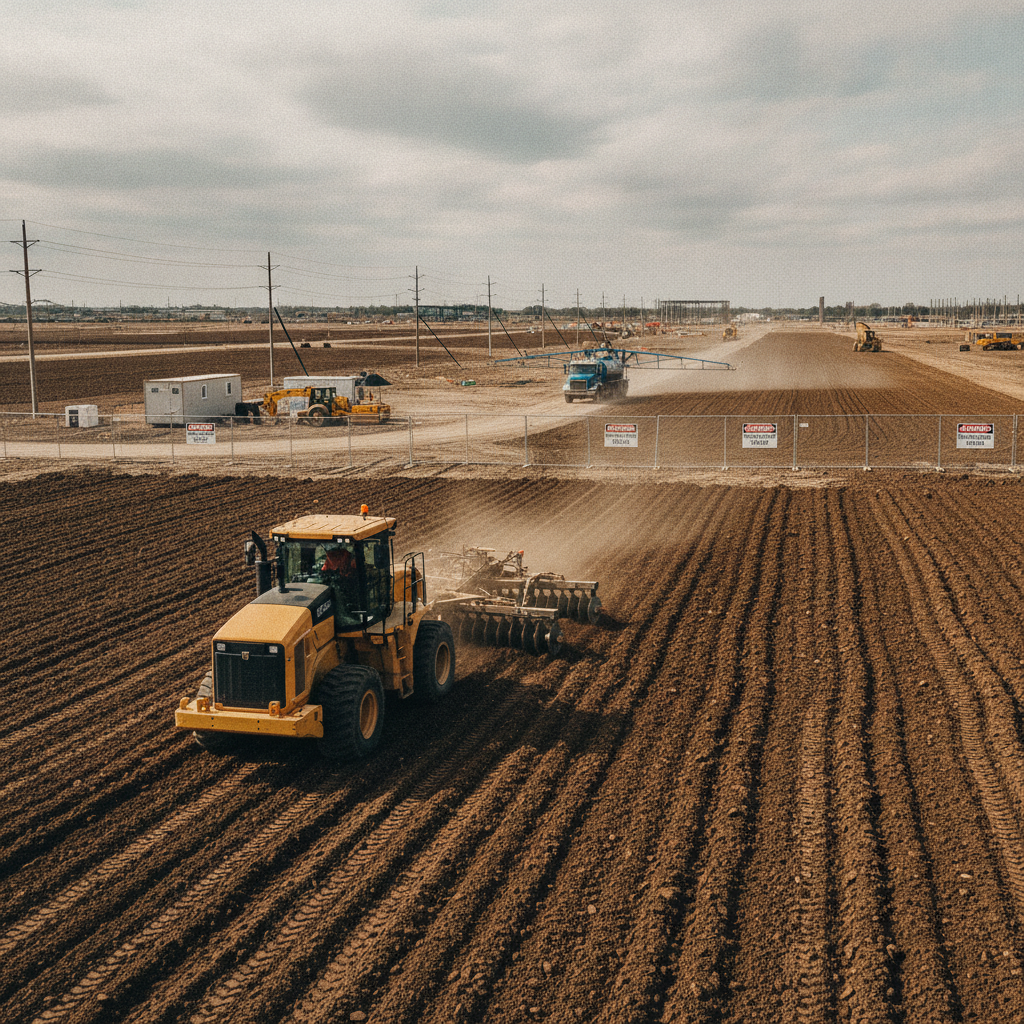
When native soils are found to be significantly above their optimum moisture content, they must be dried before compaction can begin. This is a common challenge, particularly after periods of rain or on sites with a high water table. The primary mechanical method for drying soil is to increase its exposure to sun and wind through aeration. This is typically accomplished using agricultural equipment like discs or harrows pulled by a tractor. The process involves repeatedly turning over the top lift (layer) of soil, typically 6 to 12 inches deep, to break up clumps and expose more surface area. This soil aeration process is highly dependent on weather conditions—sunny, windy days are ideal, while high humidity or overcast skies can slow progress significantly. For large data center pads, this can be a time-consuming operation that poses a major risk to the construction schedule. Effective site development planning involves building weather contingency days into the project timeline to account for these potential schedule delays.
Methods for Hydrating Excessively Dry Soils
In arid regions or during dry seasons, soils are often well below their optimum moisture content. In this scenario, water must be systematically added and mixed into the soil to achieve the target OMC for proper soil compaction. This is typically done using water trucks equipped with spray bars that distribute water evenly over the lift of soil being worked. Simply spraying water on the surface is not enough. The moisture must be uniformly blended throughout the soil lift. Immediately following the water application, discs, tillers, or graders are used to mix the soil, ensuring there are no dry pockets or overly saturated spots. Achieving this uniformity is critical; inconsistent moisture leads to inconsistent compaction, which can create hard and soft spots in the subgrade—a primary cause of future differential settlement. Careful coordination between the water truck and mixing equipment is essential for successful subgrade preparation.
Protecting the Conditioned and Compacted Subgrade
Achieving the perfect moisture content and compaction is a significant accomplishment, but the work isn’t over. The finished subgrade is highly vulnerable to weather. A single heavy rainstorm can saturate the pad, undoing weeks of work and requiring the entire moisture conditioning and compaction process to be repeated. Conversely, hot, dry, and windy conditions can evaporate moisture from the surface, taking it below OMC and compromising the density of the upper layer. Protecting the subgrade is therefore a critical step in construction sequencing. This can be achieved by placing a ‘proof roll’ of crushed stone, installing the final vapor barrier and reinforcing steel for the slab, or applying a temporary seal coat. The project’s civil engineering plans and specifications should clearly define the requirements for subgrade protection. Failure to protect the pad is a common and costly mistake that leads directly to rework and significant project delays.
How RSP Engineers Manages Earthwork Quality Control
At RSP Engineers, we approach data center earthwork with a proactive, detail-oriented mindset. Our process emphasizes collaboration and rigorous quality assurance. We work closely with the project’s Geotechnical engineer from day one to interpret the Geotechnical soil report and develop a comprehensive earthwork specification tailored to the site’s unique conditions. This specification becomes the playbook for the contractor. During construction, our role in construction administration is hands-on. We provide oversight and coordinate with the third-party materials testing agency that performs field density testing, typically using a nuclear density gauge. This testing provides real-time data on whether the contractor is achieving the specified moisture and compaction levels. By maintaining open communication between the owner, contractor, and testing lab, we can identify and resolve potential issues before they impact the schedule, ensuring the final subgrade meets the stringent demands of a mission-critical facility.
Common Moisture-Related Earthwork Challenges
Even with meticulous planning, moisture conditioning for data center earthwork can present challenges. Proactive identification is key to mitigation. Common issues include: Inconsistent Subsurface Conditions: A Soil boring test provides data at specific points, but soil properties can vary unexpectedly between borings. Hitting a pocket of highly plastic clay or an unforeseen seep can require a rapid change in strategy. Rapidly Changing Weather: A forecast can change quickly, turning a productive workday into a scramble to protect the subgrade from a pop-up thunderstorm. Over-Excavation and Replacement: If native soils are deemed unsuitable (e.g., containing organics or debris), the only option may be to undercut the material and replace it with imported engineered fill, which has significant cost and schedule implications. Contractor Inexperience: Earthwork for a data center is not the same as for a warehouse. It requires a contractor who understands the tight tolerances and the importance of meticulous quality control. Equipment Limitations: The size and type of equipment can impact the efficiency of moisture conditioning. A small disc on a massive site will be unable to keep up, leading to delays. Frequently Asked Questions What is ‘optimum moisture content’ and why is it critical for data centers? Optimum moisture content (OMC) is the specific percentage of water at which a given soil can be compacted to its highest possible density. For data centers, achieving this density is critical to create a stable, unyielding foundation that prevents differential settlement, which could damage the structure and the sensitive equipment inside. How long does it take to moisture condition a large data center pad? The timeline varies greatly depending on the site size, soil type, initial moisture content, and weather. Drying very wet soil can take several weeks of active aeration. Hydrating dry soil is often faster, potentially taking several days to a week. The project’s Geotechnical engineer and civil engineering team can provide a more accurate estimate based on site-specific data. Can we proceed with earthwork during rainy seasons? It is extremely challenging and risky. Continuous rain makes it nearly impossible to dry wet soils or maintain a stable subgrade. Most project schedules build in significant contingency for weather delays during rainy seasons. Proactive stormwater management and erosion control are paramount during these periods. What happens if the subgrade is not properly compacted? An improperly compacted subgrade can lead to a host of problems. The most severe is differential settlement, where parts of the foundation slab sink more than others, causing cracks in the slab and walls and potentially damaging critical infrastructure. It can also lead to issues with utility lines and overall structural instability. What is the role of the civil engineering firm versus the Geotechnical engineer in this process? The Geotechnical engineer investigates the subsurface conditions, performs a Soil Test, and provides the fundamental recommendations for earthwork, including the target moisture content and density. The civil engineering firm incorporates these recommendations into the overall site plan design, develops the grading and drainage plans, and writes the formal construction specifications that the contractor must follow. During construction, the civil engineer often provides oversight and construction administration to ensure the geotechnical requirements are met.
Your Partner in Mission-Critical Site Development
The success of a data center hinges on the stability of its foundation, and that stability is forged during the earthwork phase. Proper moisture conditioning is not just a task to be checked off; it is a critical risk mitigation strategy. RSP Engineers provides the expert oversight and technical diligence required for mission-critical projects. Our team excels in geotechnical coordination, detailed site development planning, and rigorous construction administration to ensure your project is built on a solid footing. Connect with our team to discuss how we can support your next data center development.
Conclusion
Ultimately, managing soil moisture is about controlling variables in an uncontrolled environment. While no one can control the weather, a skilled civil engineering team, guided by sound Geotechnical Engineering principles, can implement strategies to manage its effects. By meticulously planning, testing, and protecting the subgrade, developers can ensure the long-term integrity of their data center investment. This foundational work is essential for achieving the resilience and reliability that define mission-critical infrastructure and prevent costly rework and future structural problems.
FAQs
-
Moisture Conditioning Earthwork for Data Center Construction requires careful planning, qualified engineering, and compliance with the applicable codes and permits.
-
Getting Moisture Conditioning Earthwork for Data Center Construction right protects safety, supports regulatory compliance, and avoids costly redesigns or delays.
-
RSP Engineers provides licensed expertise and end-to-end support for Moisture Conditioning Earthwork for Data Center Construction, from early planning through permitting.