
Establishing Compaction Requirements for Data Center Fill
A technical guide for data center developers on establishing and verifying soil compaction requirements for fill material, from geotechnical reports and Proctor tests to field density testing and proo
The Role of Geotechnical Investigation in Compaction Specifications
Every successful earthwork program begins with a comprehensive Geotechnical Engineering investigation. Before any design can commence, a qualified Geotechnical engineer must explore the subsurface conditions of the site. This is accomplished through a series of Soil boring tests and laboratory analysis, the results of which are compiled into a detailed geotechnical soil report. This report is the foundational document for all subsequent earthwork and structural design. The report identifies the types of soils present, their engineering properties, the depth to groundwater, and the presence of any unsuitable materials like organic soils or debris that must be removed. For compaction, the most critical output is the classification of on-site soils and their suitability for use as structural fill. The geotechnical soil report provides the essential parameters—such as maximum dry density and optimum moisture content—that the civil engineering team uses to write the project’s technical specifications for earthwork and compaction.
Defining the Standard: Proctor Density and Optimum Moisture Content
Compaction Specification Comparison for Data Center Sites
| Site Area | Typical Required Compaction (% of Modified Proctor) | Key Considerations |
|---|---|---|
| Building Pad / Foundation Support | 98% - 100% | Zero tolerance for settlement. Highest level of quality control and testing frequency. |
| Exterior Equipment Slabs | 98% | Supports heavy, vibration-sensitive equipment. Must match building pad performance. |
| Heavy-Duty Pavement (Truck Lanes) | 95% - 98% | Must withstand high axle loads and repetitive traffic. Subgrade stability is critical for pavement lifespan. |
| Light-Duty Pavement (Parking) | 95% | Supports lighter vehicle loads. Focus is on providing a stable base to prevent pavement cracking and rutting. |
| Utility Trenches | 95% (in lifts) | Improper backfill compaction is a primary cause of pavement and surface failure over utility lines. |
| Landscape / Green Areas | 85% - 90% | Primary goal is to achieve a stable, non-erodible surface that can support vegetation. |
To create an enforceable standard, soil compaction is measured against a laboratory benchmark. This is achieved through a Proctor compaction test, typically either the Standard Proctor (ASTM D698) or the Modified Proctor (ASTM D1557). The Modified Proctor test imparts more compactive energy and is more commonly specified for projects like data centers that support heavy loads. The test determines a soil’s maximum dry density (the densest state it can achieve) and its corresponding optimum moisture content (the ideal amount of water in the soil to facilitate compaction). These two values—maximum dry density and optimum moisture content—become the baseline for all field operations. The project specifications, prepared by the civil engineering team, will require that fill placed in the field be compacted to a certain percentage of the maximum dry density determined in the lab (e.g., 98% of the Modified Proctor value). Earthwork specifications and permitting requirements often vary by jurisdiction, and every project team should confirm the applicable standards with the local, state, regional, and federal authorities that hold review authority over the site. This ensures the site plan design and construction methods align with all regulatory expectations.
Translating Lab Standards to Field Specifications
The project’s technical specifications are the bridge between the geotechnical soil report and the contractor’s work in the field. These documents provide clear, unambiguous instructions for the earthwork contractor. Key elements include the required percentage of compaction, the approved types of fill material, and the means and methods for placement and compaction. This is a critical part of the overall land development process. Specifications will dictate the maximum loose lift thickness (typically 8 to 12 inches) to ensure compactive energy reaches the entire layer. They also detail requirements for moisture conditioning—adding water if the soil is too dry or aerating it if too wet—to keep the fill material within a specified range of its optimum moisture content. The type of compaction equipment, such as a sheepsfoot roller for cohesive soils or a smooth drum vibratory roller for granular soils, may also be specified to ensure efficient and effective compaction is achieved.
Differentiated Compaction Requirements Across the Site
A common misconception is that the entire site requires the same level of compaction. In reality, a well-developed set of specifications differentiates requirements based on the intended use of an area. This optimizes the earthwork effort and cost while ensuring performance where it matters most. The highest level of compaction is reserved for areas directly supporting structures and critical infrastructure. For a data center, the building pad and foundations require the most stringent control, often 98% or higher of the Modified Proctor density. Exterior concrete slabs supporting heavy equipment like generators or cooling units demand similarly high standards. Pavement areas have slightly different needs; heavy-duty pavements for truck traffic will require a higher degree of compaction in the subgrade than light-duty pavements for employee parking. Landscape and non-structural areas may have the least restrictive requirements, often focused on achieving stability to prevent erosion rather than supporting heavy loads.
Quality Control and Assurance: Field Density Testing
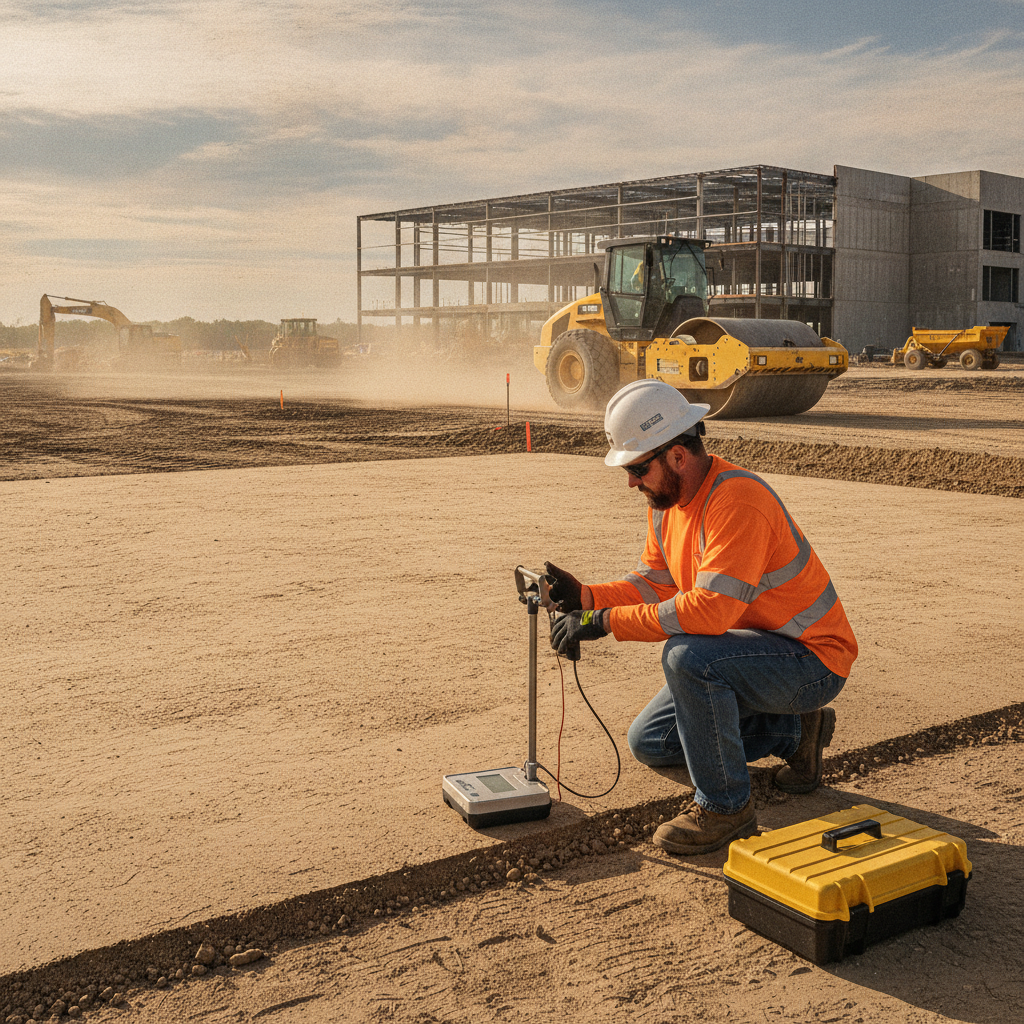
Specifications are meaningless without a robust quality control and assurance (QC/QA) program to verify them. During construction, an independent testing agency, often directed by the Geotechnical engineer or as part of Construction Management Services, performs regular field density testing. The most common method is the nuclear density gauge, which provides rapid and accurate measurements of the in-place density and moisture content of the compacted fill. The frequency of testing is defined in the specifications, typically on a grid basis (e.g., one test per 5,000 square feet) for each lift of fill placed. This systematic approach ensures comprehensive coverage and provides the documentation necessary to certify that the earthwork meets the project requirements. If a test fails, the contractor must re-work the area—by adjusting moisture, applying more compactive effort, or replacing the material—until a passing test is achieved. This rigorous process of testing and verification is fundamental to risk management in site development.
The Critical Step of Proof Rolling
While individual density tests confirm compaction at specific points, proof rolling provides a holistic assessment of a large area’s stability. After an area has been graded and compacted, and just before placing stone base or foundations, a proof roll is performed. This typically involves driving a fully loaded, tandem-axle dump truck or a similar heavy vehicle slowly over the entire surface in a systematic pattern. The purpose of the proof roll is to identify any isolated soft spots, unstable zones, or areas of excessive rutting or pumping that may not have been caught by the grid-based density testing. The Geotechnical engineer or a representative from the civil engineering firm observes the proof roll, marking any areas that deflect, rut, or weave under the load. These areas must be undercut and replaced with properly compacted fill, ensuring the entire pad is uniformly stable before subsequent construction phases begin.
RSP’s Process for Ensuring Compaction Integrity
At RSP Engineers, we integrate compaction management into our comprehensive site engineering services from day one. Our process begins with a meticulous review of the project-specific geotechnical soil report to understand the site’s unique conditions. We collaborate closely with the Geotechnical engineer to develop clear, enforceable, and practical technical specifications that leave no room for ambiguity. During construction, our team provides proactive construction administration and oversight. We coordinate with the third-party testing agency, review all field density test reports, and track the progress of earthwork operations. By observing critical milestones like proof rolling and maintaining detailed documentation, we provide our clients with the confidence that the foundation of their mission-critical facility is built on solid ground, meeting all design and permitting requirements.
Common Issues in Fill Compaction and Mitigation
Even with clear specifications, several issues can arise during earthwork operations. One of the most common is improper moisture content; soil that is too dry will not achieve density, while soil that is too wet will be unstable and prone to pumping. Another issue is the use of unsuitable fill material, such as soil with high organic content or oversized rocks, which can create voids and inconsistent support. Insufficient compactive effort or placing lifts that are too thick are also frequent problems. Mitigation relies on a combination of clear specifications and diligent field oversight. Proactive construction management services are key. This includes requiring the contractor to have water trucks or discs available for moisture conditioning, visually inspecting all fill material as it is delivered and placed, and verifying lift thicknesses before compaction begins. Consistent communication between the contractor, the testing agency, and the civil engineering team is essential to identify and correct these issues before they compromise the integrity of the work. Frequently Asked Questions What is the difference between Standard and Modified Proctor tests? The primary difference is the amount of compactive energy applied. The Modified Proctor test (ASTM D1557) uses a heavier hammer and a greater drop height than the Standard Proctor test (ASTM D698). This results in a higher maximum dry density value. The Modified Proctor is typically specified for projects with heavy loads, such as data centers and major roadways, as it better represents the compaction achievable with modern heavy equipment and provides a more rigorous standard for foundation support. Why can’t we just use any dirt for fill material? Soils have vastly different engineering properties. Some soils, like clean sands and gravels, are excellent for structural fill because they are strong and drain well. Other soils, like high-plasticity clays or silts, can be weak, difficult to compact, and prone to shrinking or swelling with changes in moisture. The geotechnical soil report identifies which on-site soils are suitable for use as fill and provides specifications for any imported material to ensure it meets the project’s structural requirements. How often should field density tests be performed? Testing frequency is defined in the project’s technical specifications and should be based on the recommendations of the Geotechnical engineer. A common specification for a building pad is one test per 2,500 to 5,000 square feet per lift of fill. For linear features like utility trenches or roadways, the frequency might be specified as one test every 100 to 200 linear feet per lift. The goal is to achieve a statistically significant representation of the overall earthwork quality. What happens if a compaction test fails? A failed density test indicates that the specified level of compaction was not achieved in that location. The contractor is required to rework the area of the failure. This may involve scarifying the soil, adjusting its moisture content, and re-compacting it with additional passes of the roller. A new test is then performed in the same location to verify that the rework was successful. No subsequent lifts of fill can be placed over an area until it has passed the required compaction testing. Can construction proceed in wet weather? Heavy or prolonged rainfall can saturate soils, making it impossible to achieve proper compaction. Attempting to work with overly wet soil can damage the subgrade and lead to long-term stability problems. Most specifications will require that earthwork operations cease during inclement weather. The site must be allowed to dry to a workable moisture content, as verified by the testing agency, before compaction activities can resume. What is the role of the Professional Engineer in this process? A licensed Professional Engineer (P.E.) oversees the entire process. The Geotechnical engineer, a specialized P.E., is responsible for the initial site investigation and provides the foundational data. The Civil Engineer, also a P.E., incorporates this data into the overall site plan design, writes the technical specifications for construction, and often provides oversight during the construction phase to ensure the design intent is met and the project complies with all applicable codes and standards.
Your Partner for Mission-Critical Site Development
The success of a multi-million dollar data center hinges on the quality of the earthwork beneath it. Ensuring proper compaction is a complex task that requires deep expertise in Geotechnical Engineering, detailed specifications, and rigorous field oversight. RSP Engineers provides the expert site engineering services and construction administration necessary to manage this critical process. We collaborate with developers, contractors, and testing agencies to ensure your facility is built on a foundation of uncompromised stability. Connect with our team today to discuss your next mission-critical project and learn how our comprehensive civil engineering services can protect your investment.
Conclusion
Establishing and verifying compaction requirements for data center fill is a foundational element of mission-critical facility design. It is an engineered process that translates scientific laboratory testing into methodical field execution and quality control. From the initial geotechnical soil report to the final proof roll, every step is designed to create a stable, uniform, and predictable foundation. By adhering to rigorous standards for fill material, moisture control, and compactive effort, developers can mitigate the risk of settlement and ensure the long-term operational integrity of their vital infrastructure. Partnering with an experienced civil engineering firm is the first step toward achieving this critical outcome.
FAQs
-
Establishing Compaction Requirements for Data Center Fill requires careful planning, qualified engineering, and compliance with the applicable codes and permits.
-
Getting Establishing Compaction Requirements for Data Center Fill right protects safety, supports regulatory compliance, and avoids costly redesigns or delays.
-
RSP Engineers provides licensed expertise and end-to-end support for Establishing Compaction Requirements for Data Center Fill, from early planning through permitting.