
Coordinating Ground Improvement With Civil Grading
A guide for data center developers on coordinating ground improvement techniques like aggregate piers with civil grading. Learn about sequencing, working platforms, and verification testing.
The Critical Role of Geotechnical Investigation in Site Feasibility
Before any grading plan can be finalized, a comprehensive geotechnical investigation is paramount. This phase, led by a qualified Geotechnical engineer, provides the foundational data that drives both the civil engineering design and the ground improvement strategy. The investigation typically involves a program of Soil boring tests, Cone Penetration Tests (CPTs), and laboratory analysis of soil samples to characterize the subsurface profile, identify problematic soil layers (such as soft clays, loose sands, or undocumented fill), and determine key engineering properties like strength, compressibility, and groundwater levels. The findings are compiled into a detailed Geotechnical soil report, which serves as the single source of truth for subsurface conditions. This report provides specific recommendations for foundation design, estimates potential settlement, and, crucially, evaluates the necessity and feasibility of various ground improvement techniques. For data center developers, this upfront investment is non-negotiable; it de-risks the project by identifying potential showstoppers early and provides the necessary parameters for the design team to develop an efficient and cost-effective site plan design.
Common Ground Improvement Techniques for Data Center Projects
Comparison of Common Ground Improvement Methods
| Technique | Primary Application | Key Civil Coordination Points | Typical Verification Method |
|---|---|---|---|
| Aggregate Piers | Supporting heavy foundations on weak to stiff soils; settlement control. | Requires a robust working platform; precise layout by surveyor; spoils management. | Modulus load tests on individual piers; production records. |
| Deep Dynamic Compaction (DDC) | Densifying thick layers of loose granular soils (sands, gravels). | Vibration monitoring; requires large, open areas; post-DDC grading to level cratered surface. | Post-improvement CPTs/SPTs; monitoring ground response. |
| Surcharging & Wick Drains | Consolidating soft, compressible soils (clays, silts) over large areas. | Requires large volumes of fill material; long duration (months); careful drainage design for water expulsion. | Settlement plate monitoring; piezometers to track pore water pressure. |
| Deep Soil Mixing (DSM) | Creating stiff, in-situ soil-cement columns for foundation support or excavation shoring. | Management of cement slurry and spoils; requires specialized plant setup; precise layout. | Core sampling and unconfined compressive strength (UCS) testing. |
| Shallow Soil Stabilization | Improving subgrade for pavements, slabs-on-grade, and utility trenches. | Requires precise depth and binder spread-rate control; coordination with grading and paving. | In-place density testing; laboratory strength tests (UCS) on treated samples. |
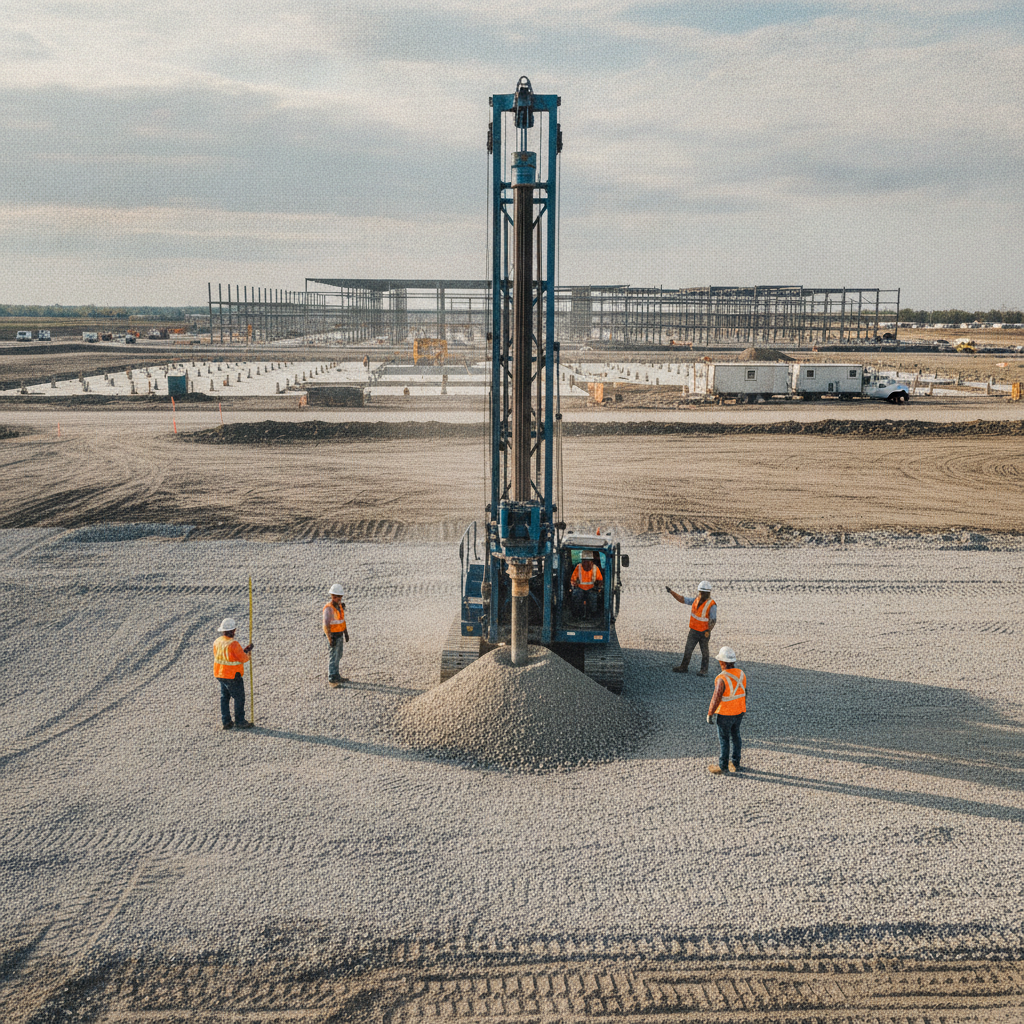
The choice of ground improvement method depends heavily on the specific soil conditions, the structural loading requirements, and the project schedule. Several techniques are commonly employed on data center sites to increase bearing capacity, control settlement, and mitigate liquefaction risk. The civil engineering team must understand the operational needs of each method to properly sequence site activities. Aggregate Piers: Also known as vibro-stone columns, this technique involves drilling cavities into the ground and filling them with compacted aggregate. The dense columns reinforce the soil matrix, significantly improving its strength and stiffness. They are highly effective for supporting the heavy, isolated column loads typical of data center structures. Deep Dynamic Compaction (DDC): DDC is used to densify loose, granular soils at depth. It involves repeatedly dropping a very heavy weight (tamper) from a significant height. The resulting energy waves compact the soil, reducing voids and increasing its density. This method requires careful monitoring to avoid off-site vibrations. Surcharging and Wick Drains: For sites with soft, compressible clays, surcharging is often used. A large mound of temporary fill is placed over the building footprint to pre-compress the underlying soils, forcing settlement to occur before construction begins. Vertical wick drains are often installed to accelerate this consolidation process by providing a rapid escape path for pore water. Soil Mixing: This method involves mechanically blending the in-situ soil with cementitious binders (like Portland cement or lime) using large augers. The result is a stiff, stabilized soil-cement mass with improved strength and reduced compressibility. It can be performed as deep soil mixing (DSM) for foundation support or shallow soil stabilization for pavements and slabs.
Sequencing Ground Improvement with Mass Grading and Utility Installation
The logistical choreography between mass grading, ground improvement, and utility installation is one of the most complex aspects of site development. A well-defined sequence is essential to avoid rework and maintain the project schedule. The typical order of operations begins with initial clearing and stripping, followed by the bulk earthwork or mass grading to bring the site to a rough subgrade elevation. It is at this stage that the critical working platform for the ground improvement equipment is constructed. Permitting requirements for site work, including erosion control and stormwater management, vary by jurisdiction, and every project team should confirm the applicable standards with the local, state, regional, and federal authorities that hold review authority over the site. This includes regulations governing earthwork, dust control, and potential impacts to protected resources, which can directly affect the land development schedule. Once ground improvement is complete and verified, final grading of the building pad and surrounding areas can proceed, followed by the installation of deep utilities. Careful utility coordination is vital to ensure that trenching for storm drains, sanitary sewers, and electrical duct banks does not compromise the newly improved ground.
Designing and Constructing the Working Platform
A stable, properly designed working platform is a non-negotiable prerequisite for most ground improvement operations. The specialized equipment used for techniques like aggregate piers and deep soil mixing is extremely heavy, with crane-based rigs exerting significant ground pressures. The working platform provides a safe and efficient surface for this equipment to operate, preventing bogging down, ensuring stability, and maintaining the tight tolerances required for element layout. The platform is a critical interface between the civil engineering design and the means-and-methods of the specialty contractor. The design of the working platform is typically a collaborative effort. The Geotechnical engineer provides parameters based on the underlying soil strength, while the civil engineer incorporates its geometry and grading into the overall site plan design. The ground improvement contractor provides the specific loading requirements for their equipment. The platform is usually constructed from compacted aggregate or crushed rock and must be maintained throughout the ground improvement phase, requiring coordination with the site grading contractor to manage weather impacts and traffic.
Verification Testing and Quality Control Protocols
Ground improvement is not complete until it is verified. A robust quality control (QC) and testing program is essential to confirm that the soil has achieved the required engineering properties specified in the design. This step provides the owner and the structural engineer with the confidence to proceed with foundation construction. The verification methods are specific to the improvement technique used and must be integrated into the construction administration plan. Common verification methods include: Modulus Load Tests: A plate load test performed directly on top of a single aggregate pier to confirm its stiffness and load-carrying capacity. Post-Improvement CPTs or SPTs: Cone Penetration Tests or Standard Penetration Tests are performed after techniques like DDC to measure the increase in soil density and strength. Settlement Monitoring: For surcharging projects, settlement plates and survey monitoring are used to track ground consolidation over time, ensuring that primary settlement is complete before the surcharge is removed. Core Sampling and Strength Testing: Unconfined compressive strength (UCS) tests are performed on cores extracted from soil-mixed columns to verify that the required strength has been achieved.
RSP Engineers’ Integrated Approach to Site Grading and Ground Improvement
At RSP Engineers, we recognize that successful site development for mission-critical facilities requires a holistic and integrated approach. Our process emphasizes early and continuous collaboration between our Civil Engineers, the client’s chosen Geotechnical engineer, and the specialty contractors. We facilitate a unified design strategy where the civil grading plan, stormwater management system, and utility layouts are developed in concert with the ground improvement requirements. Our role extends beyond design into proactive Construction Management Services. We assist in developing clear sequencing plans, defining working platform specifications, and establishing robust QC protocols. By managing the critical interfaces between the earthwork contractor and the ground improvement specialist, we help mitigate risks, prevent delays, and ensure that the final prepared site meets all engineering specifications, providing a solid foundation for the vertical construction to follow. Our expertise in complex permitting and agency coordination ensures the project moves forward smoothly.
Navigating Common Challenges in Execution
Even with meticulous planning, complex site work can present challenges. One common issue is encountering unforeseen subsurface conditions that differ from those identified in the initial Soil Test program. This requires rapid collaboration between the engineering team and contractor to adapt the design. Another significant challenge is managing groundwater, which can destabilize excavations and interfere with working platform integrity, often requiring active dewatering systems. Equipment access, laydown areas, and the logistics of material delivery (e.g., aggregate for piers, cement for soil mixing) must be carefully planned within the overall site logistics. Weather is a constant variable; heavy rainfall can saturate soils, compromise the working platform, and delay grading operations. Proactive planning, clear communication, and having experienced site engineering services on board are key to overcoming these hurdles effectively.
Partner with RSP Engineers for Your Mission-Critical Site Development
Coordinating ground improvement and civil grading is a complex, high-stakes endeavor essential to the success of any data center project. Getting it right requires deep expertise and a proactive, integrated team approach. RSP Engineers provides the comprehensive site engineering services needed to navigate these challenges. Our team excels at complex civil engineering design, rigorous utility coordination, and navigating the intricacies of land development permitting. Connect with us today to ensure your next mission-critical facility is built on a foundation of certainty and success.
Conclusion: A Foundation for Success
Ultimately, the coordination of ground improvement and civil grading is about risk management. For data center developers, where reliability and uptime are paramount, there is no room for error in the foundation. A meticulously planned and executed site work program, which integrates geotechnical engineering, thoughtful civil engineering, and specialized ground improvement, is the first and most critical step. This proactive collaboration ensures that the massive investment in vertical construction is built on solid ground, safeguarding the project’s schedule, budget, and long-term operational integrity. Related Articles The Civil Engineer’s Role in Data Center Site Selection Navigating Stormwater Permitting for Large Industrial Sites Key Considerations for Utility Coordination in Mission-Critical Facilities
FAQs
-
Ground improvement should be considered at the earliest stages of site selection and due diligence. The results of the preliminary Geotechnical soil report will indicate if poor soils are present, allowing the development team to budget for and schedule these critical activities from the outset.
-
The design is a collaborative effort. The ground improvement contractor specifies the load requirements of their equipment. The Geotechnical engineer provides allowable bearing pressures for the underlying soils. The civil engineering firm then incorporates the platform’s thickness, material type, and grading into the official construction documents.
-
If QC tests fail, the Professional Engineer of record and the geotechnical consultant will investigate the cause. This may involve additional testing or analysis. Remediation could involve installing additional improvement elements, modifying the foundation design, or performing localized repairs, all of which must be documented and approved before proceeding.