
Mat Foundations for High-Load Data Center Structures
A technical guide to mat foundation design for high-load data centers. Learn about soil-structure interaction, punching shear, differential settlement control, and mass concrete placement from civil e
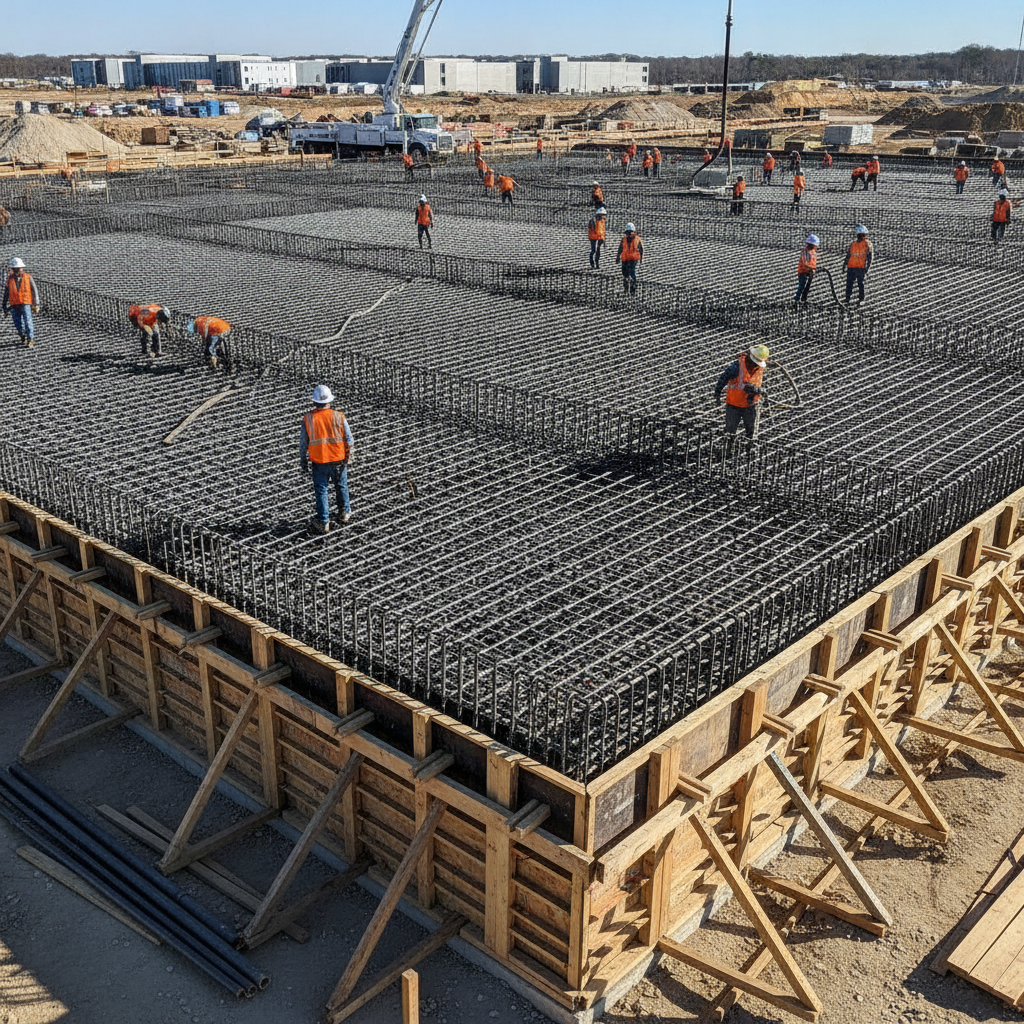
The Role of Mat Foundations in Distributing Extreme Loads
A mat foundation is a thick, heavily reinforced concrete slab that extends under the entire footprint of a building. Unlike isolated or strip footings that support individual columns or walls, a mat foundation acts as a single, monolithic unit. This design allows it to distribute the building’s total weight, including massive dead loads from equipment and the structure itself, as well as dynamic live loads, over a very large area. This broad load distribution significantly reduces the bearing pressure on the underlying soil, minimizing the risk of localized settlement and ensuring long-term structural integrity. For a data center, this approach is critical. The equipment layout often results in closely spaced columns carrying exceptionally heavy loads. A mat foundation effectively averages these loads, creating a uniform pressure profile that the soil can more easily support. This inherent rigidity is fundamental to preventing the kind of structural movement that could damage sensitive equipment, crack concrete floors, or compromise critical utility connections, making it an indispensable component of modern site development for mission-critical facilities.
Geotechnical Investigation and Soil-Structure Interaction
Key Design Parameters for Data Center Mat Foundations
| Parameter | Design Consideration | Impact on Data Center Operations |
|---|---|---|
| Slab Thickness | Determined by punching shear calculations, flexural demands, and required overall stiffness. Typically ranges from 24 to 60 inches or more. | Provides rigidity to control differential settlement and prevents structural failure under heavy, concentrated equipment loads. |
| Reinforcement Density | Calculated based on flexural and shear stresses from soil-structure interaction analysis. Often involves multiple layers of large-diameter rebar. | Ensures long-term durability and crack control, protecting the slab from tensile forces and maintaining structural integrity. |
| Subgrade Modulus (k) | A measure of soil stiffness obtained from the Geotechnical soil report. Directly influences the modeled foundation deflection. | An accurate value is critical for realistic settlement predictions. An incorrect value can lead to an unsafe or overly conservative design. |
| Concrete Strength (f'c) | Specified compressive strength of the concrete, typically 5,000 psi or higher. Mix design also considers durability and thermal properties. | Higher strength improves shear capacity and overall durability, providing a robust base for heavy equipment and high floor loads. |
| Control & Construction Joints | Planned locations for stopping and starting concrete pours. Must be carefully designed with waterstops and dowel bars to transfer loads. | Properly detailed joints prevent random cracking and mitigate water intrusion risks into the below-slab space, which often houses critical utilities. |
The success of a mat foundation begins deep in the ground. A comprehensive Geotechnical Engineering investigation is non-negotiable, providing the essential data needed for a safe and efficient design. This investigation determines critical soil parameters like bearing capacity, potential for consolidation, and the modulus of subgrade reaction, which quantifies soil stiffness. The resulting Geotechnical soil report is the foundational document upon which all structural calculations are based. This data is then used in sophisticated soil-structure interaction (SSI) analysis. SSI modeling treats the foundation and the soil as an integrated system, rather than assuming the soil provides perfectly uniform support. This analysis allows engineers to predict how the mat will deflect under load and how the soil will respond, leading to a more accurate and optimized reinforcement design. Geotechnical investigation requirements and local soil condition assumptions vary by jurisdiction, and it is crucial to confirm all applicable standards with the local, state, regional, and federal authorities before commencing design. This due diligence ensures the design complies with all relevant building codes and safety standards.
Designing for Punching Shear and Flexural Demands
Two of the most significant structural challenges in mat foundation design are punching shear and flexural stress. Punching shear is the tendency of a heavily loaded column to ‘punch’ through the concrete slab. In data centers, where columns supporting heavy equipment are common, this is a primary design concern. Engineers mitigate this risk by increasing the slab thickness at column locations, incorporating steel shearheads, or using specialized shear reinforcement like stud rails, all in accordance with standards like ACI 318. Simultaneously, the mat must resist flexural, or bending, forces that arise from upward soil pressure and downward column loads. This requires a robust system of top and bottom steel reinforcement (rebar) placed in a grid pattern. The flexural design ensures the slab can span between load points without excessive cracking or deflection. A detailed structural analysis is performed to map stress contours across the slab, allowing for precise placement and sizing of reinforcement to handle these demands efficiently.
Controlling Differential Settlement Across Large Footprints
For a data center, uniform settlement is manageable, but differential settlement—where one part of the foundation settles more than another—is a critical failure risk. It can cause floors to slope, rack alignments to shift, and severe stress on rigid piping and conduit connections. Even a fraction of an inch of differential movement can compromise sensitive fiber optic cables or cooling lines, leading to costly downtime. The inherent foundation rigidity of a well-designed mat foundation is the primary defense against this risk. By spreading loads over the entire building area, the mat bridges over localized soft spots in the soil and averages out non-uniform loading conditions. Advanced settlement analysis, informed by the geotechnical report, allows engineers to predict long-term settlement patterns and adjust the mat’s thickness and reinforcement to ensure movement stays within the strict tolerances required for mission-critical operations. This is a key aspect of the overall civil engineering design process.
Mass Concrete Placement and Thermal Control
A data center mat foundation qualifies as mass concrete due to its significant thickness. When large volumes of concrete cure, the chemical reaction (hydration) generates a substantial amount of heat. If not managed, this heat of hydration can create a large temperature differential between the core and the surface of the slab, leading to significant thermal cracking. Such cracks can compromise the slab’s structural integrity and create pathways for moisture intrusion. A thermal control plan is therefore a critical part of the construction administration phase. This plan may specify the use of supplementary cementitious materials like fly ash or slag to reduce heat generation, pre-cooling of concrete aggregates, or embedding cooling pipes within the slab. Careful planning of pour sequences and application of a high-performance curing compound are also essential to ensure the concrete gains strength uniformly and remains durable for the life of the facility.
Integrating Utilities and Below-Slab Infrastructure
Data centers feature a dense network of below-slab infrastructure, including power conduits, cooling pipes, grounding grids, and extensive drainage systems. The successful integration of these utilities is a major challenge that requires meticulous upfront planning and utility coordination between the civil, structural, mechanical, and electrical engineering teams. All sleeves, blockouts, and embedded items must be precisely located and installed before the concrete pour. Every penetration through the mat foundation is a potential weak point. The design must include details for reinforcing the concrete around larger openings to compensate for the displaced material. Furthermore, all penetrations must be properly sealed to prevent water infiltration, which is a major operational risk. This rigorous MEP coordination is a hallmark of successful civil engineering for complex facilities and prevents costly rework and delays during construction.
Our Process: A Disciplined Approach to Mat Foundation Engineering
At RSP Engineers, we follow a structured, multi-disciplinary process to deliver resilient and cost-effective mat foundation designs for data centers. Our approach ensures all technical aspects are addressed from project inception through completion. Phase 1: Feasibility and Geotechnical Review: We begin by collaborating with the project’s Geotechnical engineer to define the scope of the subsurface investigation and meticulously review the final Geotechnical soil report to understand site constraints and opportunities. Phase 2: Detailed Structural Modeling: Our structural engineers use advanced finite element analysis (FEA) software to perform detailed soil-structure interaction modeling. This allows us to optimize slab thickness and reinforcement, ensuring the design is both safe and economical. Phase 3: Construction Document Preparation: We produce a comprehensive set of drawings and specifications that clearly communicate the design intent. This includes detailed reinforcement plans, joint layouts, waterstop details, and specifications for concrete mix design and thermal control. Phase 4: Construction Administration: Our team provides robust support during the construction phase, including reviewing rebar shop drawings, responding to contractor RFIs, and performing site observations to ensure the foundation is built in strict accordance with the design documents.
Common Challenges and Mitigation Strategies
Even with a robust design, mat foundation projects can face challenges. Proactive planning is key to mitigating these risks. Inadequate Geotechnical Data: Insufficient soil borings or testing can lead to incorrect assumptions about soil behavior. Mitigation involves commissioning a comprehensive geotechnical investigation tailored to the specific loads and footprint of the data center. Reinforcement Congestion: Heavily reinforced areas, especially around columns, can make it difficult to place and properly consolidate concrete. Mitigation includes using 3D modeling (BIM) to detect clashes and specifying appropriate concrete mix designs with smaller aggregates. Poor Thermal Management: Failure to implement a thermal control plan can result in widespread cracking. Mitigation requires a detailed plan, specified in the construction documents and diligently monitored by the construction administration team. Construction Joint Failure: Improperly installed waterstops or poor surface preparation at construction joints can lead to leaks. Mitigation involves clear installation details in the drawings and quality control inspections during construction. Frequently Asked Questions How thick is a typical data center mat foundation? The thickness of a data center mat foundation is highly project-specific, driven by soil conditions and column loads. It typically ranges from 24 to 60 inches, but can be thicker for facilities with exceptionally heavy equipment or on sites with weaker soils. What is the role of the Geotechnical engineer in mat foundation design? The Geotechnical engineer is a critical partner. They perform the subsurface investigation, provide the Geotechnical soil report with key design parameters like bearing capacity and subgrade modulus, and offer recommendations for site preparation and ground improvement if necessary. Can a mat foundation be used on poor soils? Yes, mat foundations are often an excellent solution for sites with poor or variable soil conditions. By distributing loads over a large area, they can safely support a structure on soils that would not be suitable for traditional shallow footings. In some cases, ground improvement techniques may be used in conjunction with the mat. How is reinforcement congestion managed during construction? Reinforcement congestion is managed through careful design and detailing. This can include using larger-diameter bars to reduce the total number of bars, bundling bars, or using mechanical couplers instead of lap splices. Building Information Modeling (BIM) is also used to visualize rebar placement and resolve conflicts before construction begins. What happens if differential settlement exceeds design limits? Excessive differential settlement is a serious issue that can lead to structural damage, cracked walls and floors, and malfunctioning equipment. It can compromise the operational integrity of the data center. A properly engineered mat foundation, based on a thorough geotechnical investigation, is the best way to prevent this. How does seismic design influence a mat foundation? In seismically active regions, the mat foundation must be designed to resist significant lateral forces and ground motion. The mat acts as a rigid diaphragm, tying the building’s vertical elements together and helping the structure move as a single unit during an earthquake. This often requires additional reinforcement and careful detailing of connections to ensure ductile performance. Let’s Build a Resilient Foundation for Your Mission-Critical Facility A data center’s success depends on the unwavering reliability of its foundation. At RSP Engineers, we provide the expert civil engineering, structural design, and permitting support needed to deliver robust mat foundations for the most demanding mission-critical projects. Our integrated approach to site development ensures that your facility is built on a solid, stable, and durable base. Contact us today to discuss how our team can support your next data center project from the ground up. Conclusion The mat foundation is more than just a slab of concrete; it is a highly engineered system that provides the essential stability for high-load data centers. Its ability to manage extreme loads, control differential settlement, and integrate complex infrastructure makes it the superior choice for these critical facilities. A successful design hinges on a deep understanding of Geotechnical Engineering principles, meticulous structural analysis, and diligent construction administration. By investing in a well-designed mat foundation, developers and operators can ensure the long-term performance and resilience of their digital infrastructure assets. Related Articles Geotechnical and Structural Design Considerations for Data Center Foundations Managing Differential Settlement Risks on Large Data Center Campuses Planning a Comprehensive Geotechnical Investigation for Your Data Center Project
FAQs
-
Mat Foundations for High-Load Data Center Structures requires careful planning, qualified engineering, and compliance with the applicable codes and permits.
-
Getting Mat Foundations for High-Load Data Center Structures right protects safety, supports regulatory compliance, and avoids costly redesigns or delays.
-
RSP Engineers provides licensed expertise and end-to-end support for Mat Foundations for High-Load Data Center Structures, from early planning through permitting.