
Pile-Supported Data Center Buildings
A technical guide to pile-supported foundations for data centers. Learn about driven vs. cast-in-place piles, capacity analysis, dynamic testing, and design considerations for mission-critical facilit
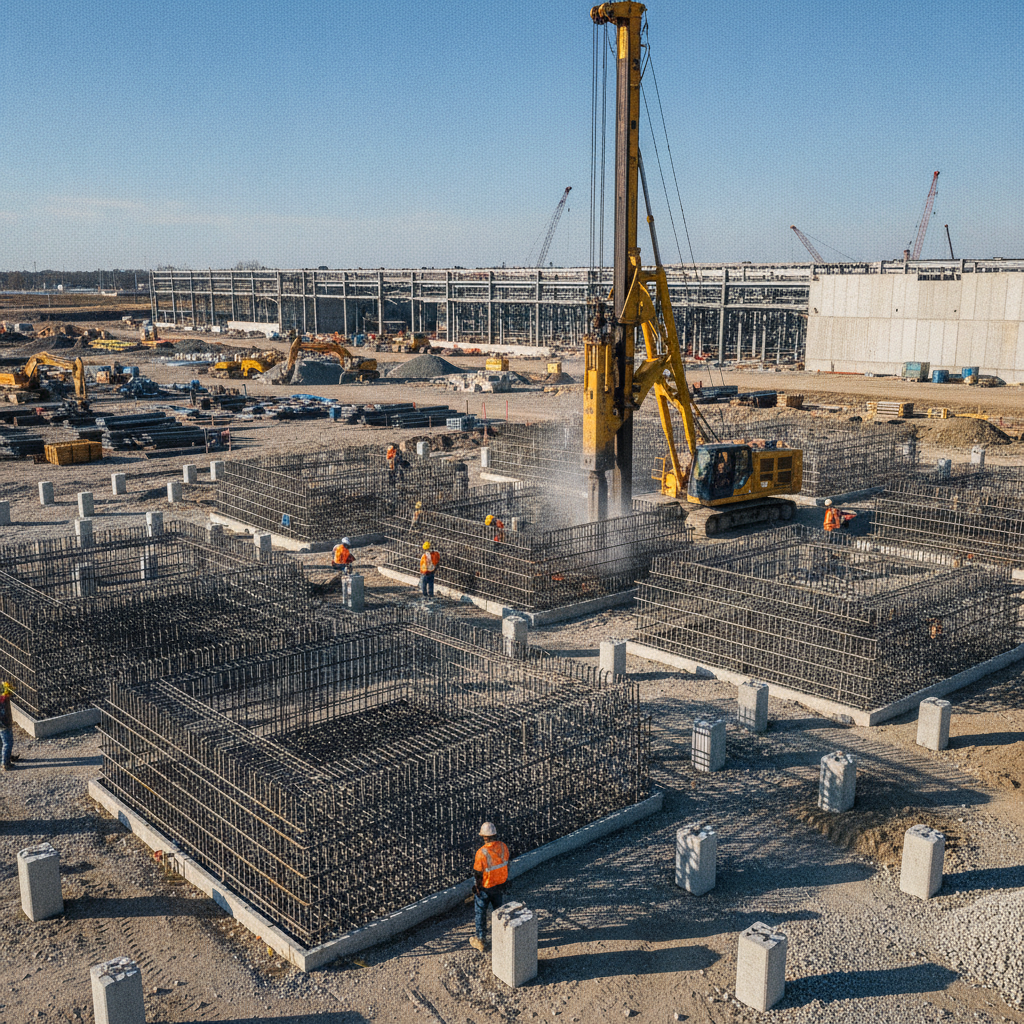
Why Pile Foundations are Critical for Mission-Critical Facilities
The decision to use a pile foundation is driven by the findings of a comprehensive Geotechnical soil report. This investigation, which includes procedures like the soil boring test, analyzes the soil layers deep beneath the surface. If the upper soil strata are found to be weak, compressible, or otherwise unsuitable, a shallow foundation system (like a mat slab or spread footings) would be at high risk of excessive or uneven settlement. This differential settlement is a critical failure point for a data center, potentially causing cracks in the slab, misaligning server racks, and damaging sensitive electrical and mechanical conduits. Pile foundations solve this problem by transferring the building’s immense structural loads through the weak upper soils to deeper, more competent materials like dense sand, stiff clay, or bedrock. This bypasses the problematic soil layers entirely, creating a stable foundation anchored in a strong bearing stratum. This approach is fundamental to achieving the resilience and longevity required for a mission-critical facility, protecting billions of dollars in IT infrastructure and ensuring uninterrupted service.
Driven Piles vs. Cast-in-Place Piles: A Technical Comparison
Comparison of Common Pile Foundation Types for Data Centers
| Pile Type | Installation Method | Key Advantages | Primary Considerations |
|---|---|---|---|
| Precast Concrete Piles | Impact or vibratory hammer | High strength, corrosion resistant, known material quality. | High noise and vibration; potential for damage in hard driving. |
| Steel H-Piles | Impact or vibratory hammer | High capacity, can penetrate dense soils and obstructions. | Vulnerable to corrosion without coating; higher material cost. |
| Drilled Shafts (Caissons) | Rotary drilling, excavation, concrete pour | Very high capacity, low noise/vibration, adaptable to soil changes. | Slower installation, requires spoil disposal, sensitive to groundwater. |
| Auger-Cast Piles (CFA) | Continuous flight auger drills and injects grout | Faster than drilled shafts, low vibration, good for poor soils. | Extensive quality control needed; potential for necking or voids. |
| Micropiles | Drilling small-diameter holes, grouting, placing steel bar | Ideal for underpinning and limited-access sites, high capacity. | Higher cost per unit of capacity; slower installation process. |
Pile foundations are broadly categorized into two main types: driven piles and cast-in-place piles. The selection depends on soil conditions, site constraints, load requirements, and project economics. A Geotechnical engineer works closely with the structural engineer to specify the optimal system. Each approach has distinct methodologies and engineering considerations that impact the project’s schedule, budget, and logistical planning. Driven piles are prefabricated structural elements—typically made of precast concrete, steel H-sections, or steel pipes—that are driven into the ground using large impact or vibratory hammers. This method is often efficient and provides a high degree of quality control, as the piles are manufactured in a controlled factory environment. The driving process itself can help densify surrounding granular soils. However, the noise and vibration generated during installation can be a significant concern, especially on sites adjacent to existing structures or sensitive operations. Cast-in-place piles, such as drilled shafts or auger-cast piles, are constructed on-site. The process involves excavating a cylindrical hole to the required depth, often with a steel casing or drilling fluid to support the hole, placing a reinforcing steel cage, and then filling the excavation with concrete. This method generates far less noise and vibration than pile driving, making it ideal for constrained or sensitive sites. It also offers flexibility, as pile diameters and depths can be easily adjusted in the field to accommodate variable subsurface conditions discovered during drilling.
Understanding Pile Capacity: End Bearing and Skin Friction
A pile supports its load through a combination of two primary mechanisms: end bearing and skin friction. The contribution of each is determined by the pile’s geometry and the properties of the soil or rock it penetrates. A thorough understanding of these forces is essential for an efficient and safe site plan design and foundation system. The analysis relies heavily on data from the Geotechnical investigation and is a core part of the structural design process. End bearing capacity is the support generated at the tip of the pile, where it rests on a very dense or hard stratum like bedrock or a highly consolidated soil layer. The pile acts like a column, directly transferring the building load to this competent material. In contrast, skin friction (or side friction) is the resistance developed along the shaft of the pile as it is pushed into the ground. This friction between the pile surface and the surrounding soil provides significant load-carrying capacity, especially for long piles installed in cohesive soils like clay. The total ultimate capacity of a pile is the sum of its end bearing and skin friction capacities. The Professional Engineer of record calculates these values and applies a factor of safety to determine the allowable design load for each pile, ensuring the foundation can safely support the data center under all service conditions.
Design Considerations for Pile Groups and Pile Caps
Data center columns carry immense loads that a single pile cannot support alone. Therefore, piles are installed in groups, and their collective behavior must be analyzed. The spacing between piles is a critical design parameter. If piles are too close, their individual zones of influence in the soil can overlap, leading to pile group effects that can reduce the overall efficiency and capacity of the group compared to the sum of the individual pile capacities. To transfer the column load to the pile group, a pile cap is constructed. This is a thick, heavily reinforced concrete slab that sits atop the piles, distributing the concentrated column load evenly among them. These pile caps are then often connected by grade beams, which are reinforced concrete beams that span between caps to support foundation walls and provide additional rigidity to the foundation system. Structural design codes and foundation requirements vary by jurisdiction, and the project team must confirm all applicable standards with the local, state, and federal authorities that hold review authority over the site. This ensures full building code compliance and a successful permitting process.
Pile Installation: Driving Criteria and Dynamic Testing
Quality control during installation is paramount to ensuring the pile foundation performs as designed. For driven piles, the Geotechnical engineer establishes specific driving criteria, which may include a minimum embedment depth and a target final driving resistance (often measured in blows per inch). The field crew meticulously records this data in a pile driving log for every pile installed on the site. To verify pile capacity and integrity in real-time, dynamic pile testing, often using a Pile Driving Analyzer (PDA), is frequently specified. This involves attaching sensors to the pile during installation to measure the force and velocity imparted by the hammer blow. This data is used to calculate the pile’s static load-bearing capacity, assess hammer performance, and detect potential damage. For critical projects, one or more full-scale static load tests may be performed, where a test pile is loaded to a multiple of its design capacity to provide definitive proof of its performance.
Mitigating Construction Impacts: Vibration and Noise Control
Pile driving, by its nature, generates significant ground vibration and noise, which can be a major concern for neighboring properties and existing facilities, especially on an active data center campus. A proactive mitigation strategy is essential for any project involving driven piles. This often begins with a pre-construction survey to document the condition of nearby structures before work commences. During installation, vibration monitoring is a critical quality control measure. Seismographs are placed at strategic locations to continuously measure ground vibration levels and ensure they remain below contractually specified or municipally regulated limits. If vibrations approach these limits, the contractor may need to modify their means and methods, such as by using a smaller hammer, pre-drilling pilot holes to loosen dense soils, or switching to a different foundation type in sensitive areas. These measures are crucial for maintaining good community relations and avoiding costly claims or project delays.
The RSP Engineers Approach to Pile Foundation Design and Oversight
At RSP Engineers, we provide comprehensive site engineering services for complex data center projects, including the design and oversight of pile foundation systems. Our process is collaborative and data-driven, ensuring a foundation that is safe, cost-effective, and resilient. Geotechnical Investigation and Feasibility: We manage and interpret the Geotechnical soil report to characterize subsurface conditions and provide initial recommendations on foundation types. Integrated Foundation Design: Our civil and structural engineers collaborate to integrate the pile foundation system with the overall site plan design, including grading, drainage, and utility layouts. Permitting and Agency Coordination: We prepare and submit all necessary documentation for permit submittals, navigating the review process with the authority having jurisdiction to secure approvals efficiently. Construction Administration and Quality Assurance: During construction, we provide on-site observation, review pile installation logs, interpret dynamic testing results, and facilitate communication between the owner, contractor, and Geotechnical engineer to ensure strict adherence to the design specifications.
Common Challenges in Pile-Supported Foundation Projects
Even with meticulous planning, pile foundation projects can encounter challenges. One of the most common is encountering unexpected subsurface conditions, such as boulders, buried debris, or soft pockets not identified in the initial soil borings. This can lead to pile refusal (inability to drive to depth) or require changes in pile length or location. Another challenge is managing pile installation tolerances. Piles must be installed within strict vertical and horizontal limits to align with the pile caps. Deviations can require costly remedial measures or a redesign of the pile cap. Finally, ensuring seamless coordination between the geotechnical, structural, and civil engineering disciplines is vital. Miscommunication can lead to design conflicts between the foundation plan and the site’s stormwater management or utility infrastructure, causing delays and change orders. Frequently Asked Questions (FAQ) How is the required number and depth of piles determined? The number and depth of piles are determined through a detailed analysis that considers the building’s structural loads, the pile type and size, and the soil properties identified in the Geotechnical investigation. The Geotechnical engineer provides capacity curves based on soil boring test data, and the structural engineer uses this information to design a pile layout that safely supports the facility with minimal settlement. What is a ‘pile cutoff’ and why is it important? Pile cutoff is the process of trimming the top of an installed pile to the precise elevation specified in the construction drawings. This is a critical step to ensure that all piles in a group are at the same level before the pile cap is constructed. An accurate cutoff elevation guarantees that the building load is distributed evenly among the piles as intended in the design. Can pile foundations be used on sites with high water tables? Yes, pile foundations are frequently used in areas with high groundwater. However, the presence of water requires special considerations. For cast-in-place piles like drilled shafts, a temporary steel casing or drilling slurry may be needed to prevent the hole from collapsing. The design must also account for potential hydrostatic uplift forces on the foundation. What kind of quality control is performed during pile installation? Quality control is rigorous. For driven piles, it includes monitoring the hammer energy and blow counts, recording installation data in a pile log, and performing dynamic pile testing. For cast-in-place piles, it involves verifying excavation depth and cleanliness, inspecting the rebar cage placement, and testing the concrete for strength and consistency. How do seismic conditions affect pile foundation design? In seismically active regions, pile foundations must be designed to resist significant lateral loads and ground shaking. The design, guided by the local building code and standards like ASCE 7, requires piles to have sufficient ductility and strength to withstand earthquake forces without failure. The connections between piles and their pile caps are especially critical and must be detailed to handle cyclic loading.
Your Partner for Mission-Critical Foundation Engineering
A robust foundation is the literal and figurative base for your data center’s success. Navigating the complexities of pile-supported systems requires deep expertise in Geotechnical Engineering, structural design, and construction oversight. RSP Engineers provides the integrated site engineering services needed to deliver a resilient foundation for your mission-critical facility. From initial site feasibility and site plan design to permitting and construction administration, our team is ready to ensure your project is built on solid ground. Contact us today to discuss your project’s unique foundation challenges.
Conclusion
Pile-supported foundations are a proven and essential solution for data centers built on challenging sites. They provide the stability and settlement control necessary to protect high-value infrastructure and ensure operational continuity. The success of these systems hinges on a thorough Geotechnical investigation, collaborative design between engineering disciplines, and stringent quality control during construction. By understanding the principles of pile capacity, installation methods, and testing protocols, developers can mitigate risks and build facilities engineered for the future.
FAQs
-
Pile-Supported Data Center Buildings requires careful planning, qualified engineering, and compliance with the applicable codes and permits.
-
Getting Pile-Supported Data Center Buildings right protects safety, supports regulatory compliance, and avoids costly redesigns or delays.
-
RSP Engineers provides licensed expertise and end-to-end support for Pile-Supported Data Center Buildings, from early planning through permitting.