
Deep Foundations for Data Center Campuses
Explore when deep foundations are necessary for data center construction. Learn about driven piles, drilled shafts, load testing, and managing settlement risks for mission-critical facilities.
Identifying Subsurface Conditions Warranting Deep Foundations
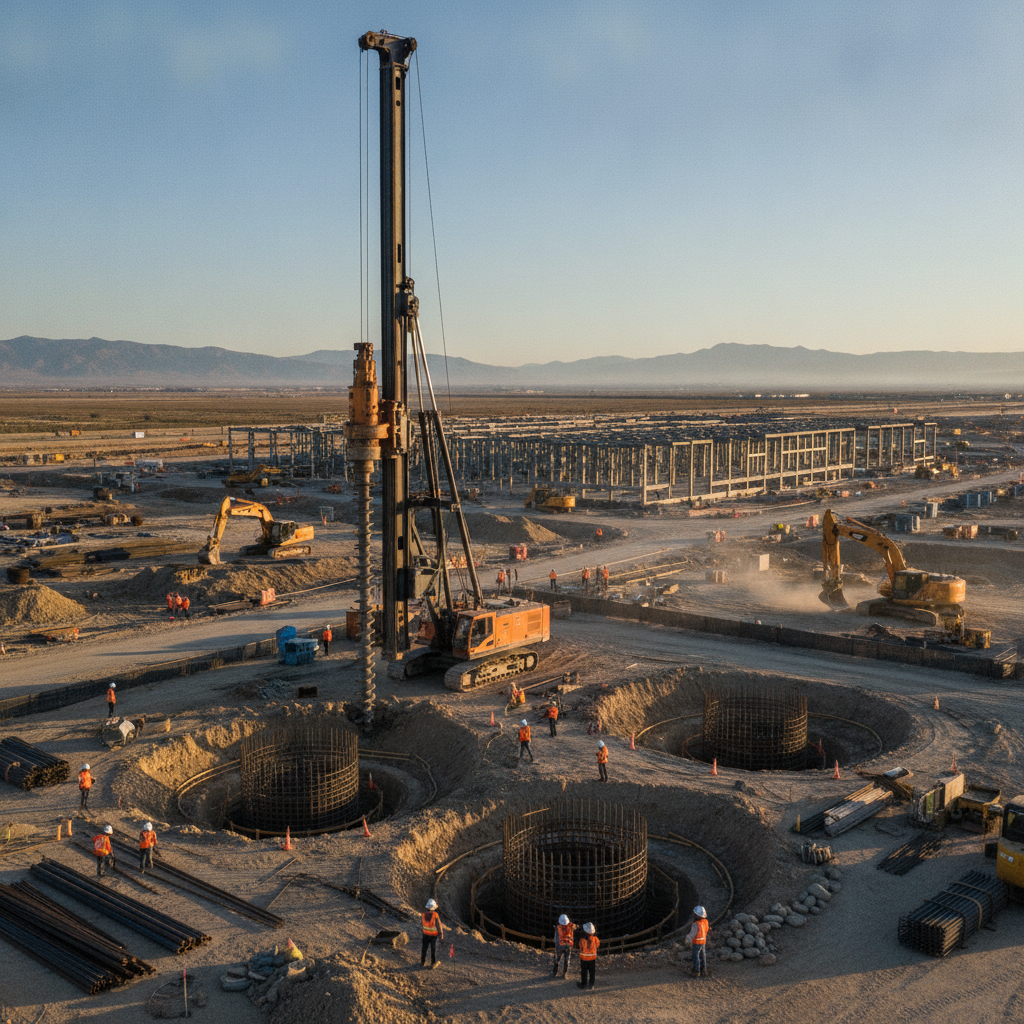
The decision to use a deep foundation system begins with a thorough understanding of the ground beneath the site. A comprehensive Geotechnical soil report, based on extensive Soil boring test data, is non-negotiable. This investigation identifies soil types, groundwater levels, and the depth to competent rock or dense soil layers. Deep foundations are typically required when the near-surface soils are incapable of supporting the proposed loads without excessive settlement. Common problematic conditions include weak or compressible soils like soft clays, loose sands, and organic silts. Sites with undocumented or variable fill material, which is common on previously developed or reclaimed land, also present significant risks for shallow foundations. The Geotechnical Engineering analysis will determine the bearing capacity and settlement potential of these upper layers. If the analysis shows that a shallow foundation system would lead to unacceptable total or differential settlement, a deep foundation system is the appropriate engineering solution to bypass these problematic zones.
Supporting High Concentrated and Distributed Loads
Comparison of Deep Foundation Systems
| Foundation Type | Primary Application | Key Design & Construction Considerations |
|---|---|---|
| Driven Piles (Steel, Concrete, Timber) | Transferring loads through weak soil to a dense layer. Good for resisting uplift and lateral loads. | Generates noise and vibration, which can be an issue on constrained sites. Requires overhead clearance for hammer. Pile driving logs provide quality control. |
| Drilled Shafts (Caissons) | Supporting very high, concentrated loads. Ideal for sites where vibration is a concern. Can be socketed into rock. | Slower installation than driven piles. Requires management of excavated spoils and potentially groundwater or casing. Allows for direct inspection of the bearing surface. |
| Augered Cast-In-Place (ACIP) Piles | Cost-effective for a wide range of soil conditions. Low vibration installation. | Installation quality is highly dependent on the operator. Concrete integrity can be difficult to verify without specialized testing. Not ideal for sites with many obstructions. |
| Helical Piles | Used for lighter loads, underpinning existing structures, or resisting uplift. Good for limited-access sites. | Capacity is highly dependent on soil type. Installation is fast with minimal site disturbance. Can be loaded immediately after installation. |
| Micropiles | Used in difficult ground conditions, near existing structures, or for seismic retrofits. High capacity for their small size. | Higher cost per unit of capacity compared to other systems. Installation is specialized and can be slower. Excellent for sites with very tight access or low overhead. |
Data centers impose unique and substantial loads on their foundations. Beyond the structure itself, these facilities support immense, concentrated loads from electrical switchgear, uninterruptible power supply (UPS) systems, backup generators, and large-scale cooling equipment like chillers and cooling towers. These point loads can create localized stress that exceeds the capacity of near-surface soils. A deep foundation system, such as a group of driven piles or drilled shafts, can be strategically positioned under these high-load points. These elements act like columns extending deep into the earth, transferring the load directly to a strong bearing layer. This approach provides a robust and reliable support system, preventing the localized settlement that could damage equipment or compromise structural integrity. The civil engineering design must integrate the foundation plan with the overall site plan design, ensuring that foundation elements do not conflict with underground utilities or stormwater management infrastructure.
Mitigating Settlement Risks for Sensitive Equipment
For a data center, even minor differential settlement—where one part of the building settles more than another—can be catastrophic. It can misalign server racks, stress high-speed fiber optic cables, crack coolant pipes, and compromise the precise environmental controls necessary for operation. The primary goal of a data center foundation is to create a rigid, stable plane that moves uniformly, if at all. Deep foundations are exceptionally effective at achieving this by anchoring the structure to deep, unyielding strata. The design must adhere to strict settlement criteria established by the project’s structural engineer and equipment manufacturers. Foundation design standards and settlement criteria often vary by jurisdiction, and the project team must confirm all applicable requirements with the local building department and the structural engineer of record, referencing the project’s adopted building codes. By transferring loads to a competent stratum, a deep foundation system minimizes both total and differential settlement, protecting the owner’s multi-million-dollar investment in technology and infrastructure.
Resisting Uplift and Lateral Forces
A data center’s foundation must do more than just resist gravity. In many parts of the country, structures must be designed to withstand significant lateral forces from seismic events or high winds, as well as potential uplift forces on certain structural elements. Deep foundations provide excellent resistance to these dynamic loads. Piles and shafts can be designed to handle significant lateral shear and bending moments, acting as anchors to keep the structure stable during an earthquake or severe storm. In situations with high groundwater tables or where structures extend below grade, hydrostatic pressure can create buoyant or uplift forces. Deep foundations designed for tension can effectively counteract this, holding the structure down. This requires careful coordination between the Geotechnical engineer, who determines the soil’s capacity to resist pullout, and the structural engineer, who designs the connection between the foundation element and the building superstructure. This integrated approach is a hallmark of successful mission-critical facility design.
Capacity Verification and Quality Control
Installing a deep foundation is not enough; its capacity must be verified. A rigorous quality control and testing program is essential to ensure the foundation will perform as designed for the life of the data center. This program is developed by the Geotechnical engineer and implemented during the construction administration phase. It provides the project owner with confidence that the foundation system meets all specifications. Common verification methods include: Static Load Tests: A test pile or shaft is physically loaded using hydraulic jacks reacting against a frame or anchor piles. This is the most direct and reliable method but is also the most time-consuming and expensive. High-Strain Dynamic Testing (PDA): Sensors are attached to the pile head during installation, and data from the hammer impact is used to estimate the pile’s capacity. This is a fast and cost-effective method for testing a large number of production piles. Integrity Testing: Low-strain methods like Pile Integrity Testing (PIT) or Cross-Hole Sonic Logging (CSL) for drilled shafts are used to check for defects, voids, or discontinuities within the concrete of the foundation element itself.
The RSP Engineers Approach to Foundation Design and Coordination
At RSP Engineers, we understand that a successful foundation design is the result of an integrated, multi-disciplinary process. Our approach to deep foundation projects for data center campuses ensures that this critical path activity is managed proactively from day one. We act as the central hub for coordination among the owner, architect, and various engineering disciplines. Our process involves seamless collaboration with the project’s Geotechnical engineer to interpret subsurface data and select the optimal foundation system. We then work closely with the structural engineer to integrate the foundation layout with the building’s column loads and shear walls. Our civil engineering team ensures the foundation plan is fully coordinated with site grading, drainage design, underground utilities, and pavement sections, preventing costly conflicts during construction. This holistic view is a key part of our site engineering services.
Common Challenges in Deep Foundation Projects
Even with meticulous planning, deep foundation installation can present challenges. Proactive identification and mitigation planning are crucial. One common issue is encountering unforeseen subsurface obstructions, such as old foundations, buried debris, or natural boulders, which can damage equipment or cause pile refusal. A thorough historical site review and supplemental Soil boring test locations can help mitigate this risk. On sites adjacent to existing structures, noise and vibration from pile driving can be a significant concern, potentially requiring a switch to a low-vibration system like drilled shafts or helical piles. Large installation equipment, such as cranes and drill rigs, requires stable access roads and working pads, which must be incorporated into the civil engineering site plan. Finally, managing groundwater during the excavation of drilled shafts is a frequent challenge that requires careful planning and potentially the use of temporary casing or slurry methods. Frequently Asked Questions (FAQ) How does a Geotechnical soil report influence the choice of deep foundation? The Geotechnical soil report is the single most important document for foundation design. It details the soil layers, their strength and compressibility, the depth to bedrock, and groundwater levels. This data allows the Geotechnical engineer to recommend viable foundation types, estimate required pile lengths or shaft diameters, and calculate the ultimate load-bearing capacity. What is the difference between end-bearing and friction piles? An end-bearing pile transfers most of its load through its tip to a strong underlying stratum, like dense sand or rock. A friction pile derives its support primarily from the skin friction that develops along its shaft as it is driven or installed into the surrounding soil. Many piles are designed as a combination of both, utilizing both end-bearing and skin friction to achieve the required capacity. Can deep foundations be used on a site with environmental contamination? Yes, but it requires careful planning. The installation process, particularly with drilled shafts, can create pathways for contaminants to migrate between soil layers or into groundwater aquifers. A detailed environmental site assessment must be performed, and the foundation installation plan must incorporate specific measures, such as containment and proper disposal of contaminated soils and water, to comply with environmental regulations. How are deep foundation costs estimated during the site development planning phase? Preliminary cost estimates are typically based on the conceptual foundation type and estimated quantities (e.g., number and length of piles) derived from the initial Geotechnical Engineering report. Costs are often calculated on a per-foot or per-pile basis. These estimates must also account for mobilization, equipment, materials, and the required load testing and quality control program. As the design progresses, these estimates are refined into a detailed construction cost. What role does the civil engineering team play during deep foundation installation? The civil engineering team plays a critical role in construction support. They are responsible for verifying that pile locations and elevations are staked out correctly according to the approved site plan design. They also manage site logistics, ensuring access for large equipment, coordinating with underground utility coordination, and overseeing the implementation of erosion control and stormwater management measures during the foundation work.
Partner with RSP Engineers for Your Mission-Critical Facility
Designing and executing a deep foundation system for a data center campus requires specialized expertise and flawless coordination. RSP Engineers provides the comprehensive civil engineering and site development leadership needed to navigate these complexities. We manage the critical interface between Geotechnical Engineering, structural design, and site construction. From initial due diligence and permitting to final inspection and verification, our team ensures your facility is built on a foundation of stability and precision. Contact us to discuss how our site engineering services can support your next mission-critical project.
Conclusion: Building Data Centers on a Solid Foundation
For data center developers, the foundation is not just a structural element; it is the bedrock of operational reliability. When faced with challenging subsurface conditions, a well-designed and properly installed deep foundation system is the only way to mitigate settlement risks and protect sensitive infrastructure. The process demands a deep understanding of Geotechnical Engineering principles, close collaboration between design disciplines, and rigorous construction administration. By partnering with experienced Civil Engineering firms, developers can ensure their facilities are built to last, providing the unwavering stability required for the digital age.
FAQs
-
Deep Foundations for Data Center Campuses requires careful planning, qualified engineering, and compliance with the applicable codes and permits.
-
Getting Deep Foundations for Data Center Campuses right protects safety, supports regulatory compliance, and avoids costly redesigns or delays.
-
RSP Engineers provides licensed expertise and end-to-end support for Deep Foundations for Data Center Campuses, from early planning through permitting.