
Shallow Foundations for Data Center Facilities
A technical guide to shallow foundation design for data centers. Learn about spread footings, bearing pressure, settlement control, and subgrade preparation for mission-critical facilities.
The Role of Geotechnical Investigation in Foundation Design
Every successful foundation design begins below the ground. A comprehensive geotechnical investigation is the first and most critical step in the site development process for a data center. This investigation, performed by a qualified Geotechnical engineer, provides the essential data that informs all subsequent structural and civil design decisions. The process typically involves performing a series of soil borings across the proposed building footprint to collect samples and understand the subsurface stratigraphy. The findings are compiled into a detailed Geotechnical soil report. This document is the foundational blueprint, outlining critical parameters such as soil type and classification, groundwater levels, and, most importantly, the recommended allowable soil bearing pressure. It also provides estimates for total and differential settlement under the anticipated building loads. The report identifies the competent bearing stratum on which the foundations must rest and provides recommendations for subgrade preparation, dewatering, and any necessary soil improvements.
Types of Shallow Foundations for Data Centers
Shallow Foundation Design Parameter Comparison
| Parameter | Spread Footing | Continuous Footing | Mat Foundation |
|---|---|---|---|
| Typical Application | Isolated columns, equipment pads | Load-bearing walls, perimeter walls | Entire building footprint |
| Primary Load Type | Concentrated point loads | Uniform line loads | Distributed area loads |
| Settlement Control | Good; sizes can be adjusted individually | Good for linear elements | Excellent for minimizing differential settlement |
| Cost-Effectiveness | High (for suitable soils) | High (for suitable soils) | Lower (more concrete and reinforcement) |
| Suitability for Poor Soils | Limited; requires competent bearing stratum | Limited; requires competent bearing stratum | More suitable; distributes load over a very large area |
| Construction Complexity | Low | Low to moderate | High |
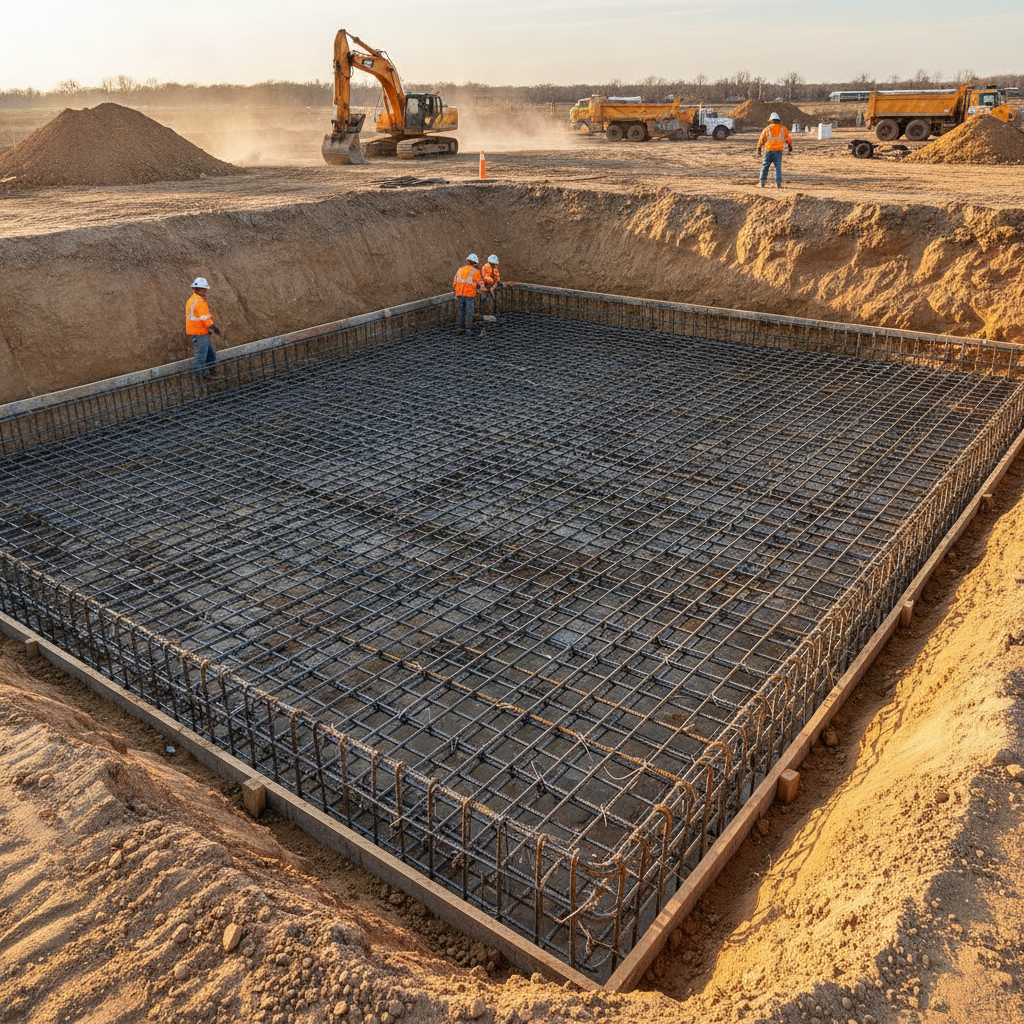
Based on the data from the Geotechnical soil report and the building’s structural loads, the engineering team selects the appropriate type of shallow foundation. For data centers, the most common types include isolated spread footings, continuous wall footings, and mat foundations. Each serves a specific purpose in distributing the massive loads from the structure to the underlying soil. Spread footings, or isolated footings, are used to support individual columns. They are typically square or rectangular concrete pads that spread the concentrated column load over a wider area to remain within the soil’s allowable bearing pressure. Continuous footings, also known as strip footings, are used to support load-bearing walls, such as the perimeter walls of the data hall. For sites with lower soil capacity or where minimizing differential settlement is paramount, a mat foundation—a single, thick concrete slab that supports the entire structure—may be employed. The choice is a strategic decision balancing performance, constructability, and cost.
Sizing Footings for Bearing Pressure and Settlement
The design of a shallow footing involves two primary checks: bearing capacity and settlement. The first principle is to ensure the pressure exerted by the footing does not exceed the soil’s allowable bearing pressure, which includes a factor of safety against shear failure. The footing’s area is calculated by dividing the total service load (including dead and live loads) by this allowable pressure. This calculation provides a preliminary size for the footing. However, for data centers, the design is almost always governed by settlement analysis. Even if a footing design is safe against bearing failure, it may still result in unacceptable settlement. The Geotechnical engineer provides methods to estimate the total settlement based on footing size, load, and soil properties. The structural engineer then adjusts footing sizes—often making them larger than required for bearing capacity alone—to ensure that both total and, more critically, differential settlement between adjacent columns remain within the facility’s strict operational tolerances.
Critical Design Considerations: Frost Depth and Eccentricity
Beyond basic sizing, several other factors influence foundation design. In regions subject to freezing temperatures, footings must be placed below the frost depth—the level to which the ground freezes in winter. This prevents frost heave, a phenomenon where freezing soil moisture can lift and damage the foundation. The required depth is a critical code requirement that protects the building’s structural integrity. Another key consideration is footing eccentricity, which occurs when a column load is not applied to the geometric center of its footing. This is common for columns located at a property line or adjacent to an existing structure. Eccentric loads create a turning moment that can cause uneven bearing pressure and tilting. To counteract this, engineers may design combined footings that support multiple columns or use grade beams to tie an eccentrically loaded footing to an interior footing, balancing the forces. Foundation design standards, including minimum frost depth requirements, vary by jurisdiction, and every project team must confirm the applicable standards with the local, state, regional, and federal authorities that hold review authority over the site. This is typically governed by the adopted building code.
Subgrade Preparation and Verification
Proper subgrade preparation is essential for the long-term performance of a shallow foundation. After excavating to the design footing elevation, the bearing surface must be carefully prepared and verified. This process often includes proof rolling, where a heavy piece of construction equipment, like a loaded dump truck, is driven over the subgrade. The operator and a Geotechnical engineer observe for any pumping, rutting, or deflection that would indicate soft or unstable soils. If unsuitable soils are discovered, they must be over-excavated and replaced with compacted engineered fill, such as crushed stone or structural fill material. The replacement material is placed in controlled lifts and compacted to a specified density, typically verified through field density testing. This step ensures that the soil directly beneath the footing provides a uniform and stable bearing surface, which is a critical part of the overall site plan design and construction sequence.
Inspection and Quality Control During Construction
Rigorous inspection and quality control are non-negotiable during foundation construction. Before any concrete is placed, the footing excavation must be inspected and approved. A representative from the Geotechnical engineering firm must visit the site to verify that the bearing soils are consistent with those described in the Geotechnical soil report. They will check that the bearing surface is clean, dry, and free of loose material. Concurrently, the structural engineer or a designated inspector will verify the placement and sizing of the steel reinforcement (rebar) according to the structural drawings. This is a critical hold point in the construction process. Only after the bearing surface and rebar have been approved can the contractor proceed with the concrete pour. This meticulous verification is a key component of successful construction administration and prevents costly errors that could compromise the facility.
How RSP Engineers Manages Foundation Design and Permitting
At RSP Engineers, we provide an integrated approach to data center site and foundation design. Our process begins with managing and closely coordinating with trusted Geotechnical engineering partners to ensure the investigation is tailored to the project’s specific needs. Our team of Civil Engineers then uses this data to inform the overall site plan design, seamlessly integrating foundation layouts with grading, drainage design, and utility infrastructure. We understand that a successful design is one that can be permitted and built efficiently. Our team handles the preparation and submission of all necessary documents for agency review, ensuring that the foundation design complies with all applicable building codes and local ordinances. We navigate the complexities of the permitting process to keep your project on schedule, from initial concept through construction.
Common Issues in Shallow Foundation Construction
Even with careful planning, challenges can arise during foundation construction. Encountering unexpected groundwater can complicate excavations and require dewatering systems. Discovering pockets of unsuitable soil not identified in the original soil boring test can lead to delays and change orders for over-excavation. Improper subgrade compaction is a significant risk that can lead to future settlement issues if not caught by quality control testing. Weather is another major factor; heavy rain can saturate bearing soils in open excavations, requiring them to be dried or replaced. A proactive project team anticipates these risks and has contingency plans in place. Close collaboration between the contractor, the design team, and the Geotechnical engineer is essential to quickly and effectively resolve any issues that emerge in the field.
Partner with RSP for Your Mission-Critical Facility
A data center’s success is built from the ground up. Ensuring a stable and reliable foundation requires a deep understanding of geotechnical principles, structural design, and construction realities. If you are planning a mission-critical facility, contact RSP Engineers today. Our team provides expert site engineering services, including geotechnical coordination, foundation design integration, and comprehensive permitting support to deliver a solid base for your investment.
Conclusion: A Foundation for Digital Infrastructure
Shallow foundations offer a robust and cost-effective solution for many data center projects, provided they are designed and constructed with the precision these facilities demand. The process is a collaborative effort, relying on a detailed geotechnical investigation to understand the site, careful engineering to control both bearing pressure and settlement, and diligent construction administration to ensure quality. By adhering to these principles, developers can build the stable foundations necessary to support our ever-growing digital world.
FAQs
-
Ultimate bearing capacity is the theoretical pressure at which the soil would fail in shear. Allowable bearing pressure is the ultimate capacity divided by a significant factor of safety (typically 2. 5 to 3. 0) to provide a conservative value for design, ensuring the foundation is safe from catastrophic failure.
-
Differential settlement, or uneven settlement between different parts of the building, can wreak havoc on a data center. It can misalign server racks, stress sensitive fiber optic and power connections, and impair the function of precision cooling systems. Maintaining a level floor slab is critical for operational integrity.
-
Yes, shallow foundations are frequently used in seismic zones. However, the design must incorporate seismic loads as specified by the governing building code. The Geotechnical soil report must also evaluate the site’s potential for soil liquefaction, a phenomenon where saturated soils lose strength during an earthquake, and provide mitigation measures if necessary.