
Mastering Florida Drainage Design: A Guide to Using SWMM for Stormwater Modeling
A technical guide by RSP Engineers on using EPA SWMM for Florida drainage design, stormwater management, and permitting. Learn key parameters, modeling techniques, and common issues.
Why SWMM is the Standard for Florida Stormwater Analysis
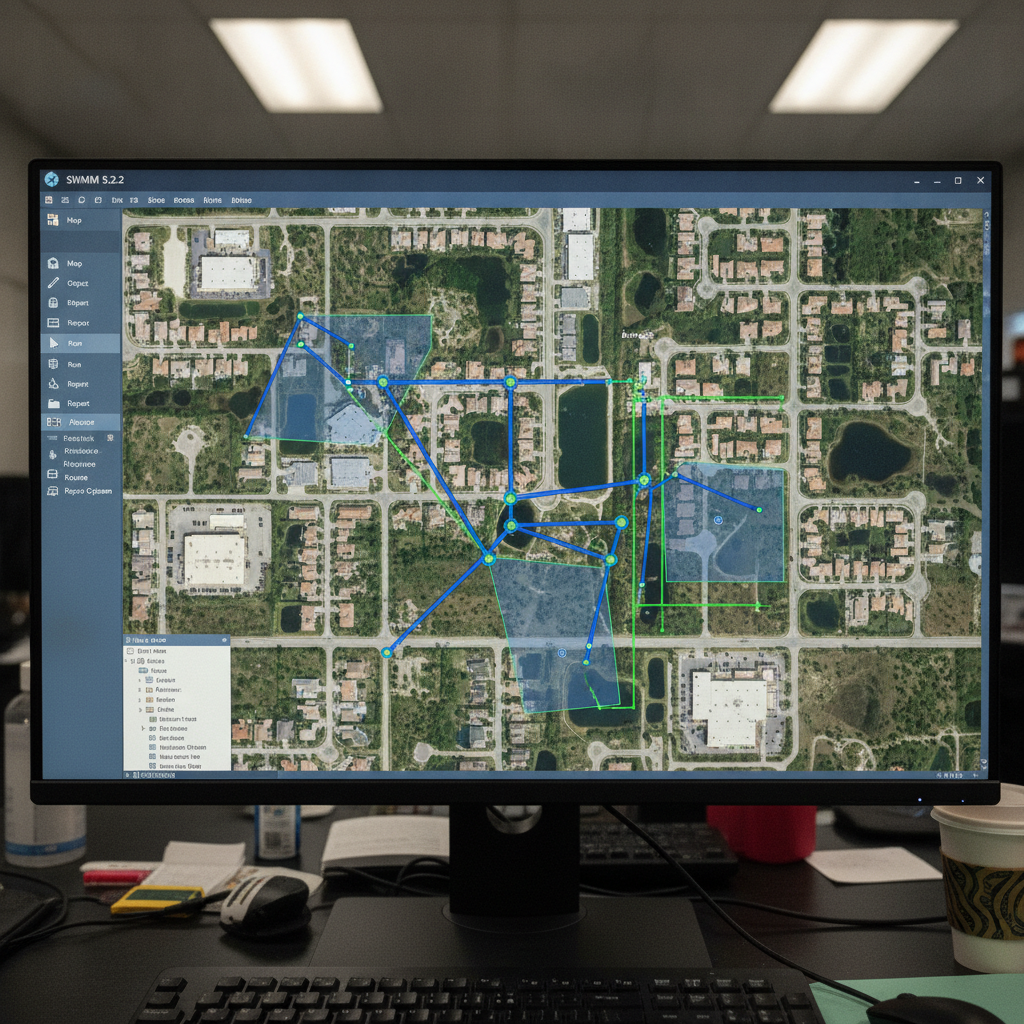
While various modeling software options exist, SWMM’s capabilities are uniquely suited to Florida’s challenges. Its primary advantage is the use of dynamic wave routing, which fully solves the Saint-Venant equations for fluid flow. This method accurately models backwater effects, pressurized flow, and flow reversal in conveyance systems—all common phenomena in Florida’s low-gradient, tidally influenced, and interconnected drainage networks. Simpler routing methods often fail to capture these complexities, leading to undersized infrastructure and potential flooding. Furthermore, SWMM is highly respected and universally accepted by Florida’s regulatory bodies. When a civil engineering firm submits a drainage report based on a well-constructed SWMM model, it provides reviewers at the FDEP and WMDs with a transparent and verifiable analysis. The software’s ability to model complex hydraulic structures, such as weirs, orifices, pumps, and multi-stage control structures, allows engineers to design sophisticated stormwater management systems that meet specific water quality and quantity control criteria. This widespread acceptance streamlines the agency review process, reducing the likelihood of extensive comments and costly project delays.
Key Input Parameters for an Accurate SWMM Model
SWMM Parameter Comparison for Florida Soil Types
| Parameter | Typical Value Range (Florida) | Modeling Consideration |
|---|---|---|
| Green-Ampt Suction Head | 2.0 - 4.0 inches | Represents the capillary forces in sandy soils. Higher values can reduce the initial infiltration rate. |
| Green-Ampt Conductivity | 0.5 - 2.0 in/hr | Crucial for modeling infiltration. Must be verified with data from a Geotechnical soil report, especially the seasonal high water table. |
| Manning's 'n' (Pervious) | 0.15 - 0.30 | For overland sheet flow. Higher end is for dense woods/pasture; lower end for maintained lawns (e.g., Bahia grass). |
| Manning's 'n' (Impervious) | 0.011 - 0.015 | Represents smooth surfaces like asphalt or concrete. A well-established value. |
| Depression Storage (Pervious) | 0.1 - 0.25 inches | Accounts for initial rainfall captured in surface irregularities before runoff begins. Higher for vegetated areas. |
| Depression Storage (Impervious) | 0.05 - 0.1 inches | Lower value for smooth, paved surfaces where less water can be stored in puddles. |
The principle of ‘garbage in, garbage out’ is especially true for hydraulic modeling. An accurate SWMM model depends entirely on the quality of its input data. The process begins with precise subcatchment delineation, where the project area is divided into smaller drainage basins based on topography. For each subcatchment, we must define key hydrologic parameters, including total area, slope, width, and percent imperviousness. This data is derived from detailed topographic surveys and site plan design documents. Equally critical is the rainfall data. Florida projects must use specific design storm events and rainfall distributions as mandated by the reviewing agency, typically sourced from NOAA Atlas 14. Soil characteristics, obtained from a Geotechnical soil report, determine the infiltration parameters (e.g., Horton or Green-Ampt methods) that govern how much rainfall soaks into the ground versus becoming runoff. Finally, the hydraulic network itself must be meticulously detailed, including pipe sizes, materials (which dictate Manning’s ‘n’ roughness coefficient), invert elevations, and the characteristics of storage nodes like ponds and vaults. Thorough utility coordination is essential to identify existing underground infrastructure that could conflict with or influence the proposed drainage design.
Modeling Low Impact Development (LID) Controls in SWMM
Modern stormwater management in Florida increasingly emphasizes Low Impact Development (LID) to mimic natural hydrology. SWMM includes robust modules specifically designed to model the performance of these controls. This allows engineers to simulate practices like bioretention cells (rain gardens), permeable pavement, infiltration trenches, and green roofs directly within the model. Each LID control can be represented as a layered system with unique properties for soil, storage, and underdrains. By incorporating LID controls, a drainage design can achieve significant runoff reduction and water quality benefits. The SWMM model quantifies this performance, generating data that is essential for demonstrating compliance with Environmental Resource Permit (ERP) criteria. For example, the model can show how a series of bioretention cells captures and treats the required water quality volume before it is discharged from the site. This modeling capability is crucial for justifying design decisions during the permitting process and ensuring the long-term sustainability of the site development.
Calibrating and Validating Your Model for Regulatory Approval
Developing a SWMM model is more than just data entry; it requires professional judgment to ensure the results are reasonable and reflect real-world conditions. Model calibration is the process of fine-tuning sensitive parameters, such as infiltration rates or roughness coefficients, to align the model’s output with observed data or established engineering principles. While observed flow data is not always available for a new design, calibration involves a thorough sensitivity analysis to understand which parameters have the most significant impact on the results. A well-calibrated and validated model provides a high degree of confidence in the design’s performance. During the agency review, regulators scrutinize model inputs and outputs to verify compliance. A model that appears uncalibrated or uses default, non-regional parameters is a major red flag that can trigger extensive requests for additional information (RAIs). Ensuring the model is robust and defensible is a critical step in securing timely permit submittals and avoiding costly redesigns during the land development process.
SWMM Application in Floodplain and Tailwater Analysis
In Florida, a project’s impact on its surroundings is a primary regulatory concern. SWMM is an essential tool for conducting floodplain analysis and demonstrating that a development will cause no adverse impact to off-site properties. The model can simulate how the proposed site development alters runoff patterns and can be used to analyze potential encroachments into the 100-year floodplain. This analysis is fundamental to obtaining permits from WMDs and local municipalities. A critical component of this analysis is defining the correct tailwater conditions at the project’s discharge point. Tailwater is the water level of the receiving body, which could be a canal, river, lake, or even a tidally influenced estuary. For coastal projects, the model must account for high tide elevations. For inland projects, it might be the peak water stage in a downstream canal during a major storm. Incorrectly assuming a low tailwater can lead to an undersized drainage design, causing the system to back up and flood the site. SWMM’s dynamic modeling accurately simulates how varying tailwater conditions affect the hydraulic grade line (HGL) throughout the system.
SWMM Model Comparison: Pre-Development vs. Post-Development
A core requirement of nearly all stormwater permitting in Florida is a direct comparison of pre-development and post-development site hydrology. To satisfy this, engineers must build two distinct SWMM models. The pre-development model characterizes the site in its existing condition, calculating the peak discharge rates and runoff volumes for various storm events. This model establishes the baseline against which the proposed design will be measured. The post-development model incorporates the proposed impervious surfaces (buildings, pavement) and the complete stormwater management system, including inlets, pipes, ponds, and any LID features. The objective is to demonstrate that the post-development peak discharge rate for a given storm event is less than or equal to the pre-development rate. This process, known as attenuation, is typically achieved with detention or retention ponds. The SWMM-generated hydrograph comparison provides clear, graphical evidence of compliance, forming the centerpiece of the drainage report submitted for agency review.
The RSP Engineers Approach to SWMM Modeling
At RSP Engineers, we follow a systematic and rigorous process to ensure our SWMM models are accurate, defensible, and aligned with project goals. Our approach includes four key phases: Data Collection & Review: We begin by gathering all necessary data, including topographic and boundary surveys, a Geotechnical soil report to understand soil properties and groundwater levels, utility as-builts, and the specific criteria of the reviewing agencies. This foundational step prevents errors later in the process. Model Scoping & Setup: We define the model boundaries, select the appropriate design storms (e.g., 25-year, 100-year events), and establish the performance targets for the drainage design. This includes confirming tailwater conditions and identifying all off-site constraints. Iterative Modeling & Design: We develop the pre-development and post-development models in parallel. As the site plan design evolves, we iteratively update the model to analyze the performance of the stormwater management system, optimizing pond sizes, pipe networks, and control structures to achieve compliance efficiently. Reporting & Submittal Support: We compile a comprehensive drainage report that clearly presents the model’s inputs, assumptions, and results. Our detailed narratives and exhibits are designed to facilitate a smooth agency review, and we stand by our models to address any regulatory comments during the permitting process.
Common Issues in Florida SWMM Modeling
Even experienced modelers can encounter pitfalls specific to Florida’s environment. Some of the most common issues we see include: Inaccurate Tailwater Assumptions: Failing to use the correct tidally influenced or flood-stage tailwater elevation is a frequent cause of agency comments and can lead to an undersized system that will not function as designed. Ignoring High Groundwater Tables: Using infiltration parameters that do not account for the seasonal high water table can grossly overestimate a pond’s recovery capability, a critical factor for WMD compliance. Oversimplifying Interconnected Systems: Many Florida drainage systems involve complex networks of interconnected ponds and wetlands. Modeling these with simple routing methods instead of SWMM’s dynamic wave routing can miss critical backwater effects. Improper Subcatchment Parameters: Using default values for subcatchment width or slope without calculating them based on actual topography can lead to incorrect calculations for the time of concentration, skewing the entire runoff hydrograph.
Partner with RSP Engineers for Your Next Project
Navigating Florida’s complex regulatory environment requires technical expertise and the right analytical tools. At RSP Engineers, our team leverages SWMM to deliver optimized, compliant, and resilient site designs. Whether you are in the early stages of due diligence or need a comprehensive set of construction documents, we provide the expert civil engineering services required for success. Contact us today to discuss your project’s stormwater management, drainage design, and permitting needs.
Conclusion
The EPA’s Storm Water Management Model is an indispensable tool for modern land development in Florida. Its ability to perform sophisticated dynamic analysis allows engineers to design effective systems that can handle our state’s unique environmental conditions. A properly constructed SWMM model is the foundation of a successful drainage design, providing the necessary proof of compliance to regulatory agencies and ensuring the long-term protection of the built environment. Ultimately, mastering SWMM is key to achieving a cost-effective and approvable stormwater management strategy.
FAQs
-
Both SWMM and ICPR are powerful dynamic models used in Florida. SWMM is a public-domain EPA model excellent for urban and suburban piped networks and integrated LID design. ICPR is a proprietary model often favored for its strong capabilities in modeling large, interconnected open-channel systems and floodplain analysis. The choice often depends on the specific project scale and the primary focus of the drainage design.
-
SWMM’s dynamic wave routing is ideal for flat terrain. It calculates the water surface elevation and flow at each point based on the full laws of physics, allowing it to accurately model the slow-moving, pressure-driven flow common in low-gradient pipe networks and channels. This is superior to kinematic wave routing, which is only suitable for steeper slopes.
-
Not necessarily. For very small or simple projects, regulatory agencies may accept calculations done with simpler methods like the Rational Method or Modified Rational Method. However, for most commercial, multifamily, or subdivision projects that require an Environmental Resource Permit (ERP), a dynamic model like SWMM is the standard of practice and often an explicit requirement for demonstrating compliance with stormwater management criteria.