
Liquefaction Studies for Data Center Sites
A deep dive into liquefaction studies for data center sites. Learn about triggering analysis, code requirements, mitigation strategies, and why geotechnical engineering is critical for mission-critica
Understanding Soil Liquefaction and Its Triggers
Soil liquefaction is a process where a saturated, or partially saturated, soil substantially loses strength and stiffness in response to an applied stress, usually earthquake shaking, causing it to behave like a liquid. For liquefaction to occur, three primary conditions must be met: susceptible soil, groundwater saturation, and a seismic trigger. The most vulnerable soils are loose, granular materials like sands, silty sands, and low-plasticity silts. When subjected to the rapid loading and unloading of seismic waves, the pore water pressure within these soils increases, reducing the effective stress that holds the soil particles together. Once the effective stress drops to near zero, the soil matrix can no longer support structural loads. The intensity and duration of the earthquake are critical factors. A stronger, longer-lasting earthquake imparts more energy into the ground, increasing the likelihood of triggering liquefaction. The presence of a shallow groundwater table is the final key ingredient, as it provides the water necessary to build up pore pressure. A thorough geotechnical investigation is the only way to definitively identify these conditions and quantify the site-specific risk. This involves not just identifying soil types but also measuring their in-situ density and the depth of the water table.
When is a Liquefaction Analysis Required by Code?
Comparison of Liquefaction Mitigation Strategies
| Mitigation Technique | Mechanism | Ideal Application | Key Considerations |
|---|---|---|---|
| Dynamic Compaction | Densifies loose granular soils by repeatedly dropping a heavy weight. | Large, open sites with deep liquefiable layers and no nearby sensitive structures. | Generates significant ground vibration; requires a clear site; not suitable for cohesive soils. |
| Vibro-Compaction / Stone Columns | Uses a vibratory probe to densify soil and/or install columns of gravel to improve density, stiffness, and drainage. | Treating sandy soils to depths of 50 feet or more; provides reinforcement and drainage. | Effectiveness depends on soil grain size; requires specialized equipment and contractors. |
| Deep Soil Mixing | Mechanically blends soil with cementitious binders to create stiff, high-strength soil-cement columns or panels. | Creates a non-liquefiable block of improved ground to support the structure. Effective in a wide range of soils. | Can be costly; requires careful quality control; creates spoil material that needs management. |
| Engineered Drainage | Installs prefabricated vertical drains (wick drains) or gravel drains to rapidly dissipate pore water pressure during shaking. | Used in conjunction with other methods or where densification is not feasible. Prevents the buildup of pressure. | Requires careful analysis of drain spacing and hydraulic conductivity; long-term performance must be considered. |
| Deep Foundations | Transfers structural loads through the liquefiable layers to a deeper, stable bearing stratum using piles or drilled shafts. | Used when ground improvement is not practical or economical. Bypasses the problematic soil. | Piles must be designed to resist downdrag forces from settling soil and lateral loads from spreading ground. |
The requirement for a liquefaction analysis is typically mandated by local and national building codes for new construction, particularly for essential facilities like data centers. These codes often reference seismic hazard maps that delineate areas with a higher probability of significant ground shaking. If a project site falls within one of these designated seismic hazard zones, a geotechnical engineering evaluation to assess liquefaction potential is generally required. The specific triggers and analytical requirements for a liquefaction study are determined by the authority having jurisdiction and the risk category of the proposed structure. Data centers, due to their critical importance, are almost always placed in a high-risk category, which imposes more stringent design and analysis standards. Permitting requirements vary by jurisdiction, and every project team should confirm the applicable standards with the local, state, regional, and federal authorities that hold review authority over the site. A qualified Geotechnical engineer will navigate these codes to determine if a liquefaction analysis is mandatory and what specific design earthquake parameters must be used. This early-stage zoning compliance and code review step is crucial for avoiding delays during the permitting process and ensuring the final design meets all life-safety and operational requirements.
The Geotechnical Investigation Process for Liquefaction Screening
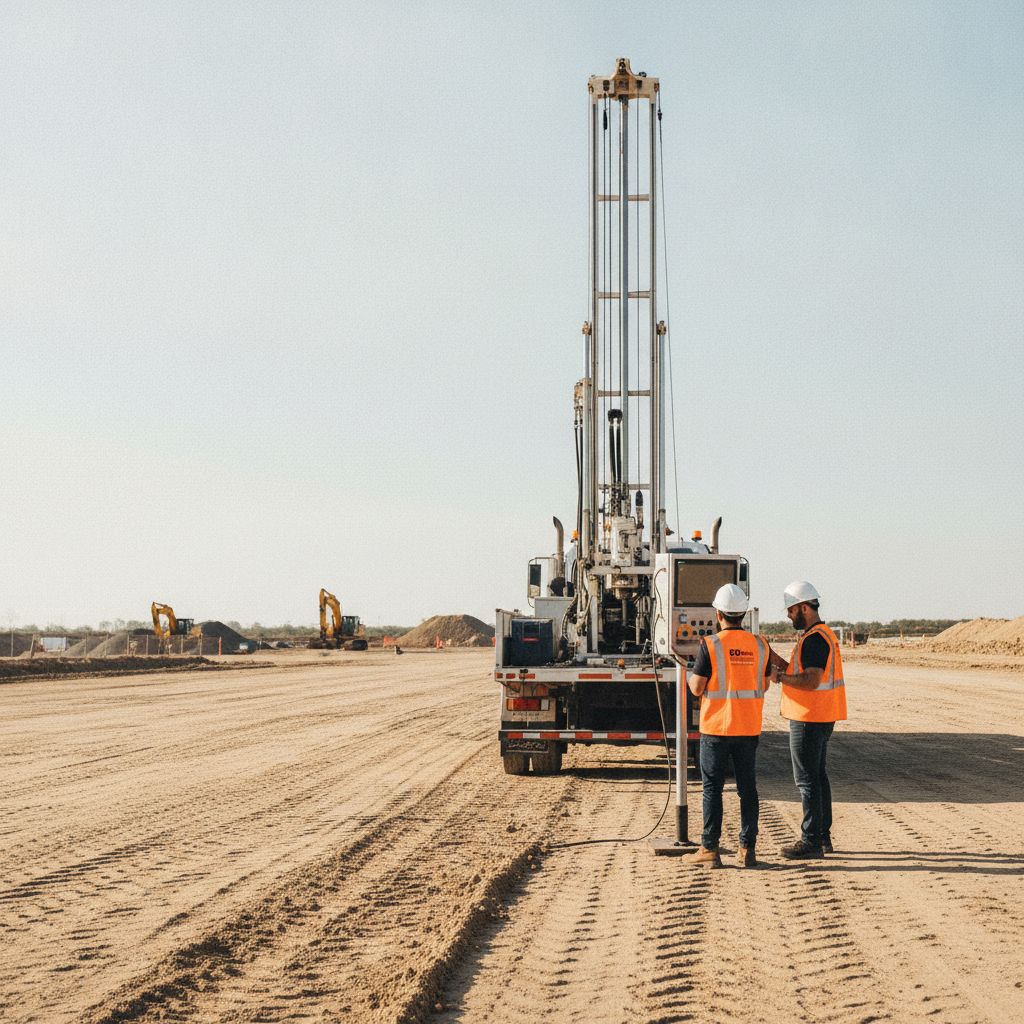
A liquefaction evaluation begins with a detailed geotechnical investigation tailored to seismic concerns. The process starts with a desktop review of published geologic and seismic hazard maps to understand the regional context. The core of the study, however, is the subsurface exploration program. This involves advancing a series of soil borings or soundings across the site to characterize the soil profile and collect data. The two most common in-situ testing methods for this purpose are the Standard Penetration Test (SPT) and the Cone Penetration Test (CPT). The SPT involves driving a standardized sampler into the ground to obtain a blow count (N-value), which correlates to soil density. The CPT pushes an instrumented cone into the ground, providing continuous data on tip resistance and sleeve friction, which are used to interpret soil behavior type and density. Both methods are invaluable for developing the soil stratigraphy, identifying potentially liquefiable layers, and measuring the depth to groundwater. This field data forms the empirical basis for the subsequent engineering analysis and is a critical part of any credible Geotechnical soil report.
Core Components of a Liquefaction Triggering Analysis
Once sufficient subsurface data is collected, the Geotechnical engineer performs a liquefaction triggering analysis. This is a quantitative assessment to determine if liquefaction will initiate during a design-level earthquake. The analysis compares the seismic demand on the soil to the soil’s capacity to resist liquefaction. The demand is expressed as the Cyclic Stress Ratio (CSR), which represents the level of shear stress induced by the earthquake. The capacity is expressed as the Cyclic Resistance Ratio (CRR), which represents the soil’s intrinsic ability to withstand that stress without liquefying. The CRR is empirically derived from the in-situ test data, primarily SPT N-values or CPT tip resistance. If the CSR exceeds the CRR for a given soil layer, liquefaction is predicted to be triggered. This analysis is performed at various depths throughout the soil profile to identify all potentially liquefiable zones. This step is fundamental to the site engineering services provided and directly informs the foundation design and any necessary ground improvement strategies.
Assessing the Consequences of Liquefaction
Triggering liquefaction is only part of the story. The next critical step is to evaluate the potential consequences, which can be devastating for a data center. A thorough analysis will assess several potential failure modes: Bearing Capacity Loss: When the soil beneath a foundation liquefies, it loses its ability to support loads, which can lead to catastrophic punching shear failure or excessive settlement of shallow foundations. Post-Liquefaction Settlement: As the excess pore water pressure dissipates after an earthquake, the liquefied soil will reconsolidate and settle. This can cause significant total and differential settlement, damaging the structure, cracking slabs, and misaligning sensitive equipment. Lateral Spreading: If the site has even a gentle slope or is near an open face like a channel or retaining wall, the liquefied soil can flow laterally. This lateral movement can exert immense pressure on foundations, shear utility conduits, and cause large-scale ground cracking. Sand Boils and Ground Oscillation: The upward flow of water can create sand boils at the ground surface. The liquefied layer can also decouple the overlying crust, leading to ground oscillation that can further damage structures and buried infrastructure. A comprehensive civil engineering design must account for these potential outcomes.
Our Approach to Liquefaction Evaluation at RSP Engineers
At RSP Engineers, our approach to liquefaction evaluation is rooted in a comprehensive, risk-based methodology. We begin every project with a thorough site screening and a detailed review of the project’s performance objectives. Our team of Civil engineers and geotechnical specialists designs and executes a targeted subsurface investigation using state-of-the-practice equipment, including CPT and SPT, to gather the high-quality data needed for a robust analysis. We believe in a collaborative process, working closely with structural engineers and the development team to translate our findings into practical, cost-effective solutions. Our site engineering services extend beyond the initial report. We provide clear recommendations for ground improvement or deep foundation systems, assist with developing specifications, and offer support through the permitting and construction phases. Our goal is to de-risk the project by identifying and mitigating geotechnical hazards, ensuring the final design provides the resilience and stability that mission-critical facilities demand. We manage the entire process from initial Soil Test to final construction administration.
Common Challenges in Liquefaction Studies
Even with a well-defined process, liquefaction studies can present several challenges. Large data center campuses can have highly variable subsurface conditions, requiring a more extensive and costly investigation to properly characterize the site. Accurately defining the design-level earthquake and associated ground motions requires specialized expertise in seismic hazard analysis. Another significant challenge is integrating the cost of mitigation into the project’s pro forma. Ground improvement can be a substantial investment, and our role is to provide options and clear cost-benefit analyses to help clients make informed financial decisions without compromising safety or performance. Furthermore, deep ground improvement techniques can conflict with underground utilities. This makes early and thorough utility coordination essential to the success of the site plan design. Identifying and relocating critical conduits before mitigation work begins is crucial to avoid costly delays and redesigns during construction.
Partner with RSP Engineers for Mission-Critical Geotechnical Solutions
Protecting your data center investment from seismic hazards starts from the ground down. A rigorous liquefaction study is a non-negotiable component of responsible site development in seismically active areas. The team at RSP Engineers provides the expert geotechnical engineering and civil engineering services needed to identify, analyze, and mitigate these complex risks. We partner with you through every phase, from initial site selection and due diligence to detailed site plan design and construction support. Contact us today to ensure your facility is built on a foundation of stability and resilience.
Conclusion
For data center developers and operators, the threat of soil liquefaction is a critical business risk that must be proactively managed. An earthquake can strike without warning, and the resulting ground failure can lead to irreversible damage and catastrophic operational failure. A comprehensive liquefaction study, conducted by a qualified Professional Engineer, provides the essential data and analysis needed to design resilient foundations and ground improvement solutions. Investing in thorough geotechnical engineering at the beginning of a project is the most effective way to ensure the long-term security, stability, and uptime of your mission-critical infrastructure.
FAQs
-
A liquefaction study is typically triggered by a combination of factors: the project’s location within a mapped seismic hazard zone, the presence of susceptible soil types (like loose sands and silts) and shallow groundwater, and the structure’s high-risk or essential facility classification as defined by the governing building code.
-
While less common, moderate earthquakes in regions with highly susceptible soils can still trigger liquefaction. Some areas of the central and eastern U. S. have seismic zones that, while less active than the west coast, still pose a credible threat that must be evaluated for critical facilities. The geotechnical investigation will assess this site-specific risk.
-
The study itself adds a few weeks to the due diligence or design phase. The major impact comes if mitigation is required. Ground improvement or deep foundations can add significant cost and time to the site development schedule. Identifying this risk early allows for accurate budgeting and scheduling from the outset.