
Expansive Soil Mitigation for Data Center Facilities
Learn how to identify and mitigate expansive soils for data center construction. Our guide covers geotechnical investigation, foundation design, and moisture control strategies to protect mission-crit
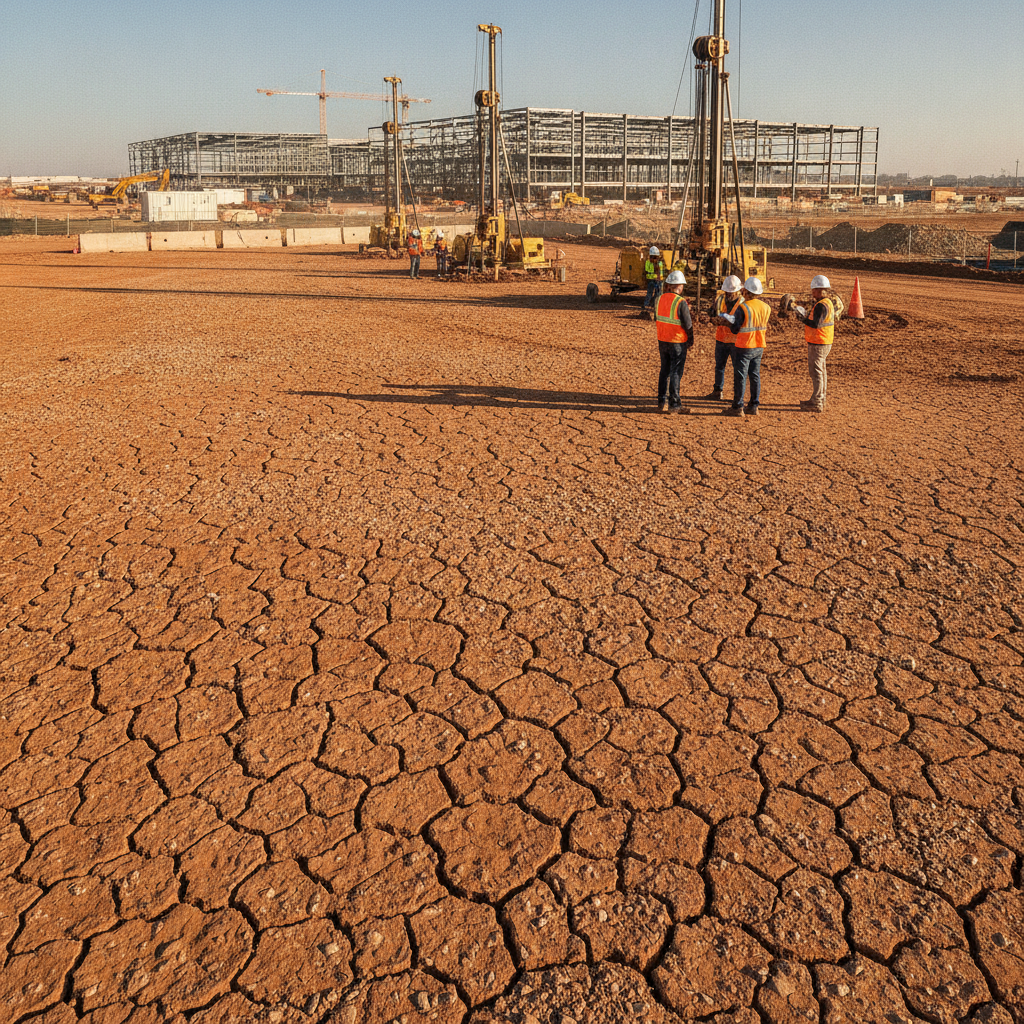
Identifying Expansive Soils Through Geotechnical Investigation
The first and most critical step in addressing expansive soils is a comprehensive geotechnical investigation. This process goes far beyond a simple site walk. It involves a detailed subsurface exploration program, typically including soil borings, to collect samples from various depths across the proposed development footprint. These samples are then subjected to a suite of laboratory tests to determine their physical and chemical properties. Key indicators of expansive potential include the soil’s mineralogy, plasticity, and density. Laboratory testing focuses on metrics like the Atterberg limits (liquid limit, plastic limit) to calculate the Plasticity Index (PI), a primary indicator of a soil’s tendency to change volume with moisture fluctuations. Direct swell tests, such as the unconfined expansion test or swell pressure test, quantify the potential for heave under specific conditions. The findings are compiled into a detailed Geotechnical soil report, which serves as the foundational document for all subsequent civil engineering and structural design decisions.
The Mechanics of Shrink-Swell Behavior and Its Impact on Structures
Comparison of Expansive Soil Mitigation Techniques
| Mitigation Technique | Primary Mechanism | Ideal Application | Key Considerations |
|---|---|---|---|
| Moisture Conditioning | Pre-swelling soil to a stable moisture content | Low to moderate swell potential; uniform soil profiles | Requires precise moisture control during construction; long-term site drainage is critical |
| Chemical Stabilization (Lime/Cement) | Alters soil chemistry to reduce plasticity | Moderate to high swell potential; clay-rich soils | Requires thorough mixing; curing time needed; potential environmental permitting for additives |
| Removal and Replacement | Replaces expansive soil with stable engineered fill | Shallow depths of expansive soil (typically < 10 feet) | Cost of excavation and imported fill; availability of suitable replacement material |
| Deep Foundations (Piers/Piles) | Transfers building loads below the active expansive zone | High swell potential; deep expansive layers; heavy structures | Higher upfront cost; requires specialized equipment and contractors |
| Structurally Supported Slab | Isolates the floor slab from soil movement | High to very high swell potential; sites where soil treatment is impractical | Creates a crawl space that requires ventilation and access; higher construction cost than slab-on-grade |
Expansive soils, rich in certain clay minerals like montmorillonite, act like a sponge. They absorb water during wet periods, causing them to swell and increase in volume. During dry periods, they lose moisture and shrink, often creating deep cracks in the ground. This cyclical shrink-swell behavior can exert uplift pressures exceeding thousands of pounds per square foot, easily lifting shallow foundations, cracking concrete slabs, and distorting building frames. The resulting differential settlement or heave can misalign sensitive equipment, damage underground utilities, and compromise the structural integrity of the entire facility. The severity of this behavior is influenced by regional climate patterns, local drainage, and site-specific factors. For instance, a broken irrigation line or poor surface grading can introduce significant moisture, triggering localized soil heave. Because site grading and stormwater management standards vary by jurisdiction, it is imperative that the project team confirms all applicable design criteria with the local, state, regional, and federal authorities. A robust drainage design is a key component of any mitigation strategy, aiming to maintain a stable moisture environment around the structure for the long term.
Pre-Construction Mitigation: Soil Treatment and Modification
Once expansive soils are identified, several pre-construction techniques can be employed to mitigate their effects before foundation work begins. The goal of these methods is to alter the soil’s properties to reduce or eliminate its swell potential. One common approach is moisture conditioning, where the soil in the building pad area is excavated, mixed with water to achieve an optimal moisture content, and recompacted to a specified density. This pre-swells the soil, minimizing its potential for future movement. Another effective method is chemical stabilization. This involves mixing additives like lime, cement, or proprietary chemical agents into the soil. These additives trigger chemical reactions that bind the clay particles together, permanently reducing the soil’s Plasticity Index and its ability to absorb water. A third strategy is removal and replacement, which is often the most straightforward solution for shallow layers of expansive material. This involves excavating the problematic soil to a predetermined depth and replacing it with a non-expansive, engineered fill material that is properly compacted to provide a stable base for the foundation.
Structural and Foundation Design Solutions
In addition to treating the soil itself, the facility’s foundation and structure can be designed to resist or isolate it from soil movement. For sites with highly expansive soils or where deep layers of problematic material exist, a deep foundation system is often the most reliable solution. This involves using drilled piers, caissons, or piles to bypass the active expansive zone and transfer the building’s loads to a stable, non-expansive stratum deep underground. This approach ensures the structure is supported on a stable base, regardless of moisture changes in the upper soil layers. Another structural approach is the use of a structurally supported slab, which creates a void or crawl space between the ground and the building’s floor. This completely isolates the slab from any potential soil heave. For less severe conditions, a post-tensioned slab-on-grade can be designed. These slabs are reinforced with high-strength steel cables that are tensioned after the concrete cures, creating a rigid foundation that can better resist and distribute the forces from differential soil movement without cracking.
How RSP Engineers Approaches Geotechnical Challenges
At RSP Engineers, our approach to mitigating expansive soils is systematic and proactive. It begins with a rigorous geotechnical investigation tailored to the unique demands of mission-critical facilities. We collaborate closely with the client, architect, and structural engineer from the earliest stages of site development to integrate the geotechnical findings into the overall site plan design. Our team of experienced engineers analyzes the data to develop a site-specific mitigation strategy that balances performance, cost, and constructability. We provide detailed recommendations for soil treatment, foundation design, and long-term moisture management. Our services extend through the construction phase, where we offer Construction Management Services and materials testing to verify that the mitigation plan is implemented exactly as designed. This hands-on oversight ensures that earthwork, foundation installation, and utility coordination are executed to the highest standards, protecting the long-term value and operational integrity of the asset.
Common Issues and Oversights in Expansive Soil Projects
Even with a solid plan, several issues can compromise the effectiveness of an expansive soil mitigation strategy. One of the most common is an insufficient geotechnical investigation, which can lead to an underestimation of the problem’s severity. Another frequent oversight is poor long-term moisture control. A perfectly designed foundation can still fail if surface drainage is not properly managed or if landscape irrigation introduces excessive water near the building perimeter. During construction, inadequate implementation of the recommended soil treatment—such as improper mixing of chemical stabilizers or insufficient compaction of replacement fill—can negate the design’s benefits. Finally, a lack of coordination between the geotechnical engineer, structural engineer, and civil engineer can lead to conflicting details in the construction documents, particularly around foundation interfaces, utility penetrations, and exterior hardscaping. A holistic, integrated design process is essential to avoid these pitfalls. Frequently Asked Questions What is the ‘active zone’ in expansive soils? The active zone is the depth of soil from the surface down to a point where the moisture content remains relatively constant throughout the year. It is within this zone that the damaging shrink-swell cycle occurs. The depth of the active zone varies based on climate and local hydrology and is a critical parameter determined during the geotechnical investigation to inform foundation design. Can expansive soils damage underground utilities? Absolutely. The vertical movement of expansive soils can shear, bend, or break rigid utility lines like water, sewer, and gas pipes. This is why flexible connections and proper bedding/backfill materials are crucial for utility lines passing through expansive soil zones. Careful utility coordination and design are required to accommodate potential ground movement. How does climate affect the risk of expansive soils? Climate is a primary driver of risk. Regions with distinct wet and dry seasons, or areas prone to prolonged droughts followed by heavy rains, experience the most significant shrink-swell cycles. A stable, arid climate or a consistently wet climate may present less risk of cyclical movement, but any change to the site’s moisture regime (e.g., from new irrigation) can activate dormant expansive soils. Is soil mitigation a one-time cost or is there ongoing maintenance? Most mitigation strategies, such as soil treatment and foundation design, are permanent, one-time capital costs. However, the success of these strategies depends on long-term site maintenance. This includes ensuring positive surface drainage away from the building, maintaining gutters and downspouts, and promptly repairing any leaks in irrigation or utility lines. These maintenance tasks are critical for preserving stable moisture conditions. What is a Plasticity Index (PI) and why is it important? The Plasticity Index (PI) is a key measure of a soil’s potential to expand. It is calculated as the difference between the soil’s Liquid Limit and its Plastic Limit. A higher PI generally indicates a greater presence of expansive clay minerals and, therefore, a higher swell potential. It is one of the primary metrics used in a Geotechnical soil report to classify a site’s risk level and guide mitigation design.
Protect Your Investment with Expert Geotechnical Engineering
Navigating the complexities of expansive soils requires specialized expertise and a proactive approach. The stability of your mission-critical facility depends on a design that addresses subsurface risks from day one. Contact RSP Engineers to leverage our nationwide experience in geotechnical engineering, site development, and civil engineering. We provide the integrated solutions needed to ensure your project is built on a solid foundation, protecting your investment for decades to come.
Conclusion
Expansive soils pose a formidable challenge to data center development, but one that can be successfully managed with proper engineering. The key lies in a thorough geotechnical investigation, the selection of an appropriate mitigation strategy, and a design that integrates structural solutions with robust, long-term stormwater management. By addressing these risks proactively, developers can ensure the structural integrity, operational reliability, and long-term performance of their mission-critical facilities. An investment in expert civil engineering at the outset is the best defense against the costly consequences of soil-structure interaction.
FAQs
-
Expansive Soil Mitigation for Data Center Facilities requires careful planning, qualified engineering, and compliance with the applicable codes and permits.
-
Getting Expansive Soil Mitigation for Data Center Facilities right protects safety, supports regulatory compliance, and avoids costly redesigns or delays.
-
RSP Engineers provides licensed expertise and end-to-end support for Expansive Soil Mitigation for Data Center Facilities, from early planning through permitting.