
How to Estimate Site Work Costs
Learn how to accurately estimate site work costs for Florida land development projects, covering key components like earthwork, drainage, utilities, and more.
Understanding Site Work Components
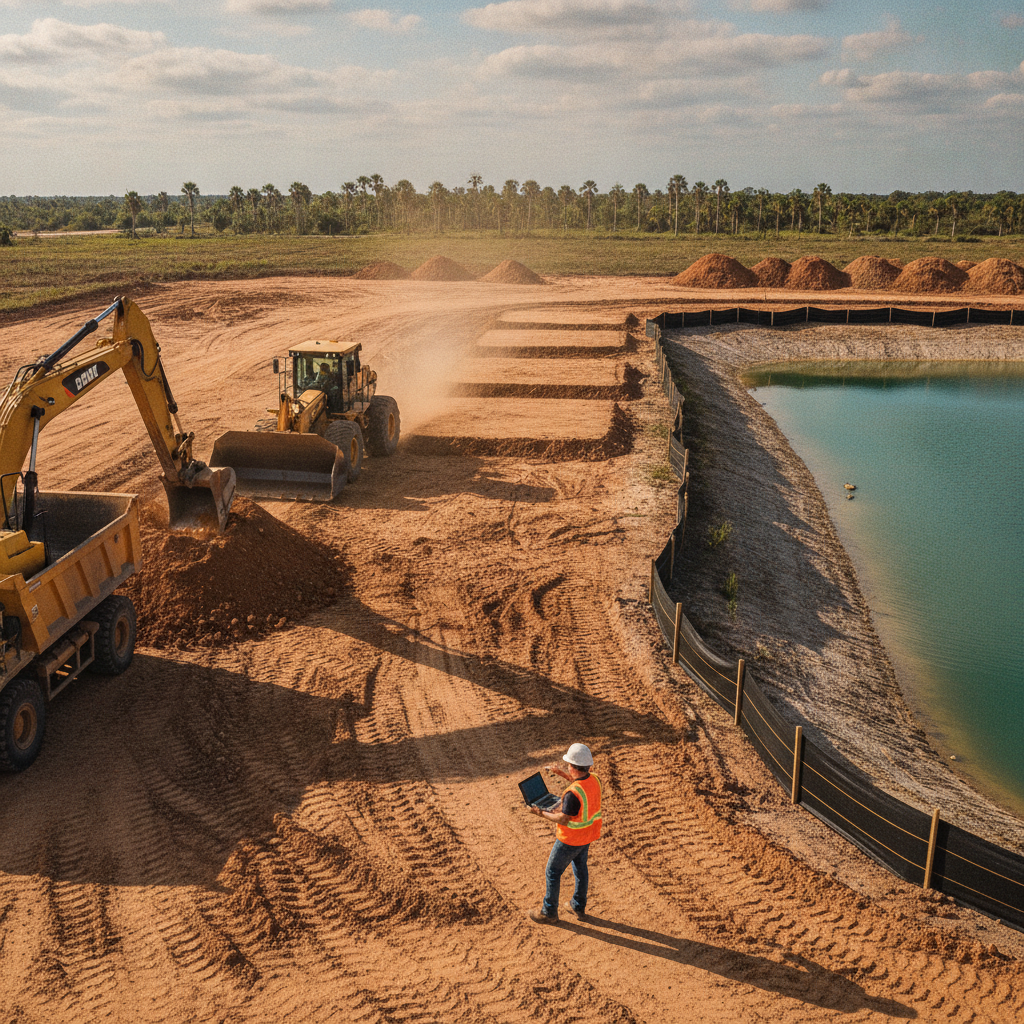
Site work encompasses a wide range of activities necessary to prepare a site for construction. These activities include: Clearing and grubbing: Removing vegetation and debris from the site. Earthwork: Cutting, filling, and grading the land to achieve the desired topography. Erosion and sediment control: Implementing measures to prevent soil erosion during construction. Stormwater and drainage systems: Designing and installing systems to manage water runoff. Water, sewer, and reclaimed utilities: Installing necessary utility lines. Paving, curb, and sidewalk: Constructing roads, curbs, and pedestrian pathways. Landscaping and sod: Planting vegetation and laying sod for aesthetic and environmental benefits.
Estimating Methods for Site Work Costs
Site Work Component Cost Drivers Table
| Site Work Component | Typical Unit Basis | Key Cost Driver |
|---|---|---|
| Clearing and Grubbing | Acre | Vegetation Density |
| Earthwork | Cubic Yard | Soil Type and Volume |
| Stormwater Systems | Linear Foot | Pipe Material and Depth |
| Utilities Installation | Linear Foot | Depth and Length |
| Paving | Square Yard | Material Type |
| Landscaping | Square Foot | Plant Selection |
Several methods are used to estimate site work costs, each with its own advantages and considerations: Quantity takeoffs from civil plans: Calculating the quantities of materials and labor required based on detailed plans. Unit-cost pricing: Applying standard costs per unit of work, such as per cubic yard of earth moved. Earthwork balance and cut/fill analysis: Using 3D models to determine the balance of cut and fill required. Lump-sum vs. unit-price approaches: Choosing between a fixed total cost or pricing based on actual quantities used.
Major Cost Drivers in Florida Site Work
Florida’s unique environmental and regulatory conditions significantly impact site work costs. Key cost drivers include: Site size and topography: Larger sites or those with challenging topography may require more extensive work. Soils and geotechnical conditions: The presence of muck or organic material can necessitate removal and replacement. Seasonal high water table and dewatering: Managing groundwater levels can add complexity and cost. Import/export and haul of fill: The need to bring in or remove soil affects transportation costs. Rock excavation: Hard rock layers require specialized equipment and techniques. Clearing density: Dense vegetation increases clearing costs. Utility depth and length: Deeper or longer utility installations are more expensive. Offsite improvements: Required improvements to surrounding infrastructure can add to costs. Permitting and impact fees: Regulatory fees vary by jurisdiction and can be significant. Mobilization and contingency: Preparing the site and accounting for unforeseen issues.
Tools and Accuracy Levels for Estimating
Accurate cost estimation requires the use of specialized tools and software. Civil 3D and other takeoff software are essential for creating detailed models and performing precise calculations. Estimations can range from conceptual budgets to bid-ready figures, with varying levels of accuracy depending on the project’s stage and available data.
RSP Engineers’ Approach to Site Work Estimation
At RSP Engineers, we employ a systematic approach to site work estimation, leveraging our expertise in civil engineering and land development. Our process includes: Conducting thorough site assessments to understand existing conditions. Utilizing advanced modeling tools to perform accurate quantity takeoffs. Applying local knowledge of Florida’s regulatory environment to anticipate permitting and impact fees. Collaborating with clients to tailor estimates to specific project needs and constraints.
Common Issues in Site Work Estimation
Despite best efforts, several common issues can arise during site work estimation: Unforeseen site conditions: Unexpected soil or groundwater conditions can lead to cost increases. Regulatory changes: New regulations or changes in permitting requirements can affect project timelines and budgets. Market fluctuations: Variations in material and labor costs can impact estimates. Incomplete data: Inaccurate or incomplete site data can lead to estimation errors.
Contact RSP Engineers
For expert guidance on estimating site work costs for your Florida land development project, contact RSP Engineers. Our team of Florida Licensed Engineers specializes in site development, permitting, and utility coordination, ensuring your project is both cost-effective and compliant with local regulations.
Conclusion
Accurately estimating site work costs is essential for the success of any land development project in Florida. By understanding the components involved, utilizing effective estimation methods, and considering Florida-specific cost drivers, developers and engineers can create realistic budgets and avoid unexpected expenses. RSP Engineers is here to support your project with expert civil engineering services and tailored solutions.
FAQs
-
Site work costs typically include clearing and grubbing, earthwork, stormwater management, utility installation, paving, and landscaping.
-
Earthwork costs are determined by calculating the volume of soil to be moved and applying unit-cost pricing based on soil type and project specifics.
-
Utility installation costs are influenced by the depth and length of the utilities, as well as the materials used and site conditions.