
Clearing and Grading 101
Learn the essentials of clearing and grading for Florida land development, including permitting, erosion control, and site preparation techniques.
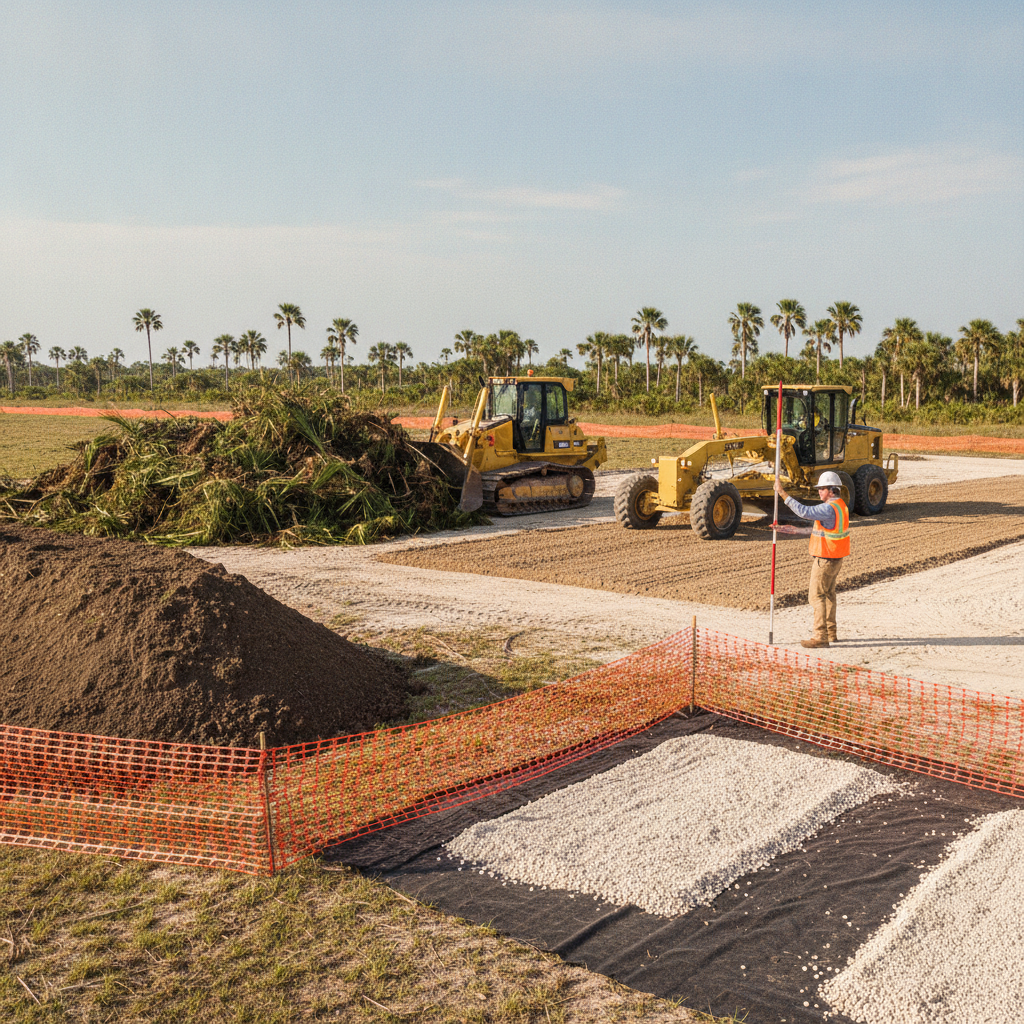
Understanding Clearing, Grubbing, and Grading
Clearing refers to the removal of vegetation, trees, debris, and existing structures from a site. Grubbing involves the removal of roots and stumps that remain after clearing. Grading is the process of shaping the land to achieve the desired elevations and slopes. It includes both rough grading, which establishes the general shape of the land, and fine grading, which refines the surface to the final design elevations.
Securing Permits and Initial Site Preparation
Clearing and Grading Sequence and Phase Table
| Phase | Activity | Purpose |
|---|---|---|
| 1 | Secure Permits | Ensure regulatory compliance |
| 2 | Install Erosion Controls | Prevent sediment runoff |
| 3 | Clear and Grub | Remove vegetation and roots |
| 4 | Strip and Stockpile Topsoil | Preserve topsoil for reuse |
| 5 | Perform Cut/Fill Earthwork | Balance site elevations |
| 6 | Compact in Lifts | Ensure soil stability |
| 7 | Rough Grade | Establish general land shape |
| 8 | Fine Grade | Achieve final design elevations |
Before any physical work begins, securing the necessary clearing and grading permits is essential. This step ensures compliance with local regulations and environmental standards. Initial site preparation also involves installing erosion and sediment controls, such as silt fences, inlet protection, and stabilized construction entrances, to prevent sediment runoff during construction.
Erosion and Sediment Control Measures
Erosion and sediment control is a critical aspect of site development. Common measures include silt fences, which trap sediment on-site, and inlet protection, which prevents sediment from entering storm drains. A stabilized construction entrance minimizes the tracking of mud onto public roads. Compliance with the NPDES Construction Generic Permit and the development of a Stormwater Pollution Prevention Plan (SWPPP) are mandatory for projects disturbing one acre or more.
Florida-Specific Considerations
Florida’s unique environment requires special attention to tree-protection and landscape ordinances, as well as the presence of protected species like gopher tortoises. Wetland buffers must be maintained, and the removal of muck or organic material may be necessary. Additionally, the seasonal high water table and stormwater management during construction are critical factors to consider.
Typical Equipment Used in Clearing and Grading
The equipment used in clearing and grading includes bulldozers for pushing debris, excavators for digging and removing stumps, and motor graders for shaping the land. Compaction equipment is used to ensure the stability of the soil, and dump trucks may be needed to transport excess material off-site.
Balancing Earthwork: Cut vs. Fill
Balancing earthwork is a key consideration in grading. The goal is to minimize the import or export of soil by balancing cut (excavation) and fill (placement) activities. This not only reduces costs but also minimizes environmental impact. Engineers use detailed calculations and site models to achieve this balance.
RSP Engineers’ Approach to Clearing and Grading
At RSP Engineers, we approach clearing and grading with a focus on precision and compliance. Our team of Florida Licensed Engineers ensures that all regulatory requirements are met, and we use advanced modeling techniques to optimize earthwork balance. Our commitment to quality and efficiency helps streamline the permitting process and ensures successful project outcomes.
Common Issues in Clearing and Grading
Common issues in clearing and grading include unexpected subsurface conditions, such as rock or high water tables, which can complicate excavation and grading. Additionally, inadequate erosion control measures can lead to sediment runoff and regulatory fines. Proper planning and experienced oversight are essential to mitigate these risks.
Contact RSP Engineers
For expert guidance on clearing and grading for your Florida land development project, contact RSP Engineers. Our team of Professional Engineers is ready to assist with permitting, site development, and stormwater management. Reach out to us today to ensure your project is on the path to success.
Conclusion
Clearing and grading are critical components of site development in Florida. By understanding the processes, securing the necessary permits, and implementing effective erosion control measures, project owners and engineers can ensure successful outcomes. RSP Engineers is here to support your project every step of the way.
FAQs
-
Clearing and grading typically require local permits, including environmental permits for erosion control and compliance with tree-protection ordinances.
-
Stormwater management during construction involves installing erosion and sediment controls, such as silt fences and inlet protection, and adhering to the SWPPP guidelines.
-
Rough grading establishes the general shape of the land, while fine grading refines the surface to meet final design elevations and slopes.