
Why Compaction Testing Is Crucial
Explore why compaction testing is essential for Florida land development projects. Learn about key tests, applications, and the consequences of poor compaction.
Understanding Soil Compaction
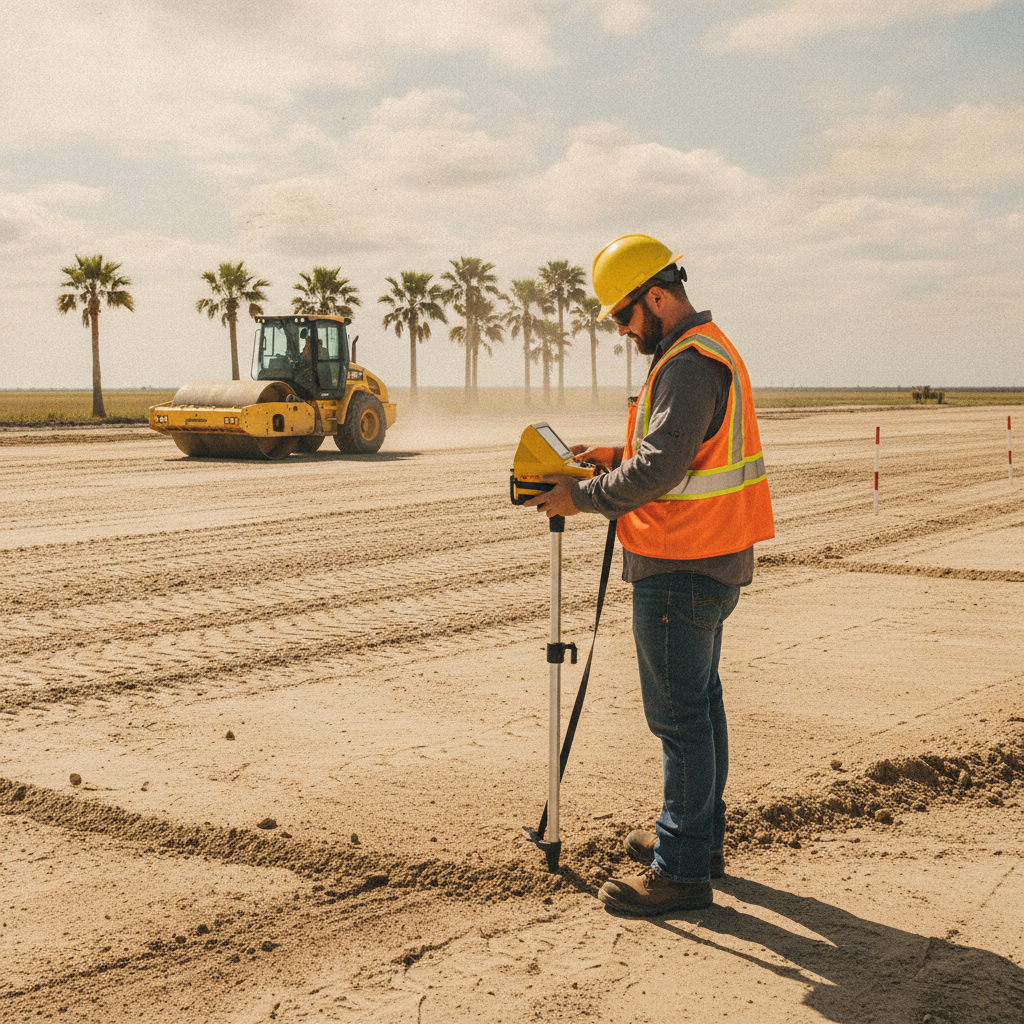
Soil compaction is the process of increasing the density of soil by mechanical means, which reduces the volume of air within the soil. This is crucial for enhancing the soil’s load-bearing capacity and stability. In land development, compaction is necessary to support structures, roadways, and utilities, ensuring they remain stable over time. Compaction is particularly important in Florida due to its sandy soils and high water table. These conditions can lead to challenges such as soil instability and increased risk of settlement if not properly addressed through compaction.
Key Compaction Tests
Compaction Requirements and Test Methods
| Application | Typical Compaction Requirement | Test Method |
|---|---|---|
| Building Pads | 95% of Modified Proctor | Nuclear Density Gauge |
| Roadway Subgrade | 98% of Modified Proctor | Sand-Cone Method |
| Utility-Trench Backfill | 95% of Modified Proctor | Nuclear Density Gauge |
| Embankments | 95% of Modified Proctor | Sand-Cone Method |
| Parking Areas | 98% of Modified Proctor | Nuclear Density Gauge |
There are several tests used to determine the effectiveness of soil compaction. The Proctor test, available in both standard and modified versions, establishes the maximum dry density and optimum moisture content of the soil. This test is essential for determining the target compaction levels for a specific site. Field density tests, such as the nuclear density gauge and sand-cone method, are used to confirm the percent compaction achieved on-site. These tests ensure that the soil meets the required compaction levels, typically between 95 to 98 percent of the modified Proctor density.
Applications Requiring Compaction
Compaction is required in various applications, including: Building pads Roadway subgrade and base Utility-trench backfill Embankments Retaining/MSE walls Parking areas Each of these applications has specific compaction requirements to ensure structural integrity and longevity.
Process of Compaction Testing
At RSP Engineers, we approach compaction testing with a thorough understanding of Florida’s unique soil conditions. Our process involves: Conducting a preliminary soil analysis to determine the appropriate compaction strategy. Performing Proctor tests to establish target compaction levels. Utilizing field density tests to verify on-site compaction. Ensuring compliance with local regulations and standards.
Common Issues with Poor Compaction
Poor compaction can lead to several issues, including: Differential settlement, causing structural damage. Pavement failures, leading to costly repairs. Foundation problems, affecting building integrity. Utility-trench settlement, resulting in service disruptions. Cracking in pavements and structures.
Contact RSP Engineers
For expert guidance on compaction testing and site development in Florida, contact RSP Engineers. Our team of Florida Licensed Engineers is ready to assist with your project-specific needs, ensuring compliance and long-term performance.
Conclusion
Compaction testing is a vital component of land development in Florida, ensuring the stability and longevity of structures and infrastructure. By understanding the importance of proper compaction and utilizing the right testing methods, developers can prevent costly issues and enhance the performance of their projects.
FAQs
-
The Proctor test determines the maximum dry density and optimum moisture content of soil, which are essential for achieving proper compaction levels.
-
Compaction tests should be performed at regular intervals during construction to ensure consistent soil density and compliance with project specifications.
-
A geotechnical engineer or a construction-materials-testing firm typically performs compaction testing to ensure accuracy and compliance with standards.