
High Groundwater Challenges for Data Centers
A guide for data center developers on managing high groundwater in Florida. Learn about dewatering, buoyancy, waterproofing, and permitting from civil engineering experts.
Understanding Florida’s Hydrogeology and Site Feasibility
Florida’s geology is characterized by porous limestone and sandy soils, which host prolific aquifer systems like the Floridan Aquifer. This results in a naturally high water table that can fluctuate significantly with seasonal rainfall. Before a site is even acquired, a thorough geotechnical investigation is the most critical first step. This goes far beyond a basic soil check; it must include numerous soil borings and the installation of piezometers to accurately measure and monitor groundwater levels over time. This data is used to determine the Seasonal High Water Table (SHWT), a crucial design parameter. The findings of the geotechnical report dictate the entire site development strategy. It informs foundation design, the feasibility of below-grade structures, the type and extent of required dewatering, and the design of the stormwater management system. Ignoring or under-scoping this initial investigation is a common but costly mistake that can jeopardize the entire project timeline and budget when unforeseen conditions are encountered during construction.
Buoyancy and Uplift Forces on Subsurface Structures
Long-Term Groundwater Control Strategy Comparison
| Strategy | Primary Mechanism | Ideal Application | Key Considerations |
|---|---|---|---|
| Permanent Foundation Drain System | Collects and removes groundwater via perforated pipes and a sump pump system. | Basements or structures where some seepage can be tolerated and managed. | Requires ongoing pump maintenance, power, and a reliable discharge point. High operational cost. |
| Structural Waterproofing & Tanking | Creates a fully sealed, impermeable barrier around the structure. | Mission-critical facilities with zero tolerance for water intrusion. | High upfront cost. Requires meticulous installation and quality control to be effective. |
| Site Elevation & Engineered Fill | Raises the entire building pad and finished floor elevation above the SHWT. | New construction on large, open sites where fill material is available. | Can significantly increase earthwork costs and may impact stormwater drainage design. |
| Passive Cutoff Walls (Slurry/Bentonite) | Creates a permanent, low-permeability vertical barrier in the ground to block lateral groundwater flow. | Protecting deep excavations or isolating a site from an off-site groundwater source. | Very high cost and requires specialized contractors. Typically used in extreme cases. |
| Buoyancy-Resistant Structural Design | Uses mass concrete, anchors, or piles to provide enough dead weight to counteract uplift forces. | Underground tanks, large utility vaults, and structures with significant below-grade volume. | Requires detailed geotechnical and structural engineering calculations. Integrated into foundation design. |
One of the most significant risks in high groundwater environments is hydrostatic pressure, which exerts powerful buoyant forces on any structure built below the water table. For data centers, this applies to large underground utility vaults, fuel storage tanks, and extensive concrete stormwater detention systems. If not properly designed, these structures can literally be pushed out of the ground, causing catastrophic damage. The upward force is equal to the weight of the water displaced, which can be immense for large-volume structures. The civil engineering design must incorporate specific countermeasures to resist this hydrostatic uplift. Common solutions include designing foundations with increased mass (thickened concrete slabs), incorporating concrete deadmen, or using deep foundation elements like helical anchors or piles to physically tie the structure down. The calculations for these anti-buoyancy measures are complex and must account for the highest anticipated groundwater levels, ensuring the facility remains stable for its entire operational lifespan.
Construction Dewatering: Permitting and Execution
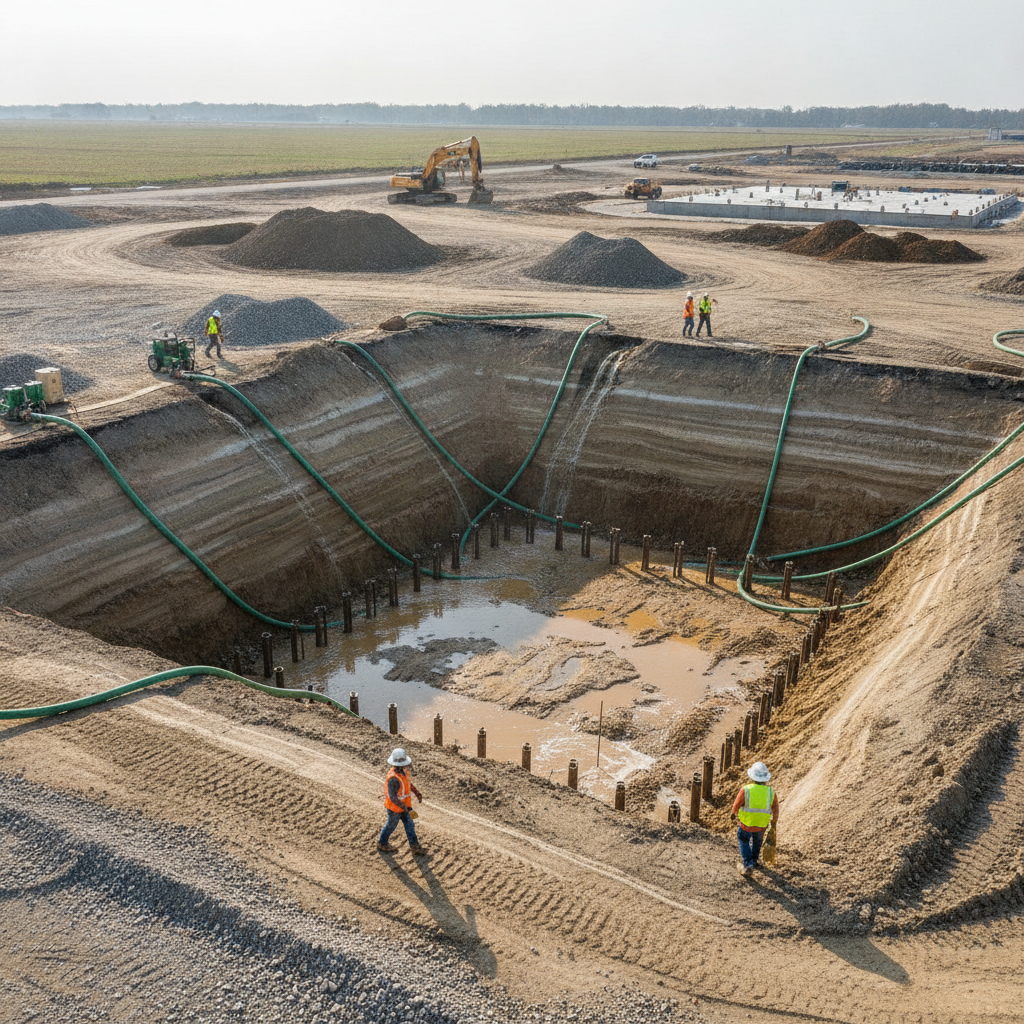
Creating a dry and stable work environment for excavation and foundation work requires an extensive construction dewatering operation. This process involves actively pumping groundwater out of the construction zone to temporarily lower the water table. Methods range from simple sump pumps in small excavations to complex wellpoint systems or deep wells for large, deep foundations. The choice of method depends on soil characteristics, excavation depth, and the proximity of adjacent structures. In Florida, dewatering is a regulated activity. Pumping significant volumes of groundwater typically requires a Water Use Permit (WUP) or a specific dewatering permit from the governing Water Management District (e.g., SFWMD, SWFWMD). The permit application requires detailed engineering plans, calculations of pumping rates, and a plan for managing the discharged water to prevent erosion and sedimentation. This agency review process adds time to the project schedule and must be factored into the initial planning stages to avoid delays.
Excavation Stability and the Risk of Soil Piping
High groundwater dramatically complicates excavation. Saturated soils have very low cohesive strength, making excavation walls prone to sloughing and collapse. This poses a major safety risk and can disrupt construction sequencing. To ensure a safe work area, engineered shoring systems such as sheet piles, soldier beams and lagging, or soil nail walls are often required. The design of these systems is a specialized discipline within geotechnical engineering. A more insidious risk is a phenomenon known as soil “piping.” This occurs when groundwater seeping into the excavation has enough velocity to carry fine sand and silt particles with it. Over time, this erosion can create underground voids or “pipes” that undermine the stability of the excavation floor and adjacent foundations. An effective dewatering plan is the primary defense, as it reduces the hydraulic gradient and the velocity of groundwater flow into the excavation, preventing the transport of soil particles.
Subgrade Preparation and Compaction Challenges
The foundation of a data center must support immense, concentrated loads from servers, cooling equipment, and backup power systems. Achieving the required soil compaction and load-bearing capacity is extremely difficult when the subgrade is saturated. Water fills the void spaces between soil particles, preventing them from being pressed together effectively. Attempting to compact wet soil is often futile and can lead to long-term settlement issues that compromise the structural integrity of the building slab. To overcome this, engineers may specify over-excavation of the unsuitable wet soils and replacement with imported, engineered fill material placed in controlled lifts. Other solutions include chemical soil stabilization or the use of geotextile fabrics to separate the subgrade from the base material and improve stability. The site development plan must account for these measures, which can have a significant impact on earthwork volumes and project costs.
Waterproofing and Vapor Barriers for Mission-Critical Resiliency
Data centers have zero tolerance for water intrusion. A robust waterproofing and vapor barrier system is not an option—it’s a fundamental requirement for operational resiliency. This goes far beyond simple dampproofing. It involves creating a continuous, impermeable envelope around all below-grade portions of the structure, including foundation walls, slabs, and utility penetrations. A breach in this system can lead to equipment damage, data loss, and costly downtime. Engineers specify high-performance systems like fluid-applied membranes, self-adhering sheet membranes, or bentonite clay panels. The selection depends on the level of hydrostatic pressure and the specific project conditions. Equally important is the installation of a high-quality, continuous vapor barrier beneath the slab to prevent moisture from migrating up through the concrete and affecting the controlled environment inside the data hall. Meticulous construction administration is essential to ensure these systems are installed flawlessly.
RSP Engineers’ Phased Approach to Groundwater Mitigation
At RSP Engineers, we address high groundwater challenges through a systematic, phased approach that minimizes risk and ensures project success. Our process begins long before ground is broken, integrating hydrogeological realities into every aspect of the design. First, we lead an exhaustive due diligence and geotechnical assessment, using deep soil borings and piezometer data to build a precise model of the site’s groundwater behavior. Second, this data drives an integrated site design, where our civil engineers collaborate with structural and geotechnical experts to align the grading plan, foundation design, and stormwater management system with the site’s constraints. Third, we manage the complex permitting and agency coordination for dewatering and environmental compliance. Finally, we provide rigorous construction administration and field oversight to ensure that critical systems like dewatering, shoring, and waterproofing are installed exactly as designed.
Common Pitfalls in High Groundwater Site Development
Even with a plan, developers can encounter several common issues. A primary pitfall is underestimating the scale and duration of the required construction dewatering, leading to budget and schedule impacts. Another is relying on an incomplete geotechnical investigation, which can force costly redesigns after construction has begun. We also frequently see attempts to value-engineer critical waterproofing or subdrainage systems, which saves a small amount upfront but exposes the facility to massive long-term risk. Finally, failing to anticipate the long lead times for dewatering permits from Water Management Districts can bring a project to a halt before it even starts.
Your Partner for Mission-Critical Site Development
Your mission-critical facility demands a foundation that’s as resilient as your data. High groundwater is a solvable engineering challenge, not a deal-breaker, when addressed with expertise and foresight. The team at RSP Engineers specializes in site development for complex projects in Florida’s unique hydrogeological environment. Contact us today to discuss your project’s geotechnical challenges, navigate the dewatering permit process, and develop a comprehensive site plan that ensures long-term success.
Conclusion
High groundwater is a defining, non-negotiable factor in Florida data center development. Proactive, expert-led civil engineering is essential to transform this challenge into a manageable risk. From the initial geotechnical investigation to the final details of the waterproofing system, every decision must be informed by a deep understanding of the site’s hydrogeology. By integrating robust design, meticulous planning, and diligent construction administration, developers can build the resilient, secure, and highly available facilities that our digital world depends on.
FAQs
-
Groundwater should be a primary focus during the initial site selection and due diligence phase, well before closing on a property. An early geotechnical investigation that specifically targets the Seasonal High Water Table (SHWT) will identify potential risks and inform feasibility studies, allowing you to make a fully informed investment decision.
-
The most immediate risk is the collapse of an excavation, which is a major life-safety hazard. Beyond that, improper dewatering can lead to foundation settlement (both on-site and on adjacent properties), structural damage, and significant project delays. A poorly managed discharge can also result in environmental fines for turbidity and erosion.
-
Yes, but it is a significant engineering undertaking. It requires a highly detailed geotechnical analysis, a robust structural design to resist immense hydrostatic uplift forces, and a multi-layered, flawlessly installed waterproofing system. The cost and complexity are substantial, and it must be carefully evaluated against the operational benefits.