
Data Center Earthwork Planning
A comprehensive guide to data center earthwork planning. Learn about geotechnical investigations, cut/fill balance, compaction, and managing cost and schedule risks from expert civil engineers.
The Critical Role of Geotechnical Investigation
Every successful earthwork plan begins below the surface. A comprehensive Geotechnical Engineering investigation is the single most important risk mitigation tool in site development. This process involves a qualified Geotechnical engineer performing a series of soil boring test procedures across the site to understand the subsurface conditions. The data gathered informs everything from foundation design to the feasibility of the entire project. The resulting Geotechnical soil report is the foundational document for all subsequent earthwork and structural design decisions. The investigation identifies the soil strata, rock depth, groundwater levels, and the presence of any unsuitable soils like highly organic material or undocumented fill. Laboratory analysis, or a Soil Test, on collected samples determines key engineering properties such as moisture content, plasticity, and maximum density. For a data center, where floor slabs must support heavy, vibration-sensitive equipment, understanding the soil’s bearing capacity and settlement potential is non-negotiable. Skipping or under-scoping the geotechnical investigation is a classic case of being penny-wise and pound-foolish, as discovering adverse soil conditions during construction can lead to catastrophic budget overruns and schedule delays.
Balancing Cut and Fill: The Key to Cost Control
Earthwork Quantity and Cost Risk Comparison
| Earthwork Activity | Key Risk Factor | Mitigation Strategy |
|---|---|---|
| Geotechnical Investigation | Incomplete or inaccurate subsurface data leading to unforeseen conditions. | Engage a qualified Geotechnical engineer early. Ensure sufficient boring depth and quantity for a data center's footprint. |
| Cut/Fill Balance | Significant import or export of soil due to poor site optimization. | Utilize 3D grading models in the design phase to optimize finished floor elevations and minimize material transport. |
| Structural Fill & Compaction | Failure to meet compaction specifications, leading to future settlement. | Implement a rigorous Quality Assurance/Quality Control (QA/QC) plan with full-time observation and frequent compaction testing. |
| Unsuitable Soils | Discovery of unexpected organic or wet soils requiring costly over-excavation. | Budget a healthy contingency for undercutting. A thorough geotechnical report can reduce but not eliminate this risk. |
| Erosion & Sediment Control | Stop-work orders or fines from regulatory agencies due to non-compliance. | Develop a comprehensive SWPPP and conduct regular site inspections to ensure BMPs are properly installed and maintained. |
| Weather Delays | Rain events saturating soils, halting compaction efforts and delaying the schedule. | Build weather days into the project schedule. Plan for soil drying or chemical stabilization methods as a contingency. |
One of the primary goals of a civil engineering design is to achieve a balanced site. This means the volume of soil excavated (cut) from high areas is equal to the volume of soil needed for fill in low areas, for building pads, and for landscape berms. Achieving a perfect cut and fill balance minimizes the immense costs associated with hauling soil off-site or importing engineered fill material. Every truckload of dirt moved on or off a project site represents a significant expense in fuel, labor, and disposal or material fees. Modern civil engineers use sophisticated 3D modeling software to perform a detailed mass grading analysis. This allows the design team to optimize the proposed elevations of the building pad, parking lots, and stormwater ponds to get as close to a balanced site as possible. The analysis also accounts for soil shrink/swell factors, as compacted fill occupies a different volume than its naturally occurring state. A well-balanced site not only saves money but also reduces truck traffic on local roads and minimizes the project’s environmental footprint, which can be a key factor in the permitting process.
Structural Fill and Compaction: Building a Stable Foundation
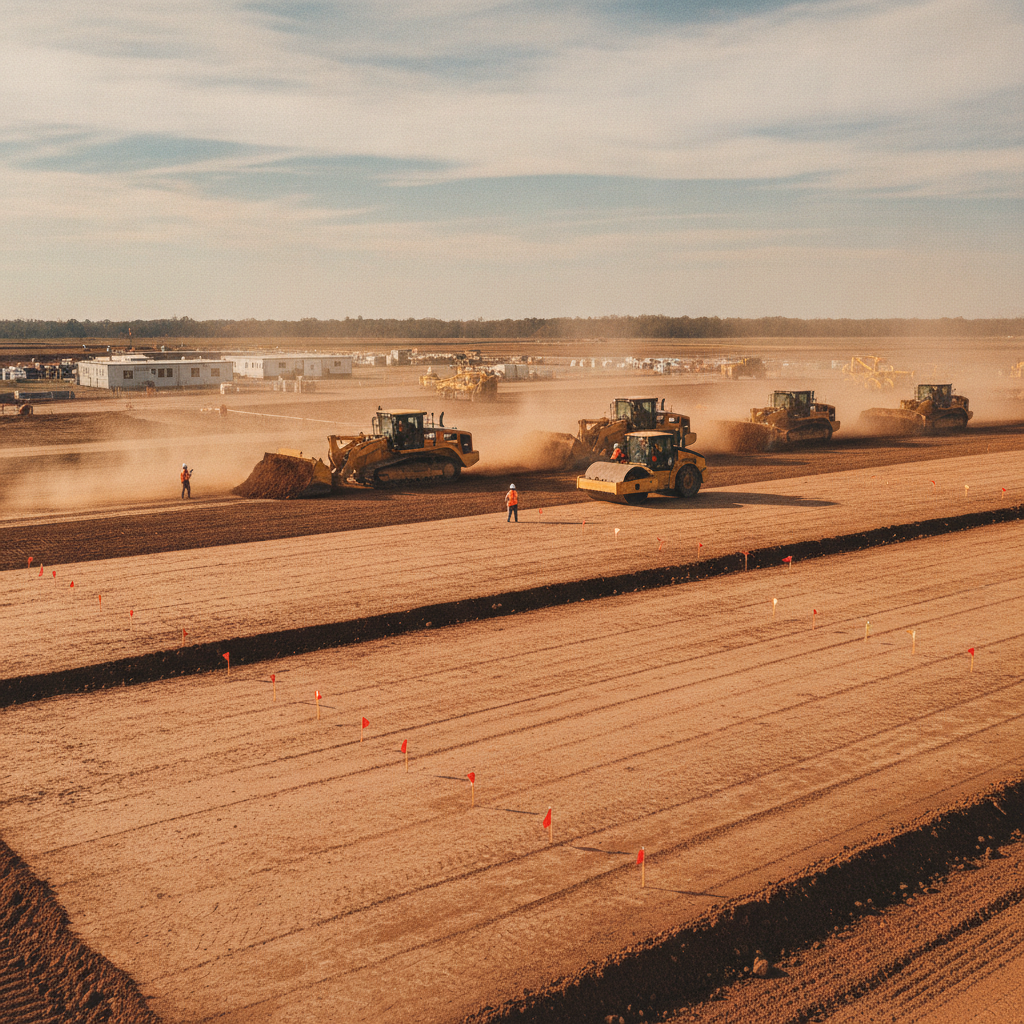
The ground beneath a data center isn’t just dirt; it’s an engineered structure. Any soil used as fill material under the building pad, roadways, and utility trenches is considered structural fill and must meet stringent specifications. This material must be free of organics and debris and placed in controlled layers, or lifts, typically 8 to 12 inches thick. Each lift is then compacted using heavy equipment like rollers to achieve a specified density, most commonly 95% of the soil’s maximum dry density as determined by a Proctor test. Verification is essential. A Geotechnical engineer or certified technician must be on-site to perform regular compaction testing using tools like a nuclear density gauge. This testing provides quantitative proof that the fill has been adequately compacted to support the immense loads of the data center structure without settling. Meticulous documentation of lift thickness, material type, and passing test results is critical for quality assurance and becomes part of the permanent project record. Failure to achieve proper compaction can lead to foundation failure, cracked slabs, and long-term structural problems that are extraordinarily expensive to remediate.
Managing Unsuitable Soils: Over-Excavation and Undercutting
Even with a thorough geotechnical report, surprises can emerge during mass grading. The most common issue is encountering pockets of unsuitable soils—materials like topsoil, organic silts, clays with high moisture content, or old debris—that were not detected by the soil borings. These materials lack the strength and stability to support structural loads and must be removed through a process called over-excavation or undercutting. The process involves digging out the unsuitable material to a specified depth and width and replacing it with properly compacted structural fill or a stabilizing agent like cement or lime. The decision to undercut is typically made in the field by the Geotechnical engineer in collaboration with the civil engineer and contractor. While necessary for long-term stability, over-excavation is a primary driver of construction change orders, as it involves unplanned labor, equipment time, and material costs. A robust geotechnical investigation helps minimize these surprises, but project budgets should always include a contingency for potential undercutting.
Erosion and Sediment Control During Mass Grading
Large-scale earthwork exposes vast areas of soil, making the site vulnerable to erosion from wind and rain. Federal, state, and local regulations mandate the implementation of robust erosion and sediment control measures to protect water quality in nearby streams, wetlands, and water bodies. This typically requires a Stormwater Pollution Prevention Plan (SWPPP), which is a key component of the National Pollutant Discharge Elimination System (NPDES) construction general permit. The SWPPP is a living document prepared by the civil engineering team that details the specific Best Management Practices (BMPs) to be used on site. These can include silt fences, stabilized construction entrances, sediment traps or basins, and temporary seeding to stabilize disturbed areas. Permitting and compliance requirements for erosion and sediment control can be complex. Importantly, these requirements vary by jurisdiction, and every project team should confirm the applicable standards with the local, state, regional, and federal authorities that hold review authority over the site. Failure to maintain these systems can result in stop-work orders and significant fines from environmental regulatory agencies.
The RSP Engineers Earthwork Planning Process
At RSP Engineers, we approach data center earthwork with a proactive, risk-management mindset. Our process is designed to provide clarity and cost certainty from the earliest stages of site development. We integrate seamlessly with the owner, architect, and contractors to ensure the groundwork is laid perfectly for a successful project. Our process begins with a thorough due diligence review, including a deep dive into the Geotechnical soil report to identify potential challenges. We then leverage advanced site plan design and grading software to optimize the site layout and achieve the most cost-effective cut and fill balance. Throughout the permitting phase, we coordinate with all reviewing agencies to secure approvals for grading and erosion control. During construction, our team provides responsive Construction Management Services, reviewing submittals, answering contractor questions, and working with the on-site testing agency to verify that all work meets the project’s stringent specifications.
Common Issues in Data Center Earthwork
Even with careful planning, challenges can arise. Being aware of common pitfalls is the first step to avoiding them. One frequent issue is an inadequate geotechnical investigation that fails to identify a critical soil layer, leading to major redesigns or change orders. Weather is another significant factor; extended periods of rain can saturate soils, making them impossible to compact and bringing the entire operation to a halt. Poor site logistics, such as mismanagement of topsoil stockpiles, can lead to double-handling of material, wasting time and money. Finally, conflicts between the grading plan and underground utility coordination can cause significant rework if not identified early in the design process.
Partner with RSP for Your Mission-Critical Project
The success of your data center hinges on the ground it’s built upon. Navigating the complexities of earthwork planning, permitting, and construction requires a partner with deep technical expertise and a proactive approach to risk management. The team at RSP Engineers, a leading civil engineering firm near me, provides the expert guidance needed to transform a raw piece of land into a stable, construction-ready site. From initial due diligence and geotechnical investigation coordination to detailed mass grading design and hands-on construction administration, we ensure your project’s foundation is solid. Contact us today to discuss how our site engineering services can support your next mission-critical development.
Conclusion
Earthwork planning for data centers is a highly specialized discipline within civil engineering. It goes far beyond simple excavation and grading, encompassing geotechnical analysis, precise volume calculations, and rigorous quality control. By prioritizing a thorough geotechnical investigation, optimizing the site for a cut and fill balance, and adhering to strict compaction and testing protocols, developers can mitigate significant financial and schedule risks. Ultimately, a well-executed earthwork plan is the essential, non-negotiable first step in delivering a reliable and resilient mission-critical facility.
FAQs
-
The depth of a soil boring test depends on the anticipated foundation loads and subsurface conditions. For a large data center, borings should extend well below the zone of influence of the foundation, often 50 to 100 feet or more, or until competent bedrock is encountered, to ensure there are no deep, compressible soil layers that could cause long-term settlement.
-
Balancing a site refers to the process in civil engineering where the amount of soil excavated (cut) is used as engineered fill elsewhere on the property. The goal is to have zero net import or export of soil, which provides significant cost savings on material and transportation. This is a key objective of the mass grading design.
-
Generally, no. Most jurisdictions require an approved grading permit before any major earthwork can begin. This permit is tied to approvals for stormwater management and erosion and sediment control plans. Starting work without proper authorization can result in stop-work orders and substantial fines.